Show full transcriptHide transcript
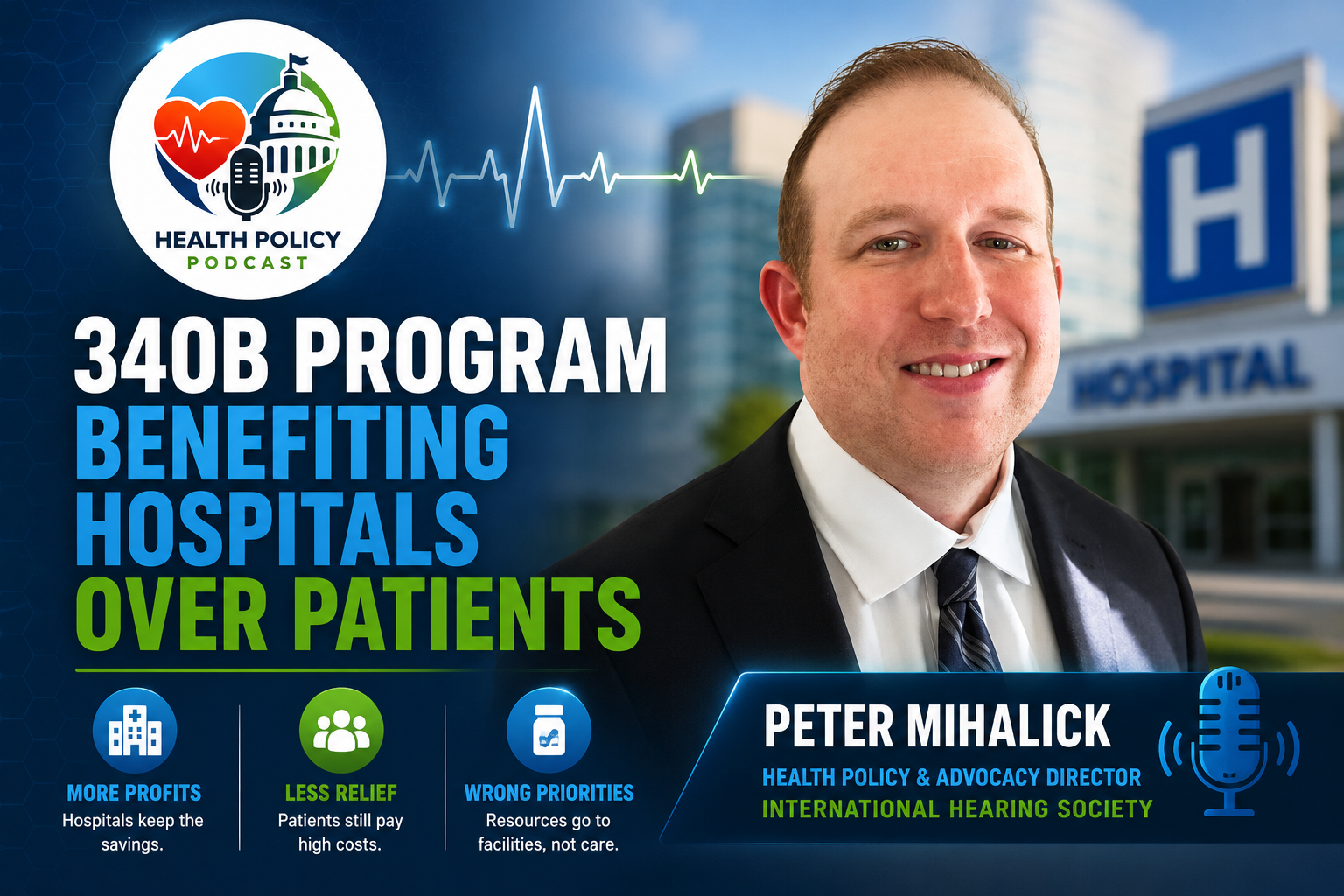
[00:00:00] Welcome to the Health Policy Podcast. I'm Brian Hyde, and today I'm joined by Peter Mihalick. Uh, Peter is th health policy and advocacy Director for the International Hearing Society, but that's not why you're here today. Is it Peter? No, I'm here, uh, because three 340B is a personal interest of mine. And make me very experienced.
Let's, we're going to delve into three 340B and, and this is a topic I, I would guess not a lot of Americans are fluent in, but they probably should be. Before we go there, tell us just a little bit about your background and, and how this became, you know, a topic of, of interest to you in the first place.
Sure. Um, well, uh, I don't like to admit this in public company, but I am, uh. An attorney by trade. Um, and after I graduated from law school, I decided to, uh, give the, the hill a try. So I found my way onto working for a Republican office in on Capitol Hill. I stayed up there for a number of years, uh, and then I, I went and worked for a trade association, um, that [00:01:00] represented a community pharmacist, the National Community Pharmacist Association.
And at both of those locations I was deeply involved with sort of health policy and three 340B. Um, and even though I haven't sort of, uh, had the opportunity to work on this issue in a professional capacity for a little while, uh, I still like to sort of follow the news and, and see what's happening and.
And to be honest, not very much has been happening in the three 340B world other than, uh, it continues to get larger and larger year after year. Okay, so let's, let's start right at the ground floor. For a person who is hearing about three 340B or thinks, well, I think I might've heard a story once upon a time.
How do we bring them up to speed on what this program is? What was it created to do? Sure. So it is effectively, um, a program where drug manufacturers provide outpatient drugs for patients at certain eligible facilities, uh, at a very steep discount. [00:02:00] And then those facilities are able to use those, the, the discounts that they received to fund other.
Healthcare programs, um, is particularly sort of situated where those eligible facilities and hospitals and clinics and everything like that, or in a, they're what is known as sort of disproportionate share hospitals, uh, where they have a large percentage of Medicaid patients. So folks that are a little bit lower on the income spectrum, um, that need additional assistance.
The, the real issue is though, is that none of the directives from Congress in establishing the program. Uh, force the hospitals or dis, you know, to actually provide anything for those particular patients. Um, so, you know, over the course of my career, uh, you know, there are facilities and clinics that are doing the right thing and providing additional services, uh, to those patients that need it, but also, uh, are funding capital [00:03:00] improvement programs or building a new parking lot in the backyard.
Or acquiring other offices. So I don't really think that that's necessarily the point of where Congress wanted this to go, but unfortunately, because the definitions are so loose, uh, that's where it has gone over the past, uh, 15, 20 years. Peter, it sounds like, you know, the, the program is working very well, just not in the way that it was intended.
In other words, those, it sounds like the, the facilities that actually get those, um, those. Price cuts and, and can utilize that money, they're doing quite well. But what about the patients? How are they doing? Uh, well one of the biggest issues, uh, back when I worked for NCPA was affordability and adherence.
So those folks that walk in that don't necessarily have a lot of money at their disposal and they have, uh, cancer or some other sort of long term chronic illness that requires. Uh, significant amounts of outpatient drugs that have an additional [00:04:00] copay. They're still required to pay those copays, uh, when they walk through the door, even at a three 340B hospital or a clinic.
Um, so if something is $50. Well, that's $50 that they didn't have to spend on something else. Um, which is a real sort of issue. And you have folks that end up taking their drugs. They're supposed to take 'em every day. They take 'em every other day, or they're skipping, um, you know, doing it five days a week and skipping the weekends or, and other things.
And that's just not, I don't think that's, uh, what really healthcare professionals really want. I don't think that's what Congress really wants. And, uh, unfortunately, um, there needs to be sort of more guardrails put onto the program where, uh, folks are, are receiving sort of the advantages of those discounts, um, firsthand.
It sounds like, um, uh, and maybe, maybe I'm totally off, off base here. This is where I'm gonna depend on your expertise. Sure. But it sounds like the hospital's acting or the facility's acting as the [00:05:00] middleman, um. If somehow those savings could be passed directly onto to the patients. What prevents that from happening is, is the, is the p pharmaceutical regulatory, uh, sphere, is it just complicated enough that, that it's just not possible for the, the needy people who need those prescription drugs to actually be able to get them at a steep discount without having to go through, you know, some type of middleman.
Well, unfortunately a lot of these hospitals don't have their own sort of pharmacy programs. Um, so they rely on what are known as contract pharmacies to distribute the drugs. So they direct these patients to the contract pharmacy. Um, and then it kind of gets lost into this, uh, more ass of untransparent drug and money networks that, uh, and end up sort of.
Playing a shell game a little bit like who gets the discounts, where do the rebates come from, the drug manufacturers, things like that. So like it's very difficult to say a particular patient x. Ought to [00:06:00] receive this drug at a reduced cost because nobody's really tracking that and it's really hard to kind of figure out in real time where all that money needs to flow.
Well, and I guess if, if we, if we really take it back to its most basic, there has to be at some level of question of, is this something government should be doing in the first place? Uh, I mean, in a free market, you would think that the free market would find solutions. And, and I think some exist just in, in very small scale.
Yeah. I think what is, uh, particularly interesting about this is like the, the eligible facilities that are the federal grantees, the Ryan White AIDS clinics and other facilities like that are probably most, you know, 99% of the time doing the right thing. They're providing their patients with either, uh, additional services or reduced costs on their drugs.
It's really gets into the sort of larger non-for-profit, but. Uh, hospital systems. So the, the ho, I'm not gonna name any names, but probably the ones that you can think of that are pretty [00:07:00] big and well known and famous. Um, they have all these facilities all over the place. They have a, a hospital downtown or in a bad neighborhood that qualifies as a disproportionate share hospital, and then they're able to kind of utilize their umbrella of other, uh, clinics and hospitals to receive those discounts.
Um, the real problem is, is that the people that are paying for this aren't particularly sympathetic politically. Uh, nobody is dying to help, uh, drug manufacturers make more money. Uh, nobody is necessarily jumping on board to help commercial insurers make more money either. Um, so at the end of the day, nobody is, uh, looking at this and trying to figure out a better way for, uh, either patients to receive that benefit or design a new program or get rid of all the programs and figure out, you know, how does, you know drug costs need to work.
But obviously, um, you know, in this political environment that [00:08:00] can be very difficult. And, uh, trying to take away, uh, somebody's benefit, um, is almost impossible. So. Well, and, and. No matter how well intentioned the way the program is currently structured, sure there's incentive for those hospitals to, you know, scoop up as much of those rebates as as they can.
Um, let's talk about reform. Um, what kind of stomach is there for? Um, I know there was LA last year at this time. There was great, you know, effort to root out fraud and waste and, and let's, let's make reforms to do away with it. How's Congress feeling about, uh, programs like three 340B this year? Sure. So, um, actually there are a few reforms scheduled to take place in the next couple years, um, that are resulting from, uh, the inflation reduction Act that is supposed to bring a little bit more transparency that the program.
Additionally, CMS has put out some rules, even though they're not necessarily the government agency in charge of all this, that is, uh, uh, hrsa. Um, but they're [00:09:00] sort of impeding on HRSA's turf and, and putting up some, um. Some more guardrails about the, the rebates that we were talking about. Um, so there is a little bit of an acknowledgement that this is kind of a problem, that this keeps growing at this rate and hopefully, you know, shining a light on it and kind of putting up some limited guardrails kind of slows that growth.
But, um, you know, that doesn't address the underlying problems of loose definitions in the statute and kind of the ability to, uh, game the system a little bit. Um. Unfortunately, three 340B has been an issue since I started working on the Hill, which was 16 years ago. It is the same, you know, the same kind of folks that, um, you know, wanna see reform.
There's the same type of folks that don't wanna see reform, and I, you know, it's really hard for a politician that's an, an elected official to be from a rural area and have a clinic in his, uh, you know, [00:10:00] district or state. Um, come up and say like, Hey, we need to get rid of that thing that, uh, you say is working and I'm gonna stake my political reputation and my reelect ability on something else that may or may not be as effective.
Um, so like a lot of, a lot of the larger hospital systems, you know, use those clinics and like, you know, the Ryan White clinics and stuff like that as kind of like their protective, um, system when they're on the hill Lobbying. Um, but I think, you know, like I said, with CMS kind of recognizing this is a breaking point and Congress kind of putting some transparency requirements in the IRA, there is a recognition that this needs to be addressed sooner or later if only for the issue of, like I said, affordability of drugs for the patients.
I'm looking at, uh, an article that you had written. This is published in DC Journal about how hospitals are failing their patients in administering three 340B drug pricing. Um. [00:11:00] Is, is there a middle ground on this or does it really come down to, you know, look, they can, they can use these federal programs to maximize their profits or they can use it to, to bolster those patients who are in, in need.
I, is there some place in the middle where they can meet on those things? Um, I think that there might be, uh, some someplace where, uh, there is, uh, a little bit of a middle ground, um, particularly in sort of defining what the, the patient is. Um, the statue leaves. It really, basically anybody who walks in the door is a patient, but they can kind of limit that, which would, would bring, you know, a little bit more of, uh, you know, some downward pressure on, on, on those rebates and who qualifies and things like that.
Again, um, as sort of tracking and, and transparency gets better, it might be easier to kind of root out some of the, the double dipping on discounts and additional rebates that are prohibited. Um, I'm not re like again gonna throw anybody [00:12:00] under the bus, but, um, that can be very difficult to track with, um, you know, the inflow and outflow of patients and money and, and drugs and things like that.
So as those tools begin to develop and, and there is transparency to the program, um, that might be able to sort of shine a better light on what is happening. Uh, it can be a really, yeah, you would think that there would be at least some middle ground in, uh, being able to accomplish those goals and, and kind of really, you know, hone in on like what the intent of Congress is and delivering on, um, on providing additional services.
Um, so even if, even if, uh, necessarily there isn't a big reform about, uh, who qualifies or where the money goes. Directing that money back towards actual medical services as a requirement might be something that. Uh, hospitals and pharmaceutical companies could agree on at least that way that there is something that the pen, the any patient, uh, is [00:13:00] walking through the door could benefit from, um, in that area, you know, which has, um, obviously a higher incidence of, of Medicaid patients.
So, um, that might be something that might be on the table. Uh, probably not because I feel like everybody's dug in, in a particular position. But, um, maybe Congress can get both sides. Um, kicking and screaming to the table and they can hammer something out that makes a little bit more, uh, rational sense.
You know, given that in recent weeks we've, we've seen other areas of where, you know, federal taxpayer dollars have, have been a very strong incentive for people to, you know, fraudulently, um, you know, say, oh yes, we're running a, a daycare here and, and, and collect, you know, millions if not billions of dollars under false pretenses.
And I'm not suggesting that's what's happening under the three 340B program. I'm just saying. When federal money is available, it seems like it's very easy for people's ethics to become more malleable. Sure. Is it time to have a discussion about the separation of government and, [00:14:00] um, healthcare for that matter?
Well, uh, actually the three 340B program isn't funded by the government. It's funded by, uh, the pharmaceutical companies. It's, it's interesting because. Um, the, like I said, the agreed parties in all of this are the pharmaceutical companies which provide the drugs at the discount and then, um, through sort of those child sites of the hospital systems, commercial payers that cover, um.
You and I that walk in and go and get an outpatient prescription, and then we go to the local Walgreens and fill it and they're taking that spread and putting that in their pocket and building a new parking lot or doing something else with it. Um, so it's not necessarily, uh, the government's money that's involved, but uh, you know, with those kind of directives, there has to be a better system out there, whether that's.
Um, the free market comes out with it are [00:15:00] just some smart endeavors, uh, elected officials in Congress, which actually are directing, you know. That spread price back to that particular patient as best as possible. So whether that's a reduced copay, whether that's additional, um, you know, requiring the hospital system to put up, you know, actual healthcare services, uh, or at least, you know, pay the nurses more or some, like something, uh, at least somebody should be receiving that benefit.
But unfortunately right now it's not the patient that is, uh, walking through the door. I, I appreciate that. And maybe, maybe a better way to reframe the question is if, if, even if the, the regulatory in incentives, you know, kind of help lead to this. Sure. It, it just seems that, that healthcare and particularly the federal government are, are very intertwined to the point that there's, there's a, there's a symbiotic relationship there, but Sure.
I don't know how it works in, on the behalf of the people or, or the patients [00:16:00] necessarily. Well, I think one of the big, uh, maybe unintended consequences of the Affordable Healthcare Act, um, was, um. With it. There was an increase in eligibility for Medicaid, which led to an increase of eligibility for the disproportionate share hospitals, which led to, uh, additional facilities being able to qualify for three 340B, um, which, you know, drove the cost of the program up.
And then, uh, additionally during the same time period, um, it used to be that. Uh, those facilities could only have a few contract pharmacies under their purview. Um, and they allowed them to sign basically, uh, unlimited amount. So like every Walgreens and CVS in a particular neighborhood could qual be, uh, characterized as a contract pharmacy.
And that sort of e expands their market, that expands their [00:17:00] ability to, um, capture those three 340B discounts. So, um, there's been some interesting decisions made by government at different levels that have kind of led to this, including not putting any of this in the statute in the first place back in 1992.
Oh. Again, we are talking with Peter Mihalick. He's a, uh, a former legislative director and council to a couple of Republican members of Congress as well as a health policy and advocacy director for International Hearing Society. Uh, where can people go to get more information on this? Peter, where would you direct them?
I think one of the better experts that doesn't necessarily have a big dog in this fight, I mean other than myself, is, uh, Adam Ween, Dr. Ween, um, on drug channels. Uh, he has a, a great plethora of information about, uh, a number of topics related to drug pricing, part D programs, part B programs, um, and all kinds of other.
Things that, uh, touch on, um, [00:18:00] healthcare, particularly in the pharmaceutical area. Alright, I appreciate it. Again, we're talking with Peter Alack. This is the Health Policy Podcast. Peter, thank you for being our guest. Thank you so much for having me. I.