2026-08-18 · Cicero Institute
McKenzie Richards on Breaking the Infant Formula Monopoly for Families
with McKenzie Richards, Health Policy Fellow — Cicero Institute
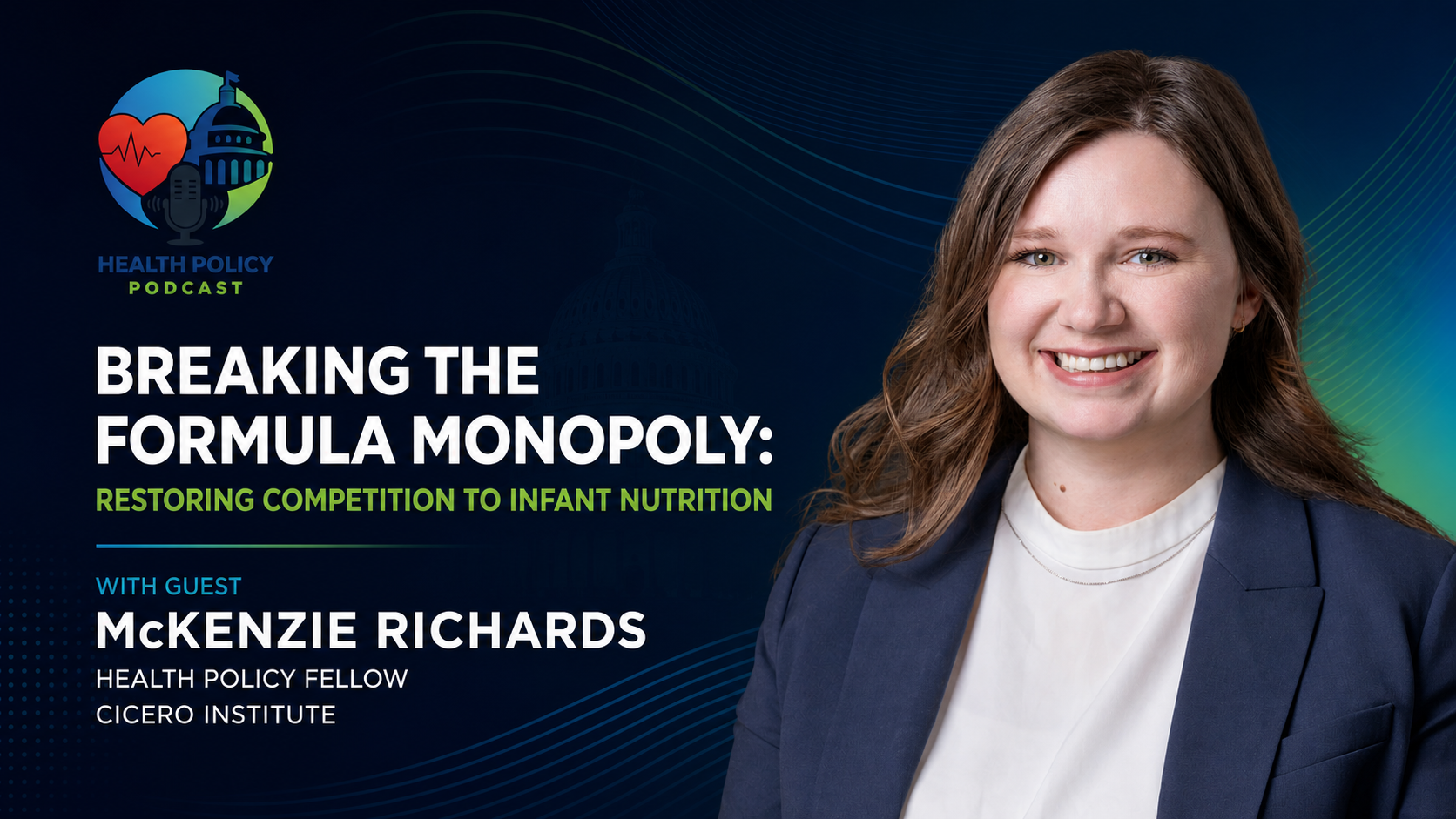
In the Health Policy Podcast episode titled "Breaking the Formula Monopoly: Restoring Competition to Infant Nutrition," McKenzie Richards, a health policy fellow at the Cicero Institute, discusses the challenges of the infant formula market, including government contracts that limit competition. Richards highlights the impact of the 2022 infant formula shortage and proposes solutions such as alternative cost containment programs and the Formula Freedom for Families Act to enhance access and safety for families relying on infant formula. The episode emphasizes the need for reform in the infant nutrition sector to ensure better options for consumers.
Breaking the Formula Monopoly: Restoring Competition to Infant Nutrition
Restoring Competition in the Infant Formula Market
In a recent episode of the Health Policy Podcast, McKenzie Richards, a health policy fellow at the Cicero Institute, discussed the challenges and potential solutions surrounding the infant formula market in the United States. The conversation highlighted the need for increased competition and the implications of government policies on infant nutrition.
Richards, who has three children, became interested in the infant formula market after struggling to find options without corn syrup and harmful additives. Her concerns grew during the 2022 infant formula shortage, which left many families without access to essential nutrition for their infants. During this crisis, she noted that only 24.9% of American mothers are able to exclusively breastfeed, meaning that a significant portion of families rely on formula.
Richards emphasized that the infant formula market is dominated by a few large manufacturers due to government contracting practices. Since the 1980s, the government has implemented a single-buyer rebate program, allowing states to contract with only one manufacturer for all infant formula needs. This has led to a consolidation of suppliers, with two companies—Abbott and Mead Johnson—dominating the market.
The consolidation creates vulnerabilities, particularly in times of crisis. Richards pointed out that if a manufacturing issue arises, 40% of infants covered by the Women, Infants, and Children (WIC) program may struggle to access formula. The geographic concentration of contracts means that supply chains are not equipped to respond quickly to disruptions.
Richards identified three main problems stemming from the current system: safety concerns, limited options for families, and increased costs. She argues that well-intentioned policies have inadvertently created a monopoly-like environment that hinders competition and innovation.
To address these issues, Richards proposed several solutions. One idea is to allow states to implement split contracts, enabling them to award contracts to multiple manufacturers, including smaller companies. This could foster competition and lead to better pricing for consumers. Another suggestion is to introduce cash value benefit vouchers for WIC participants, allowing them to choose formulas that meet their preferences while still benefiting from state contracts.
Richards also discussed the Formula Freedom for Families Act, which would provide a legislative pathway for states to explore alternative cost containment programs. The aim is to encourage experimentation with new approaches to infant nutrition that could ultimately lower costs and improve options for families.
Despite the challenges posed by government intervention, Richards believes that reform is possible. She noted that while the WIC program is essential for many families, there are opportunities for cost-effectiveness and improved access. One potential solution is to modernize the program by creating an online platform for formula distribution, streamlining the process for families and reducing administrative burdens.
Richards concluded that addressing the issues in the infant formula market requires a comprehensive look at the current rebate system, which mirrors inefficiencies seen in the pharmaceutical industry. She advocates for a reevaluation of how rebates are structured to create a more functional market.
For those interested in exploring Richards' findings further, her paper titled "Restoring Competition to the Infant Formula Market" is available on the Cicero Institute's website.
Interview Q&A
Q&A: Breaking the Formula Monopoly: Restoring Competition to Infant Nutrition
Breaking the Formula Monopoly: Restoring Competition to Infant Nutrition
Q: Who is McKenzie Richards and what is her role?
A: McKenzie Richards is a health policy fellow at the Cicero Institute, focusing on healthcare issues that affect mothers and infants. She has recently developed a paper on infant formula competition.
Q: What prompted McKenzie to explore the infant formula market?
A: McKenzie became interested in the infant formula market after struggling to find options without corn syrup and harmful additives for her child. Her experience during the 2022 infant formula shortage further motivated her to investigate the issues surrounding infant formula availability.
Q: What were the main issues during the 2022 infant formula shortage?
A: The shortage highlighted the vulnerability of families relying on infant formula, as only about 24.9% of American mothers can exclusively breastfeed. The crisis left many families without access to necessary nutrition for their infants.
Q: What is the current state of the infant formula market?
A: The infant formula market is dominated by a few large manufacturers due to government contracting practices. This consolidation has led to a lack of competition and limited options for consumers.
Q: How did government contracts contribute to the monopoly in the infant formula market?
A: In the 1980s, the government implemented a single-buyer rebate program, allowing states to contract with only one manufacturer for all infant formula. This policy favored large manufacturers and has led to significant market consolidation.
Q: What are the safety concerns related to the current infant formula market?
A: The consolidation of manufacturers means that if one company faces a manufacturing issue, a large portion of the market may be affected, impacting access to formula for many families, particularly those on the Women, Infants, and Children (WIC) program.
Q: What potential solutions does McKenzie propose to restore competition in the infant formula market?
A: McKenzie suggests allowing states to adopt alternative cost containment programs, such as split contracts with multiple manufacturers or cash value benefit vouchers for WIC participants, enabling them to choose from a wider range of products.
Q: What is the Formula Freedom for Families Act?
A: The Formula Freedom for Families Act would provide a legislative pathway for states to implement alternative cost containment programs, allowing them to experiment with different approaches to improve competition and lower costs in the infant formula market.
Q: What challenges do new infant formula companies face when entering the market?
A: New companies struggle to gain shelf space and compete against established manufacturers that dominate the market, which makes it difficult for them to succeed.
Q: Is there a possibility of scaling back or eliminating the WIC program?
A: McKenzie believes that eliminating the WIC program is unlikely due to its importance for vulnerable families. However, she suggests that there are ways to make the program more cost-effective and efficient.
Q: What are the administrative challenges associated with the WIC program?
A: The current single-contract model can be administratively burdensome. McKenzie proposes an online program to streamline the process, making it easier for families to access infant formula.
Q: How does the rebate system impact the costs of infant formula?
A: The rebate system has led to inflated prices in the infant formula market, similar to issues seen in the pharmaceutical industry. McKenzie argues that reforming the rebate system could help lower costs for consumers.
Q: Where can people access McKenzie Richards' paper on infant formula competition?
A: The paper titled "Restoring Competition to the Infant Formula Market" can be accessed at CiceroInstitute.org.
Key takeaways
- “I couldn't find an infant formula that didn't have corn syrup and didn't have some harmful seed oils or added sugars.”
- “When you have less competition and more consolidation, many, many other problems begin to pop up in those markets.”
- “40% of all infants in the United States are covered by WIC, and so that's 40% of the people with infants in a geographic region who are not able to get access to those formulas if something happens to the manufacturing plant.”
- “The way we have— okay, so rebates operate as a retrospective discount provided by the manufacturer... the rebate system itself does not work.”
- “Infants are the most precious lives amongst us, and we need to improve the food in which we're giving them.”
About the guest

Health Policy Fellow — Cicero Institute
McKenzie Richards is a Health Policy Fellow at the Cicero Institute, where she researches market-oriented solutions to improve American healthcare. A published author and researcher, she holds a bachelor’s degree in political science from Brigham Young University and a Master of Public Policy from Pepperdine University.
Full transcript
Show full transcriptHide transcript
Filed under