Show full transcriptHide transcript
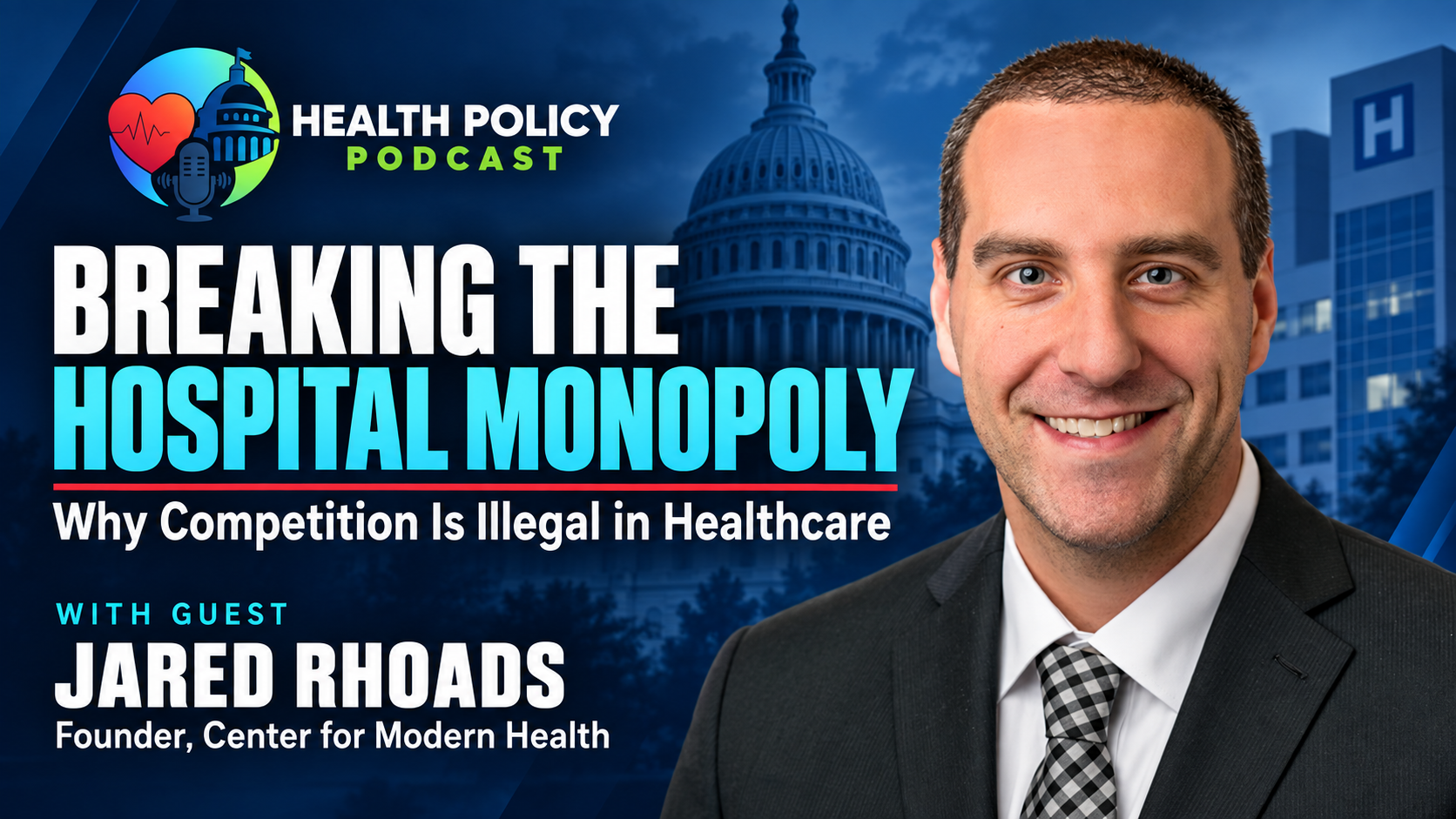
[00:00] Bryan Hyde: Welcome to the Health Policy Podcast. I'm Brian Hyde. Today, I'm joined by Jared Rhoades, founder and executive director of the Center for Modern Health. Jared, we've had you on the program before. Welcome back. And for the sake of those meeting you for the first time, take a moment to tell us just a little bit about yourself.
[00:15] Jared Rhoads: Sure, thanks again. Yeah, and thanks for having me on, and it's good to be back. My name's Jared Rhoades, and I have started the Center for Modern Health Think tank. We are a health policy think tank. It's quite market-oriented. Our tagline is health policy for a free society, and we will do research and commentary and analysis on all sorts of health policy issues. Anything that sort of dovetails with a question of markets or individual rights, often both. Those are things that we will dive into, and and we'll take a look at any any issue that that comes up, whether it's at the state level. There's There's a lot that goes on at the state level, but that's not the only place. There's federal issues. There are also just sort of like cultural and philosophical meta issues about health policy and how we think about healthcare. And so we will often write about that too. So that's what we do.
[01:13] Bryan Hyde: When you mentioned, you know, you talk about the markets, healthcare and particularly hospital pricing, this is one of those places where the market really doesn't determine a lot. In fact, there's probably more distortion here than anywhere. Talk to me a little bit about some of the more, persistent distortions that take place when it comes to pricing, whether it be just, you know, the way hospitals price things or healthcare in general. And then we can start talking about some solutions. But what are some examples of ways that we see the market being basically sent to the kids' table? Sure.
[01:49] Jared Rhoads: Yeah. Lots of different ways. I mean, there's— in general, there's, I think, kind of an overreliance on third-party payment. And, you know, which we're sort of— you might not realize that we're kind of kind of shunted into that idea, right? Like, you might think, well, healthcare is expensive. I want to be covered. Therefore, I'll approach everything with an insurance mindset. But, that's actually what you're kind of doing there is responding, whether you know it or not, to a set of incentives that have been— you could trace back as far as, for instance, the employer-sponsored, the tax preference that we give to basically healthcare that you buy through your employer. That That's one of these subtle but not so subtle distortions where you really want to purchase as much health insurance as you can because you're getting it at a tax-preferred— on a tax-preferred basis because if you were to take just more wages instead, you would have to pay income taxes on those wages, right? So you can see how you end up buying more than you probably would have, and then that creates a world in which we end up wanting to use it because, hey, if Once you've bought it, you might as well use it, right? And so, and then of course the insurers know this. They don't really generate a nice individual competitive individual market for us to kind of opt into and handle things that way instead. And then the hospitals know this. And so the providers in the hospitals are happy to keep their prices high. And yeah, it's just one of those kind of, again, like subtle but not so subtle ways. The effect is huge, but you, you know, if you don't follow this stuff, you might never have thought of that, right? If anything, you might have thought of like the employer tax preferred status there as like a good thing, like, hey, I don't have to, you know, pay a tax. And that's very understandable, right? But you have to also think about like, well, what are the effects, you know, down the road of that kind of idea? So that's one big one.
[03:59] Bryan Hyde: I'm looking at an article you wrote. This was published in lawliberty.org about the headache of hospital pricing. You point something out here that I had not I was not aware of prior to reading your article, and that is that some lines of businesses at hospitals, some, some lines of healthcare are chronic money losers. Other ones are relatively profitable. And yet, you know, they coexist in that same ecosystem, so to speak. How does that work?
[04:25] Jared Rhoads: Yeah, yeah. This is something I kind of wanted to shed a light on because, you know, and probably if you're, if you're a physician in a hospital, if you're an administrator, if you're in this ecosystem, you probably have a sense that this is true, but if not, you might not have realized this, that certain departments end up kind of cross-subsidizing other departments in many hospitals out there. This isn't really— this isn't like a private payer versus public payer thing, although there is kind of an angle to that. There's actually a whole other issue about that purely, but this is more like The idea that, look, some services, orthopedics, for instance, certain surgical services, a lot of imaging, those tend to— they get good margins on that. Those are the things that are making a healthy profit for the hospitals. At the same time, there are other services, again, painting with a broad brush, but sort of classically and traditionally, things like psychiatry, or pediatrics, the emergency department, for one reason or another, and some of those are different reasons why they fall into the latter bucket, those services end up being the real money losers, right? Then so if you're in charge of running a whole hospital, maybe you sort of figure out, well, I'll just sort of use the sort of excess profits from one to sort of prop up the sort of chronic money losers on the other side, and isn't that good? I guess if you were just looking at it just from that micro standpoint, okay, well, it's weird, but maybe that's fine. But the additional thing that I wanted to shed the light on is that that becomes a problem when other either reformers such as myself, you know, I want to go in and, uh, and, and show up and do some testimony and, and support somebody who has a bill about, uh, uh, repealing like a certificate of need law. Um, we can get into— I don't know how much of your listeners know about that, but, you know, we could explain that if need be. Um, the, you know, basically, you know, advocating for greater competition. Well, what happens in a nutshell is that, uh, anytime we challenge one of those, those moneymaker departments by, say, encouraging more— doing something on the policy side that would encourage more competition, the hospitals or more often the hospital associations would step in and say, no, no, no, no, no. We need to— don't challenge us with competition. Don't try to change the policy to make it more of a free market. We need it to be the way it is because that excess profit is keeping open the ED, like, you know, the emergency department, for instance. And so that, that's something that's, I think, a problem that, that deserves, uh, a bit of a spotlight to be shown on it.
[07:38] Bryan Hyde: No, I, I appreciate you highlighting that problem. And I, I don't want to sidetrack us, but since you brought up certificates of need, that's, that's got to be one— myself included, I don't, I don't know a lot about it. I've heard the term before. What is— what does that refer to?
[07:52] Jared Rhoads: Yeah, that, that's— that— let's double-click on that because that is kind of probably the, the most common way that this, uh, ends up being a problem. The, uh, certificate of need, it's, it's this idea, uh, they're often referred to as CON laws. Okay, so the C-O-N, right? Um, and about 36 states have them. More states used to have them, but a few states have repealed them over the years. Uh, but it's basically this idea that, um, that states who were trying to, uh, take a handle on, um, overall spending passed these certificate of need laws saying essentially, okay, If you want to open up a new surgical center, or if you want to add beds to your hospital, or if you want to— if you're an entrepreneur and you want to open up a brand new imaging center in town or in a city or whatever, you need to go to the state and ask for special permission. And the reason why is because we're trying to— not me, not we, the Center for Modern Health, but yeah, I'm putting— I'm giving the verbiage from the—
[09:01] Bryan Hyde: and the rationale from the—
[09:02] Jared Rhoads: Yeah. from the state policymaker. The idea is, oh, we need to control competition. We can't have too much competition. Well, actually, what they would say is, we can't have too much oversupply and overbuilding. All this extra capacity is a bad thing because it'll just get used. And there actually is, just to be charitable for a moment, there is such a thing as supply-induced demand and everything. But But the point is though, do we want freedom and free markets to help solve this problem, or do we want to sort of like control it by restricting supply? Yeah, if we're all concerned about pricing and a lot of spending in healthcare, we don't want people using healthcare sort of unnecessarily, but— and that's the fear that you would have in your mind if you're a policymaker. But the thing is, and I think that's the thing that goes unappreciated here is that a way to bring prices down is through allowing private actors to enter a market and put some more supply out there and basically compete that price down if we had free prices that were being driven down.
[10:21] Bryan Hyde: Jared, the way you described that, I mean, from the standpoint of the healthcare provider, it's like, oh, it sounds so reasonable. But it still sounds like barriers to competition. I mean, it's just, it's wearing a nicer title.
[10:33] Jared Rhoads: Yep, that's, it's exactly what it is. It's a, you know, the, the best, um, uh, sort of, uh, word for it is a permission slip, right? And once you start thinking of it as, oh really, like, we, certain states have this, this mechanism in place where you have to like ask for permission in order to, you know, start a new business or expand a, a, an existing business into a new kind of service area, that sort of thing. Um, yeah, you have to go ask ask government permission to do that. And the coup de grâce on this, by the way, is, is like, this is just sort of like, uh, the cherry on top, um, which is that the, the, the states will often say, well, you know, come to think of it, we're not expert enough in this area to even know whether to allow it or not, so let's, let's invite some experts from the community in. And end up, the people who end up sitting on that committee are like representatives from the competitors who you'd be competing with, who you'd be— so now, basically, you're in a position of seeking permission in order to compete with people, from the very people who you would be competing with. Of course, if they're either, I would say, not terribly principled, or if they're just looking out for their own kind of narrow, short-term self-interest, they're not going to allow that. And so that's why it becomes such a barrier.
[11:56] Bryan Hyde: I mean, just from an incentive standpoint, it's— that's kind of like, you know, convening a committee of foxes to discuss security of the henhouse. And are we doing this right?
[12:04] Jared Rhoads: You got it. Perfect. Yeah, exactly.
[12:07] Bryan Hyde: Tell me a little bit about cross-subsidization as it has— it's taken place in other industries. You mentioned this in the article. It's not— this is not exclusive to healthcare.
[12:18] Jared Rhoads: Yeah. Yeah. I mean, I've— I felt the need to— I'm not an economic historian or anything, especially on, like, you know, heavy industry, but I felt the need to mention at least briefly, like, hey, sometimes this happens almost like accidentally or something. You can go back to airlines and railroads, and there are moments in time where, okay, well, the cargo service kind of subsidizes the passenger service for a period of time and stuff. But these tend to be temporary. They tend to be unstable. In those industries, you had— well, I mean, I guess you had sort of lobbying too in various forms, but you didn't exactly have the certificate of need dynamic in the same way. So yeah, I mean, there have been moments in time where it has existed, this kind of internal cross-subsidization, but they don't tend to last very long. It's not a good economic arrangement. Obviously, with the certificate of need idea is that you're able to— if you're the incumbent, you're able to prevent those competitors from entering. In healthcare, that's bad. Another thing that I kind of point out in the article is about just the sort of value and importance of prices. If there is some service out there where, yeah, look, that's really lucrative to do right now for whatever economic reason, and people are making a really, really healthy profit on that, that is normally a signal to other entrepreneurs to move into that service and start offering it too, right? And so what that does in terms of consumer benefit is that it drives down the price of that because there's going to be, again, price competition. So that's how we normally want things to work. I also mentioned in the article about— I used the example of Walmart. Normal businesses don't set out to do this kind of cross-subsidization intentionally. I mentioned that it's sort of temporarily or accidentally emerged in various times in railroads and airlines, but nobody sets out to do this.
[14:48] Bryan Hyde: Right.
[14:48] Jared Rhoads: intentionally and set it up this way. Walmart does not make a killing on its sporting goods department, but at a massive loss of the gardening or the personal beauty and care departments. They don't let that persist. They would make changes if that were the case. Yes, there can be temporary seasonality or things like that that come and go, but in the long run, they would make structural changes. Maybe they would close down some department if they just absolutely couldn't make a profit there, or they would make adjustments so that pretty much they're doing OK in all departments. And that's good for consumers. It's good for Walmart. It's good for the retailer there. And I think crucially here, we don't see a retailer like that going to the government to say, oh, you need to keep out, um, you know, uh, the, the people— other, other sporting goods, uh, you know, stores, um, by law. You know, like, like, it's one thing to outcompete the mom-and-pop, and I know there's been a whole, um, you know, there's been a whole— society has had a debate about that, right? But that's fine as long as they're, you know, competing in, in a market. That's one thing. But, you know, they don't typically go and, and ask for, you know, other competitors to literally be blocked from entering.
[16:18] Bryan Hyde: Jared, there's another aspect of this too, and I'm gonna sound heartless for suggesting it. You point out in your article, one of the reasons that, for instance, emergency departments are, you know, they lose money for hospitals is because they're mandated by law to provide that care, you know, either emergency care or stabilization care. Are those laws a good idea? I mean, do we really need laws to have compassion? Or I guess I'm asking, is that something that could help solve the problem by not requiring them to be that way?
[16:52] Jared Rhoads: Yeah, yeah, right. Yeah.
[16:53] Bryan Hyde: So the—
[16:54] Jared Rhoads: yeah, it's called EMTALA is the law. And it— yeah, it requires any hospital that accepts Medicare to have an ED that that won't turn people away. Yeah, and we could analyze that from economic angles and things. The thing that I would— I think I mentioned this in the article— the thing that I would point out is at least if we took a different— let's say we even wanted that, right? So that's an obligation that we've voted and chosen ourselves. or at least our elected officials have chosen. Even setting aside— I mean, maybe there are better ways to do that, and I actually do tend to think that there are, although I don't have some polished policy prescriptions to share right now. But even I would say this, which is that if we've chosen that, why not have at least a more honest way of recognizing that so that everybody knows that that's what's going on, as opposed to the what we have under the status quo, which is like, well, they'll either charge some weird prices in the ED or, actually, sometimes maybe the high prices that you face in an ED are justified because they have to have so much capacity on standby, but they are getting cross-subsidized, as we said earlier, from some other department. Right. Well, It would at least be, uh, it would at least be more honest if the, if the prices that were high in the ED, or if, if we allowed those prices to rise so that we knew where it was actually going, right? And we didn't have this, this idea that things were, uh, that, that ED care was, was cheap, right? Because you wouldn't want somebody to, to, uh, kind of underappreciate how costly it can be to have a fully staffed, uh, you know, ED with, with all the, you know, they have to have really advanced technology on hand just in case they might use it. And even if they don't use it all that frequently, that's a very expensive thing. And I would say it would even be a better thing for society just to wrestle with that head-on rather than to try to hide it, which is kind of what we have under the status quo here with this cross-subsidization, and you're taking money from one department and subsidizing another.
[19:24] Bryan Hyde: No, I'm with you. The transparency would definitely do a lot toward promoting, you know, solutions that are out in the open and that, you know, people can clearly see and maybe even have some say in. One final question for you. Where does the reform begin? Who has to take that first step?
[19:42] Jared Rhoads: Yeah. Oh, that's a good question. Right. And the piece, as I wrote it, it's mainly to like just get the word out about this sort of issue and get some appreciation. I think we need some people thinking about this and looking into and figuring out what to do. I mean, I have a couple of ideas in the paper. One is with regard to certificate of need laws, like if we make that connection explicit and sort of stop allowing that the blocking and the anti-competitive behavior there from happening, I think that then hospitals will have to respond a bit. And what they might end up doing, actually, is some of the pricing and the profitability would end up kind of equilibrating a bit and leveling off. And you might see— again, you might see some higher prices in certain departments, right? So that the hospitals would have to raise their prices if they can't command the massive profits in other ones. But at least there, the hospitals would be able to plausibly have the sort of public relations cover of saying, look, in the past, we've cross-subsidised things, but that's no longer possible because with the repeal of Khan laws, we can't have this massive profit over here that we just shift hands with. So we're going to be raising prices over here, but prices are coming down in the other scenario. So again, we're at least being more transparent and open about that. That would probably be the best, most honest scenario to emerge. And I think there might be some other tinkering that you could do with the Medicare prospective payment system and that sort of thing to make sure that those prices more more reflect what's actually going on. But that's like a whole other can of worms and pretty complicated. But at least on the con law side, I think there's an opportunity there. And then let the hospitals change up their pricing a little bit. Again, and that shouldn't be too much of an ask because there are going to be some prices that are coming down. So they can use that messaging. And I know it's tough to tell anybody that the price of some goods are going up, but if the prices of other goods are falling, it would lessen lessen the, uh, the, the blow of that, I think. And, and, uh, and, and, and it should be something that they could do as feasible.
[22:21] Bryan Hyde: Again, we are talking with Jared Rhodes. He's the founder and executive director of the Center for Modern Health. Jared, thanks again for joining us here on the Health Policy Podcast.
[22:30] Jared Rhoads: All right, thanks so much.