Thursday, May 28, 2026 · The Health Policy Podcast
Health Policy Podcast logo
← Health Policy Podcast

2026-04-07 · The Commonwealth Foundation

Reevaluating the Affordable Care Act: Insights from Nathan Benefield

with Nathan Benefield, Chief Policy Officer — The Commonwealth Foundation
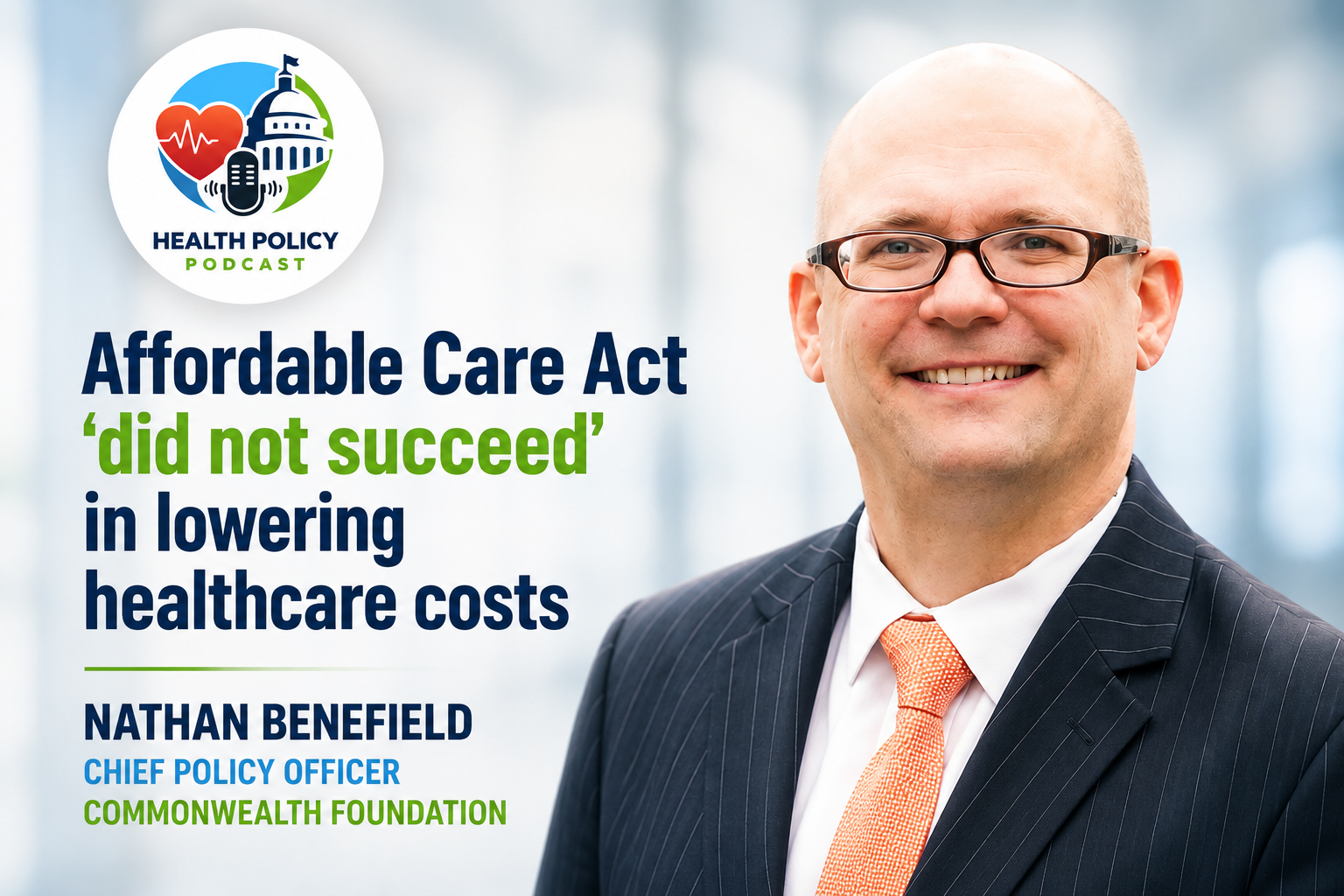
Health Policy Podcast episode featuring Nathan Benefield discussing Reevaluating the Affordable Care Act: Insights from Nathan Benefield

In the latest episode of the Health Policy Podcast, Nathan Benefield, Chief Policy Officer at the Commonwealth Foundation, discusses the Affordable Care Act's impact on healthcare costs and insurance coverage. Benefield critiques the ACA for failing to lower costs as promised and highlights the need for reform that empowers patients and increases market competition. He advocates for alternatives like health savings accounts and direct primary care to improve access and affordability in healthcare.

Reevaluating the Affordable Care Act with The Commonwealth Foundation’s Nathan Benefield

0:00 / 0:00

Reevaluating the Affordable Care Act with The Commonwealth Foundation’s Nathan Benefield

Nathan Benefield Discusses the Affordable Care Act's Impact on Healthcare Costs

In a recent episode of the Health Policy Podcast, Nathan Benefield, Chief Policy Officer at the Commonwealth Foundation, addressed the Affordable Care Act (ACA) and its implications for healthcare costs. The discussion, hosted by Brian Hyde, explored the effectiveness of the ACA since its inception in 2010.

Benefield emphasized that the ACA, often touted for its potential to lower healthcare costs, has not fulfilled its promises. "It did not succeed in that," he stated, noting that overall healthcare costs have dramatically increased since the law's passage. He pointed out that while government spending on healthcare has risen, individual families have also faced rising costs.

The ACA was designed to provide subsidies for individuals purchasing insurance on the ACA exchanges and to expand Medicaid. However, Benefield argued that these measures have not resulted in lower costs for families. "Families are still seeing dramatic cost increases," he said. He attributed this to the ACA's design, which includes mandates and subsidies that do not incentivize competition among insurance providers.

The conversation also touched on the political climate surrounding healthcare subsidies. Benefield noted that recent congressional debates have focused on temporary subsidies enacted during the COVID-19 pandemic. He expressed skepticism about Congress's willingness to acknowledge the shortcomings of the ACA, suggesting that political motivations often overshadow the need for genuine reform.

Benefield highlighted a concerning trend: a decrease in enrollment in ACA plans. He explained that many individuals are not utilizing these plans, raising questions about whether they are receiving adequate healthcare coverage. "Almost a quarter of these plans had no usage over a year," he said, indicating that many enrollees may not need the coverage they have.

The discussion also addressed the challenges of Medicaid expansion, particularly in Pennsylvania. Benefield pointed out that Medicaid often provides lower-quality coverage, which can lead to difficulties for healthcare providers. "Medicaid is paying 75 cents on a dollar of what private insurance pays for the same services," he explained, leading to financial strain on hospitals and clinics.

Benefield proposed that a more market-driven approach could improve healthcare access and affordability. He suggested expanding Health Savings Accounts (HSAs) to give individuals more control over their healthcare spending. This would allow patients to shop for insurance and healthcare services more effectively, fostering competition among providers.

When asked about the potential for interstate health insurance purchasing, Benefield noted that current regulations limit individuals to plans regulated by their home states. He argued that allowing nationwide competition could help lower prices and improve access to healthcare.

The conversation also highlighted the issue of healthcare provider shortages in rural areas. Benefield suggested that expanding the scope of practice for nurse practitioners and allowing doctors to practice across state lines could alleviate some of these challenges.

Price transparency emerged as another critical topic. Benefield acknowledged that many patients are unaware of the costs associated with healthcare services, particularly in emergency situations. He advocated for greater transparency to empower patients to make informed decisions about their care.

As the discussion concluded, Benefield expressed cautious optimism about the future of healthcare reform. He acknowledged the inertia surrounding government programs but noted a growing recognition of the need for change. "There is a realization of needing to do something differently," he said.

For those seeking alternatives to the current system, Benefield recommended exploring direct primary care models, which allow patients to pay a membership fee for access to their doctors. He emphasized that empowering patients to take control of their healthcare decisions is crucial for meaningful reform.

Benefield's insights reflect ongoing debates about the ACA and the broader healthcare system in the United States. As policymakers grapple with these issues, the need for effective solutions remains pressing.

Interview Q&A

Q&A: Reevaluating the Affordable Care Act with The Commonwealth Foundation’s Nathan Benefield

Reevaluating the Affordable Care Act with Nathan Benefield

Q: Can you tell us a bit about your background?

A: I serve as the Chief Policy Officer at the Commonwealth Foundation, Pennsylvania's Free Market Think Tank. We engage in public policy discussions, particularly focusing on healthcare issues.

Q: Did the Affordable Care Act lower healthcare costs as promised?

A: No, the Affordable Care Act did not succeed in lowering healthcare costs. Since its passage, there have been dramatic increases in overall healthcare costs, despite the expectation that government spending would reduce costs for families.

Q: What are some reasons for the increase in costs under the Affordable Care Act?

A: The design of the Affordable Care Act includes mandates and subsidies that do not incentivize insurance companies to compete or reduce costs. As a result, families are facing higher costs and fewer available plans.

Q: Are people losing their insurance under the current system?

A: Yes, there are fewer people enrolling in plans on the exchange. Some plans are not being used, and there are questions about whether those individuals are receiving adequate healthcare elsewhere.

Q: What is the impact of temporary subsidies passed during the pandemic?

A: These temporary subsidies were intended to expire, but the political debate has become focused on extending them. There is a need to reevaluate the effectiveness of the original Affordable Care Act rather than simply adding more subsidies.

Q: What are the challenges in discussing healthcare reform?

A: The political environment is highly charged, making it difficult to have honest discussions about the shortcomings of the Affordable Care Act. Many politicians are reluctant to admit that the system isn't working as promised.

Q: What are the incentives created by the current healthcare system?

A: The current system creates perverse incentives that discourage individuals from shopping around for better insurance plans. Insurance companies also lack incentives to offer more affordable plans.

Q: Are there alternatives to the current healthcare system?

A: Yes, alternatives exist, such as expanding health savings accounts that allow individuals more control over their healthcare spending. This would enable patients to make more informed choices about their healthcare.

Q: Who opposes changes to the current healthcare system?

A: Those who benefit from the status quo, such as insurance companies and certain medical groups, often oppose changes. Bureaucrats and government unions also resist reforms that would empower individuals.

Q: Why are individuals limited to buying insurance only in their state?

A: Individuals are restricted to purchasing insurance regulated by their state. This limits competition and can lead to higher prices. Allowing nationwide shopping could help lower costs.

Q: How can access to healthcare providers in underserved areas be improved?

A: Expanding the scope of practice for nurse practitioners and allowing doctors to practice across state lines could increase access to healthcare in underserved areas.

Q: What role does price transparency play in healthcare?

A: Price transparency allows patients to make informed decisions about their healthcare. Currently, many providers do not disclose prices, leading to unexpected costs for patients.

Q: Will healthcare providers adopt price transparency without government intervention?

A: If the system becomes more patient-centric, providers will likely respond to consumer demand for transparency. Currently, the lack of patient control over healthcare spending limits the need for providers to disclose prices.

Q: What is the likelihood of reforming the Affordable Care Act?

A: Reforming the Affordable Care Act is a long-term goal. While there is inertia in maintaining existing programs, there is growing recognition of the need for change.

Q: Where can individuals find accurate information about healthcare options?

A: Individuals can visit the Commonwealth Foundation's website for resources. Additionally, exploring direct primary care options can empower patients to take control of their healthcare.

Key takeaways

  • There are a number of what we call perverse incentives that... limit the competition.
  • The reality is, it didn't do that. Families are still seeing dramatic cost increases.
  • They should go back and say, 'Hey, what we created has not been working. We need a different approach.'
  • Putting people on Medicaid... is one of the lower quality forms of health coverage.
  • Allowing that national competition would actually help lower prices.

About the guest

Nathan-benefield-commonwealth

Nathan Benefield

Chief Policy OfficerThe Commonwealth Foundation

Nathan (Nate) Benefield is the Chief Policy Officer at the Commonwealth Foundation. An Ohio native, Nate holds an undergraduate degree in political science and economics and a master’s degree in public service management from DePaul University in Chicago. He also completed his doctoral studies (ABD) in political science at Loyola University, also in Chicago. Nate joined the Commonwealth Foundation in 2005. Now as Chief Policy Officer , he provides strategic leadership as well as operational oversight spanning policy analysis, government relations, marketing, and communications. Nate has researched and written extensively on public policy issues including the state budget, public sector labor reform, government spending and taxes, liquor privatization, education, and economic development. Under Nate’s policy leadership, the Commonwealth Foundation’s work on public sector pension law helped drive the bipartisan pension reform of 2017, heralded by the Wall Street Journal and Washington Post as an example for other states to follow. Nate has testified numerous times before state legislative committees and is often called upon by legislators and members of the media to provide expertise. He is a frequent commentator on both television and radio, and his writings have appeared across the state and nationally in outlets including the Philadelphia Inquirer, Pittsburgh Post-Gazette, Patriot-News, and Weekly Standard. Nate’s favorite rock song and personal motto are both “Don’t Stop Believin.”

Full transcript

Show full transcript
[00:00:00] Welcome to the Health Policy Podcast. I'm Brian Hyde, and today I'm joined by Nathan Benefield. He's the Chief Policy Officer of the Commonwealth Foundation, Pennsylvania's Free Market Think Tank. Uh, Nathan, welcome to the show. Thanks so much for joining us. Yeah. Thank you for having me on. So we're gonna be talking a little bit about, uh, you know, the Affordable Care Act, which I know is on a lot of people's minds. There have been some big congressional battles over, uh, renewing subsidies and so forth. But before we dive into our topic, would you mind giving us just a little bit of your background and tell us a little bit about yourself? Sure. I, uh, serve at, at the Commonwealth Foundation in Pennsylvania as the Chief Policy Officer, uh, and really Commonwealth Foundation. We are a state-based think tank, um, but really heavily engaged in the public policy fights, um, that, that go on here. And I provide a free market perspective on, on issues, uh, and certainly have engaged on, on healthcare that when, uh, when Obamacare first passed, kind of took things from the state level where the state was in charge. Um, to the national level. Uh, and so we, uh, saw the experience here, uh, in [00:01:00] Pennsylvania, which is where I, I I'm based, so when, when I first heard, you know, the term Affordable Care Act, of course, my first reaction was, wow, it's really going to lower healthcare costs. And that's my first question for you. Did, did it actually lower healthcare costs and why or why not? That's how it was definitely promoted as the Affordable Care Act. And you know, the idea was like, oh, this is gonna stop escal, you know, reduce costs and even stop kind of the, the rapid increase in, in healthcare costs. Um, it did not, uh, succeed in that. And we've seen in the 16 years since that was passed, dramatic increases in, in overall healthcare costs. Um, now it's no surprise I think that. The government costs have gone up. Um, you know, that included massive subsidies, um, you know, for, for those buying insurance on the Obamacare exchanges, uh, as well as expanded Medicaid federal government, picking up most of the tab on that. Uh, so no one's surprised that overall healthcare costs, uh, went up. Uh, but there are some, uh, some of the supporters. Might be surprised that, uh, even for families, the costs [00:02:00] went up and the idea was like, well, if we have more government spending, it will reduce what, what individual families are, are paying. Uh, the reality is, it, it didn't do that. Um, families are still seeing dramatic cost increases. Uh, and part of it is, is due to the design of the Affordable Care Act, um, that it has a number of, you know, mandates that have to be covered, uh, individual mandates, uh, and even the subsidy portions of it. Um, when you think about it, like, Hey, we're gonna give insurance companies. Subsidy, uh, for these insurance plans, that doesn't give them any incentive to compete or reduce costs. And so, uh, there are actually kind of fewer plans being offered now, um, but at, at a higher cost to families. I, I'm curious, you know, the, the, the big battles, especially over, you know, keeping the government over open rather versus, you know, doing a partial shutdown. Were, were over whether or not those, uh, subsidies would be included, um, in, in those, uh, revenue expenditures. At what point does Congress. Admit or will they ever admit that, hey, you know, this thing isn't doing what it was promised it would do. [00:03:00] And this is, you know why, I mean, things are so, so political and so election oriented. Um, what was being debated was not even the original Obamacare subsidies, but uh, some temporary subsidies that were passed during the, the kinda the pandemic era or COVID subsidies that said, Hey, we're in an emergency. We need to both increase the amount of subsidies and, um, kinda expand the population of who's eligible to higher income households. Um, but that was set up to be a very temporary measure, um, and set to set to expire. And then as that deadline came, like, oh, we need to do something, this deadline that we set for ourselves is expiring. Um, but it, I think it was just very politicized, like, Hey, we can, um, set this to expire and blame the other party, uh, for, for that. Um. In reality that is, you know, they should go back and say, Hey, what we created. Has not been working. Uh, we need a different approach. Um, not simply adding more taxpayer subsidies into these programs that aren't, that aren't working, [00:04:00] um, but, but reevaluate kind of what healthcare is and should look like. Um, that is a much more difficult conversation, um, especially given how dysfunctional things are in politics. Um, but that really is what need needs to happen. So I, I have to ask, are, are people losing their insurance? I know that was one of the big, uh, points of leverage as to why it has to be included, you know, in, in any budget deal. Um, are, are people losing that coverage? There are definitely less people enrolling in these plans on the exchange. Now there's questions about, um, who are those people and are they getting healthcare or health insurance, um, and elsewhere. And of course, the question of both health insurance and actually getting, getting healthcare, um, which is a whole, whole nother side topic of the debate. Um, but when we looked at some of these, um, exchange plans and the idea was like, Hey, these expanded subsidies allowed more people to enroll. Um, there are also a lot of. Plans that weren't being used. Uh, and we found on the Pennsylvania Exchange Penny, um, almost a [00:05:00] quarter of these plans had no usage over a year. So were people actually needing them? Um, were they actually being covered by their employer's plan? Um, and we can get a plan for free. Well, there's no reason to cancel it. Um, might as well sign up and get this, this free plan, uh, even if you don't need it, uh, when you have to pay. 25% of it. Um, then, you know, then people, some people were, were canceling them. Um, but the question is whether that was, was actually needed or whether moving people off this government subsidized plan to employer insurance, uh, is actually better, better for them and better for their healthcare. Is that a discussion that would be taking place if those, uh, uh, if, if the expiration date wasn't a part of those, uh, those temporary subsidies? Yeah, that's a good question. Uh, I think that, um. That is something that is, is kind of underrated of. You know, what, what kind of plan do we want people to have? Uh, and it is a big, big difference. Um, this kind of came up with the discussion of expanding Medicaid, uh, and then [00:06:00] states had to choose to opt in or not. Um, but the reality is putting people on Medicaid, uh, it's, it's one of the. Um, lower quality forms of health coverage, uh, pays a lot less, uh, to doctors and, and nurse homes. And you're, you're seeing that even now in, in states like Pennsylvania, they're seeing, hey, a lot of these, you know, hospitals are struggling. Um, part of the reason they're struggling is because Medicaid is paying 75 cents on a dollar of what, uh, private insurance pays for the same services. Uh, and as more people are, are on Medicaid and not on private insurance, uh, they're, they're struggling because of that and, and paying less. Uh, and of course some doctors won't take Medicaid because of the amount of paperwork and, and getting paid less. So, uh, those people on Medicaid, um, don't get as good a coverage. So it's a question of, you know, is simply putting people on government subsidized insurance, the same as getting them healthcare. No, I think that's a great way to frame the question, actually. Talk to me about the incentives that, that have been built into this system and, and, and what those incentives are [00:07:00] are causing. Yeah, I mean, it, there are a number of what we call perverse incentives, um, that, uh, especially with these ex, you know, subsidies and the expanded subsidies that, uh, was saying the government is going to, uh, you know, pick up whatever the cost is above what. In, you know, we're gonna cap what individuals pay, um, and pick up the rest. Well, that's an incentive for individuals to not shop around. They have no incentive to get a less expensive plan. Uh, find a better one. Uh, there's also no incentive for the insurance companies to. Offer, uh, more affordable plans, uh, because, um, they can just charge the government for whatever the cost is or what they're, what they're charging. Uh, and so it really limits the, the competition. Um, and, and prevents kind of the, the whole idea is like, Hey, we want more affordability, uh, in the system. Um, but the way the subsidies work, uh, actually does the opposite rates, incentives to increase, uh, prices. It sounds like you're making a pretty strong case for, uh, let the market work its magic. Uh, I mean, are, are there alternatives out there in the market? [00:08:00] There have been alternatives and, and there are, um, and they're getting more discussion now, and this is kind of, this opportunity is kind of renewed because of this, this debate over the expiring subsidies of getting back to some of the debates we were having, um, 16 years ago about, you know. Giving patients, uh, more control over the healthcare dollars. And, you know, one of the big concepts, um, uh, that's been out there and, um, president Trump has even talked about this is, is kind of having larger health savings accounts or portable, uh, individual and accounts, which, um, you know, you can put money in. Um, currently we have HSAs now, but they're very limited. It has to be tied to insurance, but a, you know, an uncapped wear. Uh, individuals can put in, your employer can put in instead of necessarily just having you choose whether to be on the employer plan, put into your individual account. Um, when there are Obamacare subsidies, um, put that in. So all of your, uh, money in, in one account that you control, uh, you can use it to buy insurance. Uh, you can pay for your, uh, healthcare coverage directly. Um. Pay [00:09:00] for different services, uh, pay for, you know, direct primary care, which is, uh, people that won't take insurance. They just wanna pay your, pay your doctor, um, allow people to enroll in that. So a much more flexible and portable plan, uh, where all of your healthcare dollars go into that and, and you as an individual controller rather than, uh, than a company. Now, I have to ask, I think it's a great idea, by the way, but I have to ask who would stand in opposition to this? It, it's, it's always telling as to who would say, oh, oh, we can't have that. Um, who, who pushes back on this idea? Well, I mean, everyone who's, you know, kind of making money on the status quo, um. I don't want to just demonize everyone, but you know, um, obviously in insurance companies, um, doctors who, um, different medical groups who like that they have mandated coverage. Their service has to be man, kept, covered, uh, there, uh, and even a lot of the, the, um, government unions and, and SCIU, uh, which is very vested in, in the status quo, um, doesn't like a system that, uh, gives. Power, you know, powerway. And then you have, um, really the, the bureaucrats themselves, uh, [00:10:00] kind of insurance commissioners and, uh, department that, um, well, we can't let individuals make these decisions that we as, as the experts, um, in, in government, uh, have been able to make. So there is a lot of entrenched interests that, that oppose, uh, oppose change. And, um, and while it sounds like a great idea, uh, I think even among people like, well, we, we, this is what we know and a system that we don't know is, is somewhat, uh, somewhat scary. Talk to me about, uh, the, the ability for, for Americans to, to go, um, beyond their state lines when it comes to, to finding health insurance. Um, I, I, I don't fully understand why it is that we're limited now, and maybe you could help me understand that, but talk about what would happen if we were allowed to, to shop nationwide. Yeah. This is, you know, has been an issue that, you know, really you are limited as an individual, uh, to buy insurance that's regulated in your state. Um, now. Corporations that are multi-state corporations, they can buy a plan, um, that, that, uh, from any state that they're operating in. Um, but on the [00:11:00] individual market, it's at the, at the state level, states can have their own regulations. Uh, and this was something we saw, um, especially before Obamacare. Uh, a little bit more nationalized now, but, uh, before this was the case, you saw states. Dramatically different prices, uh, on healthcare and health insurance, uh, because at different levels of regulation. Um, but it's one product where you can't buy it across state lines. You can know you can go buy a car across state lines. You can, um, you know, go shop, uh, for, uh, for, uh. Any other good, you know, service across state lines, but you can't do it for, for healthcare and health insurance, uh, because of some of the regulations that have been built in. Um, but allowing that, that national competition, uh, would actually help help lower prices and help, uh, help you be able to shop and, and, uh, make companies compete with each other. I also hear, you know, ongoing concerns about, uh, well, you know, the problem too is, um, there's just enough, not enough medical providers, doctors, nurses, and so forth in, in rural, or what they call underserved areas. Um, how, how can that supply [00:12:00] be increased? Yeah, that's, uh, is definitely a, a concern and an issue. That challenge has been been there. Um, but a lot of there is driven by restrictions. So there's restrictions on, um, who can get medical licenses and, and what they can practice. Um, but some states that have done very well have ex. You know, kinda expanded the scope of practice. One area is nurse practitioners allowing nurse practitioners to do more of the services that, uh, normally in some states only doctors are allowed to do. Uh, that would give patients a lot more, more access to getting, getting those kinds of health, healthcare, um, when they, when they go in. 'cause there's obviously a limited number of doctors that can serve them. Um, so we reduce wait times and, uh, give greater access to care. That's, um, you know, one of the solutions. There are a few others in terms of allowing. Doctors who are licensed in one state to practice in another state, um, again, it would create just more access to, to care, rather limiting it. Um. Nathan, I'd also like to get your take on, on the topic of, uh, price transparency. Anyone who [00:13:00] has, for instance, been to the emergency room in, in recent memory. Um, you know, of course, you know, you don't want to just simply, oh, that's too much. We'll just turn down that emergency care. But really, you don't really know what it's gonna be. It's, it's kind of a surprise, and sometimes when it comes, it's like you need to have the defibrillator paddles nearby because it's a huge shock. Um, you, you don't know what you're getting. Right. And, and it isn't ever posted to what the prices, um, as opposed to most other, you know, services. Most other places you shop, you'd see a price of, you know, how much am I gonna pay? Uh, in some cases like, alright, what is an emergency? I need this. Um, but some cases, like we're gonna give, you want to give different types of testing. Um, and those who do have HSA models, a lot of times we'll go in and say, Hey, I'm paying cash for this. You're ing this. Do I really need this? Um, and sometimes you'll get both. A different opinion. Like, Hey, you don't really need this. Would you also, um, say, Hey, we have a different, uh, some. Um, doctor's offices and, uh, we'll have, we'll have a different price for those who are paying cash versus who are paying [00:14:00] insurance because we can charge them insurance to full cost. But you as an individual, um, will, will pay less. Um, having more transparency will actually force that disclosure, uh, and make, allow individuals and patients to make more informed, uh, form decisions about, about their healthcare. Now, you know, I, I wanna see the market, you know, work its magic as well. I, I believe the market really has the power to find the sweet spot, but. Will, uh, will healthcare providers provide that transparency short of having government lean on them and tell 'em, you must do this, as opposed to, you know, doing it because, hey, that's the right thing to do and it'll bring more customers. Yeah. Well, I think if, if you have, you know, you can, one, you can manage the, the price transparency, um, especially for, you know, with Medicaid and Medicare covering so much that are requiring them to disclose those prices, uh, publicly. But if you move towards a more patient-centric system where, uh, you as an individual are empowered to shop around and compare, um, pricing, compare insurance, um. Providers will have to do that, [00:15:00] uh, where they have kind of this current model, uh, that they don't have to, and they don't need to because, uh, you as a patient have no control over over the dollars. Uh, so I think they will need to respond with greater transparency if we allow this. Uh, I understand. You know, we're believers. I think we, both of us are same believers in the, in the free market system. Let it work. We don't have that, uh, in, in this country and have it in a long time. Um, really it is, um. A very govern, heavily government regulated and, and government paid for system. Um, moving towards, uh, a fair market system, which we haven't really had in, in at least decades, uh, in, in this country, um, would actually open up a lot of that and, and open up transparency and, and empower patients. Nathan, based on what you've described for us here, um, I, I think it's pretty clear reform. It, it could, could definitely help. Um, now the question is where to begin. What, uh, what does reform start with and, and does it have a likelihood of succeeding or is, is there that, uh, inertia that comes from? Well, it's a program and you know, you don't do away with a program 'cause somebody's on it. That [00:16:00] was, I think, uh, something Reagan, Ronald Reagan said, it's like there's nothing as permanent in life as a government program. Um, so there is gonna be a lot of inertia, it's gonna be a lot of challenge. Um, and I think, but I do think there is, you know, realization of, of needing to do something differently. Um, a realization of, um. As much as things have happened in, in, at the national level with our national debt, like we've got, you know, there's just not enough money to go around. Uh, and some idea of returning this power back to the states and empowering states, uh, I think you're starting to see a little bit more momentum. Like, hey, um, regardless of whether which party's in power, we really want the states to have more flexibility. Um. And then, um, then there becomes more competition, a lot of turning, returning the decisions to state policy rather than, uh, than in Washington DC I think is a, a good move and something most people would agree with. Now, and I'm asking you to be a bit of a fortune teller, but I'd, I'd like your honest opinion on this, um, are, are we likely to ever see the day that, uh, that the Affordable Care Act is put to rest because politicians are, are willing to admit it. It [00:17:00] hasn't delivered what it was. You know, what it promised that it would. Yeah. Um, I think that is, is still a long-term goal, I think. I don't think it's imminent. Um, I don't put the faith in, in politicians as much as I put it in, in math and, and reality. Um, so they will eventually forced you to, uh, uh, realize that it's not, to not deliver on the promises and for the sake of people who are, you know, serious about. Um. Basically putting, putting their, their, uh, responsibility back in their own hands. Patients and families in particular. What's a good place for them to start in terms of getting accurate, uh, information that can help them, you know, uh, break free of, of a system that may have 'em trapped at the moment? Hmm. Yeah, I think, um. There's more resources on our website@commonwealthfoundationdot.org. Um, I think talking to, to, to different doctors and shopping around, um, even looking at some of the direct primary care, I think that is probably the best options available out there [00:18:00] now for those who, who really wanna have power themselves is. He's participating in a direct primary care provider, um, which is basically you, you pay for a membership, um, with, with your doctor. Uh, and there are a lot of doctors around there and, and, and folks can look into that. Um, there's a network of of folks who are doing that, um, now, which really is much more, um, patient driven and patient controlled. Again, we are talking with Nathan Benefield, he's the Chief Policy officer of the Commonwealth Foundation, Pennsylvania's Free Market Think Tank. And Nathan, I appreciate you joining us on the Health Policy Podcast. Again, thank you for having me. A great conversation.

Filed under