Show full transcriptHide transcript
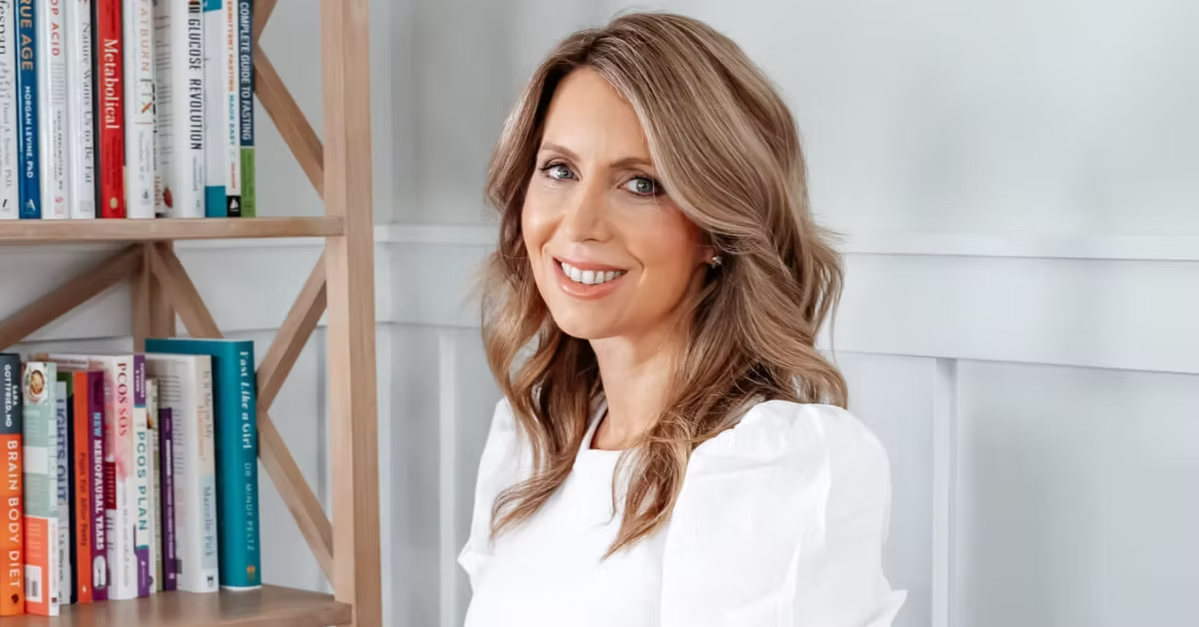
[00:00:00] Welcome to the Health Policy Podcast. I'm Brian Hyde. Today I'm joined by Cynthia Thurlow. She's a nurse practitioner and the author of the Menopause Gut. And Cynthia, it's great to have you on the program. Could I ask you, take a moment here, tell us just a little bit about who you are and what you do. So good to be here.
Brian. I am a traditionally trained allopathic nurse practitioner. I spent over 20 years working in ER medicine and cardiology, and 10 years ago I took a different path. I actually left traditional allopathic medicine, started my own. Um, lifestyle is medicine practice, and have kind of existed in the perimenopause and menopause space over the past 10 years.
I live on the East coast. I'm married, and I have two boys who are now adult sons, which is hard to believe. Um, but it's, it's such a pleasure and an honor to be connected with you. I always remind people that I'm a nurse at heart first and foremost, but, uh, the wonderful thing about nursing is that it gives you a lot of different skills that you can use [00:01:00] in different areas of your life and professionally.
You know, I'm, I'm thinking back over the course of my life, and I think it wasn't until just probably the last 10, 15 years that I really started to hear the phrase nurse practitioner, um, becoming regularly used when it came to, you know, doctor visits or office off, office visits. Um, talk to me a little bit about, uh, the role of the nurse practitioner in nurse practitioner in healthcare.
And is, is this a fairly new thing or is this something that's been there all along and maybe I just wasn't seeing it. Yeah, I think it probably depends on where you live in the United States, but advanced Practice Nurses, which is the umbrella term for nurse practitioners, nurse, mid midwives, nurse anesthetists, and also uh, Clint, nurse specs, nurse practitioners have been around since the 1960s, and certainly when I finished my nurse practitioner training at Johns Hopkins in 2001, which a long time ago.
There were a lot less of us. Now there's over 461,000 of us here in the United States, and I do think that [00:02:00] over the past probably 10 plus years, we've just been seeing more and more nurses going into, uh, nurse practitioner programs and training. I think with a strong desire to be able to fill voids in rural parts of the United States, fill primary care gaps, and then quite transparently.
Um, you'll find nurse practitioners just about everywhere. I always did the acute care medicine side. I was always in hospitals or in clinic and high acuity areas. Uh, but I really think we are designed to be used effectively in the healthcare team and to continue delivering really high quality care to patients alongside our physician colleagues and, and nursing colleagues.
Cynthia, let's take just a moment here and if you would, would you help me differentiate between. What nurses do or can do, what nurse practitioners do or can do, and likewise what physicians can do. Yeah, it's a great question. So nurses are underneath a nursing model and what they are doing is they are taking orders, like, let's give the example that we're [00:03:00] in a, uh, hospital system.
They are taking care of patients, but they are also taking orders from physicians or other nurse practitioners or. PAs, physician's assistants, and they are very much involved. I look at them as the quarterback. They are the eyes, the ears, um, of the patient. They are a patient advocate. They are a vital, important role within the healthcare system, but they really are the, uh, the point person, if you will.
Um, I marry, I, I, I've all boys, so I'm always thinking in sports analogies, but they really are the quarterback of the healthcare team. When I think about what differentiates a nurse from a nurse practitioner, it's obviously graduate level training. Um, there are other types of advanced practice nurses, but nurse practitioners can admit patients to hospitals depending on where they live.
And I'll be clear about that. They can write orders, they write prescriptions. Um, depending on the state that they live in, they may be involved in hospice care. They do many of similar roles to a physician, and I'll dis differentiate there briefly. [00:04:00] Their training is different, so advanced practice nurses have first been a nurse and then they go to graduate school.
And at the time that I finished my program, the terminal degree for nurse practitioners was a master's. It is now a doctor of nurse practitioner, so it's a clinical doctorate, different from a PhD. And that depending on the state, so there are national, there's national credentialing for nurse practitioners as well as nurses, and then there are state mandates.
So I live in a state. To give you an example, there are 30 states in the United States where NPS can function autonomously. Meaning that after a certain amount of years of experience, they can have their own business. That is like the state that I live in in Virginia. There are other states where. Nurse practitioners are required to have a practice agreement, and that's how I spent most of my nurse practitioner years because the state that I live in has only adopted this autonomous model in the past five years.
Now, what differentiates a nurse practitioner from a physician is training. Obviously a physician goes through four years of medical school [00:05:00] and depending on their specialty, they could spend another three to 12 years of training. If they're in family practice or internal medicine, a little less if they're doing, uh, neurosurgery or cardiothoracic surgery a a bit more.
Um, not understandably so. They go through medical school and then a residency, like a formal residency. At the time that I went through my nurse practitioner training, we learned on the job during clinicals, but we did not have a formal residency. Thankfully. Now that is changing, that is now an option for nurse practitioners.
So what ends up coming out is that. Physicians really are, I think of them as, you know, the, the apex predator in the healthcare team because they are oftentimes, you know, the buck stops with them and they have very different training. And I always say that all of the training, if we're talking about nurses or nps or CRNAs or other types of modalities, ultimately we work as a team.
I don't look at it as an adversarial relationship, nor does my experience as an np. Prepare me [00:06:00] to do surgery. That is, that was never an interest of mine. So I think that, you know, there's a different model of care. You know, nurses come from a nursing model, which tends to be very holistic versus a, you know, a traditional physician model of care is a medical model.
So it's a difference in philosophy and training. Although I have been very fortunate that for the duration of the 25 years I've been in medicine, I've always had very collegial relationships. Um, I've never had adversarial relationships with other physicians or other ancillary medical team members, but I think that there is differences in training, differences in philosophy.
And then applicability because depending on where you practice, meaning state-wise, you may have different rules for how your position is perceived or utilized. Um, like I mentioned earlier, Virginia is a state where we have autonomous practice. So nurse practitioners here with at least several years of experience don't need to have practice agreements with physicians.
But one thing I will tell you is. Any good nurse practitioner [00:07:00] knows that their physician colleagues are a vital part of that communication trail. And even though I have autonomous practice, I still have agreements with physician colleagues if I have questions or I need to fill in conceptual gaps. So there's the constant interplay that I think is really important.
We're all lifelong learners. I, I believe, uh, you mentioned the, you know, it's, it's, there are, there are hundreds of thousands of, of nurse practitioners now. Is there a physician shortage? And if so, why is that? Why? Why are we seeing a shortfall in physicians? Yeah, I mean, I do think that there's, there's shortfalls.
Yes. The answer is yes. There is a shortfall. Number one, there are underserved areas here in the United States, either due to being in rural or urban areas. Um, I think that there's also not enough physicians that are going into traditional, like internal family medicine. Pediatrics and so we have a bit of a void there.
Um, and a great deal of that from talking to my colleagues and, and looking at the research suggests that a [00:08:00] lot of it is the burden of loans. You know, for many individuals they have undergraduate debt and they have med school debt and they feel pushed to go into, um. More lucrative specialties to help pay off their loans.
And I certainly understand and respect that, but that void that you referred to is a real entity, and that's why nurse practitioners and other, you know, physicians', assistants, midwives, are helping to kind of fill that gap so that there are not underserved populations in rural America and even urban America.
Why is it that, uh, that patients seem to gravitate toward the, uh, the nursing model of care? Well, I think it's just a different way of thinking. I mean, I grew up in a, a, a big family where there were a lot of nurses and a lot of physicians, and so I was adamantly opposed to ever working in healthcare. But it's ironic how life ends up coming to play.
I, you know, I think that. People that are attracted to nursing are likely looking for a different quality of life. [00:09:00] Like I had had enough, uh, female physician, family members to see that that was a, you know, there's, there's a degree of sacrifice and I'm not suggesting the other fields don't. I'm just.
Telling you, you know, as, as someone who grew up in the seventies and eighties, watching older family members that were in the medical field, there's a degree of self-sacrifice that I was unwilling to make. I didn't want to be, um, you know, having, you know, on call every third night, I didn't want to be, you know, called in in the middle of the night.
That just wasn't what I was interested in. I knew that I very much wanted to have a family, so for me it was a quality of life metric that I could still have a lot of intellectual stimulation, a lot of independence. But also ultimately not have the same work hours. Um, that was something that I, I definitively knew even before I got married.
So I think for some people it's a, it's a quality life metric. Other people, it's a philosophical difference, uh, in the training itself. I, I think that medicine in general is absolutely a calling. And it's not to suggest one decision is right and another is wrong. [00:10:00] It's just what is your prevailing thought process?
What, where, where do your values fall in terms of can you have it all? And I think for women in particular, we feel a tremendous sense of pressure to have it all. We wanna have an intellectually rigorous occupation. We wanna be able to manage, um, you know, giving a lot to our family and our children. Uh, but ultimately I think for each one of us, it's a very personal decision.
But that's what I suspect is probably driving that decision making is, you know, just differences in training and differences in responsibilities. Let's take a moment to, to visit, uh, some of the, the trends in healthcare, and I'm gonna harken back to, it's an old Saturday Night Live skit. Uh, Phil Hartman played a doctor and, and they were, they were kinda lampooning the time when doctors smoked.
In fact, they used him in cigarette commercials and some young woman is, is pregnant and he's. Doctors, like, have a cigarette. Remember you're smoking for two now. And I think, you know, there was a time when, uh, yep, doctors would smoke and, and it was considered a totally normal thing. But, um, different trends have come and gone.
What are some of the trends you are seeing right now [00:11:00] that to, that contributes either to, uh, you know, the, the rise of nurse practitioners or just the, the way that healthcare is, is being approached? You know, that's a great question. I, I think that the things that I, that really stand out to me is, is the impact of, uh, healthcare companies, you know, insurance companies really, uh, dictating how physicians, nurse practitioners, PAs are practicing, not just the constraints on time that I don't think anyone I know in medicine right now is happy with this.
You know, people want to spend more time with their patients, but the constraints of reimbursement. Reimbursement is going down. Practices feel like you have to see more patients. Um, I, I think in many instances there's a lot of pushback about medication prescribing oftentimes by people who are making decisions that are not medically trained.
Um, pushback about procedures oftentimes for, for things that make zero sense. The last time I had to have a, a conversation with a [00:12:00] healthcare. You go through a formal process to appeal decisions, um, and, and talking to someone that you know, clearly didn't have any medical training, and I was having to explain to them the justification for the test that I ordered for this patient.
So there's that issue. I think that there's also, um, increasingly you're seeing, uh, hospital systems are buying out private practices. It's no longer economically feasible for some of these smaller practices to stay viable. Um, that's also something that I've, I've been witnessing. I think the other issue is, you know, shortages of drugs just in general, that, uh, from my understanding, and I always say like I am not an executive, but based on what I've been reading and discussing with other providers, is that there are constraints on availability and accessibility for certain medications.
And by that I'm referring to hormone replacement therapy, um, is getting increasingly challenging for patients to get access to it. So those are three things that I, I. C that are, that are on kind of top of mind [00:13:00] for most clinicians as a source of frustration. And maybe the last thing to say is I, I think that.
It's great that we have, uh, technology at our disposal. So I'm talking about electronic medical records. Um, I'm old enough that we used to have paper charts. In fact, I was laughing watching the pit with my husband when there was this whole kerfuffle over the computer systems were down. And I would say to my husband, that is exactly how we practiced in the 1990s with paper charts.
But I think technology is both a blessing and a curse. Meaning that we are so dependent on technology that, um, I think it, it, it kind of lends itself to a degree of depersonalization with patients. Like I still remember when we would go into a patient's room and I didn't have a tablet with me. I'd be looking at the patient.
Now I'm looking at the tablet 'cause I'm realizing I have only so much time with that patient and I have to chart as I'm talking to the patient. So I think that degree of depersonalization. As well as the pressures that clinicians feel about the volume of patients they have to see to make sure [00:14:00] they're making, um, they're able to, to meet their bills or overhead.
And why We're also seeing, uh, why we're seeing a rise in concierge medicine, uh, why we're seeing a rise in people that are no longer taking insurance, which I know is frustrating and confusing for patients. But it's also like people are trying, as clinicians, we're trying to find solutions to, uh, circumstances that are not ideal for most of us to be practicing and, which is unfortunate because no one goes into medicine because I, I think everyone fundamentally, if you, whether you are a nurse, a respiratory technician, a physical therapist, a pa, a nurse practitioner, a physician, you go into medicine because you wanna make a difference, you really care.
And you wanna make a difference. And in some instances, the, the, the business of medicine has gotten a little bit ugly and it makes it challenging to practice in that environment. So I have to ask you, do you have a hot take on AI and, and its role in medicine? It seems like it's funny, it's going to many other areas of life.
[00:15:00] What do you see happening regarding medicine and, and artificial intelligence? I think it's a dual edged sword. I think that, um, you know, for myself, if I'm writing a, a paper or I'm putting information together, it can help me aggregate research and then I have to triple check it. But I get concerned that people, instead of using their brains, are gonna just plug in all this data into AI in lieu of.
Uh, connecting with a licensed medical provider or, um, putting themselves in a position to understand like AI is not infallible. Like that is the, the biggest crux. Like I talked to my adult sons when he was in college, one who was a high school senior, and I'll say to them, you realize AI is not always correct.
Correct. It's like understanding that we can't look at it as a replacement for a licensed medical professional, but I do see the utility. When there's something very specific, a very specific task, if it's going to save you time. Um, but you know, I'll, I'll use the example I was, I was reading an article the other day that was talking about there's a hospital system that [00:16:00] wants to get rid of their radiologist and just use ai.
And I was like thinking to myself. I think we're in a, in a time and an age where we have to make ourselves indispensable because if we don't stay ahead of the curve and make ourselves invaluable, we have the potentiality of there not being as many of us. And so I, I never want it to be that we're taking the human interest side out of medicine.
I think we can utilize AI to perhaps speed up, um, you know, tasks or things that are more menial. But I get concerned when I think that. AI has the potential to replace human beings. I mean, that is a, a great concern of mine. Especially when, you know, the average physician is at least eight years into post, uh, undergraduate education.
You know, the average nurse practitioner is six plus years into like post high school education, if not more. And I think for a lot of individuals, we want to ensure that we remain, um, we [00:17:00] remain viable and we remain something that is in demand long term. Like I have a son that's in an engineering program and he said all of his friends in computer science programs.
Are leaving in droves, they're going to other majors because they're realizing that computer science, because of AI coding is catching up with a furious pace. And I said, but people will still need to code. They'll still need to do it. Um, but I think we have to make ourselves indispensable. I appreciate, uh, your take on that.
And, and I agree. I I don't wanna see the human factor leaving healthcare no matter how efficient you know, that, that AI might be. Let's take just a moment here. Absolutely. And Cynthia, let's talk about your book, um, the Menopause Gut. Uh, give us a, a brief synopsis, uh, about what's the book about? Why did you write it?
Yeah. Thank you so much. So the menopause gut is really helping women understand the gut microbiome changes that happen in perimenopause and menopause, despite the name. Um, it's helping women understand what the microbiome is, why it's so relevant. [00:18:00] I make the argument that is the key longevity organ that no one is focused on.
Um, we talk about the immune system and bone health and hormones. Um, it, it maps out a strategy for how to help support the microbiome. As we are navigating middle age, and I'm the first person to tell you that if there's any woman listening that thinks. Perimenopause and menopause is just about slapping on an estrogen patch.
There's a much more nuanced conversation in the book where I unpack why this is the missing link for my patients, how we go about addressing it with lifestyle, hormones, peptides, and even supplements. Um, it, it's really a groundbreaking piece of work and one that I'm incredibly proud of, but something that I've been fine tuning over the last 10 years with patients myself.
And, and for that matter, for, to direct people who would like to follow up and maybe, uh, you know, get their hands on a copy or otherwise follow your work. Uh, you have a website. Yes, yes. www.cynthiathurlow.com. If you go to my [00:19:00] website, you get access to all my social media channels, my podcast, everyday Wellness.
At the very top of the page is a banner that you can click on that will take you to purchase the Menopause Gut. You definitely wanna get it in a hardcover because it is a book you want at earmark and highlight. Um, and there are also presale bonuses that are actually bonuses you want, um, that are available if you purchase in presale.
Again, we've been visiting with Cynthia Thurlow. She's the, uh, she's a nurse practitioner as well as the author of the Menopause Guide. Cynthia, thank you so much for your time. Thank you for joining us on the Health Policy Podcast. Thanks so much, Brian. It's been an honor I.