· The Health Policy Podcast
Health Policy Podcast logo

Receive new episodes in your inbox.

← Health Policy Podcast

2026-08-11 · The American Prospect

David Dayen Explores Big Insurance's Influence on Healthcare Costs

with David Dayen, Executive Editor — The American Prospect
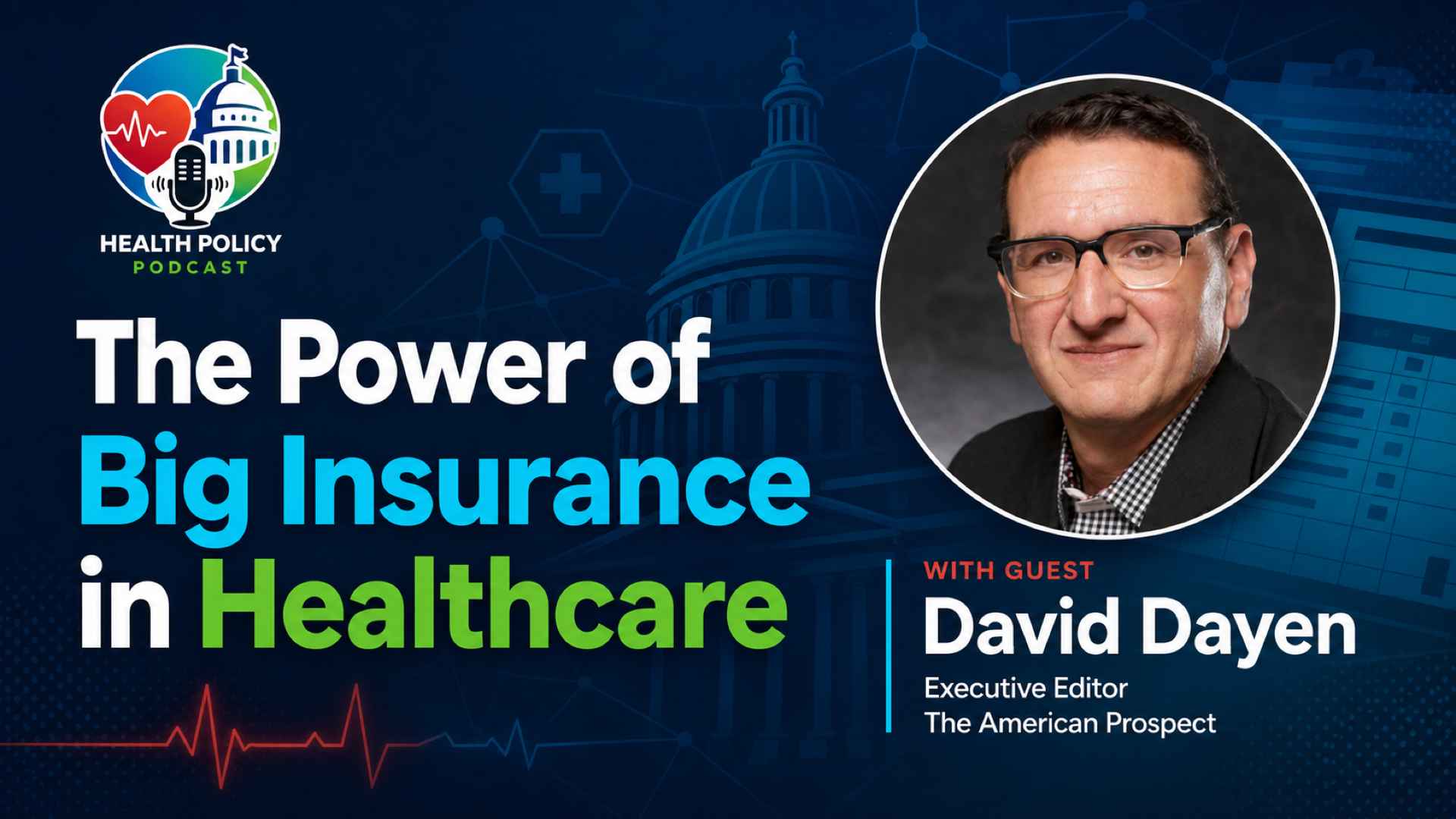
Health Policy Podcast episode featuring David Dayen discussing David Dayen Explores Big Insurance's Influence on Healthcare Costs

In the latest episode of the Health Policy Podcast, David Dayen, executive editor of The American Prospect, discusses the influence of major health insurance companies in the U.S. healthcare system. He highlights how companies like UnitedHealthcare and CVS/Aetna operate as health conglomerates, leveraging their power to maximize profits through practices such as upcoding in Medicare Advantage. Dayen also addresses the political lobbying efforts of the insurance industry and recent state-level reforms aimed at reducing costs and increasing access to healthcare.

David Dayen Discusses the Power of Big Insurance in Healthcare

0:00 / 0:00

David Dayen Discusses the Power of Big Insurance in Healthcare

David Dayen Discusses the Power of Big Insurance in Healthcare

In a recent episode of the Health Policy Podcast, David Dayen, executive editor of The American Prospect, discussed the significant influence of large health insurance companies on the U.S. healthcare system. Dayen highlighted how these conglomerates, including UnitedHealthcare and CVS Health, have transitioned from traditional insurance providers to multifaceted health service organizations, raising concerns about conflicts of interest and patient care.

Dayen explained that major health insurers have expanded their roles to encompass various aspects of healthcare delivery. For instance, UnitedHealthcare is not only the largest health insurer in the country but also the largest employer of physicians. CVS Health, through its acquisition of Aetna, operates as both an insurance provider and a pharmacy benefits manager, controlling the pharmaceutical supply chain. This vertical integration allows these companies to effectively "pay themselves," creating potential conflicts of interest that can affect patient care.

"The insurance companies are really branching out to be kind of full-service," Dayen said. He noted that this model can lead to steering patients toward preferred providers within their networks, often at the expense of quality care.

The financial implications of this system are significant. Dayen pointed out that a substantial portion of the U.S. healthcare system is funded by the federal government through programs like Medicare and Medicaid. He cited the Medicare Advantage program, which has grown to account for over half of new Medicare enrollments. However, he criticized the program for being rife with overbilling practices, estimating that Medicare Advantage companies overbill the federal government by approximately $76 billion annually through a process known as upcoding.

Dayen elaborated on how upcoding works, explaining that insurers can classify patients as sicker than they are to receive higher reimbursements. "The only people that lose are the American people and the American taxpayer," he said, emphasizing the detrimental impact of these practices on public funds.

The conversation also touched on the regulatory environment surrounding health insurance. Dayen described a system where oversight is often ineffective, allowing for practices like patient denials and prior authorizations to proliferate. He noted that the political power of the insurance industry is bolstered by substantial campaign contributions, which can influence legislation and regulatory oversight.

According to Dayen, the Health Insurance Influence Tracker has documented over $120 million in contributions from the insurance industry to political candidates and parties over the past 25 years. This financial clout can deter lawmakers from pursuing reforms that would challenge the status quo.

At the state level, some reforms have begun to emerge, particularly concerning pharmacy benefit managers (PBMs). States like Ohio and Kentucky have opted to eliminate PBMs in favor of public alternatives, which have reportedly reduced costs and improved access to medications. Dayen highlighted these developments as signs that public frustration with the healthcare system may be prompting some legislative action.

"People are very angry about the healthcare system in general, and I think insurance companies in particular," Dayen noted, suggesting that this discontent could drive further reforms.

Despite these state-level efforts, Dayen remains skeptical about the overall efficacy of a private insurance model in achieving comprehensive healthcare reform. He argued that a single-payer system, as seen in other countries, would ultimately be more effective in controlling costs and improving access to care.

In closing, Dayen reiterated the need for increased scrutiny of the healthcare system, particularly regarding the influence of large insurance companies. He emphasized that while there are signs of reform at the state level, the entrenched power of these companies poses a significant challenge to meaningful change in the U.S. healthcare landscape.

Interview Q&A

Q&A: David Dayen Discusses the Power of Big Insurance in Healthcare

Health Policy Podcast: David Dayen Discusses the Power of Big Insurance in Healthcare

Q: Can you introduce yourself and describe your work?

A: I am David Dayen, the executive editor of the American Prospect. We write about ideas, politics, and power, focusing on who has power and what they are doing with it. I also co-host a podcast called Organized Money, which discusses how the business world operates. I've been a journalist for nearly 20 years.

Q: What are your observations about big insurance in healthcare?

A: The U.S. has a few large health insurance companies, such as CVS and Aetna, and UnitedHealthcare. These companies are more than just insurers; they are health conglomerates. For example, UnitedHealth is the largest employer of physicians in the U.S., and CVS operates a significant health insurance company along with pharmacy benefits management and clinics. This vertical integration leads to conflicts of interest, as these companies can steer patients to their own services.

Q: How does the federal government play a role in the health insurance system?

A: A significant portion of the U.S. health system is funded by the federal government through programs like Medicare and Medicaid. Medicare Advantage, a private alternative to traditional Medicare, is particularly lucrative for insurers. The Medicare Payment Advisory Commission estimates that Medicare Advantage overbills the federal government by about $76 billion annually, often through practices like upcoding, where insurers classify patients as sicker than they are to receive higher reimbursements.

Q: Can you explain how insurance works and why it is profitable?

A: Insurance operates on a risk pool model, where many people pay premiums to cover the costs of a few who need claims paid. The remaining funds become profit for the insurance companies. There are regulations like the medical loss ratio, which mandates that a certain percentage of premiums go towards patient care. However, insurers can manipulate this by increasing premiums or costs, allowing them to generate more profit while still complying with regulations.

Q: What is the regulatory environment for insurance companies?

A: Insurance companies are regulated at both federal and state levels, primarily by the Centers for Medicare and Medicaid Services and state insurance commissioners. However, the regulatory system often fails to effectively check practices like patient denials and overbilling. The insurance industry exerts political influence through campaign contributions, which can reduce scrutiny of their practices.

Q: How does the insurance industry lobby for its interests?

A: The insurance industry has organized bipartisan letters to Congress that promote Medicare Advantage as beneficial for seniors. These letters often highlight premium costs without addressing the potential for high out-of-pocket expenses when patients need care. The industry's political contributions significantly influence lawmakers, making them less likely to pursue reforms that could hurt insurance profits.

Q: Is there any reform happening at the state level regarding insurance?

A: Yes, some states are enacting reforms. For instance, Ohio and Kentucky have eliminated pharmacy benefit managers, which have been shown to inflate drug costs. Arkansas and Tennessee have banned these managers from owning retail pharmacies to avoid conflicts of interest. These reforms indicate that there is some willingness to address issues within the healthcare system, although broader changes may be needed.

Q: What are the implications of the insurance industry's influence on healthcare costs?

A: The insurance industry's lobbying and campaign contributions create strong incentives for lawmakers to maintain the status quo, often at the expense of patients. This dynamic can lead to higher costs and inadequate care for consumers, as insurance companies prioritize profit over patient outcomes.

Q: How does the public perceive the healthcare system?

A: There is significant public frustration with the healthcare system and insurance companies. Many people are angry about rising costs and inadequate coverage, which has led to some legislative responses at the state level aimed at lowering costs and improving access to care.

Q: What do you see as the future of healthcare reform?

A: While there are some positive reforms at the state level, the existence of a private insurance system remains a barrier to achieving the cost efficiencies seen in single-payer systems in other countries. However, growing public dissatisfaction may drive further reform efforts in the future.

Q: Thank you for your insights, David. Any final thoughts?

A: Thank you for having me. The conversation about healthcare and insurance is crucial, and I appreciate the opportunity to discuss these important issues.

Key takeaways

  • We only have a handful of big health insurance companies in America.
  • Medicare Advantage effectively overbills the federal government by the tune of $76 billion per year.
  • The only people that lose are the American people and the American taxpayer.
  • The insurance industry has effectively used its own power to reduce scrutiny of its practices.
  • Those members have received hundreds of thousands, if not millions of dollars from the industry over the course of their careers.

About the guest

Headshot of David Dayen, Executive Editor at The American Prospect

David Dayen

Executive EditorThe American Prospect

David Dayen is the executive editor of The American Prospect. He is the author of Monopolized: Life in the Age of Corporate Power and Chain of Title: How Three Ordinary Americans Uncovered Wall Street’s Great Foreclosure Fraud. He co-hosts the podcast Organized Money with Matt Stoller.

Full transcript

Show full transcript
[00:00] Bryan Hyde: Welcome to the Health Policy Podcast. I'm Brian Hyde. Today I'm joined by David Dayen. He is the executive editor of the American Prospect and co-host of the Organized Money Podcast. David, it's wonderful to have you on the program. Take a moment, if you will, to tell us a little bit about who you are and what you do. [00:16] David Dayen: Sure, thanks for having me on. Uh, I am, as you said, the executive editor of the American Prospect. Uh, we write about ideas, politics, and power. Who has power, what they're doing with it, and why it matters to you. Yes, I also co-host a podcast called Organized Money, which is about how the business world really works. And I've been a journalist for close to 20 years now. [00:43] Bryan Hyde: I'm looking at an article on your website, prospect.org, about the threat of big insurance. And, you know, I have to admit, that sparked some interest in me. I have friends who, when they refer, for instance, to the automotive insurance industry, They call it the insurance mafia, meaning it's one of those things you have to buy. It's an offer you can't refuse. You know, the state laws require you to. But when it comes to health insurance, talk to me a little bit about big insurance and money and power as it pertains to, you know, to health insurance. What kind of observations do you see from your vantage point? [01:22] David Dayen: Yeah, well, we only have a handful of big health insurance companies in America. One of them is CVS and Aetna. One of them is UnitedHealthcare, which is not just the largest, and this is true of CVS as well. They aren't just— these are more health conglomerates than they are health insurance companies. UnitedHealth is also the largest employer of physicians in the United States. CVS has a major health insurance company, but it also has a pharmacy benefits manager, which tracks pharmaceutical transactions and manages that supply chain, and then also has a large pharmacy network, and it has clinics within those pharmacy networks which provide primary care. So you're starting to see these insurance companies really branch out to be kind of full-service You know, and in many ways, they're paying themselves. If they're providing the care and also providing the insurance for the care, they're reimbursing themselves. And that creates a whole host of conflicts of interest, including steering patients to their own preferred providers that happen to be in their networks or directly employed by them, and preferential rates and the money that gets involved. So there's— there are just a number of issues here. [03:04] Bryan Hyde: I would say, you know, it must be very fortunate to those insurance executives for how it all worked out. But I'm afraid it might destroy someone's sarcasm meter because, I mean, it's what you've just described here sounds like they're in a position to kind of print money, so to speak, because they have access to power like that. [03:26] David Dayen: Yeah, and one of the big reasons that they have that ability is because so much of our health system is paid out by the federal government through Medicare, through TRICARE, through the VA system, and to a lesser extent, the state level through a state-federal partnership through Medicaid. And so much of that system has now been infiltrated by large insurance concerns. As you may know, Medicare Advantage, which is the private sector offering that is in competition with traditional Medicare, is now responsible for over half, I believe, of new signups to Medicare. This is a very lucrative system. And the Medicare Payment Advisory Commission, which is a commission set up by Congress to track various issues within Medicare, estimates that Medicare Advantage effectively overbills the federal government by the tune of $76 billion per year. And most of this is in the form of what they call upcoding. The federal government on Medicare pays out more for sicker patients. And so the Medicare Advantage companies have figured out if we can just code these patients as sicker, whether we treat them for those illnesses or not, we can get more money in reimbursement from the federal government. And they do this repeatedly. And this, uh, you know, that is where this sort of shift from insurance companies to be health conglomerates plays in, because UnitedHealth has a lot of sway over the physicians that it directly employs, and it encourages them, indeed intimidates them, into increasing and Upcoding those patients so that they can get higher reimbursements. Kind of win-win for everybody on their side. The only people that lose are the American people and the American taxpayer. The flip side of that is denial of coverage. So so there's under delivery in addition to the over billing, and that's just one example of how there are these giant pools of money within the federal government that the insurance industry has access to, and they can game the system in various ways to maximize. how much of that pool they can take out. [05:57] Bryan Hyde: I want to touch on the incentives that you've been describing, you know, and it sounds like there's an immense amount of money available, particularly where they're dealing with, you know, federal taxpayer dollars. But before we go there, David, could you, would you mind just kind of walking me through the basics of how does insurance work? I mean, we have a vague idea if we file a claim, but walk me through some of the history of, you know, particularly how insurance companies do what they do And, and why it's so massively profitable for them. [06:30] David Dayen: Right. I mean, when we talk about insurance, there's a number of different types of insurance— auto insurance, home insurance, uh, health insurance, uh, etc. Um, but basically the, the, the, the bargain here is that you're gonna pay into this company, and that's gonna give you peace of mind that if you do get into, uh, an accident or have an illness, that you're going to be covered. That's kind of the basic bargain, the basic idea behind it. So a bunch of people pay into a pool, what is sometimes called a risk pool, that let's say a million people pay $20 a month. I know it's much more than that. I'm just using simple numbers. A million people pay $20 a month into this system. At any given time, in any given month, A small fraction of those people are gonna need their claims paid. Whatever's left over at the end of that month ends up becoming profit for the insurance companies. Now, there are rules, federal rules. One of them is called the medical loss ratio that says 85% of all those premium revenues have to go back into patient care. And literally, if that doesn't happen by the end of the year, the insurance companies have to pay pay back out to their, their, uh, policyholders, uh, leftover money. So in theory, that should mean that a certain level of care is being paid for, and, uh, you know, the, the, the insurance companies are making their profit, but they're not making an excessive profit. In reality, what happens is, uh, the more you extend the denominator, the more that, that percentage becomes a larger number, right? So if you're, if you're increasing your premiums, Or if you are paying for more expensive care, then the increasing of the denominator makes it so that you're getting more profit out of it. And so there are also ways in which the insurance industry, when they— it's not a sort of one-to-one relationship of money coming in and money going out, right? At some point, the money comes in and then a claim gets paid off, but they go on a sort of staggered basis, whereas the revenue flow is very regularized. [08:57] Bryan Hyde: Right. [09:00] David Dayen: And so what insurance companies do with that money while they're holding it until they have to pay some of it out in a claim is they're investing it. They're investing it in a number of different places. This money is usually referred to as float, and they use that float to make lots and lots of money on investments, which has nothing to do with patient care or or, you know, whatever other thing that insurance companies are insuring. And often, whether those investments go well or not has a direct bearing on what you're going to end up paying. This is particularly true after 2022 when there was a correction in the stock market of about 20%. All of a sudden, car insurance rates started going up. Well, why would car insurance rates have anything to do with the stock market? Well, those insurance companies used that float, they lost a bunch of money, and they decided to recoup it on their own customers, not because they were more reckless drivers, but because they wanted to make back the money that they lost by their own decisions in the stock market. So there are a lot of complicated factors in terms of how insurance works and how this, this money is generated, but it is a very, very lucrative business, especially if it is vertically combined, you know, like in health insurance where UnitedHealthcare is also a large employer of physicians. commissions, or, you know, what we've talked about with CVS. In that sense, if you have to pay out a certain percentage in claims, but you're paying it out to yourself, then the higher that those claims are, the more money you're going to end up making. [10:45] Bryan Hyde: Talk to me about the regulatory climate in which these companies have to operate. And more specifically, I'm wondering, is this where their interaction with government really takes root? [10:59] David Dayen: Sure. I mean, there are federal regulators, the Center for Medicare and Medicaid Services. Depending on the insurance, there's also state-level regulators that are insurance commissioners in every state. Some of them are elected, but most of them are appointed. And so there are supposed to be, allegedly, a lot of checks on this system. The reality is that it doesn't really work out that way. And patient denials, prior authorization, those kinds of things, continue to rise while overbilling continues to go unchecked. And one of the big reasons for that is the way in which these companies turn their economic power into political power. And the primary way that that's done is through campaign contributions. So the story that I wrote recently highlighted this new tracker called the Health Insurance Influence Tracker, where they looked at donations through corporate PACs from the insurance industry over the last 25 years. And they found $120 million in contributions, both to state and federal candidates and also to political parties. So it's not just members of Congress who have the ability to say, hey, there's something wrong here and we're gonna legislate to end upcoding, for example, and they don't. But it's also political parties. In other words, when a party gets in power in the White House, who they nominate to run the Center for Medicare and Medicaid Services, how strong they are at the Health and Human Services Department to actually crack down on some of these abusive practices, that can be influenced as well. So there are a number of ways where the insurance industry has effectively used its own power to, you know, reduce scrutiny of its practices. [13:00] Bryan Hyde: You had mentioned earlier about, you know, the fact that with upcoding, there is inflated, inflated, you know, overpayment, you know, using taxpayer dollars. That would definitely seem to create some incentive on the part of the insurance companies. Hey, as long as there's money there, you know, why, why not do what it takes to get it? How does that play into, though, do they, uh, I guess, what are their political lobbying efforts like? It seems like that would incentivize a great deal of participation on their part. [13:31] David Dayen: Yeah. So, uh, for many, many years, um, the insurance industry has organized an annual bipartisan letter that, uh, members of Congress sign on to extolling how important Medicare Advantage is to get— getting people healthcare. This is just one example. Members of the Senate, members of the House jump onto this letter every year. There's this claim that Medicare Advantage increases access to seniors. It can be seen as sometimes cheaper. That's because the notion of affordability in insurance coverage only matters if you can actually use it When you need it, right? So you could have a low premium, or you could have a low you know amount of money that you're paying out every month. But if you go to the hospital because you've gotten sick, and they say, "Well, actually, you have a giant deductible," or "You have a giant copayment," or "We're going to deny you this service," then it doesn't become so affordable, does it? So typically, what happens with these letters is they focus on the premium price. and say that this is an affordable level of coverage for millions of seniors in Medicare Advantage, but they don't focus on what happens after that senior gets sick. And so it's a little bit of a bait and switch, and those talking points are carried through by members of Congress on behalf of the insurance industry. And as this Health Insurance Influence Tracker shows, Those members have received hundreds of thousands, if not millions of dollars from the industry over the course of their careers. [15:22] Bryan Hyde: I mean, that sounds like a pretty strong incentive not to lean too hard into efforts to reform the system. [15:29] David Dayen: Yeah, I would say so. And the insurance industry is very, very specific about who they end up donating to. Often it's, you know, members of the jurisdictional committees in Congress, for example. the Energy and Commerce Committee, which has some bearing over healthcare, or the Senate Finance Committee, which has the most jurisdiction over healthcare in the Senate, for example, or if they enter leadership, you often see this spike in donations. One good example is Mike Johnson, the Speaker of the House. He was just sort of a backbencher without a whole lot of institutional power before he was elected to be speaker. And his— the change in the PAC contributions from the insurance industry prior to that leadership election in 2023, he received 2 contributions total. And then since then, he's received $150,000. So, so it's, it's just very obvious what happens. is that they will go after the people that are the decision makers, the people who have the ability to say, we're going to put this bill on the floor, or we're going to, you know, have this hearing in this particular committee. They go after those people and they try to secure them on their side. [16:58] Bryan Hyde: And let's jump back over to the state-level approaches. Is there reform happening at the state level, and what does that look like? [17:09] David Dayen: There actually are some reforms happening at the state level. First, the first thing to say here is that states that haven't expanded Medicaid, and that is 10 states including Texas and Florida and even Wisconsin, which has had Republican control for quite a while, those companies or those states are getting a disproportionate amount of spending on campaigns from the health insurance industry for obvious reasons. Similarly, states that have private management of their Medicaid programs, those states also get a lot of attention from the insurance industry. As far as what kind of outcomes are happening at the state level, I think it is actually quite interesting. So states like Ohio and Kentucky have thrown out these pharmacy benefit managers, which are allied, you know, each major— there are 3 main pharmacy benefit managers. These are the companies that basically control the transaction of pharmaceuticals. They say that they're middlemen that come in and make health insurance or health prescription drug prices cheaper, but they actually increase the cost of prescription drugs. And several states like Ohio and Kentucky have thrown them out and gone with a public PBM that has both saved money and increased the ability for people to access drugs. Arkansas and Tennessee have banned PBMs from owning retail pharmacies, a clear conflict of interest, most apparent with CVS, which owns a PBM and also owns all the CVS stores. So they steer, you know, patients to get their drugs at CVS areas. And so there's a lot of reforms on that level, maybe not in some of the other areas of insurance, but certainly at the pharmaceutical benefit manager level. And that shows that to me, that all of this money only goes so far and it doesn't have to be the total destiny of where we end up. as far as reform of the health system is concerned. People are very angry about the healthcare system in general, and I think insurance companies in particular. And legislators are, at least at the state level, responding to that in some way to try to lower costs in the system. Ultimately, I think having a private insurance system is going to be an impediment to getting to where the costs can be and have proven to be in other countries in the world with a single-payer system. But I do think at the margins, you're starting to see some, you know, appetite for reform. [20:15] Bryan Hyde: Once again, we are visiting with David Dayen. He is the executive director of the American Prospect and co-host of the Organized Money podcast. And David, thank you so much for joining us today on the Health Policy Podcast. [20:27] David Dayen: Thank you so much.

Filed under