
· The Health Policy Podcast
Health Policy Podcast logo

Receive new episodes in your inbox.

← Health Policy Podcast

2026-09-08 · National University of Singapore

Dr. Augustus John Rush on Advances in Treatment-Resistant Depression

with Dr. Augustus John Rush, Professor Emeritus — National University of Singapore
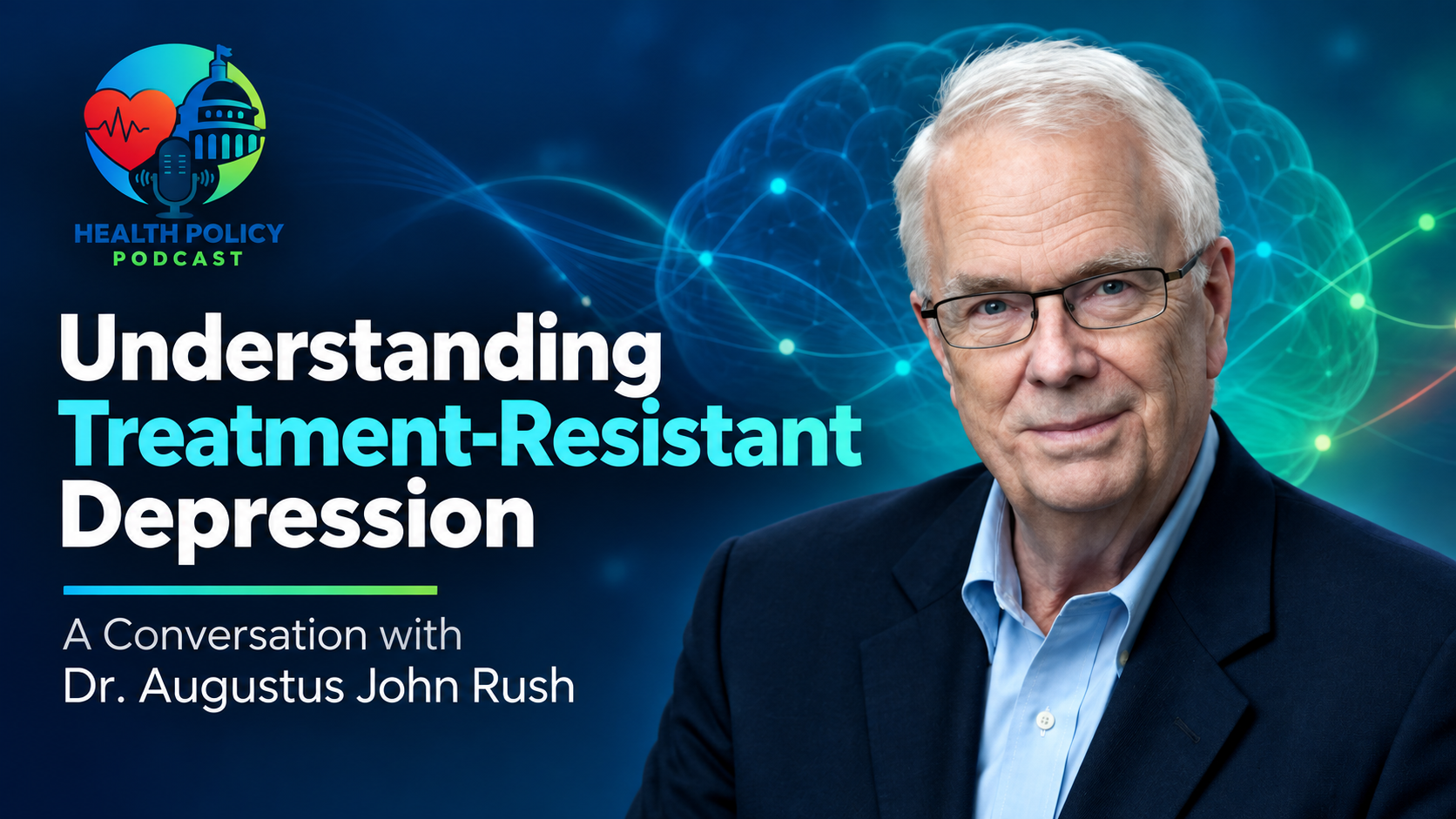
Health Policy Podcast episode featuring Dr. Augustus John Rush discussing Dr. Augustus John Rush on Advances in Treatment-Resistant Depression

In the latest episode of the Health Policy Podcast, Dr. Augustus John Rush, Professor Emeritus at the National University of Singapore, discusses advances in treatment-resistant depression (TRD). Dr. Rush shares insights from his extensive career, emphasizing the importance of accurate diagnosis, personalized treatment strategies, and the role of emerging therapies like transcranial magnetic stimulation and vagus nerve stimulation in managing TRD. He highlights the evolving understanding of neurotransmitter systems and the significance of patient-clinician relationships in improving treatment outcomes.

Dr. Augustus John Rush Discusses Advances in Treatment-Resistant Depression

0:00 / 0:00

Dr. Augustus John Rush Discusses Advances in Treatment-Resistant Depression

Dr. Augustus John Rush Discusses Advances in Treatment-Resistant Depression

In a recent episode of the Health Policy Podcast, Dr. Augustus John Rush, a Professor Emeritus at the National University of Singapore, shared insights on treatment-resistant depression (TRD). With over 50 years of experience in clinical psychiatry and research, Dr. Rush discussed the complexities of TRD, its impact on patients, and the evolving treatment landscape.

Dr. Rush began his career collaborating with Aaron Beck, a pioneer in cognitive therapy, which laid the foundation for his interest in depression. He emphasized the spectrum of depression, noting that it ranges from brief, manageable episodes to severe, chronic conditions that can be life-altering. "There's no the depression; there are the depressions," he stated, highlighting the diverse nature of the illness.

Differences Between TRD and Responsive Depression

Dr. Rush explained that TRD differs fundamentally from depression that responds to treatment. He noted that accurate diagnosis is crucial, as many patients initially misdiagnosed may have conditions like bipolar disorder or schizophrenia. He emphasized the importance of personalized treatment approaches, which may include adjusting medication doses or switching medications that could be contributing to depressive symptoms.

He remarked, "Some of these individuals require larger doses of our ordinary drugs because they have genetic differences in terms of how they metabolize things." The introduction of neuromodulation treatments, such as transcranial magnetic stimulation (TMS) and vagus nerve stimulation (VNS), has expanded the options available for TRD patients.

Evolving Understanding of TRD

The understanding of TRD has evolved significantly over the years. Dr. Rush noted that earlier discussions focused primarily on serotonin and norepinephrine neurotransmitter systems. Now, he explained, there is a broader recognition of various neurotransmitter systems and brain circuits involved in depression. This shift has led to a more integrated approach to treatment, combining biological and psychological factors.

Dr. Rush also mentioned the potential for biomarkers to improve treatment outcomes. Identifying specific biological markers could help clinicians better target therapies for individuals who have not responded to previous treatments. "It's the natural evolution of going from syndrome to disease," he said.

Clinical Approach to Treatment

When treating patients who are not responding to treatment, Dr. Rush follows a systematic approach. He first evaluates the accuracy of the diagnosis and the patient's adherence to medication. He also considers genetic factors and previous treatment responses. "Sometimes we have the right diagnosis on the right drug for the wrong duration at the wrong dose," he explained.

He highlighted the importance of psychotherapy, noting that many patients with TRD may not have had adequate therapeutic support. "Sometimes our patients really haven't had a good run at psychotherapy," he said, underscoring the value of evidence-based therapies.

The Role of the Clinician-Patient Relationship

Dr. Rush emphasized the significance of the clinician-patient relationship in improving treatment outcomes. He believes that trust is essential for patients to adhere to treatment plans. "The treatment doesn't work unless the patient takes it," he stated. He encourages open communication and provides his contact information to patients, fostering a sense of security and support.

Impact on Patients and Families

Dr. Rush shared that successful treatment of TRD can be transformative for patients and their families. He described cases where patients transitioned from unemployment to stable employment, highlighting the profound impact of effective treatment. However, he cautioned that the journey to recovery can be fraught with challenges, including the risk of relapse and the emotional toll of previous treatment failures.

"Treatment-resistant depression isn't just trouble getting well; it's trouble staying well," he noted. The more failed treatments a patient experiences, the less likely subsequent treatments are to succeed.

Encouragement for Those Feeling Hopeless

For individuals who feel they have exhausted all options, Dr. Rush offers a message of hope. He encourages persistence, reminding patients that even the most resistant forms of depression can improve over time. "Don't give up," he urged, emphasizing the advances in treatment options available today compared to previous decades.

He also advised patients to seek diverse treatment options and not to hesitate in consulting multiple providers. "It's still a trial and error approach," he acknowledged, underscoring the complexity of finding the right treatment.

Promising Advances in Treatment

Dr. Rush identified TMS and VNS as two significant advancements in the treatment of TRD. He noted that recent studies have shown promising results for VNS, indicating that it can provide sustained benefits for patients over extended periods. "When it works, it keeps on working 80% of the time out to 2 years," he reported.

As the field continues to evolve, Dr. Rush remains optimistic about the future of TRD treatment, emphasizing the importance of ongoing research and development in this critical area of mental health care.

Interview Q&A

Q&A: Dr. Augustus John Rush Discusses Advances in Treatment-Resistant Depression

Advances in Treatment-Resistant Depression: A Q&A with Dr. Augustus John Rush

Q: Can you tell us about your background and expertise in treatment-resistant depression?

A: I am a clinical psychiatrist with over 50 years of experience in clinical research. I began my career working with Aaron Beck, who developed cognitive therapy. My focus has been on depression, including treatment-resistant depression, exploring how medications, therapy, and brain modulation can help.

Q: What differentiates treatment-resistant depression from other forms of depression?

A: Treatment-resistant depression requires both diagnostic and therapeutic skills. Many patients may have been misdiagnosed, and some may require higher doses of medication due to genetic differences. Additionally, combinations of treatments may be necessary, and new neuromodulation treatments have expanded our options.

Q: How has the understanding of treatment-resistant depression evolved?

A: Our understanding has shifted from focusing solely on serotonin and norepinephrine to considering a variety of neurotransmitter systems and brain circuits. We are also moving toward identifying biomarkers that can help target treatments more effectively.

Q: What steps do you take when a patient is not responding to treatment?

A: I first reassess the diagnosis and ensure the patient is taking the medication at the correct dose. I consider their treatment history and family background. If necessary, I may extend the trial period for the medication and explore neuromodulation options.

Q: When should a clinician consider changing the treatment strategy?

A: If a patient has not responded to medication after a sufficient trial, I consider psychotherapy as an alternative. Evidence shows that psychotherapy can be effective for treatment-resistant depression, and it should not be overlooked.

Q: What role does the clinician-patient relationship play in treatment outcomes?

A: Trust is crucial. Patients need to believe that their treatment is in their best interest. Clear communication about treatment expectations and outcomes helps build this trust. I also encourage patients to reach out if they have concerns.

Q: Can you share insights on how treatment-resistant depression affects patients' lives?

A: Improving a patient's condition can be life-changing. Many patients experience significant improvements in their employment and relationships. However, treatment-resistant depression often leads to chronic issues that affect overall happiness and stability.

Q: What advice would you give to someone who feels they have run out of treatment options?

A: I would advise them not to give up. Even treatment-resistant depression can improve over time. There are also new treatment options available that did not exist in the past. It is important to seek providers who offer evidence-based treatments.

Q: What recent advances in treatment for treatment-resistant depression are most promising?

A: Two major advances are transcranial magnetic stimulation (TMS) and vagus nerve stimulation. Both have shown promising long-term results, with vagus nerve stimulation maintaining effectiveness over extended periods.

Q: How important is it to measure treatment outcomes?

A: Measuring outcomes is essential. It allows both the clinician and the patient to assess the effectiveness of the treatment and make necessary adjustments. I use simple scales to facilitate these conversations.

Q: What is the significance of understanding the heterogeneity of treatment-resistant depression?

A: Recognizing the diversity in how individuals respond to treatment is critical. This understanding can lead to more personalized treatment approaches and better outcomes for patients who have not responded to standard therapies.

Q: How do you view the future of treatment for treatment-resistant depression?

A: The future looks promising with ongoing research and development of new treatments. We are moving toward a more tailored approach that can better address the unique needs of each patient.

Key takeaways

  • There's no the depression, there are the depressions, in my view.
  • When I was running a depression clinic, one of the things we found is that a number of these individuals had not been properly diagnosed.
  • If you get one of these patients better, it is life-changing.
  • Depression itself, even very treatment-resistant depression, eventually will... get better.
  • Don't give up. Be tenacious and work the problem. It is a treatable problem more often than not.

About the guest

A. John Rush, M.D.

Dr. Augustus John Rush

Professor EmeritusNational University of Singapore

A. John Rush, MD is Professor Emeritus of the National University of Singapore. His research has focused on the development and testing of innovative treatments for mood disorders, including medications, medication combinations, somatic treatments, psychotherapy, and disease management protocols. As the author of over 800 peer-reviewed articles, book chapters, and books, his work has received international recognition with awards from many professional organizations, including the American Psychiatric Association, the American College of Psychiatrists, the American Psychopathological Association, the National Alliance for Research in Schizophrenia and Affective Disorders, and the Society for Biological Psychiatry. In 2014, Thomson Reuters recognized Dr. Rush as one of the “World’s Most Influential Scientific Minds.” He is also CEO of Curbstone Consultant LLC, which provides research consultation to commercial and academic organizations and career development mentoring to individual academicians.

Full transcript

Show full transcript
[00:00] Bryan Hyde: Welcome to the Health Policy Podcast. I'm Brian Hyde, and in a recent episode, we explored new research on treatment-resistant depression, or TRD, and what the data can tell us about its impact on patients as well as on the healthcare system. Today, we're joined by one of the world's leading experts on TRD to talk about what he's learned from decades of caring for these patients, as well as how the illness changes lives and where he sees hope. I want to welcome Dr. Augustus John Rush, internationally renowned psychiatrist and one of the world's leading experts on depression and treatment-resistant depression. [00:31] A. John Rush, MD: Thank you. [00:31] Bryan Hyde: resistant depression. Dr. Rush, welcome to the show. Would you— could you fill in a little bit for us too and just tell us a little bit about who you are and what you do? [00:40] A. John Rush, MD: Well, thank you, Ryan. Yeah, I'm basically a clinical psychiatrist that has done clinical research over the— gee, I don't want to say it— last 50 years. And I began with work with a guy named Aaron Beck who helped develop who created cognitive therapy, and I had a hand in helping him in testing some of it, not developing it. And then of course I got interested in medications. Depression became my game. I was so interested in the fact that medications, therapy, and even brain modulation like ECT can all work, different kinds of depression and so on. So I've been, as they say, I've been in depression a long time. And I think the The most important thing about the condition is it ranges from brief spells that are time-limited that may just require some readjustment in one's life, with or without some therapy, of course, all the way out to a devastating, recurrent, disabling, very difficult to treat, life-shortening condition. So it's a whole range. There's no the depression, there are the depressions, in my view. [01:51] Bryan Hyde: Now, given that you have spent so much of your career working and studying and treating treatment-resistant depression, I'm curious, what makes it fundamentally different from the depression that actually does respond to treatment? [02:04] A. John Rush, MD: Well, I think it calls on both our diagnostic and our therapeutic skills. And it calls on psychosocial as well as biological considerations. So what do I mean by that? When I was running a depression clinic, a specialty clinic at UT Southwestern, where we would see basically everyone who came in had treatment-resistant depression, they're referred by practitioners. One of the things we found is that a number of these individuals had not been properly diagnosed. They had bipolar disorder, they didn't have depression, they may have schizophrenia. Even people with diabetes, blood sugar of 500, You're fatigued and you are depressed, but not depression of the type we're talking about. So there's the diagnostic part of it, and then there's the therapeutic part of it. And some of these individuals require larger doses of our ordinary drugs because they have genetic differences in terms of how they metabolize things. Sometimes their depression is caused by a concomitant medication that's not recognized. Change that medication. It's not for psychiatry. Maybe it's an antihypertensive or something. Boom, the depression is gone. So there's the diagnostic, then there's the therapeutic personalization, especially low doses, especially high doses. And then you get into combinations. Certain combinations will work for individuals where an individual medication may give you a little bit of an effect, but that combination is a home run. And then of course with the development of our neuromodulation basically armamentarium now with TMS and VNS and so on and ketamine, we now have a whole panoply of new treatments that we can aim at these individuals. And they are in fact, I think, the bread and butter of psychiatry these days. The easy ones should have been treated well in primary care. And often are. And so we, we as psychiatrists live with these individuals every day. [04:15] Bryan Hyde: How has our understanding of TRD evolved over the course of your career? [04:21] A. John Rush, MD: Well, I think we've, we've recognized there are a whole range of neurotransmitter systems that we initially didn't talk about. In the old days, it was serotonin and norepinephrine. And the big debate, is it serotonin? Is it norepinephrine? Is it both? And blah, blah, blah. But now we're talking about, you know, the GABA system, NMDA system, all kinds of other neurotransmitters with other kinds of medications. And now we're also talking about circuits. We're thinking much more in terms of which parts of the brain are not working well, how are they— how can we get them to be better integrated? So are depressed patients too directly connected between their executive function and their limbic system, for example? And can we even train people to modify that connection. So it's a very interesting confluence of both biology and psychology and physiology. And finally, I think one of the great things that's in process, not yet there but really close, is so-called biomarkers. Again, this heterogeneity that I mentioned is quite dramatic. And when you get into People that have, let's say, failed 2 prior treatments, and now with the 3rd treatment, usually 15 or 20%, you might have a pretty good outcome. That means 80% not so good. And if you can somehow get rid of the 80%, or at least reduce the number of people for whom that treatment is very likely to fail, the actual effectiveness of the treatment goes up because you're now— selecting the target, selecting the patient. And I think the arrival of biomarkers, whether they're physiological or biochemical or psychological or historical or genetic, doesn't really matter. We're going to be able to target much, much as we do now with arthritis, for example. It's the natural evolution of going from syndrome to disease. [06:24] Bryan Hyde: So as a clinician, what goes through your mind when you recognize that a patient isn't Responding to treatment? [06:31] A. John Rush, MD: Well, it's the usual steps. First, how's the diagnosis? Are they actually taking the medication? Is the medication at the appropriate dose? Is it— then I think about their metabolism. Maybe genetic testing might be helpful. Maybe they're rapid metabolizers. I look at all the other medicines that they're taking. Of course, I look back at their treatment. Many of these people have had a prior treatment that worked well, but for some reason that wasn't reinstituted. That would be the first place to go if in fact it hasn't been retried. And then I look at their course of illness and their family history. Is there— do they have relatives with bipolar disorder, for example? That may be a little bit different depression and maybe would lead us to lithium augmentation more rapidly than otherwise. And of course, this whole range of medications. So we look at what has been tried and what has not been tried, and also the patient situation. These individuals can become depressed from being depressed, if you will, so discouraged, demoralized, they don't really think they're even getting better anymore, that they can't get better. They're obviously at risk for suicide, and they're also at risk for— I can prescribe something, they may not feel motivated to take it. So I do a little of the psychological evaluation as well. And then I literally start out with, let's see how bad your depression is. Let's see how your life function is. Let's give this particular treatment a trial for a period of time. And it does look like in the more resistant cases, Sometimes a 6-week trial is not enough. A 12-week might do just fine, but they may have never had more than a 4-week trial of any medication. We had an article some years ago from the STAR-D project. In the second step switch, we found that people were actually responding at 8 to 12 weeks out. So sometimes it's just slower. Sometimes we have the right diagnosis on the right drug for the wrong duration at the wrong dose. And then sometimes we have to decide, you know, drugs need to be sort of held where they are, but then add something else, some sort of neuromodulation story. [08:53] Bryan Hyde: So is there a point where the treatment strategy has to change rather than just simply trying, you know, a different medication? What are some of the factors that tell you it's time to take a different path? [09:04] A. John Rush, MD: I think at some point you have to consider other than medication. I would underline a little bit of psychotherapy. Sometimes our patients really haven't had a good run at psychotherapy. And there are trials that have shown in TRD psychotherapy actually works. So we have to consider that not as, oh, did you pass that threshold so I can give you a medication? But rather, did you have a really solid depression-focused psychotherapy, whether it's problem-solving, interpersonal, cognitive, some sort of evidence-based therapy? Have you really had a good shot at that? And that, you know, it's certainly not going to hurt and it may really help a lot. So that's important. And then you say, okay, with the patient, let's do something different. We've been at this for a while and we have other things up our sleeve. [09:59] Bryan Hyde: Tell me a little bit about— [10:01] A. John Rush, MD: So it's a clinical judgment, basically what I'm saying. Some people are more ready for it sooner than others. For example, depends on how chronically ill and how severely ill they are. [10:11] Bryan Hyde: What role does the clinician-patient relationship and the ongoing follow-up play in improving outcomes for these patients? [10:20] A. John Rush, MD: 2 major roles. Number one, the treatment doesn't work unless the patient takes it, and the patient won't take it unless they believe that what they're doing is going to be in their own interest. And that requires that they trust the doctor To make, you know, yet another suggestion. Now, in this case, in the context of already having had a lot of suggestions, is this guy blowing smoke or is there something real here? And I think the most important thing for managing these patients is to be very direct and very clear-cut, not to be vague, not to be sort of— not talk in ambiguous terms. So, for example, I would say to the patient, evidence shows in your kind of situation, the chance of you having a good outcome, meaning at least getting back to where life is tolerable, is 20%. I don't say 70% because it's not 70% when you're dealing with TRD. And we will know that. When will we know that? Somewhere between 4 weeks and 12 weeks if we're talking medication, or maybe a slightly different time period depending on neuromodulation, Maybe sooner, maybe later. Ketamine, you'll know sooner. And having that structure, I think, helps the patient, number one, trust you. You're not blowing smoke. You're being very specific. And secondly, it gives them something to look forward to. Second thing is I tell them, and I do this with all my patients, I give them my phone number, you call me. And the reason is these individuals are at risk for suicide. [11:55] Bryan Hyde: Right. [11:55] A. John Rush, MD: A phone call is a lot better way to deal with that than finding out in the newspaper or finding the patient doesn't show up in the next visit. And it's very rare that the patients call, but they're very respectful of that. But it's very reassuring to me also because I'm— if I'm reducing a medication in order to increase another medication, for example, or I'm adding on neuromodulation, they've never had it before. That's really kind of an experiment for that individual. Not that we don't know what we're doing, but for that individual, it's unique and it's anxiety-provoking. So I think creating that sense of trust and a transaction that is transparent. And then I also, I personally always measure outcome. And I think by some sort of scale, it doesn't matter what the scale is, including just a— I like a penny-to-dollar rating scale. Penny's the worst you ever felt, dollar's the best. What are you worth today? And it's as good as a Hamilton rating scale, basically. It's been studied already. So it makes it very easy to have a conversation so the patient can tell you, this is not working, and not feeling that they're disappointing you or they can't say that. I want to know if I have a failing treatment as well as a successful treatment. So I make that very clear to the patient. [13:17] Bryan Hyde: I can only imagine how tough it must be for a patient, you know, living with treatment-resistant depression. Do you have any patient experiences or lessons that have stuck with you throughout your career, particularly as to how this has impacted families, careers, daily life? [13:35] A. John Rush, MD: Oh, if you get one of these patients better, it is life-changing. And I, you know, there are many, thank goodness, stories I can tell you about that, but going from unemployed to employed, that is gigantic. And sometimes that is in fact the result when you finally get the right treatment. I think that is most important. Also, of course, depression chronically grinds away at occupational happiness and success and interpersonal happiness and success. So By the time you have treatment-resistant depression, your job is already a little tenuous and your marriage or your relationship has been equally stressed out. And you have secondary problems from anxiety to overuse of substances, not necessarily dependence, but excessive inappropriate use of substances that interfere with the treatment itself. And seeing an individual who can get on top of this and say to you after 6 or 8 months, boy, I am close to back to where I thought I would never be. That is very moving. I'm not saying we hit a home run in every case. I want to be clear about that. But it's always worth going after these problems with a kind of like a whole new start because the patient has already as I mentioned, been discouraged and demoralized by repeated attempts at getting better that haven't worked or haven't lasted. That's the other thing that's maybe worth mentioning is treatment-resistant depression isn't just trouble getting well, it's trouble staying well. And it's at least half the battle, maybe more. In other words, the more treatments a person has had that has not worked, the less well the next treatment is going to work initially. But even more problematic is if you finally get it, you may not keep it. And the more prior failed trials you run into, the more likely you are, at least with medication treatment, to have a subsequent relapse sooner rather than later. So there's a great tendency in patients to not trust getting better because that's happened to them before and they kind of know it might not last. The key is to not declare victory and then run away, but stay with the patient over time. And if other things need to be done, you know, plug them in and do it. [16:12] Bryan Hyde: Dr. Rush, what message would you have for someone who feels like they've run out of options? [16:17] A. John Rush, MD: I would say, number one, don't give up. Why do I say that? Depression itself, even very treatment-resistant depression, Eventually will, at 5% a year or a small percentage, 2% a year, they will get better. So there's always a chance you're going to get better with no doctors, no nothing. Secondly, because we've had such an influx of, I would say, very substantial improvements in our treatment armamentarium from not just neuromodulation, but also new medications that work more rapidly, that can be targeted to suicide and so on and so forth. It's not the same as even 5 years ago and certainly not the same as 40 years ago. So there is that to look forward to. So I would say do not give up. And secondly, realize that doctors recommend what they do. That makes sense. So if you see a primary care doctor, you're not going to get neuromodulation. You see a TMS doctor, you're not going to get psychotherapy. You see a psychotherapy doctor, you're not going to get medication typically. It is just the way our healthcare system is. So it's kind of like taking your car that doesn't work and you go to the muffler shop and it doesn't fix it. Then you go to the, you know, whatever, the radiator shop, that doesn't fix it. You keep going. Go to something that makes sense, has evidence, FDA approval, for example, And don't give up because it is really true we're not very good at picking which treatment is best for which patient. It is still a trial and error, trial and error kind of approach. We don't want to use more extensive, expensive treatments if we can obviously get away with the less expensive if they're effective. But if they're not effective, you don't get better or you don't stay better, that's when you should start shopping. And there's all kinds of ways to shop that people do now on the internet, from ChatGPT to their best friends to whatever. But I would look across providers and settings. Don't give up. Don't assume that person in front of you has all the answers. I don't. No one does. It's very hard to keep up in one field, forget multiple fields. So I would say don't give up. Be tenacious. and work the problem. It is a treatable problem more often than not. [18:51] Bryan Hyde: One final question, Doctor, and that is, what advances in the treatment of TRD are you finding most encouraging? [18:57] A. John Rush, MD: I think the 2 major advances are TMS and the way it is now being delivered more efficiently with greater targeting, less inconvenience to the patient, And the other is vagus nerve stimulation. It's now undergone a number of publications in the large RECOVER, or RECOVER trial. I think the most important message from that trial is that is a treatment that looks like it, when it works, which is slow, it's an adjunctive treatment to medication, it keeps on working 80% of the time out to 2 years. And we now have data not yet published that shows it out to 3 years. And that means that these individuals with a very gradual onset of benefit to the point where at the end of 2 years we're still recruiting people into the winner box, meaning response or remission. And at the 3rd year you're still looking at 80% retention of that. So it's a slow onset treatment, But it's pretty darn stable when you get it. And that, I think that's a big advantage as well. And as you know, vagus nerve stimulation is being used in other conditions in addition to epilepsy and others. So I think the vagus nerve and transcranial magnetic stimulation are the 2 big ones. I think you're going to see a few more in the medication domain coming out shortly. [20:28] Bryan Hyde: Again, we have been visiting with internationally renowned psychiatrist and one of the world's leading experts on depression, and treatment-resistant depression, Dr. Augustus John Rush. And Dr. Rush, thank you once again for joining us here on the Health Policy Podcast. [20:42] A. John Rush, MD: Thank you, Brian.

Filed under