Show full transcriptHide transcript
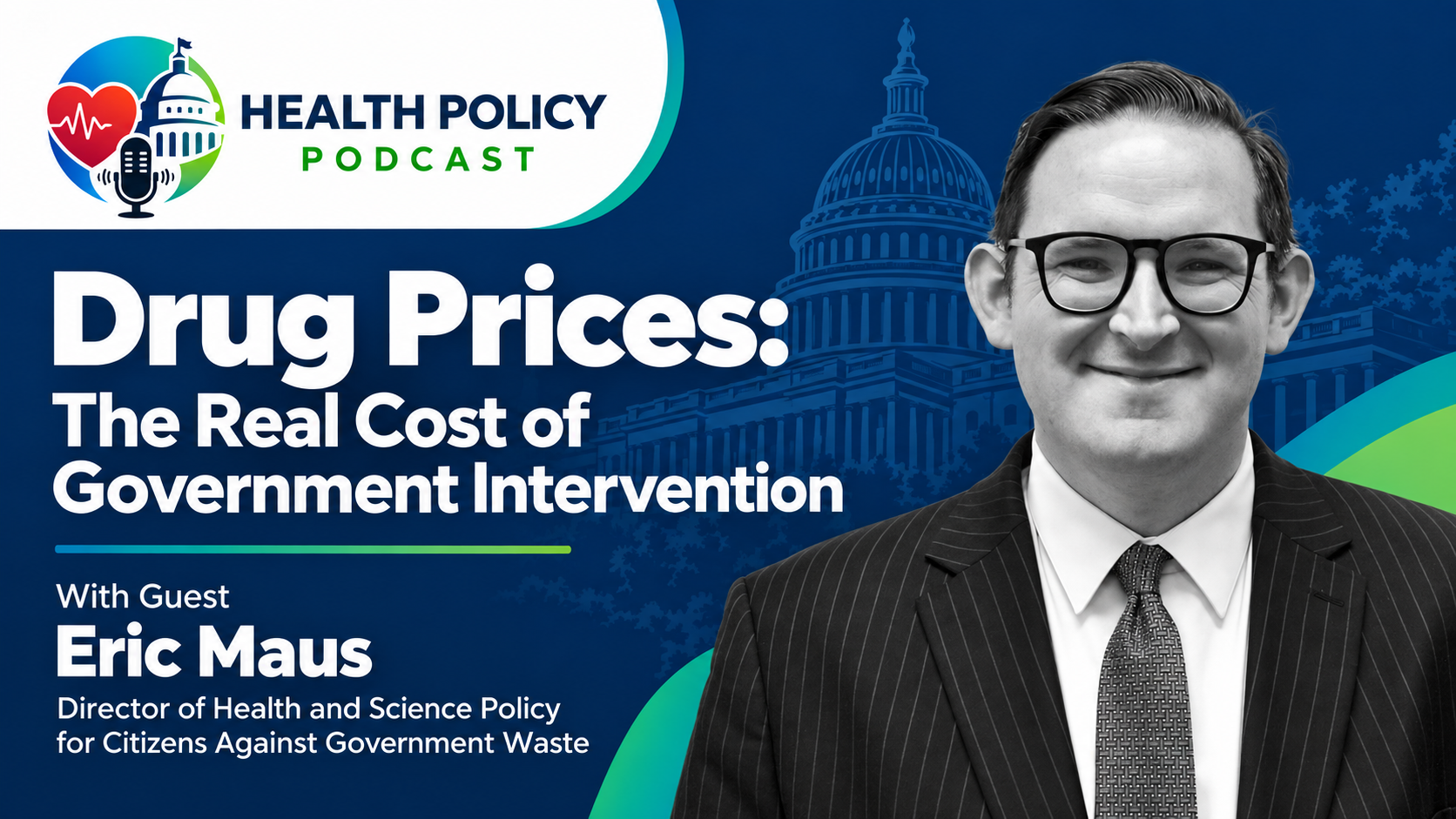
[00:00] Bryan Hyde: Welcome to the Health Policy Podcast. I'm Brian Hyde, and today I'm talking with Eric Moss, who is the Director of Health and Science Policy at Citizens Against Government Waste. Eric, I want to welcome you to the show and ask you if you wouldn't mind taking just a moment to tell us a little bit about your background, about who you are and what you do.
[00:18] Eric Maus: Yeah, first, thank you for having me on. My name is Eric Moss. I'm the Director of Health and Science Policy for Citizens Against Government Waste. We're a taxpayer advocacy group. We were founded in 1984 by businessman J. Peter Grace and columnist Jack Anderson. And J. Peter Grace served on, during the Reagan administration, the president's private sector survey on cost control, which looked at inefficiencies and waste in the government, sort of like a previous version of the DOJ. in the Trump administration. And then they founded CAGW after that commission went out of operation to carry out the recommendations from their report.
[01:09] Bryan Hyde: And today we have you on the program to talk a little bit about something that I know a lot of people can relate to, and that is the price of drugs and prescriptions and legislation. There's, there's actually a lot going on here. Let's, let's first set the stage. When it comes to the amount of money spent on prescription drugs in America, how, how big are the numbers that we're talking on a yearly basis, whether it's from private, you know, right out of our own pockets or taxpayer money being spent to help people access those medications?
[01:38] Eric Maus: Yeah, I mean, I would imagine— I don't have an exact figure on that, but I'd imagine it's probably hundreds of billions or trillions of dollars, including private insurance and Medicare and Medicaid. So it's a very large issue and it's an issue that's top of mind for a lot of people. You know, prices are kind of a main concern for people across the board, but especially in healthcare and with prescription drugs.
[02:04] Bryan Hyde: I mean, even if we just look at the 340B program, which was supposed to help make, you know, a number of those medications, you know, more affordable for patients in need, we're talking hundreds of billions, right?
[02:20] Eric Maus: Yeah, so the Health Resources and Services Administration, which administers the program, they released their data from 2025. And for the first time in the program's history, it exceeded $100 billion in purchases. And this program was started in 1992, and it was really meant to help a very narrow set of people get affordable drugs. It was meant to help federally funded clinics that serve a lot of uninsured patients. So manufacturers give them discounted drugs, which the hospitals then pass on to their patients. But Congress didn't define who is an eligible patient when the law was created. So there's been really a loose interpretation and a lack of oversight on the program. And so it's grown exponentially through the decades, and especially since 2010. Wow.
[03:15] Bryan Hyde: And, you know, that's— this is just one aspect of the drug issue. And again, the federal government's involvement. Talk to me a little bit about Medicare Part D. I understand that there's a fair amount of money passes through that program as well.
[03:28] Eric Maus: Yeah, yeah, that's another large program. And one thing of particular note was in 2022, in the Inflation Reduction Act, there were provisions in there that let— essentially, the government gets to set prices on select drugs. And if manufacturers Refuse to accept those price controls or don't participate, they get hit with a massive excise tax. And at the time that the law was signed, the Congressional Budget Office estimated it would save $129 billion from 2022 to 2031. But now, thanks to the diligent oversight of some House committee chairman, we now know that. That is going to cost $700 billion. And again, at the time the law was signed, the CBO claimed that spending on drugs would go from $3,200 a month to $2,300. But instead, since it's been signed into law, prices have raised from $3,200 to $3,500 per month. Wow.
[04:40] Bryan Hyde: Talk about going the opposite direction. I mean, yeah, you know, they estimate $129 billion in savings from 2022 to 2031. But if I understand you correctly, what has already been spent is $700 billion. I mean, that's, that's not even extrapolating out to 2031, correct?
[04:58] Eric Maus: Uh, yes, that's right. So, uh, the Correctional Budget Office sent a letter in response to a request by these committee chairmen, including Jason Smith of the Ways and Means Committee, uh, Brett Guthrie of the Energy and Commerce Committee, and Jody Arrington of the Budget Committee. Just asking for an updated estimate so far. And yeah, again, they found that those provisions have cost $700 billion.
[05:26] Bryan Hyde: Okay, so I have to ask you this, Eric. Is there any shame on the part of those who sold this measure as, well, you know, this doesn't seem to be working? Or do they have anything to say about it? Or is it just, you know, hum a tune and Keep on walking.
[05:44] Eric Maus: Well, they seem to do a lot of keep on walking. You know, I said a couple of minutes ago that drug prices are really a top concern for really most Americans. So I think, you know, the lawmakers who supported this bill, they can kind of claim that they did something to lower drug prices, even if the reality doesn't match that. So I think they're, they're happy to kind of claim the victory, even if reality doesn't match up with it.
[06:13] Bryan Hyde: But the bottom line is, according to the numbers you just gave, instead of reducing the spending on drugs from $3,200 monthly to $2,300 monthly, it now is $3,500 per month. So it's actually raised the cost for seniors.
[06:29] Eric Maus: Yeah, exactly. And that's not overly surprising. Throughout history, price controls, especially on medication, have been found to increase prices and limit access to these medicines. So, you know, that's a lesson that I wish more members of Congress and the government learned at the time. But, you know, history dictates that we maybe should have seen this coming and that these price controls don't work and actually raise costs for patients.
[07:01] Bryan Hyde: So who pushes for those price controls? I'm curious, does that originate from legislators themselves, from the lawmakers, or— I'm trying to imagine, you know, someone in pharmaceutical industry, uh, you know, pushing for that, and that just doesn't seem to make sense.
[07:17] Eric Maus: Yeah, that's right. It's a lot of lawmakers who push for it, and really from both parties, uh, Republicans and Democrats. It's mostly Democrats, but some Republicans as well. Uh, you see some of that now with them pushing for most favored nation policies. Uh, but yeah, it's kind of a populist message. You know, people are fed up and concerned about the cost of healthcare. And it seems like an easy solution. So I think there was kind of a popular call for it. And again, mostly lawmakers actually implemented it.
[07:53] Bryan Hyde: This is going to seem like kind of a strange question, but you seem like the perfect guy to ask this to. The drug manufacturers, the pharmaceutical companies, would they prefer less government intervention in, in, you know, drug pricing? Would they prefer basically the, the free market working, you know, its, its ability to find that balance? Or does this benefit them in some way?
[08:17] Eric Maus: I think it's safe to say that they would prefer a more free market approach. You know, drug research and development is a very costly and kind of a long-shot business. It costs a lot of money to develop a drug, and there is no guarantee that the drug will be viable and commercially successful. So, you know, these companies invest a lot in research and development and manufacturing. So I think we've seen that when the government takes a more free market and hands-off approach, that these innovations really succeed. And, you know, the European Union, for example, took the opposite approach where their government is very involved and they're place as a leader in developing these drugs has really diminished and the US has taken over. So that's why it's important for the US government lawmakers to keep up with the free market approach.
[09:10] Bryan Hyde: Are there any lawmakers in Congress right now that are working to roll back some of this— I'm going to call it interventionism, you know, in the market? And if so, who would that be?
[09:24] Eric Maus: Yeah, I think there's a number of lawmakers who are still touting this free market approach, thankfully. A lot of elected Republicans in the House and the Senate are really advocating for this. Again, a more market-friendly, hands-off approach from the government.
[09:41] Bryan Hyde: Well, definitely something to keep an eye on. Now, I was curious too about— I see an article here from you on the Citizens Against Government Waste website about new legislation introduced earlier this month. that would modernize prescribing information. Set the stage for me, Eric. What, what was the, the purpose behind this legislation being introduced? What prompted it?
[10:06] Eric Maus: Yeah, so to kind of set the table and provide context, you have to go back to the 1960s, to 1962, when the FDA issued a regulation that drug manufacturers had to send information For doctors. So this is just information for pharmacists and doctors. It's not for patients. But these companies develop a drug and they study, you know, side effects with it and, you know, certain scenarios when or when not to prescribe it. And so this regulation required that they send this information to pharmacies and healthcare providers. And obviously it's the 1960s, so it was done on paper. I think with modern technology, you know, like Zoom, which we're using today, that this practice would keep up with the times. But unfortunately, we're still operating under that kind of outdated approach, and this information is still sent on paper. And the whole process of formatting and printing and shipping it is very time intensive and it's really bad for the environment. This information is on average 30 to 45 pages long, and the whole process takes about 8 to 12 months on average. So it's timely, it's cost-consuming, it's wasteful. And, you know, the companies are constantly studying the effects of their drugs. So this information also— so this information often needs to be updated and the process repeated over and over. And yeah, so, so thankfully, there is some good news on this front. Just earlier this month, like you said, Senators Cory Booker from New Jersey and Jim Banks from Indiana introduced a bill that would finally modernize this process and allow these companies to send it electronically instead of on paper.
[12:03] Bryan Hyde: Let's talk a little bit about that bill. First of all, what's the name of the bill?
[12:07] Eric Maus: Yeah, it is S.5242, the Prescription Information Modernization Act of 2026. And I think it's important to note a previous version of this bill was introduced in the last Congress by Cory Booker, who has been on this issue for a long time, and then-Senator Markwayne Boland.
[12:26] Bryan Hyde: All right. And what does the bill seek to do? How does it address this problem that you had just described for us?
[12:35] Eric Maus: Yeah. So essentially, kind of takes the regulation from 1962 off the books and it allows these companies to send this information electronically. So doctors and pharmacists will have this information much sooner. It'll be much more up to date. It does allow those healthcare providers, if they want, to still receive it on paper. But I don't think many people will be going for that option because this information is accessible instantly now online. So It really just, it modernizes the whole process and will cut down on the waste and cost of it.
[13:14] Bryan Hyde: I'm a little bit shocked at just how often they have to, the FDA has to, you know, report these changes to drug labeling. I mean, it's, I think you break it down in the article, you know, it went from 747 changes reported by the FDA in 2010 to, you know, 1,257 In 2012. And I assume that number continues to grow with each passing year.
[13:39] Eric Maus: Yeah, yeah. I think history indicates that it keeps getting larger and larger. And again, the process just is redundant and really unnecessary the way that we do it.
[13:52] Bryan Hyde: What has held up this kind of reform? Is it just that the system was working okay as it was, and finally, you know, Senators Booker and Banks, you know, decided to step up and do something? Or was there something else that kind of, you know, forced some action?
[14:11] Eric Maus: Yeah, I'm not sure the original intent, but the FDA has attempted to modernize this rule in the past. They tried in 2014, but that year, Congress inserted a provision in one of their appropriations bills that would keep the regulation in place. And then that has just been kind of renewed each year that Congress passes their appropriations bill.
[14:36] Bryan Hyde: Is there a downside to, you know, delivering that information electronically versus, you know, the written changes on paper?
[14:46] Eric Maus: I mean, none that I can think of. You know, it seems like common sense. And, you know, clearly Cory Booker and Jim Banks, I don't know, you know, they're on opposite sides of the aisle. So it's a very clear kind of common sense bipartisan proposal. And I really don't see much downside with doing it electronically.
[15:06] Bryan Hyde: Well, I guess for that matter then, is there opposition to this? I know it's pretty early. If the bill was just introduced earlier this month, you know, it takes time to work its way through the legislative process. But has anybody stepped up to push back on it?
[15:20] Eric Maus: Not that I've seen. But like you said, it's still early in the process. So, you know, it's possible that as the bill moves through Congress, the remainder of the year that there will be some opposition to it. But I have not seen any so far.
[15:36] Bryan Hyde: And I guess this is, this is the taxpayer in me that wants to know this too. You had mentioned, you know, that there's, there's a lot of waste in terms of, you know, the amount of paper, the many pages that this information can take up when it's printed. Would this be a cost-cutting measure? I mean, would it save significant amounts of, of money and resources by doing it electronically as opposed to You know, the analog version on paper?
[16:01] Eric Maus: Uh, well, modernizing this process would certainly save, uh, the pharmaceutical manufacturers lots of money and time. Uh, I'm not sure what the taxpayer impact or savings would be from it, uh, but, you know, it's kind of an example of Washington just being stuck in the past. And, you know, I think it's, it's finally time that we joined the, the 21st century.
[16:28] Bryan Hyde: Right. And as nice as it is as taxpayers, you know, to know that our money isn't being squandered or wasted, really, it sounds like the driving purpose here, though, is to make sure that these healthcare providers and pharmacists have access to the very latest prescribing information and don't have, you know, outdated information, you know, with whatever's on their shelves.
[16:50] Eric Maus: Yeah, exactly. And, you know, another facet of this is a lot of this information is available online. So, pharmacists and healthcare providers know the information by the time that they get it on paper, and they basically immediately toss it in the trash can. So thankfully, they're up to date, you know, on the latest prescribing information. But that kind of shows how unnecessary and redundant the process and this regulation are.
[17:18] Bryan Hyde: Let's direct people to your website. You have actually a number of articles on this topic and on, you know, prescription drug policy at the federal level. Tell me a little bit about Citizens Against Government Waste and where can people find the website?
[17:36] Eric Maus: Yeah. So you can find our work on healthcare as well as a lot of other issues, including defense and tax and tech and telecom on our website. It's CAGW.org.
[17:49] Bryan Hyde: And Eric, is there anything that you would like our listeners to have as a takeaway from this conversation regarding whether it's the, you know, modernizing the prescribing information or the 340B program, or just the way the Inflation Reduction Act raised costs? What would you like people to take away from the discussion you and I are having right now?
[18:12] Eric Maus: Yeah, I think the through line that I've noticed when writing these articles and preparing for this interview is that Washington and lawmakers tend to deliver big and the results don't match it and don't deliver. And there's a lot of waste and just unnecessary provisions in the process. So I think when you see stuff coming out of Washington claiming to solve X, Y, or Z problem, oftentimes the reality doesn't match up.
[18:44] Bryan Hyde: Well, and we have— we talked a little bit about the free market. You know, this is one of the things when you're insulated from the effects of the market, you don't have that accountability. People can't really take their business elsewhere. So hopefully Hopefully, we can get more of the free market involvement here and less of the managed intervention on the part of the government. And when bad policy shows that it's bad, then necessary changes can be made.
[19:13] Eric Maus: Yeah, yeah, absolutely. And I think it's important to remember that while these issues may seem kind of abstract or in the weeds, it affects everybody who's a taxpayer because it's our money that the government is wasting. So it's a very personal issue for Really every American. Yep.
[19:30] Bryan Hyde: If you're not, if you're not, you know, for instance, on a number of monthly medications, just wait. With age, the opportunity seems to come. And, and there's a lot of people feeling that pinch. Again, we are talking with Eric Moss. He is the director of health and science policy for Citizens Against Government Waste. And Eric, I appreciate you joining us today here on the Health Policy Podcast.
[19:49] Eric Maus: Of course. Of course. Thank you for having me.