· The Health Policy Podcast
Health Policy Podcast logo

Receive new episodes in your inbox.

← Health Policy Podcast

2026-11-03 · Empower Patients Initiative

Empowering Patients: Dr. Deane Waldman on Reclaiming Healthcare Control

with Deane Waldman, Chairman of the Board — Empower Patients Initiative
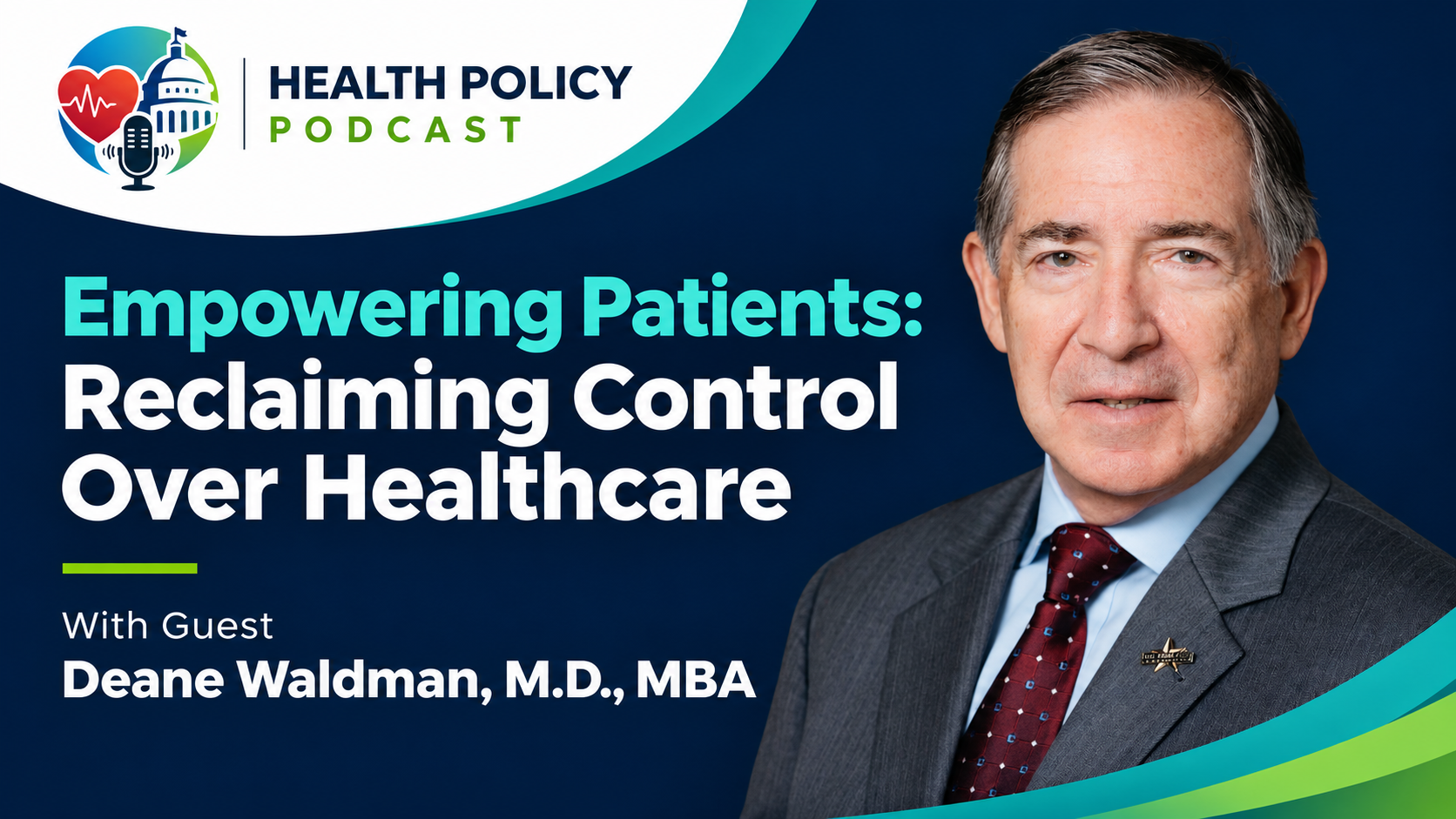
Health Policy Podcast episode featuring Deane Waldman discussing Empowering Patients: Dr. Deane Waldman on Reclaiming Healthcare Control

In the latest episode of the Health Policy Podcast, host Bryan Hyde interviews Dr. Deane Waldman, Chairman of the Board at Empower Patients Initiative. Waldman discusses the loss of patient control over healthcare spending, the challenges faced by healthcare providers, and the implications of government programs like Medicaid and Medicare. He advocates for empowering patients to manage their healthcare dollars directly to improve service and reduce costs.

Empowering Patients: Reclaiming Control Over Healthcare

0:00 / 0:00

Empowering Patients: Reclaiming Control Over Healthcare

Empowering Patients: Reclaiming Control Over Healthcare

In a recent episode of the Health Policy Podcast, Dr. Deane Waldman, Chairman of the Board at the Empower Patients Initiative, discussed the challenges patients face in controlling healthcare spending. Waldman, a former pediatric cardiologist and healthcare policy expert, emphasized the historical and systemic factors that have led to a loss of patient autonomy in the healthcare system.

Waldman explained that the shift away from patient control began with the introduction of prepayment systems in the 1930s. He noted that these systems, designed to provide financial stability during the Great Depression, evolved into employer-sponsored health insurance after World War II. This change effectively removed patients from direct control over their healthcare dollars. “The average American worker last year had $27,000 of their wages go to an insurance company,” he said.

He argued that this structure has created a disconnect between patients and their healthcare spending. “Consumers whose money is being spent on their behalf don’t control that money,” Waldman said. He proposed a radical solution: repealing employer-sponsored health benefits and allowing patients to manage their own healthcare expenditures. “Let them decide how to spend their healthcare dollars, and they will control their spending,” he added.

Waldman also addressed the impact of this system on healthcare providers. He noted that many skilled doctors are leaving the profession due to frustrations with bureaucratic constraints and reduced autonomy. “The dominant reason is what I call the psychic reward,” he explained. “When the government or insurance companies dictate treatment options, it takes away that positive connection with the patient.”

The conversation shifted to government programs like Medicaid and Medicare. Waldman criticized the expansion of Medicaid since its inception, stating that it was originally intended for a small percentage of the population. “Last year, 24% of our entire nation is on government support,” he said, arguing that many recipients do not meet the original criteria for assistance.

He emphasized the need for state control over Medicaid, citing Section 1801 of the original Medicaid law, which prohibits federal interference in state programs. “The state should do that,” he said, referring to the need for tailored healthcare solutions based on local demographics and resources.

Waldman expressed concern over the rising costs associated with the Affordable Care Act (ACA), stating that a significant portion of the funds allocated to the ACA went to administrative costs rather than direct patient care. “Last year, the United States spent just over $5 trillion on our healthcare system. Less than half provided any medical care,” he noted.

He advocated for a shift in the healthcare payment model, suggesting that the patient should be the single payer in the system. “I believe in single payer. The single payer should be the patient,” he stated. This approach, he argued, would eliminate many inefficiencies and reduce fraud in the system.

Waldman highlighted the potential for improved patient care if individuals had direct control over their healthcare funds. He cited a case in Minnesota where fraudulent activities led to a halt in Medicaid funding, impacting legitimate providers and their patients. “What if the patient had control?” he asked, emphasizing that direct patient involvement could prevent such issues.

For those interested in exploring these topics further, Waldman recommended his book, Become an Empowered Patient, which is also available in Spanish. He encouraged individuals to engage in discussions about healthcare and to educate themselves on the myths surrounding the system.

Dr. Dean Waldman’s insights shed light on the complexities of the healthcare system and the need for a paradigm shift that prioritizes patient empowerment and autonomy.

Interview Q&A

Q&A: Empowering Patients: Reclaiming Control Over Healthcare

Empowering Patients: Reclaiming Control Over Healthcare

Q: Can you tell us a little about your background and what you do?

A: I was a pediatric cardiologist for 40 years. I loved working with kids and had many successful outcomes. However, I was frustrated by the healthcare system that made it difficult for doctors to provide care. This led me to pursue an MBA at age 55 to better understand the system, but I still couldn't make it patient-focused.

Q: How have consumers lost control over healthcare spending?

A: Consumers have lost control due to a prepayment system that began during the Great Depression. This system, combined with employer-sponsored insurance, means that employers take wages and send them to insurance companies, removing control from patients. The solution is to repeal employer-sponsored health benefits and allow patients to decide how to spend their healthcare dollars.

Q: How is this situation affecting doctors? Why are some leaving the profession?

A: The primary reason is the loss of psychic reward. Doctors entered the field to help people, but government and insurance regulations often devalue their work and limit their ability to provide the best care. The regulatory burden adds to the frustration, making it difficult to focus on patient care.

Q: What is your perspective on the future of Medicaid and Medicare?

A: Medicaid was originally intended for the medically vulnerable, but now 24% of the population is on government support, many of whom are not medically needy. The original law allowed states to manage their programs without federal interference, which is crucial for tailoring healthcare to local needs.

Q: How does the Affordable Care Act fit into this discussion?

A: The Affordable Care Act has led to significant government spending on infrastructure rather than direct medical care. It has created price controls that do not benefit patients. I believe the single payer should be the patient, not the government.

Q: What are the financial implications of the current healthcare system?

A: The U.S. spent over $5 trillion on healthcare last year, but less than half of that went to actual medical care. Much of the spending goes to bureaucracy and compliance, which detracts from patient care and increases costs.

Q: What are your thoughts on healthcare fraud and its impact on services?

A: Fraud in programs like Medicaid can lead to significant losses, affecting the services available to those who genuinely need them. If patients controlled their healthcare dollars, there would be less opportunity for fraud.

Q: Where can people learn more about empowering themselves as patients?

A: People can visit our website, empowerpatients.info, and read my book, "Become an Empowered Patient," which is also available in Spanish. The goal is to encourage individuals to take control of their healthcare decisions.

Q: What is the key message you want to convey about healthcare?

A: Patients need to reclaim control over their healthcare spending and decisions. The government and third parties are not going to do it for them; they must take action themselves.

Q: How can individuals engage in discussions about healthcare issues?

A: I encourage people to talk to each other about healthcare myths and realities. Engaging in these discussions is vital for understanding and addressing the issues within the healthcare system.

Q: What is the significance of patient empowerment in the healthcare system?

A: Empowering patients can lead to better healthcare outcomes, more efficient spending, and a more responsive healthcare system. When patients have control, they can make informed choices that benefit their health and well-being.

Key takeaways

  • “Consumers whose money is being spent on their behalf don't control that money that is being spent.”
  • “The average American worker last year, 84 million Americans, had $27,000 of their wages went to an insurance company.”
  • “The reason we all, most of us, went into medicine was for what Maslow called the highest of human needs, which is self-actualization.”
  • “I believe in single payer. The single payer should be the patient.”
  • “What if the patient actually had control... there'd be no third party to steal it.”

About the guest

Deane Waldman

Chairman of the Board — Empower Patients Initiative

Full transcript

Show full transcript
[00:00] Bryan Hyde: Welcome to the Health Policy Podcast. I'm Brian Hyde, and today I'm joined by Dr. Dean Waldman, Professor Emeritus of Pediatrics, Pathology, and Decision Science, also former director of the Center for Healthcare Policy at Texas Public Policy Foundation. He has— he's been the founding director of the New Mexico Health Insurance Exchange and is the author of the award-winning book, Become an Empowered Patient. And that sounds like a very rich history, Dr. Dean. Welcome to the program. Would you mind taking just a moment to tell us a little bit about who you are, as well as what you do? [00:32] Dr. Deane Waldman: Sure. I was, for a long time, a very, in one sense, happy and very other sense, unhappy pediatric cardiologist for 40 years. I loved kids. They seemed to like me. We did really marvelous things taking care of babies with holes in their hearts or blood vessels that were blocked and things of that nature. And so the work was wonderful and successful the vast majority of the time. So in that sense, I was a very happy doctor. I was a very unhappy doctor because all the time I had to fight the system that you would think— you work for a company, that's your employer. You would think that your employer would help you do your job because that's why you're employed. Well, The system made it hard for us doctors, nurses, medical, mental health therapists, whatever. It makes it hard for us to actually do what we're supposed to do. And so that was very frustrating to me, which is what eventually drove me to get my MBA at the age of 55, believe it or not. Thinking, okay, well, it's my problem. I don't know how to use the system, so I will get the management tools and financial understanding and so forth. Well, I did that, and it's still—I still couldn't make the system patient-focused. So then I began studying the patient—the the system—and here's the key: I began to look at the system. Just the way I looked at a patient, which is well, I'm not going to just treat the symptoms. The the patient's got a headache or the patient's got a stomach diarrhea, whatever. Why? What's the cause of the patient's illness? So I said to myself, okay, why is healthcare not working for the patients and not working? For the doctors, the nurses, those of us who are supposed to provide care. That's my very long story to show you how I came to be where I am now. [02:54] Bryan Hyde: And we have you on this program today, the Health Policy Podcast, to talk about healthcare cost and healthcare spending. And I guess I wanna start with the question is, how have consumers lost control over healthcare spending? [03:09] Dr. Deane Waldman: That's— thank you for actually going right to the key question. Why is it that consumers whose money is being spent on their behalf don't control that money that is being spent? Because it's their money. All right. The answer is 2 things. One, it started with a prepayment system, which, believe it or not, actually started here in Texas. in Dallas, Texas with a well-meaning, right at the, well, Great Depression. Long story I won't bore you with, but the bottom line was prepayment and a third-party structure started here. When you add, and here's the key, when you add the Second World War, Second World War, we declared war. December 7th, well, right after December 7th. In January and February of 1942, they declared the government, quite rightly so, wartime economy. They created wage and price freezes so that they could control the economy and make the whole industrial system work as efficiently as possible, giving up our freedoms Okay, consumer freedoms, namely control of our own money. Okay, fine. That was necessary during wartime. At the end of the war, all those wage and price freezes were repealed except one. The one that remained was the ability of an employer, tax-free, to pay for your insurance. Now, the thing is, that's your wages that the employer is taking and giving to the insurance company. So now fast forward to 2026. The average American worker last year, 84 million Americans, had $27,000 of their wages went to an insurance company. So that's a very long-winded answer to say to your question, how did we lose control when the employers have the advantage of taking our wages before we get 'em and sending 'em to insurance company and let the insurance company say, oh, well, we're gonna spend it on your behalf. Right. So, okay, our simple solution, first major solution, repeal the employer-sponsored— a nice misnomer— employer-sponsored health benefit and give those wages, last year $26,993 average, to 84 million Americans and let them decide how to spend their healthcare dollars and they will control their spending. And watch what happens to prices. Watch what happens to service in terms of, instead of 4 months when the patient is paying the doctor directly, you're not gonna wait 4 months for your appointment. It's gonna be next day or the day after. Why? 'Cause if the doctor doesn't deliver that service, you ain't going to him. Or her. [06:43] Bryan Hyde: And actually, this, this raises another question, and that is, you know, look, obviously that's a lot of money coming out of the patient's pocket, but how is this affecting doctors? Why are the best doctors stepping away from medicine? [06:55] Dr. Deane Waldman: Okay, 2 reasons, but the dominant reason is what I call the psychic reward. The reason we all, most of us, went into medicine It was for what Maslow, if you're into psychology, called the highest of human needs, which is self-actualization. Well, for us, I call it the psychic reward. I get a baby, the baby has cyanotic heart disease, is going to die in the next 6 months. We do what we need to do. We operate, we give medications, whatever we do, and the patient gets better. Okay. Now, I may get paid, I may not get paid, diddly squat. I got rewarded because I feel that I have done something wonderful with my life. You could say the same thing about nurses and other doctors and therapists, which is we get up in the morning because we feel good about ourselves because we help people, and that makes me feel good about me. That's my psychic reward. Okay. Well, when the government, A, devalues you by taking your charge and paying you 10 or 20% of your charge, B, much more important, when the government says this, or the insurance company says, no, you can't give the patient that drug, you have to give this drug, which happens to be cheaper, but I know the right drug is not that drug. So we get taken away from that, positive connection with the patient because the government, or well, let's just say third parties, tell us what we can and cannot do. That's the reason. Then you add this regulatory burden. I mean, the number of forms that I have to fill out for every single patient I see, and I could give you a long list, but it'll make you nauseous, so I won't. You throw all that, and it's like instead of helping us, do what we— God's work or noble work, whatever you want to call it. They actually make it as hard as possible to do our work. [09:05] Bryan Hyde: Wow. Well, I'm starting to understand why you wrote the book Becoming an Empowered Patient. Talk to me about the future of Medicaid and Medicare. [09:16] Dr. Deane Waldman: The original Medicaid law, let's see, it's— last time I looked, it was '77. Million Americans were on Medicaid. Okay, well, the fact is the intention of the original law was for medically, for disabled, for survivors, and I forget the third category, but basically the original law in 1965 was for medically vulnerable people who basically without government would die. without government support for their healthcare. They estimated, and the data showed initially, that that was roughly 2% of the population. To be exact, it was 1.8% was what their calculation says. So we'll call it 2%. Well, last year, 24% of our entire nation is on government support, which means taxpayer-funded support. They're not all medically needy. They don't all have chronic lung disease or kidney failure or things of this nature. Most of them are healthy, able-bodied Americans, and they shouldn't be on Medicaid. So there's that. Now you add the fact that the original law, and this is really important, has Section 1801. Section 1801 of the original Medicaid law says And I quote, the federal government is prohibited from interfering in a state program. They're not supposed to tell you what eligibility is, what benefits, what payment structure. The state should do that. The government simply gives a certain amount of money to the state, and the state then takes care of its medically needy 'Cause the state knows better than the federal government how to handle their patients. It's very different if you live in Rhode Island where there are 3 major medical centers within a 45-minute drive, or you live in Montana where there's no trauma center less than 8 hours' drive away. Hello? Well, excuse me, you shouldn't have the same structure for your healthcare system in Montana as you do in Rhode Island. But that's— and by the way, those 2 states have the exact same number of people, but one's got 5,000 physicians and the other one's got 1,000 physicians. Well, you gotta structure things differently. Bottom line is Medicaid should be run by the states and without the federal interference. You put those 2 things together, And suddenly you will have a more efficient system for those who really need it. And those who really shouldn't be on Medicaid can be on their, quote, employer-supported, except for the minor detail that they should be getting their wages in the first place anyway. [12:22] Bryan Hyde: Wow. You know, when you talked about, you know, taxpayer funding, you know, moving those programs along, it makes me think about the Affordable Care Act and about— I've heard people say we're steadily moving in the direction of single payer, you know, healthcare or health coverage. And yet that single payer isn't the patient, though, is it? [12:45] Dr. Deane Waldman: Yeah, I just finished an article which I haven't sent in yet about price controls. And this is an answer to your question. Just bear with me for a second. And that is, I say price controls, yes, but the controller should be the patient. Not so. Do I believe in single payer? Absolutely. I believe in single payer. The single payer should be the patient. Now, you talked about affordability. Let's talk about money for a second here, which is last year the United States spent— to start again, spent just over $5 trillion on our healthcare system. Of that, less than half provided any medical care. It went to government bureaucracy, regulations, enforcement, compliance directives, all that mandate for the— you brought up the Affordable Care Act. The Affordable Care Act. cost the United States taxpayers $1.76 trillion, repeat, trillion dollars. Most of that went to the infrastructure. How do I know that? You mentioned earlier at the beginning of this program that I was on the New Mexico Insurance Exchange that was created by the Affordable Care Act. The government at the time, Susana Martinez, put me on that board. She said, you're going to have fun dealing with the, with the, the crazies who want to spend our money. And anyway, so I know the Affordable Care Act infrastructure because I was part of it. That's where most of that $1.76 trillion went to the infrastructure, just the way every They passed Trump and some things he do and some things he does are really questionable. Price fixing. It started with Biden in the Inflation Reduction Act, but then he added price fixing and price transparency. Okay. Price transparency. You think, well, all it takes is, you know, the hospital has to publish a list of their prices? Well, no. There's a whole series of rules and regulations that have to be written. They have to be passed through the Federal Register, and then it goes to an agency, and the agency has to set up guidelines and has to set up overseers. And you start adding up, and suddenly you're talking about several billion dollars, probably hundreds of billions for Just a list of prices, which by the way are irrelevant because that's not what actually the doctor gets paid. That's the charges. And charges and payments are very different. My average charge for doing a cardiac cath in a critically ill newborn baby range between as low as maybe $1,500 and as much as, I don't know, maybe $9,000 if I had to insert a device, a stent, use a special balloon, whatever. Okay. Medicaid paid me the maximum allowable reimbursement. You ready? $387. [16:22] Bryan Hyde: How generous. [16:25] Dr. Deane Waldman: Yeah. Well, so the question is, but the system put up my $1,500. Where did that money go? Answer: rules, regulations, directives, mandates, enforcement, compliance, review, all these things that you don't need if the patient is connected directly to the doctor. You don't need the third party checking up. Which brings me, actually, you wanna talk money? I don't know if you've paid attention to this whole fraud thing that went on in Minnesota, is going on. We're talking about— Hundreds of billions of Medicaid money, which makes me crazy because then I think about, well, think of all the services that those medically needy patients aren't getting because these people have stolen hundreds of billions of dollars. Now stop for a second and think about this. What if the patient had control? What if that mother with an autistic child who wants to have counseling and have help for her child, if she had control of her Medicaid money and she contracted with, you know, I'm sure you didn't pay attention to the congressional hearings, but Ms. Larson, who was a And she founded 4 autism counseling centers in Minnesota. When the fraud came out and the federal government basically stopped all Medicaid funding for Minnesota Medicaid because they didn't know how much was being stolen, she, a legitimate Medicaid provider, literally had to stop providing care, which means that the children weren't getting the care or the children weren't getting the food. So again, what if the patient actually had control, in this case the mother, but the patient had control of the money? You can't, there'd be no third party to steal it. [18:45] Bryan Hyde: It sounds like you have made, I think, the most solid case I've heard for putting the patients back in the driver's seat. One final question for you, Dr. Dean, and that is for people who want to really sink their teeth into this topic, where would you direct them? Do you have a website, or is there an organization you can point them toward? [19:04] Dr. Deane Waldman: The answer is yes. The— we have a website called empowerpatients.info. It's not a commercial operation, that's why it's not .com, it's .info. But the main thing is to read that book, Become An empowered patient, which by the way is also available in Spanish. Se un paciente empoderado. I I want people to talk to each other about these issues, these thoughts, the the myths that exist in healthcare that are just plain wrong, that are getting in the way of our actually fixing the system. Read that book. It's a really easy to read book. The readers, the reviewers have really loved the thing. Anyway, the point is, help yourself by becoming empowered. And that's why we call it Become an Empowered Patient. I'm not going to do it for you. Brian's not going to do it for you. The government sure as hell is not going to do it for you. But you can do it for yourself. Read the book and you'll know how. [20:11] Bryan Hyde: Again, we've been talking with Dr. Dean Waldman. Thank you once again for joining us here on the Health Policy Podcast. [20:18] Dr. Deane Waldman: Thank you.

Filed under