Thursday, May 28, 2026 · The Health Policy Podcast
Health Policy Podcast logo
← Health Policy Podcast

2026-04-21 · Center for Modern Health

Dr. Colleen Smith on Healthcare Reform: Breaking Up Big Medicine

with Colleen Smith, MD, Visiting Fellow — Center for Modern Health
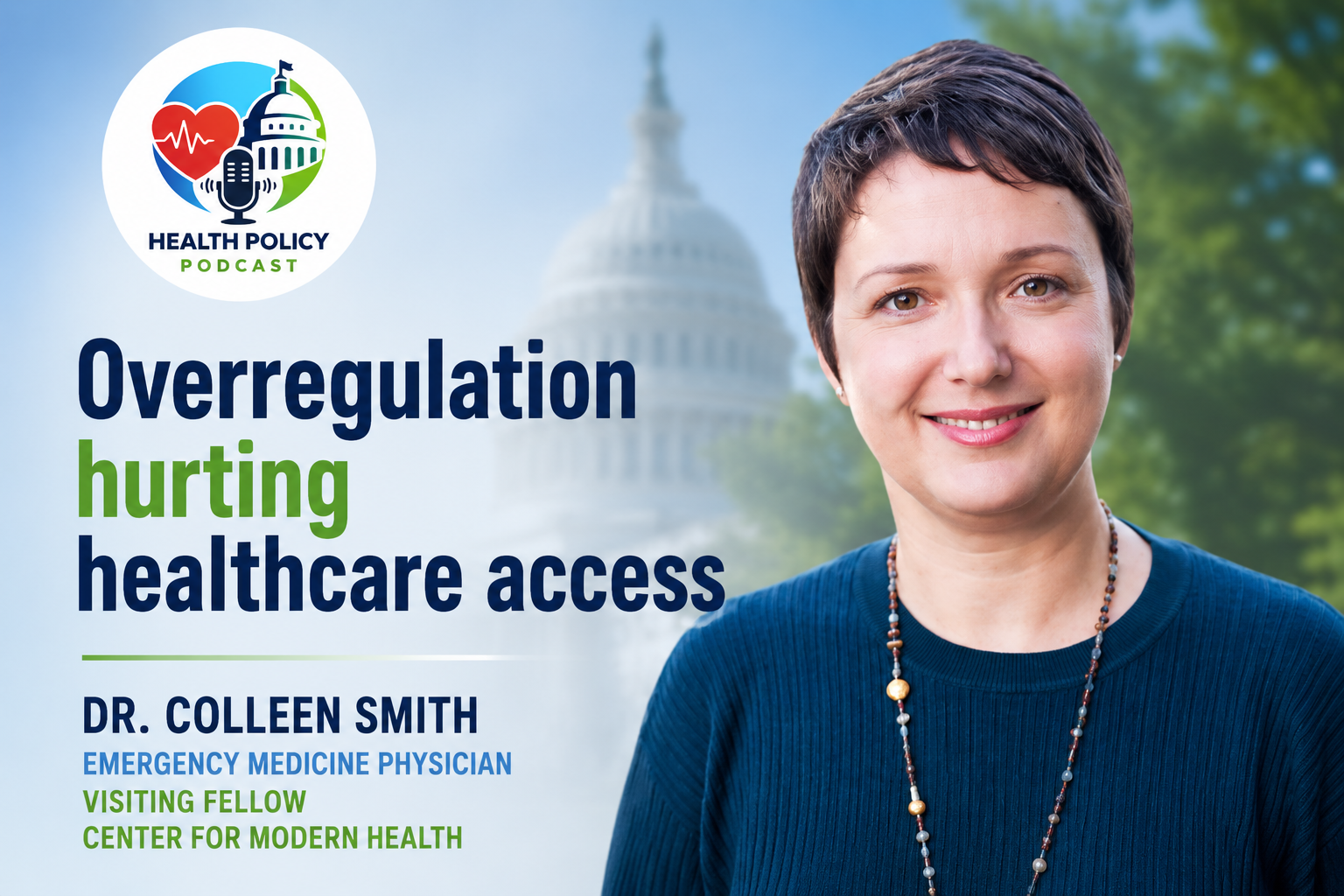
Health Policy Podcast episode featuring Colleen Smith, MD discussing Dr. Colleen Smith on Healthcare Reform: Breaking Up Big Medicine

In the latest episode of the Health Policy Podcast, Dr. Colleen Smith, an emergency medicine physician and visiting fellow at the Center for Modern Health, discusses healthcare reform and regulation. She addresses the proposed "Breakup Big Medicine Act" by Senators Elizabeth Warren and Josh Hawley, which aims to tackle the increasing vertical integration in healthcare. Dr. Smith advocates for deregulation and increased competition, suggesting reforms such as repealing certificate of need laws and promoting health savings accounts to empower consumers and healthcare providers.

Dr. Colleen Smith Discusses Healthcare Reform and Regulation

0:00 / 0:00

Dr. Colleen Smith Discusses Healthcare Reform and Regulation

Dr. Colleen Smith Discusses Healthcare Reform and Regulation

In a recent episode of the Health Policy Podcast, Dr. Colleen Smith, an emergency medicine physician and visiting fellow at the Center for Modern Health, discussed the complexities of healthcare reform and the challenges posed by vertical integration in the industry. The episode, hosted by Brian Hyde, highlighted the urgent need for policy changes to improve patient care and reduce the influence of large healthcare corporations.

Dr. Smith has practiced emergency medicine in New York City for 14 years. Over the past few years, she has become increasingly involved in health policy, motivated by frustrations with the current healthcare system. She noted that both patients and providers face significant obstacles in accessing necessary care. “I struggle every day because of our system to help my patients get the healthcare that they need,” she said.

The discussion centered on a proposed legislative measure known as the Breakup Big Medicine Act, introduced by Senators Elizabeth Warren and Josh Hawley. The bill aims to address the growing consolidation of healthcare corporations, which have been acquiring smaller practices and pharmacies, leading to a lack of competition in the market. Dr. Smith explained that this consolidation creates a complex web of relationships among hospitals, insurance companies, and pharmacy benefit managers. “Large healthcare corporations have developed and kind of grown almost like they're on steroids,” she said.

Dr. Smith pointed out that this vertical integration often results in backroom deals that prioritize corporate profits over patient care. She emphasized that patients lack purchasing power in this system, as they do not directly control the majority of healthcare spending. “We are not even as much as we're the ones with the skin in the game when we're patients,” she said.

The conversation also touched on the historical context of healthcare regulation in the United States. Dr. Smith traced the roots of the current system back to the introduction of Medicare and Medicaid in the 1960s, which were created in response to rising healthcare costs and the need for coverage for retirees. She explained that subsequent regulations, such as certificate of need laws, have further entrenched the power of large healthcare entities. “It has allowed these large, vertically integrated giant healthcare corporations to sit on the board of certificate of need evaluation boards,” she said.

Dr. Smith argued that breaking up these large corporations without addressing the underlying regulatory framework may not yield the desired improvements. She suggested that a more effective approach would involve deregulating the healthcare market to foster competition. “If you just come at them and break them apart, we're gonna still be left with the same regulatory landscape that we were in to begin with,” she said.

In her article, Dr. Smith proposed several steps to deregulate healthcare and increase competition. She emphasized the need to repeal restrictive laws, such as certificate of need regulations and Stark laws that limit physician ownership of hospitals. Additionally, she advocated for the establishment of health savings accounts to empower patients to manage their healthcare expenses.

Dr. Smith concluded by stressing the importance of creating a competitive healthcare marketplace that prioritizes patient choice and provider autonomy. “We need to do something with regard to health insurance,” she said, suggesting that allowing a marketplace for catastrophic plans could help reduce costs for routine care.

As the healthcare landscape continues to evolve, Dr. Smith's insights underscore the critical need for policy reforms that address the challenges posed by consolidation and regulation. The full discussion is available in the latest episode of the Health Policy Podcast.

Interview Q&A

Q&A: Dr. Colleen Smith Discusses Healthcare Reform and Regulation

Dr. Colleen Smith Discusses Healthcare Reform and Regulation

Q: Can you tell us about your background and current work?

A: I am an emergency medicine doctor practicing in New York City for the past 14 years. Recently, I became more involved in health policy because I believe it should be a non-partisan issue. I am frustrated with the healthcare system as both a patient and a doctor, and I want to help improve it.

Q: What is the Center for Modern Health, and what is its mission?

A: The Center for Modern Health is a think tank focused on healthcare reform across the country. It is run by Jared Rhodes, a health policy expert. The center aims to modify health policy and the regulatory landscape to support the freedom of patients and healthcare providers.

Q: What is the "Breakup Big Medicine Act"?

A: The "Breakup Big Medicine Act" is a bill proposed by Senators Elizabeth Warren and Josh Hawley. It addresses the rapid growth of large healthcare corporations that are acquiring smaller practices and pharmacies, leading to a lack of competition in healthcare.

Q: How has vertical integration affected healthcare?

A: Vertical integration in healthcare has led to large corporations controlling various aspects of the system, including hospitals, insurance companies, and pharmacies. This consolidation can create conflicts of interest and limit patient choices, as many patients do not have the purchasing power to influence these corporations.

Q: Can you provide an example of vertical integration that works well?

A: Costco is a good example of effective vertical integration. They manage the entire supply chain for their rotisserie chickens, ensuring high standards for health and safety. This allows them to offer quality products at lower prices, benefiting consumers.

Q: How does competition in healthcare differ from other industries?

A: Unlike industries like retail, where consumers have choices, healthcare often lacks competition. Patients typically have limited options for providers and services, which diminishes their ability to influence prices and quality.

Q: What historical factors contributed to the current state of healthcare regulation?

A: The establishment of Medicare and Medicaid after the Great Depression played a significant role in shaping healthcare regulation. As companies began offering health insurance as a benefit, the government stepped in to provide coverage for retirees, leading to increased regulations over time.

Q: What are certificate of need laws, and how do they impact healthcare?

A: Certificate of need laws were implemented to control healthcare costs by regulating the supply of services. However, they often allow large healthcare corporations to veto new competitors, which can stifle innovation and keep prices high.

Q: What steps could be taken to deregulate healthcare?

A: A two-pronged approach is needed: freeing producers and consumers. This includes repealing certificate of need laws and allowing doctors to own hospitals. Additionally, promoting health savings accounts and reforming health insurance regulations could empower consumers.

Q: How might transparency in healthcare pricing affect competition?

A: While transparency is generally positive, it could lead to a situation where consumers flock to the most visible options rather than encouraging competition. This could reduce bargaining power and keep prices high.

Q: What are some potential outcomes of breaking up large healthcare corporations?

A: Breaking up large corporations may not solve the underlying issues in the healthcare system. The same regulatory landscape would remain, and it could lead to unintended consequences that do not improve competition or patient care.

Q: What is your overall perspective on healthcare reform?

A: I believe that we need to rethink our approach to healthcare reform, focusing on empowering both patients and providers. We must create a system that fosters competition and innovation rather than relying on large, integrated corporations.

Key takeaways

  • I'm frustrated with it, both as a patient and as a doctor.
  • I think that it should be a non-partisan issue, and I think everyone in this country is frustrated with the way that healthcare is.
  • We're not really in, we are not even as much as we're the ones with the skin in the game when we're patients speaking as a patient, we also don't have very much of the purchasing power.
  • The problem is in healthcare, there's not another choice.
  • We've just entirely eliminated competition almost from the marketplace.

About the guest

colleen-smith-md

Colleen Smith, MD

Visiting FellowCenter for Modern Health

Colleen Smith, MD. Colleen Smith is a Clinical Policy Analyst at the Center for Modern Health. She is also an emergency medicine physician who currently practices in New York City. She completed medical school in Atlanta, Gerogia, at Emory University School of Medicine, residency in Emergency Medicine at Maimonides Medical Center in Brooklyn, New York, and a fellowship in Medical Simulation and Education at New York University and Bellevue Hospitals. In addition to contributing to our policy work, Colleen also writes about health policy, medical education, and her experiences of the American healthcare system on her personal Substack.

Full transcript

Show full transcript
[00:00:00] Welcome to the Health Policy Podcast. I'm Brian Hyde, and today I'm joined by Dr. Colleen Smith, who is an emergency medicine doctor and visiting fellow at the Center for Modern Health. Uh, Dr. Smith, welcome to the program. Thank you so much for having me, Brian. We have a wonderful topic to discuss today, and I say that because, uh, I, I was looking at an article on your substack and, and it filled in so many gaps in my own knowledge. But before we dive into this, and before we start talking about, um, you know, vertical integration, what it is and what it is in terms of, of, uh, healthcare, let's talk a little bit about your background. Would you mind setting the stage for us by, by telling us a little bit about who you are and what you do? Sure. Um, I'm an emergency medicine doctor. I practice in New York City. I have been an emergency medicine doctor for the last. 14 years, I think. Um, and in the last maybe three or four years I've started to get more involved in, uh, health policy, [00:01:00] largely because I think that it should be a non-partisan issue, and I think everyone in this country is frustrated with the way that healthcare is. I'm frustrated. With it, both as a patient and as a doctor. I struggle every day because of our system to get the, to help my patients get the healthcare that, that, uh, they need. But I also think that, especially, at least in New York City, in my world, the, a lot of the prevailing views of how we should fix healthcare frighten me. I think they're not the way that we should really be going about this. And I've just, it's just come to. To me to be kind of a situation where either I'm going along for the ride or I start to take action and write about and talk about the ways that I think we should be considering how we approach the healthcare reform that we so [00:02:00] desperately need for all of us. Uh, and so I joined with, uh, the Center for Modern Health, which is a think tank working on healthcare specifically across the country. And the thing that I, uh, like about the Center for Modern Health, which is run by Jared Rhodes, who's a health policy, um, expert, and he teaches, uh, health policy at Dartmouth. Um, in there, I think in, in any case, sorry, I'm forgetting exactly where he teaches, but, but he looks at health policy from a standpoint of how can we. Change and modify our health policy and the regulatory landscape that we have for healthcare in such a way that we support. The freedom of everyone involved so that patients have freedom to choose and to, uh, work within the healthcare system and physicians and providers of healthcare, not just physicians. So [00:03:00] pharmacists and nurses and, and whoever else is providing healthcare in the healthcare space has freedom to create, um, different ways of interacting with each other so that healthcare is something that we do together, that we work on together instead of. Being something that's kind of done to you, which is a little bit what we're in now. And so I really love this kind of forward thinking, progressive way of thinking about healthcare and how it could be in some sort of, uh, you know, postmodern world that we're entering now with AI and all the other amazing technologies that we have. Um. Rather than kind of being stuck in what we currently have, which is not working for anyone, you know, and, and obviously there are members of Congress who have, have heard the complaints or heard some of the concerns that people have. So when they talk about, well, then we will step in and maybe we can break up big medicine, what exactly are they proposing to [00:04:00] do in, in breaking up big medicine? Well, there's the, I we're referring a little bit, and this is my article that I think we're gonna discuss today is referring to a bill that was proposed recently by senators, uh, Warren, Elizabeth Warren and Josh Ley. And the bill is called the Breakup Big Medicine Act. So we are now in this, I guess over the last 10 years really. Um. Large healthcare corporations have developed and kind of grown almost like they're on steroids. So in big cities and even in in more rural areas and other states outside of New York, I'm just most familiar with New York State, but this is happening all across the country. Hospitals are buying up smaller practices, insurance companies are buying up pharmacies. Then there are these kind of middlemen, which are pharmacy benefit managers and [00:05:00] managed care organizations. The pharmacy benefit managers are now. Kind of owned under the same corporate umbrella as many insurance companies and pharmacies, and also sometimes physician practices. And similarly, this other middlemen kind of entity, the managed care organization, they kind of started because they were taking over things like billing or contract negotiation with insurance companies or, um, health, health, um, human resource management for, uh, for. Physicians' offices or small hospitals that were struggling to do that as a solo entity. And so these managed care organizations came in and contracted with multiple physician offices or multiple small hospital centers and um. Just slowly have taken on more and more of the administrative roles. And now these managed care organizations, they manage a lot of the billing that goes back to [00:06:00] the pharmacy benefit manager or the insurance company, uh, much of which is controlled by Center for Medicaid Services, which is kind of the government, um, healthcare agency that. Controls Medicare and Medicaid. So all of us kind of interlinked together. And then, uh, following the rules of Center for Medicaid Services and now we have these great healthcare conglomerates that include pharmacy benefit managers. Um. Managed care organizations, doctors, practices, pharmacists, and it's kind of it how Warren and Halle really did hit on something, which is there's some sense in which there are a lot of deals going on between these groups and back rooms. And, um, money is being moved from one group to the other, all to benefit this large overarching corporation, uh, kind of at, at the expense of the patients. Because we're not [00:07:00] really in, we are not even as much as we're the ones with the skin in the game when we're patients speaking as a patient, we also don't have very much of the purchasing power. 'cause we don't, we, we don't really spend that much money comparatively. Right. Compared to what your employer pays or what your insurance company might pay. And so, um. They, they're not, Holly and Warren aren't wrong to say that. There's an issue here with these vertically integrated, or even horizontally integrated. You can kind of look at it in either way with these corporations. There is sort of something kind of underhanded going on, a little bit sneaky backroom deal kind of things. But, um, you know, I, I think the bigger question is why, how did we get here and why are we here? And if you just come at them and break them apart. We're gonna still be left with the same regulatory landscape that we were in to begin with. Just [00:08:00] no big, giant companies. And there could also be, I think I argue a little bit that some, there could be some benefit to these companies too if, if things were right with the world, but things aren't right with the world. One of the things I appreciated in your article is you actually give some examples of vertical integration. Where it's not a bad thing, it actually benefits people. For instance, I think you mentioned Costco and their rotis re chickens. A lot of people can relate to that, but the vertical integration can, can you kinda walk us through how, how Costco vertically integrated in order to deliver, you know, something that people really appreciate at a price that to really seems outstanding. So Costco I think is a great example of, of a company that does vertical integration really well, and some of it is Costco is a little bit of a weird company because it's private and you, you pay a membership fee and you know, there's some weird kind of creative things that Costco does and we don't know all the details, but Costco [00:09:00] has, um. Basically they contract with a company that owns portions of chicken farms, and they tell that company, here's what, what's important to us in the way that you manage chickens. So they, um. And I don't know the exact details, but, but because it isn't totally relevant, but you know, they want their chickens to be raised to a particular standard of health and safety. They want them to be, they, they also, this company that they contract with also manages how the chickens are slaughtered. So they're like slaughtered in a way that that meets. Costco, which is as far as I understand, superior to government regulations for how chickens need to be slaughtered. So the chickens are, are like even better, even safer than what you might buy at, uh, you know, Walmart or, or Kroger or some whatever grocery store, your favorite grocery store.[00:10:00] And then. Um, they, they're able to, uh, send the chickens to the right stores. And so the chicken processing ha they, they're in it from the beginning, from when the chickens are eggs, so they're vertically integrated into this whole farming practice of how the chickens are raised. They get their chickens from these places and, and presumably these farmers like. Working with Costco, they probably get a good deal from Costco and, um, and they're, they know where, where they're gonna be selling their chickens every year. And so it, in a sense, it's a win-win. And then as consumers, we are able to buy arguably the most delicious rotisserie chicken. These chickens are huge also, and they're really great and at a really decrease, like, like a really low price compared to everything else Now. To be able to buy that, you have to have bought the Costco membership. But for most people, that actually ends up saving them money in the long run. [00:11:00] Um, you know, Walmart and Amazon are also vertically integrated as is target and. There are pros and cons for all of these things. So like maybe the, the products that you get from Costco, for example. Um, I like Trident Gum, but maybe I like Strawberry Trident gum. That's my favorite. Well, Costco sells Trident gum, but they only sell spearmint or something, so I might decide. It's worth it to me to save money on gum and just to spearmint gum and occasionally splurge for a strawberry trident some other time. Or I might decide like, huh, Costco really just doesn't have the variety that I need and I can choose not to go to Costco. The problem is in healthcare, there's not another choice. Beside in, in most cases for most people. And so that's why the vertical integration, a major reason why the vertical integration in healthcare is such an issue and because there's not another choice, there's no way for consumers to [00:12:00] send the message to these vertically integrated companies that is like, you are not serving me with your version of vertical integration. No, that makes sense. And you, one of the things I love that you pointed out too is that unlike Costco and Walmart and Amazon and some of these others that have, have actually used vertical integration, you know, in a productive way, um, that competition is lacking. In, uh, in medicine. Let's talk about how did we get there? How did we get to where medicine is so heavily influenced by government regulation? I mean, I, how did we really, I mean, I think it goes back to, you know, the, the start of Medicare and Medicaid, which was, um. Back after, like a little bit after the Great Depression. Um, there was a time during the Great Depression where, um, as we were sort of coming out of it, there was a cap on wage increases. So companies weren't allowed to pay their employees more and they wanted to come up [00:13:00] with ways to retain their employees. And so the government said, okay, you can buy them health insurance. Um, and we won't. We'll let you, uh, we will give you a tax benefit for the health insurance that you buy your employees. And as soon as that happened, we ran into this problem of now people are retiring, uh, from these companies that they've worked for their entire life, and they got health insurance through that company. And when they retire, they have no health insurance anymore. And so everyone over the age of 55 or 65, I forget exactly what it was at that time. That was as they were retiring, they were losing their health insurance coverage. And of course, obviously the older you are the more you need healthcare. Um, and so the, so that really set the stage for the government needs to step in and, and provide healthcare for elderly people. And so that was how Medicare, um, started and kind of, [00:14:00] it's sort of snowballed since then. We've had increasing regulations on healthcare and the way that it can be practiced, um, and then in, uh, with the Affordable Care Act, which in some ways was great. It did provide health insurance to a lot of people. Um, it also did things like, um. It expanded these, uh, stark regulations, which are regulations around kickbacks and um, also around doctors referring to themselves. So there were these worries that as a doctor, if I own, if I own part of a hospital and I refer somebody to the MRI center associated with my hospital, well then I'm making money off of that referral and so that there's a conflict of interest there. And there's a sense in which there is a conflict of interest there. It's true, but I also think that like you can manage those sorts of things by like making your conflict of interest known. [00:15:00] Uh, you don't necessarily need to. Uh, and, you know, and then allowing the patient to decide if they wanna go to your MRI or the one down the street. Um, if, as long as they know that you own the MRI think it kind of like balances that out. But, but, um, that type of thing was just, uh. Essentially turned into a, you, you, um, basically there's now civil penalties for it, and there are ways around it, but the ways around it are so complex that it becomes basically just prohibitive for doctors to do it. So essentially it's become impossible for doctors to own their own hospitals and still participate in Medicare and Medicaid and the general insurance marketplace. Um, and then kind of separately from this. In the like seventies, we implemented these things called certificate of need laws. And, and you know, we did that because we were, uh, everyone was seeing prices in healthcare rising and rising and rising as insur health insurance was paying for more and more [00:16:00] things, and prices were going up and up. And so there was this thought that, well, maybe if we control, uh, supply a little bit more, then we won't have this escalation in price. And I, you know, I think one of the. Major issues in economics, and I'm not an economist, so not at all an economist, but I think like a lot of people understand that in economics, if you risk, if you constrain supply, then the cost goes up usually. So I'm not really sure who came up with this idea, but. What has actually happened with certificate of need laws is that it has allowed these large, vertically integrated giant healthcare or, uh, corporations to sit on the board of certificate of need, uh, evaluate, evaluation, um, boards. And so when someone says, I wanna start a new radiology company, or I wanna start a new urgent care center, or I wanna start a nicu, a neonatal ICU, um. I wanna [00:17:00] add a neonatal ICU to my hospital, which happened I think in West Virginia not that long ago. The other larger healthcare corporations come and sit on the board where they hear, you know, what are the reasons why we need this new neonatal ICU or the new urgent care center? And then they just say, no, we don't need it, because it's competition to them. And so. It would actually drive down prices and they wouldn't be able to charge as much. And so it's allowing, you're actually giving, giving the monopolies, the giant, vertically integrated companies a, a veto, veto power over. Over their competition. So I, you know, I think we've just, we've really done a number on ourselves in creating this non-competitive marketplace. And at the same time, the consumer, the pa who, the who you, the person you would think of as the major consumer of healthcare who's really making these decisions. The patient doesn't spend any money and doesn't have any choice about where they spend, what money they do have anymore. And so [00:18:00] we've just entirely eliminated competition almost from the marketplace. And so even if we do break up the vertically integrated companies as Warren and Howley would like to do, I'm not sure that it will make that much of a difference or it will do some kind of unexpected thing. It's going to change incentives in some strange way. Um, I, I have to confess, I don't think I'm smart enough to even begin to figure out exactly what will happen, but I don't think it will make it better. We're down to just a couple of minutes left in the program. Mm-hmm. But I have to ask you about this, 'cause in your article, in your Substack article, you mentioned five very clear steps that we could begin to take, you know, to deregulate mm-hmm. Healthcare and increase competition for big medicine. Could you touch on a couple of those just as examples for us? Yeah, I mentioned a few here, but I sort of think of it as a two-pronged attack. You have to free the producers, and so that's things like, uh, repealing certificate of need laws and repealing the laws, the stark [00:19:00] laws that prohibit doctors from owning hospitals and owning. Um. Yeah, from, and um, and then you also have to free the consumers, which is the patients. And so that means things like, you know, one idea for that that's been big lately is health savings accounts. Like, let everyone have a health savings account. Encourage everyone to save for their own health care. Um, I think also we need to do something with regard to health insurance. So re. Um, I guess changing some of the regulations around the way that health insurance is. So allowing a health insurance marketplace to exist outside of the affordable care plans. Think, um, allowing actual catastrophic plans, kind of moving things in a direction of, for routine care. People are using more of their own money to pay for that rather than having it covered by health insurance. Uh, I think you would begin to see the cost of that routine care come down over time. If you did that, um. [00:20:00] Uh, I think there's a lot of talk about transparency. I, there's a sense in which I think transparency is a good thing, but I think I also worry that, um, transparency would also, would result, will result in everyone going toward the one goal that everyone sees rather than things kind of coming down because we won't have as much bargaining happening if we're so transparent. Um, so yeah, I mean, I think there are lots of other things we could do, but those are just a few kind of. Red flag things that I think we could address to increase competition in the marketplace. Once again, we are visiting with Dr. Colleen Smith. She's an emergency medicine doctor, as well as a visiting fellow at the Center for Modern Health. And Dr. Smith, thank you so much for being our guest on the Health Policy Podcast. Thank you so much for having me, Brian.

Filed under