· The Health Policy Podcast
Health Policy Podcast logo

Receive new episodes in your inbox.

← Health Policy Podcast

2026-08-31 · Council for Affordable Health Coverage

Joel White Discusses Healthcare's Impact on Midterm Elections Voter Sentiment

with Joel White, President — Council for Affordable Health Coverage
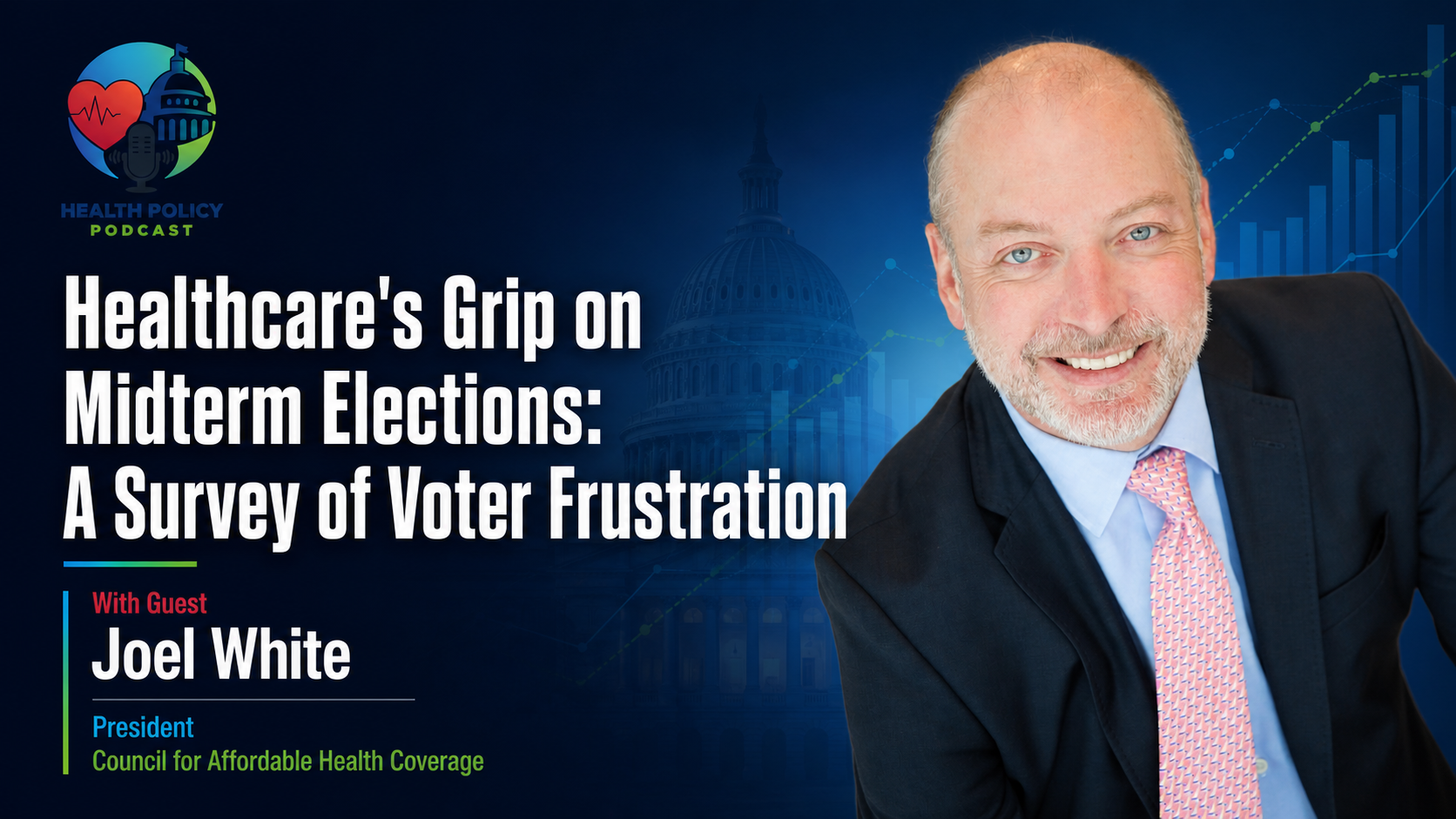
Health Policy Podcast episode featuring Joel White discussing Joel White Discusses Healthcare's Impact on Midterm Elections Voter Sentiment

In the latest episode of the Health Policy Podcast, host Bryan Hyde interviews Joel White, president of the Council for Affordable Health Coverage, about the impact of healthcare issues on the upcoming midterm elections. A survey conducted in key battleground states reveals significant voter frustration over healthcare costs, with 79% of respondents indicating healthcare is a top-tier issue influencing their votes. The discussion highlights the evolving political landscape regarding healthcare, with Republicans gaining ground on traditionally Democratic issues and a notable shift in voter sentiment towards consumer-focused healthcare policies.

Healthcare's Grip on Midterm Elections: A Survey of Voter Frustration

0:00 / 0:00

Healthcare's Grip on Midterm Elections: A Survey of Voter Frustration

Healthcare's Role in the Midterm Elections: Voter Frustration at the Forefront

In the lead-up to the midterm elections, healthcare is emerging as a pivotal issue for voters across the United States, particularly in key battleground states. Joel White, president of the Council for Affordable Health Coverage, discussed the results of a recent survey that highlights voter dissatisfaction with the current healthcare system and its implications for political races. The survey, conducted by North Star Opinion Research in early August, focused on nine states with competitive Senate races: Alaska, Georgia, Iowa, Maine, Michigan, North Carolina, New Hampshire, Ohio, and Texas.

According to White, the survey of over 1,200 likely voters revealed a significant level of frustration regarding healthcare costs. "The primary driver of that frustration is cost," he said. "It is absolutely unaffordable for most of the people that we talk to, and it is a top-tier issue for these voters heading into November." This sentiment transcends party lines, affecting Republicans, Democrats, and Independents alike.

Key States and Voter Concerns

White explained that these nine states were chosen due to their importance in the upcoming elections, with a third of the Senate up for reelection. He noted that Texas, often not considered a battleground state, has seen increased political activity, with Democrats attempting to make it competitive. Other states, such as North Carolina and Maine, are also drawing attention due to their unique political dynamics.

The survey results indicate that healthcare is a higher priority for voters than issues like immigration and gas prices. "In the nine battleground states we looked at, 79% said it would be very important to their vote," White said. This widespread concern suggests that candidates who address healthcare effectively may have a better chance of swaying undecided voters.

Party Lines and Healthcare Policy

When examining voter attitudes toward healthcare policy, White noted that there is a historical advantage for Democrats, who typically lead by 20 percentage points on healthcare issues. However, the current political climate shows a shift. "Voters trust Democrats over Republicans by 54 to 42," he said, but "that number is usually 60 to 40." This narrowing gap reflects a growing Republican narrative focused on consumer-friendly healthcare solutions.

The survey also explored opinions on Medicare for All. While initial support for the concept is high, it diminishes significantly when voters learn about the implications of government control over healthcare decisions. "Once you start explaining what's behind that, that's where it gets dangerous for Medicare for All advocates," White stated. He pointed out that concerns about losing personal healthcare choices and the high costs associated with such a program contribute to this decline in support.

The Role of Insurance Companies

White highlighted the growing antipathy toward insurance companies, which he attributes to their increasing involvement with the federal government, particularly since the implementation of the Affordable Care Act. "Once these subsidies started flowing to insurers rather than directly to consumers, we saw a lot of games being played," he said. This has resulted in rising premiums and out-of-pocket costs for patients, further fueling voter dissatisfaction.

The survey found that a significant majority of voters across party lines believe that subsidies should be directed to patients rather than insurance companies. "By a three-to-one margin, people say Democrats are too close to the insurance companies," White noted. This sentiment underscores a potential vulnerability for Democrats in the upcoming elections.

Republican Strategies and the Future

As the midterm elections approach, Republicans are already capitalizing on healthcare as a central campaign issue. White pointed to various races where Republican candidates are actively promoting their healthcare plans. "We're seeing it in the Montana race with Curt Almey and in North Carolina with Greg Murphy," he said.

In contrast, White described the Democratic Party's current healthcare messaging as disorganized. "Democrats are trying to address that by saying, well, you cut Medicaid, you cut— you didn't provide the ACA subsidies," he explained. This lack of a cohesive message may hinder their ability to connect with voters.

In conclusion, healthcare is poised to be a decisive factor in the midterm elections, with voter frustration over costs and insurance companies shaping the political landscape. Candidates who effectively address these concerns may have a significant advantage as the election date approaches.

Interview Q&A

Q&A: Healthcare's Grip on Midterm Elections: A Survey of Voter Frustration

Healthcare's Grip on Midterm Elections: A Survey of Voter Frustration

Q: Can you tell us about yourself and the Council for Affordable Health Coverage?

A: I am Joel White, president of the Council for Affordable Health Coverage, a DC-based advocacy organization promoting affordable healthcare for all Americans. Our organization was founded in 2001, and we believe in free markets and consumer-friendly policies that lower premiums and out-of-pocket costs. I have worked in healthcare policy for about 30 years.

Q: What polling did you conduct regarding healthcare's impact on midterm elections?

A: We conducted a survey with North Star Opinion Research in August, focusing on nine key states with tight Senate races: Alaska, Georgia, Iowa, Maine, Michigan, North Carolina, New Hampshire, Ohio, and Texas. We surveyed over 1,200 likely registered voters and found a significant level of frustration with healthcare costs across party lines.

Q: Why did you choose these specific states for your survey?

A: A third of the Senate is up for reelection, making these states key battlegrounds. We wanted to understand what drives voter concerns that could swing Senate races and impact the balance of power in the Senate. These states also have competitive House races that could flip control.

Q: Is healthcare a priority for voters across party lines?

A: Yes, healthcare is a top-tier issue for voters across all party lines. In the nine battleground states, 79% indicated that healthcare would be very important to their vote, ranking just behind cost of living issues.

Q: How do voters view the federal government's involvement in healthcare?

A: Historically, Democrats have had an advantage in healthcare issues, but our survey shows that Republicans are now nearly even with Democrats. Voters are frustrated with the perception that Democrats favor large insurance companies, leading to a shift in support towards Republican messaging that emphasizes giving money to patients instead.

Q: What did the survey reveal about support for Medicare for All?

A: While 54% initially support Medicare for All, that support collapses when voters learn about government control over healthcare decisions and the potential loss of existing coverage. Concerns about costs and control significantly decrease support for the program.

Q: Do Democrats still hold an advantage in healthcare discussions?

A: Traditionally, Democrats have had a significant advantage, but Republicans have gained ground. Voters now trust Democrats over Republicans by a smaller margin than in previous years. This change is partly due to dissatisfaction with the Affordable Care Act.

Q: How have insurance companies influenced voter perceptions?

A: Many voters feel that insurance companies have become too intertwined with the federal government, especially after the Affordable Care Act. This has led to rising premiums and out-of-pocket costs, causing frustration and a desire for change among voters.

Q: Are Republicans actively campaigning on healthcare issues in the midterms?

A: Yes, Republicans are already running on healthcare issues in various races. They are emphasizing their message of giving money to patients rather than insurance companies, while Democrats struggle to present a cohesive healthcare message.

Q: What is the general sentiment towards the consolidation of healthcare providers by insurance companies?

A: Voters across party lines overwhelmingly oppose the practice of insurance companies buying providers, with a 20-to-1 margin against it. There is bipartisan support for making healthcare markets more competitive and preventing such consolidations.

Q: What do you foresee for the future of healthcare policy in the upcoming elections?

A: Regardless of which party controls Congress next year, there will likely be bipartisan support for addressing the issue of insurance companies' vertical integration and the need for competitive healthcare markets.

Key takeaways

  • There is an amazing level of frustration amongst consumers with how healthcare works today, and the primary driver of that frustration is cost.
  • 79% said it would be very important to their vote, behind only cost of living issues generally, so groceries, gas, energy, housing, etc.
  • Most voters feel like Democrats have favored the insurance companies with massive subsidies and kind of unchecked power to deny claims and deny care.
  • When you start talking about that control issue, it collapses to where more— 43% support to 44% opposed.
  • Voters across party lines are basically saying give those subsidies directly to people.

About the guest

Joel-white-council-affordable-health-coverage

Joel White

PresidentCouncil for Affordable Health Coverage

Joel White is the President of the Council for Affordable Health Coverage (CAHC). As CAHC’s president, Joel leads a seasoned team of government affairs professionals while managing the coalition of more than 30 organizations representing patients, drug manufacturers, providers, employers, and other sectors committed to market-based reforms that lower costs for consumers. CAHC has helped enact a number of laws to lower health costs and advance market-based reforms, including small businesses and individual coverage reforms, drug cost reductions, consumer transparency, and expansion of HSAs. Joel’s dedication to advancing healthcare reform is unmatched. For over two decades, he has led various issue campaigns to lower healthcare costs, including reforming Medicare, improving small business health coverage, lowering drug costs, and promoting healthcare transparency. Joel is a sought-after health policy expert, frequently speaking at national events, testifying before Congress, and producing high-profile policy summits and briefings featuring White House officials, Cabinet Secretaries, and Members of Congress. His thought leadership has been featured in major media outlets, including the Wall Street Journal, The New York Times, The Washington Post, Forbes, National Journal, Politico, and more. Previously, Joel served as the Staff Director for the U.S. House Committee on Ways and Means, where he played a crucial role in enacting significant health policies, including the creation fo the Medicare prescription drug benefit and Health Savings Accounts. He also helped negotiate and pass key legislation such as the Deficit Reduction Act and the Tax Reform and Health Care Act. Joel is also the co-author of the book, Facts and Figures on Government Finance (1992), which brings together data on public finance at all levels of government, with comparisons of taxing and spending levels spanning half a century. He holds a BS in Economics from the American University.

Full transcript

Show full transcript
[00:00] Bryan Hyde: Welcome to the Health Policy Podcast. I'm Brian Hyde. Today, I'm joined by Joel White. He is president of the Council for Affordable Health Coverage. Joel, welcome to the program. Tell us a little bit about yourself and about your organization. [00:12] Joel White: Yeah, thanks for having me again, Brian. Joel White, I'm the president of the Council for Affordable Health Coverage. We are a DC-based advocacy organization promoting more affordable healthcare for all Americans. We were started in 2001, and we believe in free markets, pro-innovation, and consumer-friendly policies that drive down premiums and out-of-pocket costs. And so my background is I've been in healthcare policy and advocacy for about 30 years. I have been president of CHC for— since 2008, actually. And before that, I was on Capitol Hill where I helped write 9 different laws, mostly in the Medicare space, but also If anyone out there listening has a health savings account, helped write that law that provided 66 million Americans now with an HSA, a better way to afford and pay for your healthcare. [01:08] Bryan Hyde: Excellent. Actually, I'm one of those Americans and I thank you. That's been very useful. Now, we're coming up on the midterm elections. I know healthcare is on a lot of people's minds, but today you and I are gonna discuss how healthcare is being reflected in some of the political races, particularly some of the swing states and the impact that healthcare is having on Senate races. races in those states. Set the stage for me, if you will, about some of the polling that has taken place that shows the role that healthcare is playing in these states. [01:38] Joel White: Yeah, so just for context, we did a survey with North Star Opinion Research, who is best in the business, at the beginning of August in 9 key states where there are tight Senate races. So it was Alaska, Georgia, Iowa, Maine, Michigan, North Carolina, New Hampshire, Ohio, and Texas. And we surveyed a little more than 1,200 likely registered voters. So these are people who are most likely to go out to the polls. And we asked them what you think about healthcare and what do you think about Republicans and Democrats and the different policies that are put into place. And I think the big takeaway from our perspective in cross-party lines, Republicans, Democrats, Independents, is that there is an amazing level of frustration amongst consumers with how healthcare works today. And the primary driver of that frustration is cost. It is absolutely unaffordable for most of the people that we talk to, and it is a top-tier issue for these voters heading into November. And so we think politicians are foolish to ignore this issue. And there's some interesting data that we found on how Democrats and Republicans can engage voters on this and what they'd like to see this year and next year to help drive their, their costs down and make health coverage much more affordable. [03:15] Bryan Hyde: Joel, before we get into some of the specific findings of this survey, in other words, some of the specific issues, talk to me a little bit about the states, why these particular states in which, you know, this has played out like it has? [03:30] Joel White: Yeah, well, first of all, a third of the Senate is up for reelection, so 33 races, and these are the top-tier Senate battleground states, or, you know, states that people are paying attention to from a political perspective. And a lot of people don't think Texas is a battleground, but there's a lot of money flowing into Texas right now in the election, and I think Democrats are trying to make it competitive. I think Paxson's got a very good shot at winning that race. But these other states like Maine, a lot of people were focused on the Collins matchup before it changed, the Democrat candidate changed because there was some controversy on that side over their pick with Plattner. Alaska, there's going to be a battle up there. But I think Dan Sullivan is pretty well positioned. North Carolina, an interesting state where you've got a very popular governor, former governor running against a Republican. And that's the seat that Tillis, Senator Tillis is leaving. And so all these states that we picked, we wanted to kind of put our finger on what's really driving voter concerns, where a little push in one direction or another could literally swing that state Senate race, but also the balance of power for the Senate because it's very closely held right now. It's 54 Republicans, so 4 seats needed from the Dems to pick up. And there's going to be speculation between now to November about will it flip, will it not flip. And the other thing is a lot of these states, these voters are in House districts where we see a lot of the swing state House races happening. And so I think for listeners here, there's probably somewhere between 16 and 20 jump balls, that is very close House races that could flip the chamber from Republican control today to Democratic control next year. But Republicans have a natural advantage, right? There was a redistricting case before the Supreme Court that really ended up favoring Republicans. Republicans also have a massive money advantage over Democrats right now. On the downside, they've got a midterm election cycle where typically the party that controls the presidency loses seats in the House. But with redistricting, this has all kind of changed. And so I think it's kind of too early to speculate on whether the House or the Senate will flip. There's a lot of dynamics yet to play out over the next couple months. But right now, Republicans definitely have the advantage. I think about 210, 206 to 210 safe or, you know, very good prospects for Republicans, and then you basically got 16 jump balls that Republicans have to win 8 in order to maintain control of the chamber. [06:41] Bryan Hyde: Joel, when you mentioned that the cost of healthcare is a top-tier priority for voters. Is there any divergence, you know, as far as along party lines— Democrats, Republicans, independents— or, or do they line up pretty well regardless of which party we're talking about? [07:00] Joel White: It's kind of across the board. I think when you talk to a typical voter— I travel all around the country, I talk to folks everywhere I go, in coffee shops, gyms, gas stations, love talking to people. This is a top-tier issue across all party lines. In the 9 battleground states we looked at, 79% said it would be very important to their vote, behind only cost of living issues generally, so groceries, gas, energy, housing, etc., and federal taxes. But basically, voters said that this was more important than War, immigration, gas prices, immigration enforcement, abortion. So if you think of those really important issues to subsets of voters, this is kind of hitting across a broad population because the healthcare system isn't working for them and the costs are too much. The friction with the health insurers denying coverage, denying claims, things like that is really translating into voter dissatisfaction with the status quo. They want to support support a member of Congress, a candidate who is going to change things up. [08:17] Bryan Hyde: I'm curious too if, you know, the federal government's involvement in healthcare, whether it's through the Affordable Care Act or through expansion of Medicaid or Medicare rather, I'm curious, does that break down along party lines? Or again, is it— is the support pretty consistent, you know, across the board in terms of what this survey was able to show you? [08:40] Joel White: Yeah, I think the other top line that came out of what we were seeing in this survey is that, first of all, historically, Democrats have a 20% lead on healthcare as an issue, right? They're just— they kind of come at the issue at an emotional level. They grab your heart. It's appealing. It's usually on a personal level. Republicans kind of come at it and go for your head, right? They use logic and data and numbers And that doesn't always resonate with voters. This year, what we're seeing is that Republicans in a head-to-head matchup with Democrats are actually basically evenly tied in these areas. And so it goes to really the issue and what is the history here a little bit. And most voters feel like Democrats have favored the insurance companies, the big insurance companies, with massive subsidies and kind of unchecked power to deny claims and deny care. And voters don't like that. And so they really like the message from Republicans and President Trump in particular when he says, look, I don't want to give more money to insurance companies. Insurance companies are jacking up your premiums and they're denying your coverage, denying your care. I want to give that money to people. So give it to people, not companies. And that when we, when we talk about that issue, tested that with voters. voters across the board. Republicans, Democrats, independents favor that by a 2-to-1 margin at least. And that's really where we see the advantage for these candidates is to— if you're on the side of the consumer and you want to help people with their costs, give that money— talk about that. Give that money to the patients, not to the insurance companies, and let them choose what works best for their family. [10:35] Bryan Hyde: What about the prospect of Medicare for All? What did the survey show you about that? [10:40] Joel White: Yeah, I think— so again, going back to the point that voters are so frustrated with the system right now, they're looking for a change in the status quo. And so what we tested was a couple of Medicare for All questions. And if you just say Medicare for All, most people support that because Medicare is known, right? My mom or my grandma or my grandfather is on Medicare, seems to work well for them. And so 54% support Medicare for All. But once you start explaining what's behind that, that's where it gets dangerous for Medicare for All advocates. And so when you tell people, look, you're gonna put the government in control of all these healthcare decisions, right? The federal government is now gonna decide what doctor you get to go see, what care you actually have covered under the plan, and— whether that care is approved for you or not. And so whether you're a Democrat or Republican, that's a dangerous prospect. Like, so if you want Secretary Robert F. Kennedy in charge of what kind of care you get and which doctor you see, well, go for Medicare for All. But most people say, we don't like that kind of system. We want the power with the doctor and the patient. So when you start talking about that control issue, it collapses to where more— 43% support to 44% opposed. The other key message is that Medicare for All would cost $42 trillion. You can't raise taxes high enough to pay for that. That's after you consider you're getting away, you're doing away with all private insurance, every union plan that they negotiated hard for their benefits, every small business coverage option, every HSA, in America, Medicaid, the military programs, the veterans programs, all that stuff. Everyone would just kind of be put into this big blob of a program and have to fight it out for access to a doctor. And once you tell people that 163 million Americans are going to lose what they have today and go to beg the federal government for their care, the support just absolutely collapses. So you can't just say Medicare, I'm opposed or I'm for Medicare for All. You can't say I'm opposed to Medicare for All without then explaining why you're opposed. And so outlining those 3 top points: lose control, the costs are astronomical, and you lose what you currently have. And if you like what you have, you can't keep it. [13:26] Bryan Hyde: Wow, the devil is in the details for sure. Talk to me a little bit about, do the Democrats have an advantage when it comes to healthcare? I'm talking traditionally, I mean, I think back to the ACA, and that was kind of a banner issue going back to the Obama administration and moving forward since. Do the Democrats hold an advantage? Do they still have that advantage, or have the Republicans found ways to make it work for them? [13:57] Joel White: Republicans have definitely found an in here, and I think this was one of the surprising things. We thought that, if you remember, just last year, the Democrats shut the government down over this issue of extending bonus subsidies that were instituted in COVID. And they ultimately weren't successful in that, extending those subsidies to very high-income people as well as others. And so we were expecting some kind of a bump for the Democrats here. Like I said, normally they have a 20-point advantage on health issues. But right now in these states, what we're seeing is that it's basically head-to-head. So Voters trust Democrats over Republicans by 54 to 42. Normally, that number is 60 to 40. So Republicans have actually made up a lot of ground on this issue. And I think what's happening is the Democrats put a lot of stock into the Affordable Care Act, and that's their signature issue. The Affordable Care Act is not working out well for people. It's not very affordable. And also, you know, 8 months ago, Chuck Schumer, Senator Schumer, you know, the minority leader, Hakeem Jeffries, others were basically saying, we wanna take $400 billion and send that money to insurance companies, and that'll make healthcare affordable. And Republicans said, no, we wanna give that money to patients and let them decide what they wanna do with that. And once that message got out there, It absolutely flipped to a Republican edge. They're beating Democrats by 10% when they talk about healthcare that way. [15:39] Bryan Hyde: You know, Joel, you mentioned earlier that there's a fair amount of antipathy toward insurance companies, and, you know, frankly, having dealt with some of those, I can kind of understand that. Can you give me some context in terms of when did insurance companies become so intimately involved with the federal government? I was gonna say, you know, in bed with them, but I just, I'm not sure when that actually I think the main switch was flipped during Obamacare. [16:13] Joel White: When Obamacare passed, it was really— again, these subsidies don't go to people. The check from Treasury goes to the insurance company. And so that's where we saw a lot of games being played. We saw these phantom enrollees who were signed up for a plan, but they never actually knew they were on that plan. And the check just went to the insurer. And then the insurers started playing games with what's called the medical loss ratio and trying to avoid that by buying hospitals and doctors and pharmacies and consolidating the market and then jacking up prices because they could avoid paying rebates to consumers. And then the premium is just going sky high and the out-of-pocket costs, the average deductible for an ACA plan, the typical plan on Obamacare is $5,300 this year. Wow. [17:01] Bryan Hyde: Wow. [17:01] Joel White: $5,300. Most Americans have less than $500 in their savings account. So you, you've gotta pay $30,000 in a premium to get your family plan on Obamacare and then pay another, uh, $5,000 to $10,000 deductible before you even start seeing benefits. So it's just all that money is going to, uh, the insurers, and I think people see that. And they feel like they're getting screwed. And so I think the popular populist message is really resonating with those voters, and they turned against them. And they think Democrats, to put it, you know, lack of a better term, Democrats are in bed with the insurers, that they've given them these very, you know, hundreds of billions of dollars in subsidies, and they don't like that. And in our polling, we basically found that You know, based on political donations and subsidies to insurers, by a three-to-one margin, people say Democrats are too close to the insurance companies. The the the the other interesting thing when I talked about give money to people, not insurance companies, voters across party lines are basically saying give those subsidies directly to people. And that's true of overall 57% support for that concept. For Republicans, it's 64%. For Democrats, it's 49%. So it's a plurality of Democrats and most independents, most Republicans. So they want this money to go directly to the patient, to the consumer, to help them afford their care. And that's not the system that the Democrats created. [18:55] Bryan Hyde: So one final question for you, Joel, and that is, how likely is it that Republicans will actually run on healthcare in these midterm elections? [19:03] Joel White: We're already seeing it, quite frankly. We're seeing it, you know, in the Montana race with Curt Almey. We're seeing it in North Carolina with Greg Murphy, in Iowa with Congresswoman Miller-Meeks. You know, this is a potent issue right now. They're running ads there. You know, we see it all over the country. And I think what Democrats are trying They're so disorganized on healthcare this year, they can't figure out the Medicare for All message, whether they support that or oppose that. Hakeem Jeffries just basically said, I no longer support what I supported for 10 years. And the Democrat Socialists of America, this is one of their big campaign planks. But then you've got other Democrats who are saying, we don't wanna scare voters off by throwing everyone to the mercy of the federal government. I think Republicans are running hard on this. They're running on, you know, what they want to do, more importantly, compared to what they did. And Democrats are trying to address that by saying, well, you cut Medicaid, you cut— you didn't provide the ACA subsidies. Well, that's actually working against them. So the Democrats have no one cohesive message. I think Republicans do have one, and it's give money to people, not insurance companies. And the biggest zinger on this study that we did, everyone sees in their— most markets are local monopolies. So your health plan or your hospital, a local hospital, basically controls the market, basically sets the price. And I think that the link that voters have made in their minds is they saw these hundreds of billions of dollars going to the insurance companies, and making the insurance companies rich. But they also saw the insurance companies buying those doctors, buying those hospitals, buying those clinics, buying those pharmacies by a 20-to-1 margin in this poll. And this is true of Republicans, Democrats, and independents. 20-to-1, people say insurance companies shouldn't be allowed to buy providers, doctors, hospitals, clinics, pharmacies by a 20-to-1 margin. And when I testified to Congress earlier this year, I saw the same thing. There was bipartisan support for making these markets competitive again and preventing the insurance companies from buying up these practices. So I think regardless of who controls next year, I think it'll be Republicans. But regardless of who controls, you're going to see more bipartisan support for addressing these vertical integration companies and the practice of buying Again, we are talking with Joel White. [21:56] Bryan Hyde: He is the president of the Council for Affordable Health Coverage. Joel, you've just, you've just kindled, I think, a lot of people's interest in keeping an eye on the midterms here. Thank you so much for joining us on the Health Policy Podcast. [22:08] Joel White: Absolutely. Great being here.

Filed under