2026-07-30 · Juniper Research Group
Chris Jacobs: Hospitals' Role in Healthcare Affordability Crisis Explained
with Chris Jacobs, Founder — Juniper Research Group
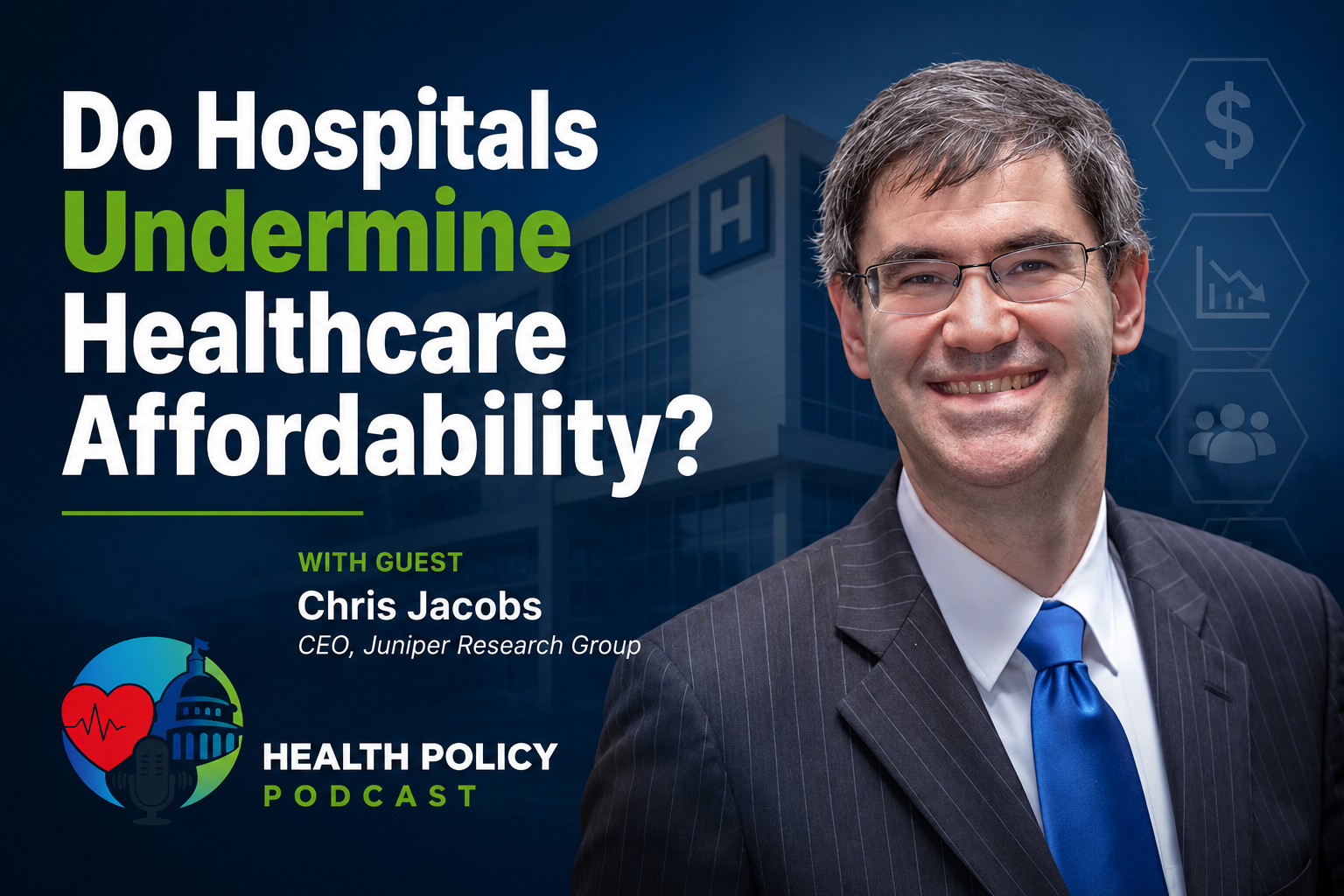
In the latest episode of the Health Policy Podcast, host Bryan Hyde interviews Chris Jacobs, founder of Juniper Research Group, about the rising costs of healthcare and the role of hospitals in making care unaffordable. Jacobs discusses how hospital consolidation and corporate practices have led to higher prices for consumers, emphasizing the need for transparency and reforms such as site-neutral payments. He also highlights the bipartisan recognition of these issues and the potential impact of healthcare costs on upcoming elections.
Hospitals Undermine Healthcare Affordability, Says Health Policy Expert
Hospitals Undermine Healthcare Affordability, Says Health Policy Expert
In a recent episode of the Health Policy Podcast, Chris Jacobs, founder and CEO of Juniper Research Group, discussed the rising costs of healthcare and the role hospitals play in making it unaffordable for consumers. Jacobs, an independent policy analyst with extensive experience on Capitol Hill, outlined the factors contributing to this issue and potential solutions.
Jacobs explained that over the past two decades, healthcare has become increasingly corporatized, leading to the formation of regional oligopolies. "Hospitals buy up physicians. Insurers are buying up physician groups. Everybody's trying to buy everybody else up," he said. This consolidation allows these entities to dictate prices, often at the expense of ordinary consumers.
The discussion highlighted a rare point of consensus among political parties regarding the problem of hospital monopolies. Jacobs noted that both conservative and liberal factions agree on the detrimental effects of the Affordable Care Act, also known as Obamacare, which he claims has accelerated consolidation in the healthcare sector.
Jacobs pointed to two key elements of the Affordable Care Act that have contributed to the problem. First, the movement toward accountable care organizations has encouraged hospitals to acquire physician practices. Second, the medical loss ratio, which restricts insurers to spending only 20% of premium dollars on administrative costs and profits, has led insurers to invest in other business lines, such as hospitals and pharmaceutical benefit managers, to bypass these restrictions.
As the midterm elections approach, Jacobs believes healthcare affordability will be a significant issue for voters. A recent Pew study indicated that healthcare costs are a top concern, particularly as enhanced Obamacare subsidies are set to expire. Jacobs anticipates partisan debates over the impact of these changes on healthcare affordability.
In terms of solutions, Jacobs mentioned a surprising agreement between conservative and liberal groups, including Families USA and the Paragon Health Institute, on several policy proposals. One of the key recommendations is implementing site-neutral payments, which would prevent hospitals from charging more for services simply because they are classified under a hospital outpatient clinic rather than a physician visit.
Jacobs emphasized the need for greater transparency in the healthcare sector, particularly among nonprofit hospitals. He noted that many nonprofit hospitals provide less charity care than their for-profit counterparts, raising questions about their tax-exempt status. "Why are you getting a tax break if you're actually providing less charity care?" he asked.
The conversation also touched on the monopolistic behavior of large healthcare organizations. Jacobs argued that the lack of transparency in pricing and the dominance of a few large players hinder competition. He recounted a personal experience where he faced unexpected charges for an MRI, highlighting the difficulties consumers encounter when trying to understand healthcare costs.
Jacobs suggested that empowering patients to make informed decisions about their healthcare could drive change in the industry. He advocated for transparency mandates that would require healthcare providers to disclose prices upfront, allowing consumers to make educated choices.
As the discussion concluded, Jacobs acknowledged the challenges conservatives face in proposing healthcare reforms. He argued that the healthcare market has never functioned like a true free market due to the lack of price transparency. He believes that empowering patients and providing them with financial resources to make their own decisions could lead to more efficient healthcare delivery.
Jacobs's insights underscore the complexity of the healthcare affordability crisis and the need for reforms that prioritize consumer interests. For more information, Jacobs can be found at juniperresearchgroup.com and on Twitter at @ChrisJacobsHC.
Interview Q&A
Q&A: Hospitals Undermine Healthcare Affordability, Says Health Policy Expert
Hospitals Undermine Healthcare Affordability, Says Health Policy Expert
Q: Can you tell us about your background and what you do?
A: I am an independent policy analyst and consultant with extensive experience on Capitol Hill. I focus primarily on healthcare policy analysis, writing, and research.
Q: Why have hospital costs become such a significant financial burden for consumers?
A: Over the past 10 to 20 years, healthcare has become more corporatized, leading to regional oligopolies. Hospitals are acquiring physicians and insurers are buying physician groups, which allows them to dictate prices. This consolidation often results in consumers facing exorbitant bills and aggressive debt collection tactics.
Q: Is there bipartisan agreement on the issue of hospital monopolies and their impact on pricing?
A: There is a surprising consensus across the political spectrum that hospital monopolies are a problem. Both sides agree that the Affordable Care Act accelerated consolidation through accountable care organizations and the medical loss ratio, which restricts how insurers spend premium dollars.
Q: How might healthcare costs influence the upcoming midterm elections?
A: Healthcare affordability is expected to be a top issue for voters in the midterms. Recent surveys indicate that concerns over rising costs will lead to partisan debates, especially regarding the expiration of enhanced Obamacare subsidies.
Q: What solutions have been proposed to address healthcare affordability?
A: Organizations like Families USA and Paragon Health Institute have proposed solutions such as site-neutral payments, which would prevent hospitals from charging more for services based on their classification as outpatient or inpatient. There is agreement on the need for reforms, but lobbyists often hinder progress.
Q: How does the lobbying power of healthcare organizations affect policy?
A: Healthcare is a significant part of the economy, making hospitals and health systems the largest employers in many congressional districts. This financial clout allows them to influence legislation and maintain the status quo, which is often not in the best interest of consumers.
Q: What role do nonprofit hospitals play in the healthcare affordability issue?
A: Nonprofit hospitals often lack transparency regarding the charity care they provide. Studies suggest they may offer less charity care than for-profit hospitals, raising questions about their tax-exempt status. There is a need for clearer definitions of community benefit and greater oversight.
Q: How can we curb monopolistic behavior in healthcare?
A: Increased antitrust enforcement could help address consolidation in the healthcare sector. Additionally, empowering patients to make informed decisions about their care is essential for promoting competition and accountability.
Q: What contributes to anti-competitive behavior among healthcare providers?
A: The lack of price transparency is a major issue. Hospitals and insurers often resist disclosing prices, making it difficult for consumers to make informed choices. This opacity allows providers to charge higher rates without accountability.
Q: How can conservatives promote positive healthcare ideas?
A: Conservatives can advocate for transparency in pricing and empower patients to make their own healthcare choices. By giving individuals control over their healthcare spending, the market could become more competitive and responsive to consumer needs.
Q: Where can people find more information about your work?
A: My website is juniperresearchgroup.com. I am also active on Twitter @ChrisJacobsHC and write for The Federalist and The Wall Street Journal.
Key takeaways
- “Healthcare has become much more corporatized, and so you have these regional oligopolies.”
- “The medical loss ratio provision is a problem and that it's encouraging this kind of consolidation.”
- “It's absurd that hospitals can charge more just because they buy a physician practice.”
- “A lot of these quote unquote nonprofit hospitals are part of huge chains... This is a big business.”
- “If you knew what the prices were to begin with, you would at least be able to make an educated, informed decision.”
About the guest

Founder — Juniper Research Group
Chris Jacobs, the Founder and CEO of Juniper Research Group and author of The Case Against Single Payer, has over a decade of experience in a variety of policy roles on and off Capitol Hill. He previously worked as Policy Director for America Next, a start-up think tank, and as a Senior Policy Analyst for the Heritage Foundation and the Joint Economic Committee’s Senate Republican staff. Before that, Chris worked as a Policy Advisor for the House Republican Conference under then-Chairman Mike Pence during the debate surrounding the Patient Protection and Affordable Care Act, and as a Health Policy Analyst for the Senate Republican Policy Committee during the first two years of the law’s implementation. He got his start on Capitol Hill as an intern for then-Congressman Pat Toomey of Pennsylvania. While serving as Policy Director for America Next, Chris contributed to the Wall Street Journal‘s Think Tank policy blog. He has taught part-time on health policy at The American University, where he received his Bachelor’s Degree in Political Science and History Phi Beta Kappa.
Full transcript
Show full transcriptHide transcript
Filed under