Thursday, May 28, 2026 · The Health Policy Podcast
Health Policy Podcast logo
← Health Policy Podcast

2026-03-10 · Council for Affordable Health Coverage

Joel White on Healthcare Costs and Monopolies: A Call for Change

with Joel White, President — Council for Affordable Health Coverage
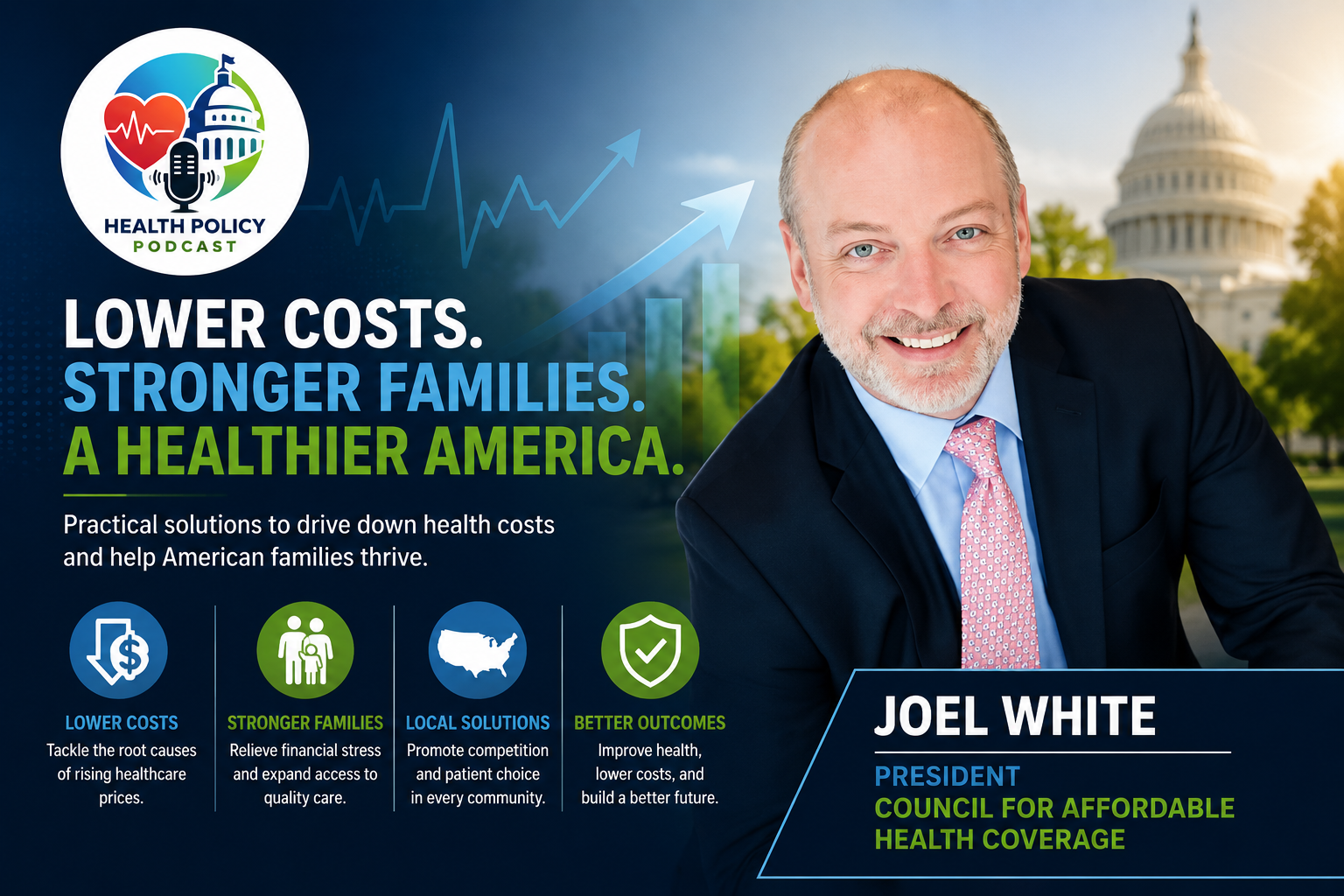
Health Policy Podcast episode featuring Joel White discussing Joel White on Healthcare Costs and Monopolies: A Call for Change

In the latest episode of the Health Policy Podcast, Joel White, president of the Council for Affordable Health Coverage, discusses rising healthcare costs and market monopolies. White highlights the significant increase in health insurance premiums compared to wages, attributing the issue to regulatory burdens, lack of competition, and the consolidation of healthcare providers and insurers. He emphasizes the need for transparency, consumer choice, and breaking up monopolies to improve affordability in the healthcare system.

Council for Affordable Health Coverage’s Joel White Discusses Healthcare Costs and Market Monopolies

0:00 / 0:00

Council for Affordable Health Coverage’s Joel White Discusses Healthcare Costs and Market Monopolies

Joel White Discusses Rising Healthcare Costs and Market Monopolies

In a recent episode of the Health Policy Podcast, Joel White, president of the Council for Affordable Health Coverage, addressed the escalating costs of healthcare in the United States and the role of market monopolies in this crisis. The discussion, hosted by Brian Hyde, highlighted the challenges American families face as healthcare expenses continue to outpace wages.

White, who has spent over two decades in Washington, D.C., emphasized that the typical American household is experiencing a significant affordability gap. Since 2000, health insurance premiums have increased by more than 300%, while wages have only risen by 100%. He projected that by 2032, Americans will spend 40% of their income on healthcare, up from the current 20%.

"The reason those costs are increasing are many," White said. He pointed out that the primary drivers of rising premiums are the increasing costs of healthcare services and prescription drugs. White noted that the cost of hospital services, physician visits, and medications has risen at rates significantly faster than wages or inflation.

White explained that the U.S. does not have a truly competitive healthcare market. He stated that 97% of hospital markets and health insurance plan markets are highly concentrated, with one or two companies dominating. This lack of competition allows these companies to set prices without constraints, ultimately burdening consumers.

The consolidation of healthcare providers and insurers has been exacerbated by regulatory changes, particularly the Affordable Care Act (ACA), enacted in 2010. White argued that the ACA inadvertently encouraged monopolies by creating a complex regulatory environment that favored larger entities. "The only way you could succeed and comply with all those regulations is if you got bigger," he said.

White criticized the ACA for not addressing the underlying affordability crisis, stating that it has instead contributed to the problem. He pointed out that the structure of the ACA incentivizes insurance companies to raise premiums, as any increase results in corresponding subsidies from taxpayers. "The more you subsidize an expensive system, the more expensive that system will be in the future," he added.

During his testimony before the Senate Committee on Homeland Security and Government Affairs, White outlined several principles aimed at restoring market competition in healthcare. He called for increased transparency in pricing, allowing consumers to shop for services based on cost and quality. He also advocated for giving consumers more agency in selecting their insurance plans, rather than being limited to government-approved options.

White proposed that instead of funneling taxpayer money to insurance companies, funds should be directed to consumers. He likened this approach to the Supplemental Nutrition Assistance Program (SNAP), where individuals receive assistance directly to purchase food.

Additionally, White urged lawmakers to enforce existing antitrust laws to break up monopolies in the healthcare sector. He expressed concern that the current system is rigged against consumers, stating, "We need to get back to free market principles and break up these vertically integrated monopolies."

As the conversation concluded, White encouraged listeners to engage with their representatives in Congress about their healthcare experiences. He stressed the importance of constituent voices in shaping policy, stating, "Congress listens to their constituents."

For more information about the Council for Affordable Health Coverage, visit their website at cahc.net.

Interview Q&A

Q&A: Council for Affordable Health Coverage’s Joel White Discusses Healthcare Costs and Market Monopolies

Q: Can you tell us about your background and your role at the Council for Affordable Health Coverage?

A: I am the President of the Council for Affordable Health Coverage, a coalition in Washington, D.C., focused on driving down health costs for American families. I have worked in Washington, D.C., for over two decades, including 12 years on Capitol Hill, where I was the staff director on the Ways and Means Health Subcommittee. I helped write several laws, including the health savings account law, which currently serves 67 million Americans.

Q: What are the current trends in healthcare costs in the United States?

A: Since 2000, health insurance premiums have increased by more than 300%, while wages have only increased by 100%. By 2032, the typical American is projected to spend 40% of their income on healthcare, up from 20% today. This rising cost is significantly impacting family budgets and the economy.

Q: What are the primary factors driving up healthcare costs?

A: The main drivers of rising healthcare costs are the increasing prices of healthcare services and prescription drugs. When these costs rise, insurance premiums also increase. Currently, these costs are rising at rates faster than wages or inflation, resulting in higher premiums for consumers.

Q: How do market monopolies affect healthcare costs?

A: The U.S. does not have a truly free market in healthcare; instead, we have localized monopolies. About 97% of hospital markets and health insurance plan markets are highly concentrated and uncompetitive. This lack of competition allows dominant health plans to set prices without constraints, leading to higher costs for consumers.

Q: What role does Congress play in the current healthcare landscape?

A: Congress has contributed to rising healthcare costs through regulatory burdens that favor larger companies. The Affordable Care Act, enacted in 2010, added layers of regulation that encouraged consolidation in the healthcare market, leading to fewer competitors and higher prices for consumers.

Q: What impact has the Affordable Care Act had on healthcare costs?

A: The Affordable Care Act has not alleviated the affordability crisis; instead, it has exacerbated it. The structure of the law incentivizes insurance companies to raise premiums, as they receive subsidies from the government for every dollar increase in premiums. This creates a cycle of rising costs without improving consumer value.

Q: What solutions do you propose to address these issues?

A: I propose several principles to return to free market healthcare. First, we need transparency in pricing so consumers can make informed decisions. Second, we should give consumers the agency to choose their plans. Third, we should allocate funds directly to consumers rather than insurance companies. Finally, we need to break up monopolies and enforce existing antitrust laws to promote competition.

Q: Can you elaborate on your testimony before the Senate Committee on Homeland Security and Government Affairs?

A: My testimony focused on the structural flaws of the Affordable Care Act, particularly how it incentivizes insurance companies to raise premiums. I outlined principles for reform, including transparency, consumer choice, direct funding to consumers, and breaking up monopolies in the healthcare market.

Q: How can individuals engage with their representatives regarding healthcare issues?

A: Individuals can engage with their congressional representatives by sharing their personal experiences with healthcare costs. Writing emails, visiting district offices, or using online portals to communicate concerns can influence policy decisions. It's important for constituents to express that the current system is not working for them.

Q: Where can people find more information about the Council for Affordable Health Coverage?

A: More information can be found on our website at CAHC.net. We also share content on Twitter at @C4AHC. We aim to make our information accessible to everyone.

Q: What is your perspective on the future of healthcare in the U.S.?

A: The current system needs a reset to prioritize free market principles. Addressing monopolies and promoting competition are essential to making healthcare more affordable and accessible for American families.

Key takeaways

  • Health costs are really crushing American families right now.
  • By 2032, the typical American is gonna spend 40% of their income just on healthcare.
  • We think that we have free market healthcare in the United States and we don't.
  • The only way you could succeed and comply with all those regulations is if you got bigger.
  • The fact is, when President Obama said we've got an affordability crisis in America, the answer was the Affordable Care Act.

About the guest

Joel-white-council-affordable-health-coverage

Joel White

PresidentCouncil for Affordable Health Coverage

Joel White is the President of the Council for Affordable Health Coverage (CAHC). As CAHC’s president, Joel leads a seasoned team of government affairs professionals while managing the coalition of more than 30 organizations representing patients, drug manufacturers, providers, employers, and other sectors committed to market-based reforms that lower costs for consumers. CAHC has helped enact a number of laws to lower health costs and advance market-based reforms, including small businesses and individual coverage reforms, drug cost reductions, consumer transparency, and expansion of HSAs. Joel’s dedication to advancing healthcare reform is unmatched. For over two decades, he has led various issue campaigns to lower healthcare costs, including reforming Medicare, improving small business health coverage, lowering drug costs, and promoting healthcare transparency. Joel is a sought-after health policy expert, frequently speaking at national events, testifying before Congress, and producing high-profile policy summits and briefings featuring White House officials, Cabinet Secretaries, and Members of Congress. His thought leadership has been featured in major media outlets, including the Wall Street Journal, The New York Times, The Washington Post, Forbes, National Journal, Politico, and more. Previously, Joel served as the Staff Director for the U.S. House Committee on Ways and Means, where he played a crucial role in enacting significant health policies, including the creation fo the Medicare prescription drug benefit and Health Savings Accounts. He also helped negotiate and pass key legislation such as the Deficit Reduction Act and the Tax Reform and Health Care Act. Joel is also the co-author of the book, Facts and Figures on Government Finance (1992), which brings together data on public finance at all levels of government, with comparisons of taxing and spending levels spanning half a century. He holds a BS in Economics from the American University.

Full transcript

Show full transcript
[00:00:00] Welcome to the Health Policy Podcast. I'm Brian Hyde. Today I'm joined by Joel White, who is president of the Council for Affordable Health Coverage. Joel, it's great to have you on the program. Welcome. Thanks for having me. It's great to be here. So, first of all, let's, let's talk a little bit about your background. If you don't mind, take a moment and tell us about, uh, who you are and what you do. Well, as you mentioned, I'm the President of the Council for Affordable Health Coverage. We're a coalition effort here in Washington dc. Our whole mission in life is to drive health costs down so that American families can prosper and focus on other things like education and housing and raising their kids and good things like that. Um, I've been in Washington DC for a couple decades. I worked on Capitol Hill for 12 years. I was the staff director on the Ways and Means Health Subcommittee at where I wrote nine different laws, primarily in the Medicare area. But, uh, if anyone listening has a health savings account, I helped write that law. And today, [00:01:00] 67 million Americans use a health savings account to better afford their coverage. And so healthcare costs and affordability have been a passion of mine. For many, many years, and I wish I could say we were doing a better job because health costs are really crushing American families right now. Yeah. You know, there are a lot of topics on which Americans will disagree, but if you say, boy, health costs are really going up, pretty much everybody's gonna nod their head and go, oh, you aren't kidding. Let's talk a little bit about, uh, about some of the reasons why, uh, the, the health costs continue to rise, and let's talk about what's being done as, as well. Um, let's start with. Why are we seeing such, such high prices when it comes to, to health? Well level set first. Um, so the typical American, uh, has health coverage, whether that's in their employer, through their employer or in the individual market through Obamacare or in Medicaid or Medicare. Uh, most people have employer [00:02:00] coverage. And there what we're seeing. Just since, uh, the turn of the century 2000, uh, premiums have increased more than 300%, three times, and wages have only gone up a hundred percent. So that's created this affordability gap. Where costs are rising faster than incomes, and it's eating up a bigger share of our family budgets. So by 2032, just a few years from now, the typical American is gonna spend 40% of their income just on healthcare. Right now, that number's 20%. So it's, it's getting worse. It's hurting families. It's hurting our economy and it's definitely hurting our, our federal budget, uh, finances. And so, um, the reason those costs are increasing are many. Um, but if you think about it this way, premiums by. Uh, insurance that pays for healthcare services and drugs, and the cost of [00:03:00] those services and drugs are the primary factor that are driving up those premiums. So when a hospital service or a physician office visit or a prescription drug gets more expensive. People pay higher premiums and the cost of those things have, uh, increased at, um, rapid rates over the past 10 years. Uh, this year they're going up about seven, 8% depending on the service, and that's a lot faster again, than wages or the economy or inflation. So that's the primary driver. The reason those costs are going up is because, uh, people get a little confused. We think that we have free market healthcare in the United States and we don't. What we have is, uh, localized monopolies all over the US in Idaho, where you are in Virginia, where I live in, uh, Maine, down to Florida. You can drive anywhere in this country and [00:04:00] never drive through a competitive hospital market. 97% of all hospital markets are highly concentrated uncompetitive. 97% of, uh, health insurance plan markets in Medicare are uncompetitive. Most local health insurance markets are not competitive. So in other words, you have a lot of, um, logos on a page, but one or two health plans dominate those markets. When they dominate those markets, they set the price. They control every aspect of a patient's care. Uh, when you go to a pharmacy, when you go to a doctor, they set the price and they pay for the service. And so when that happens, we don't have competition, we don't have any price constraints. The prices go up and we all pay the bill. So I'm sure this is a process that that took some time, uh, that in other words, we didn't just arrive at this state, uh, overnight. Help me [00:05:00] understand how did we get to the point where, where the free market, uh, yielded to, to monopolies like that? Yeah, we, we were pretty much there, uh, around 2010. And the other major factor that's driving up costs, uh, I don't wanna shock you or your listeners, but it's Congress and it's the regulatory burdens that Congress has placed on. Insurers, hospitals, doctors, drug manufacturers. So in 2010, Obamacare was enacted and that layered regulatory layer on regulatory layer on top of all these private sector actors. And basically what happened was the only way you could succeed and comply with all those regulations is if you got bigger. Right. Your scale helps you, uh, deal with all the regulatory complexity. And so they got bigger and what we saw since 2010 was just a massive increase in consolidation and this [00:06:00] market power that's now, it's like the big company versus the family. We're at the mercy of these monopolies now that are setting prices that are increasingly becoming unaffordable. So this year, the typical family is gonna pay about $30,000 in premiums, and then they've got a deductible on top of that. You know, $2,003,000 is the typical, but that's more than most people can afford and still get food and education and get to work, fill up their car with gas, et cetera. So these monopolies, um. You know, they're highly vertically integrated. So that's where the insurance company owns the pharmacy benefit manager, which controls all your drug costs, and then they own the pharmacy where you pick up the drug and then they own the physician office where you get the prescription. And a lot of times they own the clinic, uh, where you go see the doctor to get your services and sometimes they own. Part role of a [00:07:00] hospital. And so what that means is the person you're paying the premium to is paying everyone down that food chain that you're going to see, and they're setting a price for your service that is getting kicked back to the insurance company. So these massive, uh, in some cases, global insurers are, have rigged the system in a way to. Extract massive dollars from the typical American, and most people, and I, I talk to folks all over the country are saying, I'm paying a lot, but I'm getting a lot of friction. I'm not getting a lot of value. What am I getting for $30,000? That's, that's a cost of a new Chevy Trailblazer. Every year I'm buying a new Chevy Trailblazer. At least with a trailblazer, I can drive it around and get to work. But what am I getting from my insurance? I'm getting a lot of claim denials. I'm getting prior authorizations. I'm getting sent [00:08:00] to a pharmacy I don't wanna go to. I'm paying cost sharing on top of my premiums that I can't afford. Um, very low value. So I think what I'm hearing around the country is a lot of people saying, I'm frustrated with the system, the status quo isn't working for me. We need to change things up. I have to ask, uh, what to what degree are, are insurers playing a role in this? I mean, clearly Congress has some responsibility, but, um, is there some blame to be laid at the feet of the insurers? Oh, a hundred percent. They, they have organized their businesses as monopolies, as vertically integrated enterprises. Very intentional. Uh, to structure this way and to be able to set the prices and make money at every stage of the process. That was a very conscious business decision. Now that was in response to market forces and, and, you know, monopolies get big to extract a lot of money from people. We saw it with US Steel, we saw it with at and t where [00:09:00] they controlled long distance services and local connections. We're now seeing it in health insurance and in healthcare provider markets, hospitals and doctors. That was driven not just by markets though, and the desire to maximize profits, it was also done by law, by Congress, and I believe that was intentional too. So again, the regulations drove complexity that only big companies could. Comply with and succeed and make money. But they also said, if you get bigger, we're gonna reward you with higher reimbursements, lower input costs, like discounts on drugs, and we'll give you a subsidy on top of that that consumers can only use if they go to you, the compliant plan. So Congress rigged a system to, to kind of screw the little guy as well. Um, and that's what we're seeing right now is that people are locked into a system where they can only get [00:10:00] help if they go to the government preferred insurance company or the, you know, government preferred accountable care organization that's run by the big hospital. And a lot of times, uh, that's not the cheapest option and it's certainly not the most convenient, especially for folks in rural areas who maybe the pharmacist is the only provider in the area. Pharmacies aren't recognized in Medicare even though they're the lowest cost clinical option. So the whole system is kind of, uh, needs a reset in my opinion. We need to get back to free market principles and we need to break up these vertically integrated monopolies that are really, uh, causing a lot of the unaffordability problems in America. Uh, like we hear, talk about separation of church and state, it sounds like we need a separation of, of insurance or healthcare insurance and state. Talk to me about the, uh, the Affordable Care Act, um, also known as as Obamacare. Um, [00:11:00] it was sold on the premise that, hey, this is going to make your, your costs manageable. I don't think I've heard anybody say, you know, wow, this sure has helped me. In fact, I hear the opposite. Yeah, the, the fact is, you know, when, when, uh, president Obama said we've got a, a affordability crisis in America, um, the answer was the Affordable Care Act. And really it was gasoline on the fire, uh, of the unaffordability, uh, problem. And, you know, several things again happened at the same time. It encouraged the monopolies, which raised the prices. It also, the structure, you know, there was a lot of debate last year over extending these bonus subsidies for Obamacare. Not the, the underlying subsidies remain in, in place in law, and folks under 400% of poverty four times the poverty level continue to be subsidized. But the bonus [00:12:00] subsidies that Congress enacted on a temporary basis during COVID. At the end of the year and the Democrats actually shut the government down and said we we're gonna end the government. If you don't provide subsidies to anyone above four times the poverty level, you know, people making a hundred thousand, 200,000, 400,000, $500,000 a year should get a subsidy paid for, by the way, by taxes on people who work at gas stations and gyms and restaurants and things like that. Um. They reopened the government. They didn't extend those bonus subsidies. And we have, uh, 23 million people enrolled in Obamacare this year. That's about a million less than last year, so they shut the whole government down. We didn't extend the subsidies and people still signed up. That's because most people on Obamacare, 93% get a subsidy. Okay? Now those subsidies go directly to the insurance company. If [00:13:00] they raise their premium, they get another subsidy dollar. It doesn't come out of the consumer pocket, it comes out of the treasury. It comes outta taxpayers. So they have every incentive to raise their price, their premium, 'cause it's subsidized dollar for dollar. The other thing that we're starting to see with these big, uh, monopolies is because the insurance company owns the doctor. They're required. The insurance company has to pay at least 20 cents of every dollar out in a medical claim. It's called the medical loss ratio. And what we're starting to see insurance companies do is buy doctors and then pay their doctors more to avoid, uh, paying out more in medical claims and more medical benefits to consumers. So again, screwing the little guy, the consumer. They can pay their own doctor employees more. And guess where that profit goes? It goes to the [00:14:00] insurance company. So the interesting thing in DC when we had this debate over extending these bonus subsidies, pretty much it was the insurance companies and the Democrats arguing we should extend the subsidies. And you know, I don't wanna draw too many direct lines here, but, uh, the insurers are heavily invested in Democrats. From a contribution standpoint. Um, and, and the Democrats kind of had their back to the point where, like Congressman Frank Palone, the ranking member of the Energy and Commerce Committee said, it's not your fault, but premiums are going up. It's not your fault. Well, it is, it, it's, there's shared blame enough to go around here. It's the, it's the insurers, the hospitals, the doctors, like we all, we all gotta recognize that, um, we have rigged this system to drive prices and costs ever higher. And subsidized it. And the more you subsidize an expensive system, the more expensive that system will be in the future.[00:15:00] Joel, talk to me about, uh, your testimony before the Senate Committee on Homeland Security and Government Affairs, uh, permanent subcommittee on investigations back in December. Uh, what, what did you talk about? Yeah, the, the, uh, Senator Ron Johnson chairs that committee from Wisconsin and, um. He wanted to get at the underlying problems with Obamacare and it's structurally flawed, right? Like the things I mentioned, like where if a, an insurance company raises a premium, uh, by a dollar, they get a dollar from the taxpayer. That's a structural design flaw. What we want is an incentive for the insurance company to lower their premium, and maybe they make more money doing that versus raising their premiums. So. He had two hearings, actually one in November where I testified, and then he invited me back in December to testify. So the first hearing was about those structural problems. And the second, um, hearing was really about, okay, so if we have established we've got a problem, what do we do [00:16:00] about it? And what I laid out were, uh, four, uh, five principles, um, to really address how we get back to free markets. And, uh, I'll just go through a couple. The first thing we need is transparency. Okay? You would never go to a gas station and fill up your car if you didn't know what the price per gallon was, but we do that every day in healthcare. Every day we go to the doctor's office, they don't know what it costs me. I don't know what it costs me. No one knows what it costs me until after I see the doctor. Well, guess what? They charge me more because there's no incentive. For me to shop around. So transparency empowers me to know what the price is and the quality before I actually shop for a service. And 75% of services, uh, for the typical consumer are shoppable. So that's foundational. We need to know what it costs. The second thing, um, and this was really the law, uh, [00:17:00] said, the second principle is give people agency. And what I mean by that is. Allow families and consumers to choose the plan that works best for them. Right now, the law says if I get help, if I get a subsidy, I have to go to the plan the government has picked. And if I'm in Medicaid, the state picks that plan for me. Whether it works for me well or not. What we're saying is give people choice. Let them pick any plan that's approved for sale in the marketplace. Idaho has an insurance commissioner. That insurance commissioner has approved a bunch of plans in every market in America. There's a cheaper plan for a consumer than Obamacare, but the law says you can't go there, so let's free people up, give 'em choice. The third thing is really what President Trump has talked about, and that is instead of taking, uh, trillions of dollars, we're gonna spend [00:18:00] $18 trillion over the next 10 years and send it to insurance companies, very profitable insurance companies. Instead of sending $18 trillion to insurance companies over the next 10 years, let's send that money to consumers. Let's give the money to people, not companies. Let the people pick where to go and spend that money. The analogy here is snap. So a lot of people need food help and assistance. We don't give the money to the grocery store. We give the money to the person and they go and buy the food they want. Uh, at the grocery store they pick. That's the model. Give people the money, not the company. Uh, and then the fourth thing, uh, really to get us back on track is to break up these monopolies. And, and really I think what, what we haven't done well is use the laws on the books, the Sherman Act, the Clayton Act, the FTCs authority to police the [00:19:00] market and say monopolies are bad for consumers. We need to break these guys up and get back to a free market, uh, healthcare system in America. Again, we're talking with Joel White, who's president of the Council for Affordable Health Coverage. Um, Joel, where can people go to, to access your website, learn more about your organization? Yeah. If you go to our website, it's CAHC. Or sorry, net, N-E-T-C-A hc.net. Um, and if you go to Twitter, it's at c, the number four a hc, and we try and put out a lot of content. We try and make it really accessible to, to everyone. Um, and I would say the best thing that folks can do, okay, I worked for Congress for 12 years and a lot of people never believe me when I say this, but I'll say it. [00:20:00] Congress listens to their constituents, okay? They don't always vote with you. Um, because they're listening to other constituents and there's a divide in this country. Take the time and effort to write your member of Congress. Send 'em an email, go on their website. They have portals weigh in when they're, uh, when congress isn't in session. They're typically back at home in their districts. They've got a district office set up a time to go talk to your member of Congress and say, I just wanna share my experience with you. I'm not sure what to do about it, but I'm getting crushed by healthcare costs. And I can tell you the Obamacare's not working for me. Medicare seems to be a mess right now. Medicaid never lets me choose the doctor or the plan that I want. This is a mess. You need to do something about this. And I don't think the answer is the government should run everything. Uh, otherwise we'd have government gas stations on every corner. You're here. Again, we're talking with Joel White, who is [00:21:00] president of the Council for Affordable Health Coverage. Joel, thank you so much for joining us today on the Health Policy Podcast. Appreciate being here. Thanks. I.

Filed under