Thursday, May 28, 2026 · The Health Policy Podcast
Health Policy Podcast logo
← Health Policy Podcast

2026-03-24 · National Taxpayers Union

Pete Sepp on Urgent Medicare Reforms and Taxpayer Advocacy Needs

with Pete Sepp, President — National Taxpayers Union
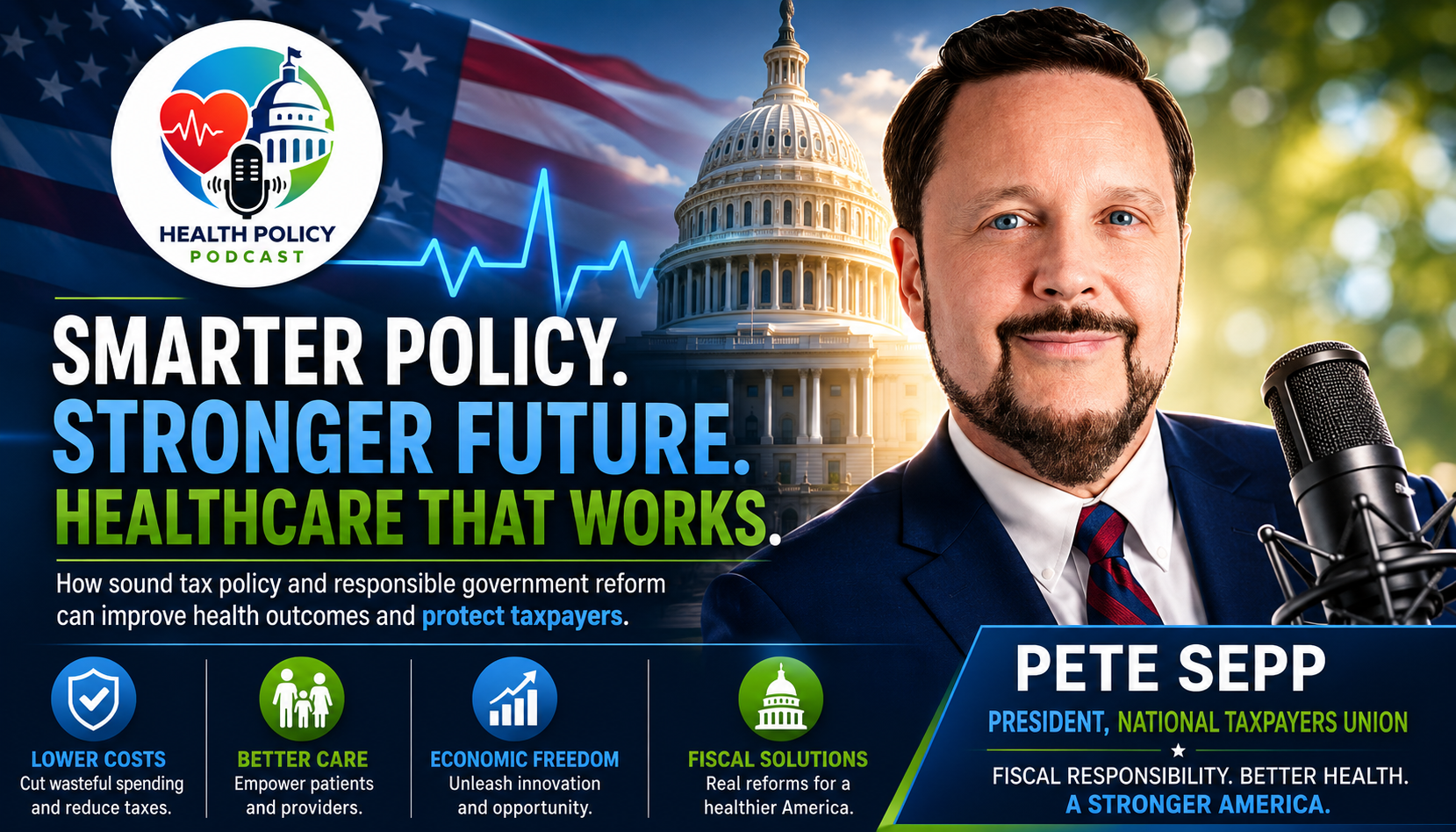
Health Policy Podcast episode featuring Pete Sepp discussing Pete Sepp on Urgent Medicare Reforms and Taxpayer Advocacy Needs

In the latest episode of the Health Policy Podcast, Pete Sepp, President of the National Taxpayers Union, discusses the urgent need for Medicare reforms and taxpayer advocacy. Sepp highlights the impending financial crises facing Medicare and Social Security, emphasizing the necessity for legislative changes, such as the bipartisan No UP Code Act, to address issues like upcoding in Medicare Advantage plans. He urges taxpayers to recognize the looming challenges and get involved in advocating for fiscal responsibility and healthcare reforms.

National Taxpayer Union President Pete Sepp on the Urgent Need for Medicare Reforms and Taxpayer Advocacy

0:00 / 0:00

National Taxpayer Union President Pete Sepp on the Urgent Need for Medicare Reforms and Taxpayer Advocacy

National Taxpayers Union President Calls for Urgent Medicare Reforms

Pete Sepp, president of the National Taxpayers Union (NTU), emphasized the urgent need for reforms in Medicare and other federal health programs during a recent interview on the Health Policy Podcast. Founded in 1969, the NTU advocates for lower taxes, reduced government spending, and economic freedom.

Sepp highlighted the impending financial crises facing Medicare and Social Security, warning that the Medicare Part A trust fund could become insolvent by 2033. If this occurs, beneficiaries may face an 11% cut in benefits, which he described as a significant burden for seniors and taxpayers alike. He noted that this situation is exacerbated by the rising costs of Medicaid, which is projected to grow by an average of 4% annually, placing additional pressure on the federal budget.

"The clock really is running down on taxpayers and patients," Sepp said. He urged listeners to recognize the urgency of these issues, particularly for those who may soon rely on these programs.

Medicare Reforms and Legislative Proposals

Sepp discussed the "No Unreasonable Payments, Coding or Diagnoses for the Elderly" (No UP Code) Act, a bipartisan bill aimed at addressing the problem of upcoding in Medicare Advantage plans. This legislation, sponsored by Senators Bill Cassidy of Louisiana and Jeff Merkley of Oregon, seeks to ensure that insurance companies receive payments based on accurate health assessments rather than inflated diagnoses.

Currently, insurers can receive higher payments by overstating the health risks of their enrollees. Sepp stated that this practice costs the Medicare system approximately $40 billion annually. The No UP Code Act proposes requiring two years of diagnostic data and mandates that patients see a doctor in person to confirm their diagnoses.

"This is a matter of common sense," Sepp said, arguing that the bill would not only help control costs but also improve the quality of care for patients.

Challenges in Congress

Sepp acknowledged that there may be resistance to the No UP Code Act from those benefiting from the current system, including some insurers and hospitals. However, he expressed optimism about the growing recognition among lawmakers that reforms are necessary.

"There is renewed and increased interest in solving this upcoding problem," he said. Sepp believes the legislation could be included in future budget reconciliation processes or pass as a standalone bill due to its bipartisan support.

Broader Implications for Federal Programs

In addition to Medicare, Sepp pointed out that Social Security is also facing financial challenges, with potential benefit cuts looming in the coming years. He noted that while there are various levers to extend the life of Social Security, healthcare programs are more complex due to their interconnectedness with other federal initiatives.

Sepp also mentioned the Highway Trust Fund, which is projected to be depleted by 2028, highlighting the urgency of addressing multiple federal funding issues.

Call to Action for Taxpayers

Sepp urged taxpayers to engage with the NTU and advocate for reforms that protect their interests. The NTU has a long history of involvement in taxpayer issues at local, state, and federal levels, including efforts to limit taxes and improve IRS oversight.

"Our message is that there are people standing up for taxpayers," Sepp said. He encouraged individuals to visit the NTU website at NTU.org for more information on how to get involved.

As the financial challenges facing Medicare, Social Security, and other federal programs become increasingly pressing, the NTU aims to raise awareness and drive legislative action to ensure the sustainability of these vital services.

Interview Q&A

Q&A: National Taxpayer Union President Pete Sepp on the Urgent Need for Medicare Reforms and Taxpayer Advocacy

National Taxpayer Union President Pete Sepp on Medicare Reforms and Taxpayer Advocacy

Q: Can you tell us about the National Taxpayers Union?

A: The National Taxpayers Union is a nonprofit, nonpartisan citizen group founded in 1969. We advocate for lower, fairer, and simpler taxes, reduced government spending, and economic freedom at all levels. Healthcare in America is a significant part of our fiscal policy agenda.

Q: What are the current priorities for the National Taxpayers Union regarding health policy?

A: One of our top priorities is addressing the financing problems of Medicare and Social Security. The Medicare Part A trust fund is projected to go broke by 2033, which could lead to an 11% cut in benefits. This situation requires urgent attention from taxpayers and policymakers.

Q: What are the implications of the Medicare funding crisis?

A: If the Medicare Part A trust fund becomes insolvent, seniors would face significant cuts in benefits. Additionally, taxpayers may be pressured to increase payroll taxes to cover the shortfall, which could negatively impact the economy.

Q: Can you explain the No UP Code Act and its significance?

A: The No UP Code Act, or Senate Bill 1105, aims to address the issue of upcoding in Medicare Advantage plans. Insurers currently receive fixed payments based on reported health risks, incentivizing them to overstate patient diagnoses. This bill seeks to ensure that payments are based on accurate, verified diagnoses, potentially saving the Medicare system $40 billion annually.

Q: How does the No UP Code Act improve patient care?

A: By requiring in-person doctor visits for accurate diagnoses, the No UP Code Act not only addresses financial waste but also enhances the quality of care for patients. This approach ensures that those who genuinely need help receive appropriate medical attention.

Q: What challenges does the No UP Code Act face in Congress?

A: There is resistance from those who benefit from the current system, including insurers and some hospitals. However, there is a growing recognition that reforms are necessary, and the bipartisan nature of the bill may help it gain traction.

Q: Are there other federal programs facing similar financial challenges?

A: Yes, Social Security also faces significant funding issues, with potential benefit cuts on the horizon. Additionally, the Highway Trust Fund is projected to be depleted by 2028. These programs require urgent reform to prevent breakdowns during the terms of elected officials.

Q: What can be done to prioritize these issues for elected officials?

A: It is crucial to communicate the urgency of these financial challenges to elected officials. As the clock is ticking on these programs, it is not just a fiscal issue but a moral imperative to ensure that vulnerable populations are not adversely affected.

Q: How can individuals get involved with the National Taxpayers Union?

A: Individuals can engage with the National Taxpayers Union by participating in our advocacy efforts, supporting our initiatives, and staying informed about taxpayer issues. We have a variety of programs focused on tax administration, IRS oversight, and budgetary reforms.

Q: What resources does the National Taxpayers Union provide?

A: We offer resources such as the Better State Budgets project and the Taxpayer's Budget Office, which focus on budgeting and fiscal policy issues. Our team includes lobbyists, researchers, and litigators dedicated to protecting taxpayer interests.

Q: What is the website for the National Taxpayers Union?

A: Our website is NTU.org, where individuals can find more information and resources related to taxpayer advocacy.

Key takeaways

  • The hidden problem here is that healthcare systems face an even bigger crisis at the federal and state levels in their financing.
  • Medicare Part A is projected to go broke in 2033, which will necessitate an immediate 11% payment cut in Medicare Part A benefits.
  • We can't afford the cookie cutter approach anymore, and we're not out to deprive seniors of the healthcare they need.
  • It's a moral imperative. Do we want huge cuts in these benefit programs that many seniors, many veterans, many folks living paycheck to paycheck won't be able to afford?
  • It's no longer something that is well over the horizon. It's a good six years from now, and that's it.

About the guest

Pete-sepp-ntu

Pete Sepp

PresidentNational Taxpayers Union

As NTU President, Pete Sepp leads the non-profit, non-partisan National Taxpayers Union’s (NTU’s) government affairs, public relations, and development activities. Pete also oversees strategic planning for NTU and its staff, and supervises the research and educational operations of the National Taxpayers Union Foundation (NTUF). Since beginning his service with NTU in 1988, Pete has written and edited numerous policy papers, informational publications, and activist manuals, as well as studies on topics such as Congressional perquisites, citizen-initiated tax revolts, antitrust and competition regulation, and Pentagon spending. He has testified before Congress on matters ranging from Government-Sponsored Enterprises in lending to Medicare and federal pension reforms, from underground infrastructure to small business taxpayer concerns. He has lectured in the U.S. and abroad on issues such as tax administration reform, and has lobbied on numerous legislative matters including the IRS Restructuring and Reform Act and successor proposals, the Balanced Budget Constitutional Amendment, and the Whistleblower Protection Enhancement Act. Pete has appeared on every major television network, and regularly provides interviews and commentaries to cable channels such as CNN, CNBC, and the Fox Business. He is a frequent guest on radio programs from coast-to-coast, and has been widely featured in print media, including The New York Times, the Chicago Tribune, U.S. News & World Report, The Washington Post, The Wall Street Journal, USA Today, Forbes, and Money Magazine. Pete graduated cum laude from Webster University in St. Louis, MO with a degree in History and Political Science. Before coming to NTU, Sepp served with the St. Louis County Board of Elections and with a U.S. Senate campaign.

Full transcript

Show full transcript
[00:00:00] Welcome to the Health Policy Podcast. I'm Brian Hyde, and today I'm joined by Pete Sepp. Pete is President of the National Taxpayers Union. Pete, it's wonderful to have you on the podcast. For those meeting you for the first time, could you take a moment, just tell us a little bit about yourself. Well, sure. I really appreciate your having me on. National Taxpayers Union is a nonprofit nonpartisan citizen group. We were founded back in 1969 to work for lower fairer, simpler taxes, less wasteful government spending and economic freedom at all levels. Healthcare in America actually encompasses all. Of those things, government spending, taxes and economic freedom. So it is a very important component of our own fiscal policy agenda here at NTU. Well, and it seems like we hear a lot about health policy in Congress and in particular, I believe there, there were a couple of, uh. Pieces of, of health policy that, [00:01:00] that you wished to cover. Um, tell me about, uh, what is at the, the top of your priority list right now and, and why this needs to be, you know, on more people's radar screens. Yeah, sure. Well, we often hear, for example, about social securities financing problems. The fact that the so-called trust fund for the old age of retirement system is not going to be able to pay out all of its obligations very soon. In fact, in 20 32, 6 years from now, we may be facing a benefit cut in social security of about 28%. The hidden problem here is that healthcare systems face an even bigger crisis at the federal and state levels in their financing. The Medicare part, a trust fund that provides hospital insurance. That has only one extra year of life beyond social [00:02:00] securities trust fund. Currently, part A is projected to go broke. In other words, not be able to pay out all of its obligations in 2033. That will necessitate an immediate 11% payment cut in Medicare Part A benefits. That would be really an incredible adjustment for seniors to have to make, for the government, to have to make. And of course there will be a lot of pressure on taxpayers to make up that difference, and instead of cutting benefits, raising taxes. By 11% on the payroll tax that currently funds Medicare. That would be a huge hit to the economy. After we've been going in roughly the right direction with income tax reductions, um, we would suddenly see a big jump in the payroll tax. We also have problems in [00:03:00] Medicaid, even after the one big beautiful Bill act that passed in 2025, kind of slowing the growth rate of federal Medicaid expenditures with a number of reforms. Well, Medicaid's gonna keep growing. Uh, that's kind of the hidden story here, that even with everything that so-called one big, beautiful Bill did last year, Medicaid on the federal level is gonna grow by an average of 4% a year. In the foreseeable future, those are all putting huge pressure on the rest of the federal budget. Healthcare is more than a quarter of federal expenditures right now, and that even assumes that those so-called premium tax credits, the Obamacare subsidies that were in the news at the end of last year. That the more generous ones from the COVID era expired. This is a lot of gloom and doom, [00:04:00] and I hate to bring it, uh, to all of those who subscribe to your podcast, but it's vitally important. We understand that this time the clock really is running down on taxpayers and patients here. Well, and it, it sounds like, yo, well, six years, that is so far away. No, it's, it's really not. And, and for people who maybe aren't even on those roles at this time, um, but will be, you know, in another four to five years, um, this is gonna be a big deal. I'm, I'm looking. That's funny. I'm looking at an op-ed that was, uh, written by one of your colleagues, Al Alexander Cone, about, uh, this one bipartisan bill would cut billions in Medicare waste. And I'd like to just kind of have you walk me through, uh, some of the things that, uh, that Alexander covers in, in this article. Um, clearly there are some reforms that are needed. Um, let's talk about where, where those kind of things have to or have to begin, you know, starting with Congress. Sure, sure. Well, the [00:05:00] centerpiece and, uh, this is just one of many reforms really, that we should be contemplating in this Congress is something called the no unreasonable payments, coding or diagnoses for the elderly or No UP Code CLEVER Acronym act. Uh, this is, uh, Senate Bill 1105. It is. Bipartisan sponsored by Senators Cassidy. Uh, Cassidy being from Louisiana, Merkley being from Oregon, and what this attacks is a problem with, uh, private insurance companies that participate in Medicare Advantage or Medicare Part C. What is currently happening is that insurers receive fixed monthly payments from the government based on the reported. Reported health risks of their enrollees. Well, Medicare Part C Medicare Advantage is supposed to offer a [00:06:00] kind of flexibility that traditional Medicare part A just can't provide. Yeah. But the problem is. By allowing companies to receive these monthly payments based on, again, reported health risks rather than actual health risks, it incentivizes them to overstate patient diagnoses. They can upcode a patient's diagnose. By a home healthcare visit or simply by some doctor reviewing a patient's charts and saying, well, I don't know. This moderate diabetes might actually be severe diabetes. Let's give them that diagnosis, and then suddenly the insurance companies are getting a bigger payment without really examining the patient in person to determine whether they really. Have a severe condition. The [00:07:00] average, uh, problem here, the cost that we're talking about is something like $40 billion more a year due to this upcoding alone to the Medicare system, 40 billion. Just from this problem, we can't afford it. We have got to do something to address it, and this bill does so. Pete, one of the things that strikes me as you describe the, the situation there is that, uh, the taxpayers are the ones who are on the hook for this. Um, but it seems like congress, I, Congress seems awful agreeable with these private insurance companies, you know, to, to take it on, on good faith that, well, you know, the information they're giving us, sure we can still give them the money. Um, it seems like there's an incentive there. Um, not so much for accuracy, but uh, just for. Keeping it going. I wanna use the word scheme, but I feel like that might be a little too harsh. Yeah, it's, it's kind of a cookie cutter approach, and we can't [00:08:00] afford the cookie cutter approach anymore, and we're not out to deprive six seniors of the healthcare they need. We, that's the whole purpose of the Medicare system, parts A, B, C, and D. And so. What the No Up Code Act does is say, okay, we're going to trust medical judgment. We just want a little more verification here. In other words, um, Medicare Advantage Payments being based on just one year of a patient diagnosis. Well, the No UP Code Act would say we want two years of diagnostic data and instead of just reviewing a patient's chart and making a judgment. That their condition gets upgraded to a more costly diagnosis. The patient simply has to see a doctor in person to make sure that the diagnosis is accurate. Those are really simple common sense steps that we can and [00:09:00] should take, not only to help patients. I mean, they'll benefit by seeing a doctor in person rather than having their diagnosis done from a chart. But taxpayers will benefit too. We'll start to get at that $40 billion a year excess cost, and will lengthen the life of the Medicare program as a result. Will this also make sure that the people who actually need help. We'll, we'll have help as opposed to, um, you know, the, I guess the, the insurance companies just, uh, continuing to, hey, we're doing really well under this system. And, and if it happens to help, you know, if some of the insured, that's great, but it, it seems like that's kind of a secondary thought. I think it will because when you require a real life doctor to see the patient in person and make an honest diagnosis, who knows what other kinds of things might come out about the patient that's simply [00:10:00] reading a chart. Or doing a home health visit from someone who's not a doctor would never reveal. I mean, that's the other point of this, is to improve the quality of the care And no UP Code Act can do that. So tell me about, uh, how is the No UP Code Act being received, uh, so far in, in Congress are, are they having an easy time finding, um, co-sponsors or people to help carry this forward? Is there resistance for that matter? Well, of course, those who benefit from the current system are indeed going to resist any changes. And, uh, that would be insurers and, uh, to some degree even hospitals who, uh, are already claim that they are overloaded with, uh, Medicare patients. There are doctor shortages in certain areas, so on and so forth. But there is a rec, a recognition. I think that something has to change in the Medicare system and we've got to [00:11:00] start making the changes now. So we have that window, it's shrinking. Uh, we're down to six years now for Medicare Part A, but even that window will give us time to implement these changes in a gradual and rational manner. So. There is renewed and increased interest in solving this upcoding problem and in this legislation. I think that if Congress decides to do another budget reconciliation process like they did last year, which, uh, passed that one big beautiful bill act. This would be a prime candidate to include in it if the reconciliation process fails, because it's always driven by the party in power, in this case, the Republicans, well, it's got bipartisan pedigree. Maybe it can either hit a ride on another bipartisan bill or it could even go [00:12:00] through Congress on a standalone basis. It's that important that we start doing reforms like these and there are other reforms. Are there other, um, programs that, that likewise are, are facing, um, a kind of a, a financial countdown similar, uh, to, to Medicare? Um, I, I'm just curious, what's the health of some of the other, you know, federally funded, uh, programs? Well, social Security, which I spoke about earlier, is in a similar bind. Now, the advantage we have with Social Security Reform is that we are much more familiar with the levers that can be pulled to extend the life of the program. You can raise the retirement age, you can. Raise the ceiling at which you stop paying payroll taxes so that there's a little more revenue coming in. Um, you can change the formula [00:13:00] for indexing, uh, the annual benefit for inflation right now. They use a form of consumer price index that's, uh, pretty generous. Uh, for taxpayers. Our tax brackets are indexed to something called chained Consumer Price Index. If we did that for social security, we could get a lot of savings, and that would mean no benefit cut. It would just mean perhaps we have a more accurate measurement of benefit increases in the future. With healthcare, there are so many more levers. There's payment systems for hospitals and insurers. There's the type of care the government will cover. Uh, there are veterans programs, senior programs, there's Medicaid. All of these interact in various ways and. It is very difficult to unravel them. That's the real challenge with the [00:14:00] healthcare programs. I also point out, uh, the clock is ticking on something called the Highway Trust Fund. Uh, that is a fund that, uh, gasoline taxes and, uh, a few other taxes are put into to provide, uh, resources for surface transportation, roads, bike paths, what have you. And, uh. That trust fund, unfortunately, will be depleted by 2028. So that's two years. I mean, any way you look at this. And, uh, th this just occurred to me when I read the headline, the US Senators who are standing for election in this cycle in 2026, because they serve six year terms. All of the programs I spoke about will have. Real problems, breakdowns during their terms. The senators we elect in this [00:15:00] November election will be facing all of these crises. So I'm curious, how do we shift, uh, those who are going to be elected, um, how do we shift this into, into a, a high priority for them? I, part of me understands. Yeah. It's easier to kick the can down the road. We'll do a continuing resolution. We'll do something else. We'll push it off for somebody else. It, it sounds like we're, we're approaching a point where pushing it off to the future is no longer going to be an option. That's right, and it's a matter of compassion. Now, as someone who's been with National Taxpayers Union for 37 years, we've been sounding the warning cry year after year on behalf of taxpayers. Well, it's not just a fiscal policy matter anymore. It's a moral imperative. Do we want. Huge cuts in these benefit programs that many seniors, many veterans, um, many folks who are [00:16:00] living paycheck to paycheck won't be able to afford. Do we want tax increases that would be very hard to afford for still other folks? It, it's something that is going to be very personal very quickly, and you're right about the inability to kick the can down the road because we can now see the end of the road. Cliff it. It's no longer something that is well over the horizon. It's a good six years from now, and that's it. It could be less as the economy fluctuates, or the finances of the program might fluctuate. So let's, uh, let's shift and, and we just have a few minutes left here, but talk to me a little bit, uh, if you would, Pete, about what the, the National Taxpayers Union, um, does, how people who with whom this re this message resonates. How they can get involved, uh, to help you guys do what you do. Sure, sure. Well, as I said, we have a 55 [00:17:00] plus year history of involvement in taxpayer issues at the local, state, and federal levels. That includes ballot measures to limit taxes or spending at the state level. Uh, we've had successes in places like Colorado, Missouri. Even Massachusetts in California, if you're interested in the way taxes are administered, not just the levels of tax, but how the IRS treats its citizens. Well, we have a whole program of IRS oversight as well as a public interest litigation arm that tries to set precedents in court that will protect taxpayers. Um, if you're interested in the nitty gritty details of. Budgeting. Uh, we have the Better State Budgets project, uh, as well as the taxpayer's budget office, which get into technical, but vital issues about how lawmakers score various bills that are [00:18:00] moving through Congress or how state budget, uh, predictability can be improved. So we do the pragmatic, we do the technical. We do the 30,000 feet, we go into the weeds when necessary with a team of lobbyists and researchers and litigators who are all working for taxpayers. This is a message that I hope reaches the ears of every person who either is working on or has just finished working on their, their yearly taxes. 'cause they need to know that there's someone who's standing up for 'em. And it sounds like National Taxpayers Union is, is, is all about that. Uh, what is your website? It's NTU, our initials for National Taxpayers Union n nt.org. Again, we are talking with Pete Sepp. He is the president of the National Taxpayers Union. And Pete, thank you for coming on the Health Policy podcast today. My pleasure. Hope to see you again soon.

Filed under