Thursday, May 28, 2026 · The Health Policy Podcast
Health Policy Podcast logo
← Health Policy Podcast

2026-05-12 · The Brokerage, Inc.

Mike Smith Explores If Obamacare Is the ‘Unaffordable Care Act’

with Mike Smith, President Emeritus — The Brokerage, Inc.
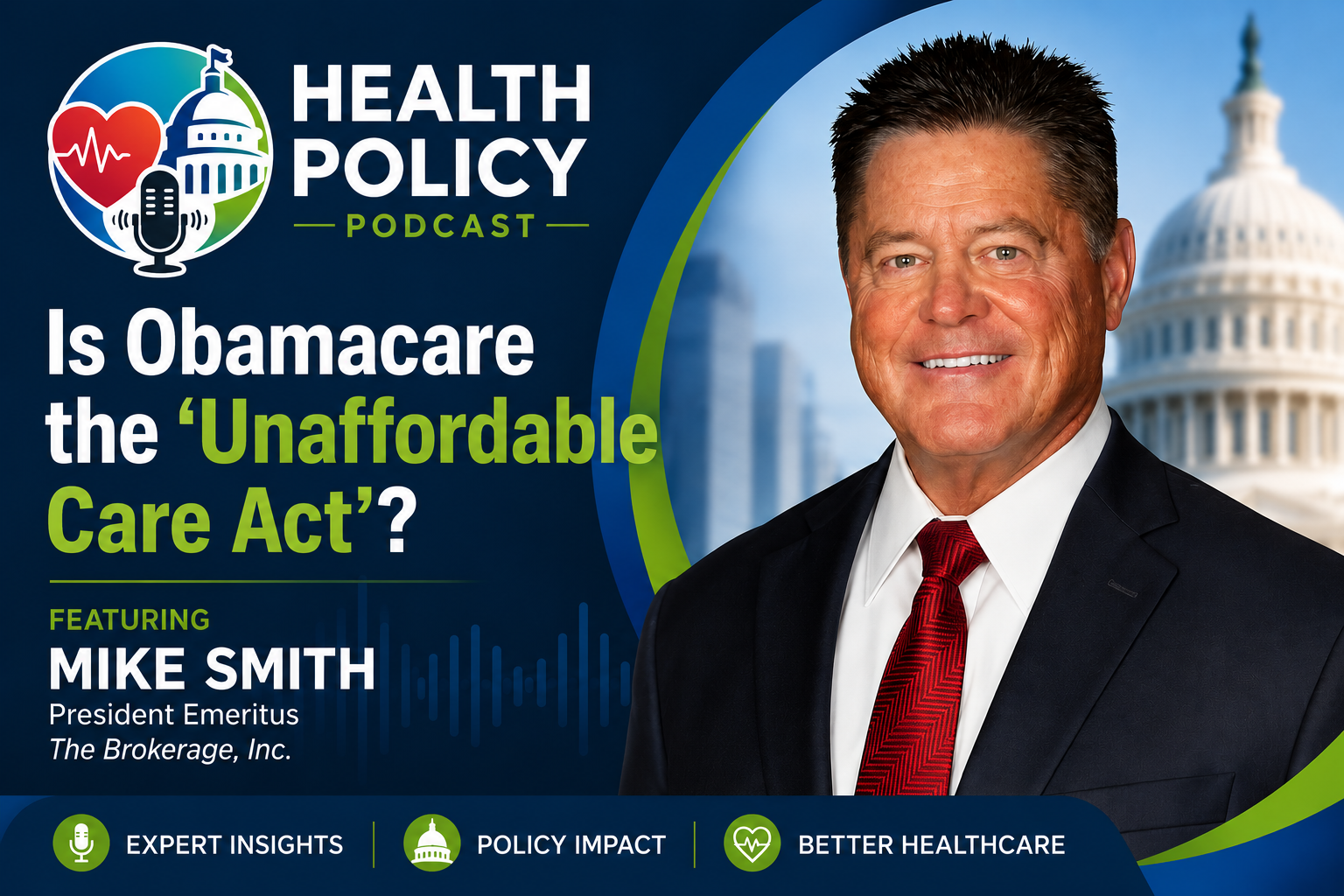
Health Policy Podcast episode featuring Mike Smith discussing Mike Smith Explores If Obamacare Is the ‘Unaffordable Care Act’

In the latest episode of the Health Policy Podcast, host Brian Hyde interviews Mike Smith, President Emeritus at The Brokerage, Inc., about the Affordable Care Act (ACA) and its implications for health insurance in the United States. Smith discusses the ACA's initial promises, the challenges it has faced, including rising premiums and the impact of enhanced premium tax credits, as well as the potential future of health care policy in America. He emphasizes the need for innovative solutions and possible government partnerships to address ongoing issues in the health insurance market.

Mike Smith: Is Obamacare the ‘Unaffordable Care Act?’

0:00 / 0:00

Mike Smith: Is Obamacare the ‘Unaffordable Care Act?’

Mike Smith Discusses the Affordable Care Act's Impact on Health Insurance

In a recent episode of the Health Policy Podcast, Mike Smith, President Emeritus at The Brokerage, Inc., shared insights on the Affordable Care Act (ACA) and its long-term effects on the U.S. health insurance landscape. The discussion, hosted by Brian Hyde, highlighted the ACA's promises, challenges, and the current state of health insurance in the United States.

The ACA, signed into law in March 2010, aimed to reduce the number of uninsured Americans and make health insurance more affordable. Smith noted that before the ACA, approximately 48 million Americans lacked coverage. The law was intended to provide comprehensive insurance plans and allow individuals to keep their existing doctors. However, Smith emphasized that the reality has diverged significantly from these promises.

Smith explained that the ACA's rollout faced significant hurdles, particularly with the launch of healthcare.gov in January 2014, which was plagued by technical issues. Despite these challenges, the ACA did lead to millions of people obtaining insurance for the first time. However, many of these newly insured individuals lacked basic knowledge about health insurance, necessitating extensive education efforts from brokers and insurers.

As the years progressed, insurance companies began reporting substantial losses, with some exiting the market entirely. Smith pointed out that between 2015 and 2018, many large insurers withdrew due to financial pressures. Yet, he noted a resurgence of some companies returning to the market post-2018, coinciding with the introduction of enhanced premium tax credits during the COVID-19 pandemic.

Despite these subsidies, Smith highlighted a troubling trend: base premiums for ACA plans more than doubled from 2014 to 2020. He referred to the ACA as the "Unaffordable Care Act" due to the significant premium increases experienced by many consumers. The expiration of enhanced subsidies in December 2025 led to further premium hikes, prompting some individuals to drop their coverage and return to the uninsured population.

Smith shared that the impact of these changes has been mixed across states. In Texas, for example, the anticipated drop in coverage did not materialize as expected, with the state reportedly gaining insured individuals. Conversely, states like North Carolina and Ohio saw significant losses in coverage.

Looking to the future, Smith expressed concern about the sustainability of the current health insurance model. He noted that while some insurance companies are exploring innovative solutions, there is no "magic bullet" to resolve the ongoing challenges. He warned that without a viable solution, the U.S. may face pressure to adopt a national healthcare system.

Smith acknowledged the political implications of the ACA, suggesting that its design may have been intended to pave the way for a national healthcare system. He pointed out that while many individuals gained access to necessary healthcare services, the financial burden on insurance companies and consumers remains a significant issue.

The conversation also touched on the potential for partnerships between private insurers and government programs. Smith indicated that collaboration could help address the challenges faced by both sectors. However, he cautioned that any solution would likely require increased taxes to finance expanded coverage.

In conclusion, Smith underscored the complexity of the U.S. health insurance landscape. He noted that the majority of Americans receive health insurance financed by tax dollars, suggesting that a shift toward a more integrated system may be inevitable. As the discussion wrapped up, Smith emphasized the need for ongoing dialogue and innovative solutions to navigate the evolving healthcare environment.

The full episode of the Health Policy Podcast featuring Mike Smith provides a comprehensive overview of the ACA's impact and the future of health insurance in America.

Interview Q&A

Q&A: Mike Smith: Is Obamacare the ‘Unaffordable Care Act?’

Health Policy Podcast: Mike Smith on Obamacare

Q: Can you tell us about your background?

A: I have worked at The Brokerage, Inc. for 33 years, starting as a service representative for insurance agents. Our role is to help insurance companies like Blue Cross find independent agents, who then sell insurance to consumers. We have evolved into both a wholesaler and a retailer of health insurance and related products.

Q: What was the promise of the Affordable Care Act (ACA)?

A: The ACA was promoted to make health insurance more affordable, comprehensive, and to allow individuals to keep their own doctors. There was cautious optimism about these promises, but we also had concerns based on previous experiences with Medicare Advantage.

Q: What were some challenges faced during the implementation of the ACA?

A: The launch of healthcare.gov in January 2014 was a significant challenge, and many people who gained insurance were unfamiliar with the healthcare system. This led to a need for education for both brokers and consumers.

Q: How did the ACA impact insurance companies?

A: By 2015, many insurance companies reported significant losses, leading some to exit the market. Between 2015 and 2018, we saw large companies leave, but some smaller regional players began to enter the market.

Q: What happened with premium tax credits during the COVID-19 pandemic?

A: The pandemic led to enhanced premium tax credits, making insurance more affordable for many. However, base premiums more than doubled from 2014 to 2020, leading some to refer to the ACA as the "Unaffordable Care Act."

Q: What has been the impact of the expiration of enhanced subsidies in December 2025?

A: The expiration resulted in significant premium hikes for many individuals. Some people dropped their plans and returned to the uninsured rolls, although Texas surprisingly saw an increase in insured individuals.

Q: Are there innovative solutions emerging in the health insurance market?

A: Some creativity is emerging in the market, with new products and funding mechanisms being introduced. However, there is no magic bullet solution, and concerns remain about the sustainability of these innovations.

Q: Is there a possibility of a national healthcare plan in the future?

A: There is a fear that without a reasonable solution, we may see a move toward a national healthcare plan. The ACA may have been designed to push toward that direction, especially as many uninsured individuals gained coverage.

Q: Were there any winners from the ACA?

A: Yes, many previously uninsured individuals gained access to necessary healthcare. They were able to seek preventive care instead of relying on emergency services, which is a significant benefit.

Q: Do insurance companies need to partner with the government to succeed?

A: Not necessarily, but there may need to be some form of partnership between state and federal governments and health insurance plans. This could help manage costs and improve access to affordable coverage.

Q: Is the current healthcare situation sustainable?

A: The trends suggest that the current system may not be sustainable without some form of partnership between private insurance and government programs. The majority of Americans receive health insurance financed by tax dollars, indicating a need for a reevaluation of the current model.

Q: What are the implications of the current trends in healthcare?

A: It is difficult to ignore the trends toward increased government involvement in healthcare. While I am not advocating for a national healthcare plan, the current trajectory suggests that a significant shift may be necessary in the future.

Key takeaways

  • When the Affordable Care Act was promoted back in 2008, it was promoted in such a way that it'll be more affordable.
  • We almost have to call that the Unaffordable Care Act, because now all of a sudden we're seeing significant premium hikes.
  • If we can't come up with some form of a reasonable, affordable, suitable solution, that we may be staring down the pipe of a national healthcare plan.
  • There were a lot of winners, but that did come with a price tag.
  • It's important to distinguish the difference between healthcare and health insurance.

About the guest

mike-smith-brokerage

Mike Smith

President EmeritusThe Brokerage, Inc.

Mike Smith entered the insurance industry in 1993 as a marketing and agent service representative at The Brokerage Inc. and later became president of the company. The Brokerage is licensed in all 50 states and specializes in life, health, financial and senior insurance products, along with marketing services for insurance professionals. Smith oversees the company’s marketing strategy, operations, sales support, business development, website development and public relations efforts.

Full transcript

Show full transcript
[00:00:00] Welcome to the Health Policy Podcast. I'm Brian Hyde. I'm joined today by Mike Smith. He's the President emeritus at the Brokerage Incorporated. And Mike, it's good to have you on the podcast. Would you mind taking just a moment to tell us a little bit about yourself and about your background? Sure. Thanks Brian for having me. Uh, you know, I've worked at the brokerage for 33 years and started out as a basic service rep calling on insurance agents, trying to help them to bring health insurance solutions to their customers. And over the last 33 years, we've seen a significant number of change. So it's important to understand our role here at the Brokerages. As a marketing organization, our job is to help insurance companies. Like Blue Cross United and many others to go out and find independent agents. And then those independent agents are the actual customers of ours. They are the ones who go and sell the insurance to the people who are looking for the coverage. So in that angle, we are a wholesaler. However, what we've learned is that there's [00:01:00] so many people out there that need help and there's so few brokers that really want to deal with health insurance anymore. It's kind of forced our hand to change our stripes a bit. Now we actually have a retail division, so we, we are both a wholesaler and a retailer of health insurance, Medicare, and other type of products related to life help and accident. Let's talk a little bit about, uh, one of the big challenges that I know a lot of people are gonna recognize immediately when I say the letters a CA, the Affordable Care Act has. Uh, it's, I can't believe it's been with us now for almost 16 years. Talk to me a little bit about, uh, what that, uh, what the a CA was promised to do for, for health insurance. And then let's talk about what it actually did and, and what we're contending with today. All right. Let me preface my comment by saying I don't want to try to make this a political thing, and you know, but it's hard to ignore the politics of this because we are dealing with an industry unlike anything else in America, where healthcare consumes one outta $6. Of our gross [00:02:00] domestic product. There's nothing else like that. So it's very difficult when that amount of money is coming into one system or one industry that politics can't somehow cross into that. So that said, when the Affordable Care Act was promoted back in 2000 8, 0 9 and 10, it was promoted in such a way that it'll be more affordable. Uh, the, the insurance plans will be more comprehensive, that you'll be able to continue to see your own doctor. Some of this might sound familiar and we were optimistic, cautiously optimistic that those promises could be delivered, but at the same time, uh, we have a significant amount of history with Medicare Advantage and the parallels of what was developing with the Affordable Care Act and what was also occurring with me Medicare Advantage. Were frighteningly familiar, and so we kind of had a little bit of a headstart on getting into the a CA because we had that experience with Medicare Advantage. So the bill was passed March of 2010. There was a lot of [00:03:00] debate back and forth about how this would be implemented, healthcare.gov, which launch January 1st, 2014. That in itself was a gigantic debacle to the technology. That first year was a big, big challenge that we did not anticipate. But the good news is there were a lot of people, 48 million plus Americans that were uninsured at that point in time, that began to enroll in insurance for the first time. And we were excited about that because the sales were coming in, we were helping a lot of people. But then another unexpected event occurred where we started dealing with a bunch of people who didn't have insurance, and they didn't know the difference between urgent care and emergency rooms, or the difference between a copay and co-insurance. So we had to really step back and try to educate not only our brokers that we serve, but also all of the people that they were bringing to the table for the first time. So we, we went through a few of these learning experiences and then [00:04:00] 2015 or so rolled around and a lot of the insurance companies started reporting significant losses. I mean measured into the hundreds of millions to billions of dollars. And then we started to see some other unintended consequences with insurance companies that were eager to be in the business or suddenly exiting the business. Uh, companies that were having to answer to the bottom line, to the board of directors, to the stock market that just said, this is not an area in which we feel we can make a profit. So between say, 2015 to 2018, we saw a lot of. Large companies leave the market. Then we saw some smaller regional players that were trying to tiptoe into the market, and things settled down a little bit. After about 2018, some of the insurance companies started coming back to the market that actually left two or three years previous, and then we had CO. We all know how impactful that was on our society, and that brought us enhanced premium tax credits. And what that did [00:05:00] was elevated the ability for more people to afford coverage. At the same time, the base premiums, regardless of the subsidized amount, the base premium. Had more than doubled between 2014 to about 2020. So when we say the Affordable Care Act, we almost have to call that the Unaffordable Care Act, because now all of a sudden we're seeing significant premium hikes. And if it weren't for those enhanced premium subsidies, a lot of people would've dropped their policy. But because of the enhanced premium subsidies, we saw, again, another uptick in enrollments. And not to mention a lot of the, uh, enrollments that could now start to happen on a yearly, an annual, or a month by month basis. It was not just a fourth quarter enrollment, but rather there was special enrollment periods that allowed people to jump in during the plan year. So we saw our, our numbers of enrollments continue to grow. So that was the good news. But [00:06:00] then there was December of 2025, a few short months ago where the enhanced subsidies expired. And for that reason, a lot of people saw significant premium hikes, some in excess of 100%. They simply couldn't afford it, and a lot of people elected to drop the plan and now are back on the uninsured role. So that's kind of a 30,000 foot overview of the past 16 years. You know, the crazy thing is as you're outlining that timeline. I'm distinctly remembering conversations that my wife and I have had as we've pondered our health coverage and, you know, and had to make changes because of, you know, the rising premiums. So, um, talk to me about you. You mentioned, you know, with the, those subsidies expiring at the end of last year. What are we looking at now in terms of the number of people who have dropped off the a CA? It's kind of a mixed bag and some surprises. We've seen some areas that have had significant decreases percentage wise of people that just simply could not afford their plan and drop their plan. And we were really [00:07:00] bracing for the worst case scenario here in in my home state, which is Texas. And Texas, as you know, has a very large. Population. So we were expecting that there, there may be 1 million or more people that would drop their coverage. We have about 4 million or so that are covered through the Affordable Care Act. But the surprise here is that Texas really did not lose the amount of people. In fact, you could say according to statistics, that we actually gained more insureds than we did before. So there's sort of a mixed bag there. We see other states like North Carolina, Georgia, Ohio, and others. That had some pretty significant losses, and the question then becomes where do they go for affordable coverage after that? And there's really not a good answer at this point in the marketplace. Okay, so we can, we can put it out there right, right up front here that, you know, if, if someone's looking for the magic answer, it hasn't been found yet. But let me ask you this, Mike, you know, where, where difficulties or challenges come up, [00:08:00] um, this is when people really become innovative. And I I'm just gonna ask, are you aware of, of people who are looking at this and seeing opportunity in ways to meet the needs of the market, um, as opposed to just seeing it as a roadblock? We are seeing some creativity and that's a dangerous word to use in my business because I have always operated by the old saying the big print giveth and the little print taketh away. And so creativity sometimes breeds a lot of small print, and that's where a lot of got you language can be found. But the good news is we have a number of health insurance companies in the United States that still want to be a part of the solution, and they're coming to the market now with different types of products, different type of funding mechanisms. Some of them may be a limited major medical plan. Others, uh, you may have heard of that are. The healthcare sharing programs, uh, there are short-term duration policies. Some of these plans can be written for up to 36 months in [00:09:00] certain states, so we are seeing some level of creativity at play. But there's not really a magic bullet here in this solution. I wish there were, and the fear I have is that if we can't come up with some form of a reasonable, affordable, suitable solution, that we may be staring down the pipe of a national healthcare plan sometime within the next decade. And I just have to ask the question, could that possibly have been by design? Absolutely. In fact, I'll just say, as I mentioned a minute ago, it's kind of hard to ignore the politics of this, but Obamacare, as it was nicknamed, I do believe, had a an intention of having some form of migration towards that national healthcare system. At the end of the day, when you find that there were some 48 or 50 million people that were uninsured, and that number gets cut in half, you have to ask. How did that happen? And the way that it happened was because of the advanced premium tax credits. Who is that that pays those [00:10:00] credits? You, me and anyone else that has payroll deductions that, or income taxes that are being paid and rever, you know, redirected towards the Centers for Medicare and Medicaid services that oversees the Affordable Care Act. So were there any winners in terms of, uh, what was promised versus what was delivered thus far for the a CA? Yes, there were a lot of very unhealthy people out there, some of which were facing, you know, some fatal diseases that needed to have, uh, kidney uh, replacements or liver transplants or other diseases, uh, va you know, things that are uncontrolled diabetes. And for the first time, they were given a health plan that they were able to go to the front door of their primary care doctor and not through the side door of the hospital emergency room. So there were a lot of winners, but that did come with a price tag. And as I mentioned, some of those price tags were high enough that a lot of insurance companies just simply did not [00:11:00] wanna weather the storm. So at the end of the day, if you're keeping score who won and who lost, I think there are probably more winners than there were losers by far. A lot of people were able to finally get that type of healthcare coverage that they needed, and it's important to distinguish the difference between healthcare and health insurance. A lot of these people were uninsured. They've always had access to healthcare, but it was through the emergency room door. Finally, we were able to encourage preventive care maintenance and things that people had not explored before with a policy that allowed them to be able to access that type of care and afford it. And again, in, in the interest of, I, I don't wanna put politics into this, but I have to ask for insurance companies that, that want to come forward with maybe some new ideas or new approaches. Do they have to partner with the government at some level if they want to have any prospect of succeeding? Not necessarily. And I mean, when you [00:12:00] say government, we have to split that into a two part answer of a state regulatory environment versus a federal regulatory environment. And Medicaid is a partnership between those two. So the idea here would be to try to figure out how is it that the government can partner with a state in such a way that doesn't cripple their Medicaid budget? And that's a difficult challenge on many states. The Medicaid budget is the number one line item. So then we have to look to the private insurance market and say, okay, what can you do to help? And I think a lot of the insurance companies would like to be a part of that solution. And we've explored a lot of hybrid versions to where maybe the government might be able to act as kind of a stop-loss company. In other words, the insurance plan might pay the first 50,000 or a hundred thousand dollars of risk. And then at some point when that risk is. Exceeded. Then the government health plan, a stop-loss plan can take over more of as a [00:13:00] catastrophic type of a program. So I think that there has to be some form of a partnership between the government plan, be that state and federal or both. And the health insurance plan. We see that kind of a relationship within the Medicare Advantage marketplace, and history is a good teacher, and there are good lessons that have been learned from the Medicare Advantage world that can be applied to the under age 65 world. The question then becomes how do you pay for these things? And it seems impossible to have that. True answer without some form of a payroll tax increase and also income tax re increase that would try to finance, because a lot of people that work, they want to buy health insurance, but if they can't afford it, they just don't enroll. But if they go to work and they're mandatorily told they have to pay these additional taxes, well those taxes could go in some way to help finance what we're talking about here. Okay. One final question for you, Mike, and that is. [00:14:00] The, the way things are right now with the current situation, is it sustainable or is is something gonna have to give at some point? You know, I'm, I'm gonna be realistic here because I've been doing this a while and I've seen the trends and when you partner up with all the different things related to the federal employee health benefit welfare plan, Medicare, medicaid, the Affordable Care Act, and you add all that up, and then you compare that to how many people get their health insurance through a private health insurance plan, the vast majority of Americans already are receiving their health insurance somehow financed by a tax pay. Dollar. So that trend has continued and does seem to continue. So at some point, I do think we'll have to acquiesce and admit that there's just not really a reasonable private market solution that we're gonna have to somehow partner up. I'm not, I'm not advocating for a national healthcare plan because we can certainly have an entire discussion about the pros and cons of that in other countries. Uh, [00:15:00] but it's hard to ignore the trends, and I'm afraid that at some point that probably will happen. Again, we are talking with Mike Smith. He is President Emeritus at the Brokerage Inc. Mike, thank you so much for joining us today on the Health Policy Podcast. Thank you, Brian. Thanks for having me.

Filed under