2026-10-13 · University of Wisconsin-Madison
Tony LoSasso Explains Why Silver Plans Cost More Than Gold Under ACA
with Tony LoSasso, Professor — University of Wisconsin-Madison
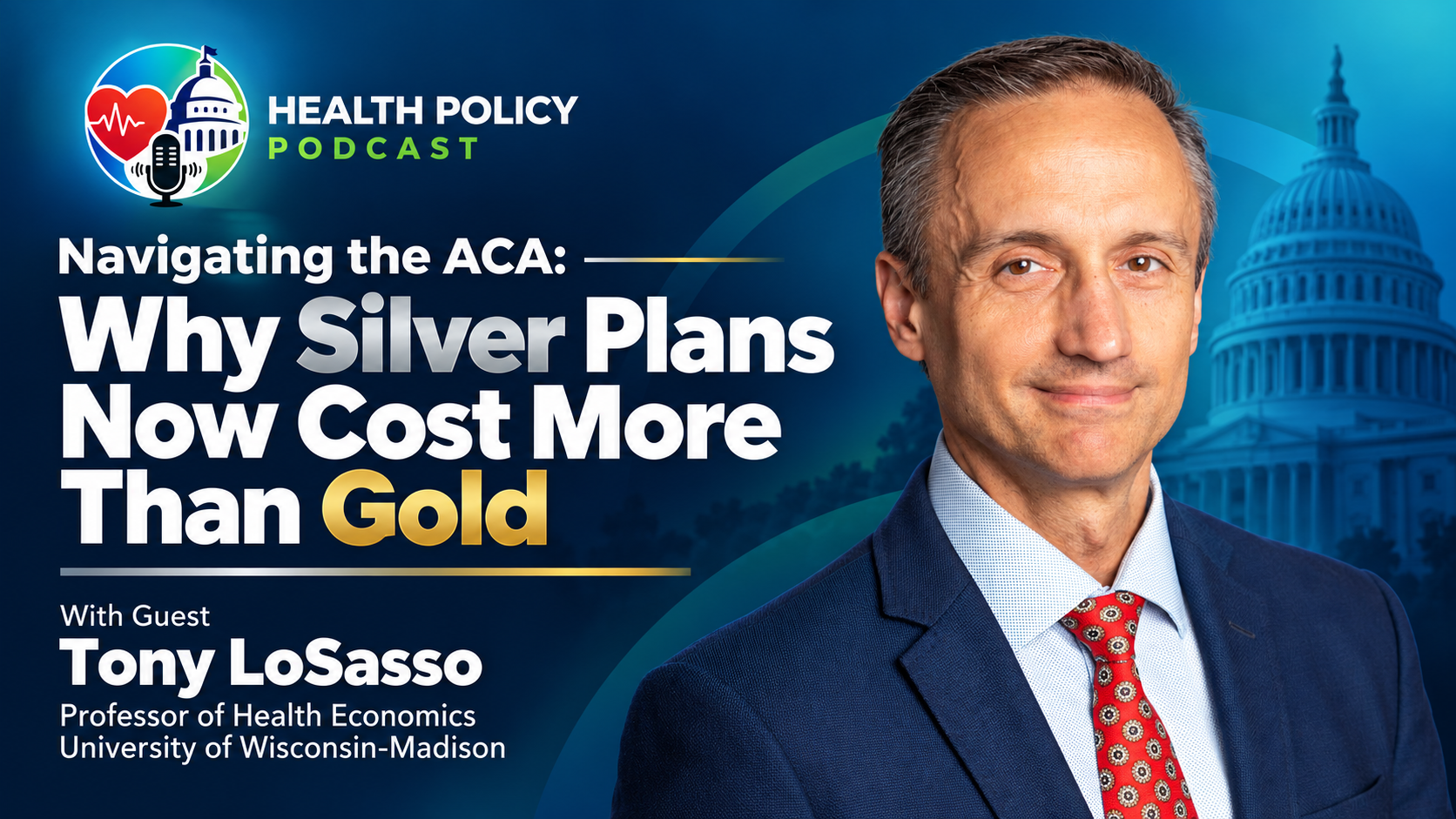
In the latest episode of the Health Policy Podcast, host Bryan Hyde speaks with Tony LoSasso, a professor at the University of Wisconsin-Madison, about the rising costs of silver health insurance plans under the Affordable Care Act (ACA). LoSasso explains how misaligned incentives and policy design have led to silver plans costing more than gold plans in many ACA marketplaces, a situation that has resulted in inflated premiums and disrupted enrollment. He proposes restructuring premium tax credits and funding cost-sharing subsidies to stabilize the market and reduce costs for consumers.
Navigating the ACA: Why Silver Plans Now Cost More Than Gold
Silver Plans Cost More Than Gold in ACA Marketplaces, Expert Says
In a recent episode of the Health Policy Podcast, Tony LoSasso, a professor at the University of Wisconsin-Madison, discussed the unexpected trend where silver health insurance plans under the Affordable Care Act (ACA) are now costing more than gold plans. This shift raises questions about the underlying economic factors and policy decisions influencing health insurance costs in the United States.
LoSasso, a health economist with over 30 years of experience, explained that silver plans traditionally cover about 70% of healthcare costs, while gold plans cover approximately 80%. This pricing structure would typically suggest that gold plans should be more expensive than silver plans. However, LoSasso noted that in more than half of ACA marketplaces, this is no longer the case.
The professor emphasized that the situation is not the result of fraud or mismanagement but rather stems from misaligned incentives and flawed policy design. He traced the issue back to the ACA's implementation in 2010, which established marketplaces for individuals to purchase health insurance. These marketplaces were designed to provide affordable coverage, particularly for those transitioning between jobs or retiring before becoming eligible for Medicare.
Two critical components of the ACA aimed at making insurance more affordable are premium tax credits and cost-sharing subsidies. Premium tax credits are designed to help lower-income individuals afford insurance premiums, while cost-sharing subsidies limit out-of-pocket expenses for low-income enrollees. Originally, the federal government funded these cost-sharing subsidies directly to insurers. However, in 2017, the Trump administration cut off these payments, leading insurers to inflate the cost of silver plans to cover the lost subsidies.
As a result, the inflated premiums for silver plans have led to higher premium tax credits, which are funded by taxpayers. This cycle of inflation has created a situation where silver plans are now more expensive than gold plans, a phenomenon that has surprised many, including LoSasso himself.
LoSasso pointed out that this issue is not confined to any particular political party or state. It reflects a broader trend in which states are compelled to adjust premiums based on the incentives created by federal policy. He noted that the inflated premiums have led to significant disruptions in the ACA marketplaces, with millions of individuals disenrolling from their plans after the expiration of enhanced premium tax credits at the end of 2022.
To address these challenges, LoSasso proposed a two-part solution. First, he suggested reinstating the original funding mechanism for cost-sharing subsidies to stabilize the market. By funding these subsidies outside of the premium structure, he argued that premiums for silver plans would decrease, ultimately lowering the overall cost of premium tax credits.
Second, LoSasso advocated for a restructuring of the premium tax credit system. He proposed disconnecting the tax credits from the price of the second-lowest silver plan, which currently drives the subsidy calculations. Instead, he recommended linking the tax credits to a more stable economic indicator, such as the consumer price index, to prevent further price inflation in the insurance market.
LoSasso emphasized that these changes could lead to a more competitive insurance market, where insurers would need to justify their premiums to consumers directly. He expressed concern that without intervention, the current trajectory could lead to further disruptions and increased costs for consumers.
For more information on LoSasso's work and insights into health policy, he encouraged interested individuals to visit his website and explore his writings on platforms like Forbes. He remains open to discussions with both academics and the general public about health economics and policy.
The conversation highlights the complexities of health insurance markets and the importance of thoughtful policy design in promoting affordable and accessible healthcare for all Americans.
Interview Q&A
Q&A: Navigating the ACA: Why Silver Plans Now Cost More Than Gold
Navigating the ACA: Why Silver Plans Now Cost More Than Gold
Q: Can you tell us about your background and expertise?
A: I am a professor at the La Follette School of Public Affairs at the University of Wisconsin-Madison. I am a health economist by training and have spent the last 30 years studying the interplay of health policy and private decision-making.
Q: What do economists study in relation to healthcare markets?
A: Economists study trade-offs and how individuals make decisions under constraints and uncertainty, which is a significant aspect of healthcare utilization.
Q: What recent trend has emerged in the ACA marketplaces regarding silver and gold plans?
A: In more than half of the ACA marketplaces, silver plans now cost more than gold plans, which is surprising since silver plans typically cover about 70% of healthcare spending, while gold plans cover about 80%.
Q: What factors have contributed to this unexpected pricing situation?
A: This situation arises from misaligned incentives and poor policy design, rather than fraud or bad actors. The ACA created marketplaces to help individuals buy insurance, but the way subsidies were structured led to inflated silver premiums.
Q: How did the ACA's premium tax credits work?
A: The ACA incorporated premium tax credits on a sliding scale based on income. The credits were keyed off the second lowest silver plan in the marketplace to make insurance affordable.
Q: What happened to cost-sharing subsidies under the Trump administration?
A: In 2017, the Trump administration cut off direct payments to insurers for cost-sharing subsidies, which led insurers to inflate silver plan premiums to cover these costs.
Q: How has this inflation affected the ACA marketplace?
A: The inflation of silver premiums resulted in higher premium tax credits, which taxpayers ultimately fund. This has caused premiums for silver plans to exceed those of gold plans in many states.
Q: What are the proposed solutions to address these issues?
A: One solution is to fund cost-sharing subsidies directly to insurers, which would stabilize silver plan premiums and reduce overall costs. Another proposal is to restructure premium tax credits to unlink them from the prices of plans.
Q: What impact did the expiration of enhanced premium tax credits have?
A: The expiration of enhanced premium tax credits led to significant disruptions in the marketplace, causing premiums to rise and enrollment to drop by millions.
Q: What long-term changes do you suggest for the ACA?
A: I suggest restructuring premium tax credits to be linked to a more stable measure, such as medical CPI, rather than directly to plan prices. This would encourage competition among insurers and stabilize the market.
Q: Where can listeners find more information about your work?
A: Listeners can visit my website, anthonylosasso.com, for my writings. I also contribute to Forbes and have more details on my La Follette homepage. I'm open to conversations with anyone interested in this topic.
Key takeaways
- “I like to think about it as trade-offs and how individuals make decisions under constraints and uncertainty, which is, of course, a big feature of healthcare utilization.”
- “This is not a fraud thing. This is not a— there's not really even a quote unquote bad guy in this. It really is just about misaligned incentives and sort of bad policy design.”
- “What happens then is that you get an inflated silver premium. And so, okay, what happens next? Well, along with that inflated silver premium comes an inflated premium tax credit.”
- “If you do that, if you fund the subsidies outside of this shoehorning it into the premium, the CBO and others have calculated that you actually save money.”
- “I think it skews individuals' behavior. It skews insurers' behavior. And it prevents a robust competitive market for insurance.”
About the guest

Professor — University of Wisconsin-Madison
Tony Lo Sasso is the Robert F. and Sylvia T. Wagner Professor of Public Affairs in the La Follette School of Public Affairs at the University of Wisconsin–Madison. His research spans multiple areas, including health and labor economics, health policy, and health services and outcomes research. Lo Sasso has secured funding from the Agency for Healthcare Research and Quality (AHRQ), the National Institutes of Health (NIH), and numerous private foundations. With over 80 publications, he is highly interested in how government policies influence private-sector decisions and how market forces can be used to improve the healthcare sector and, ultimately, the health of the American public.
Full transcript
Show full transcriptHide transcript
Filed under