Show full transcriptHide transcript
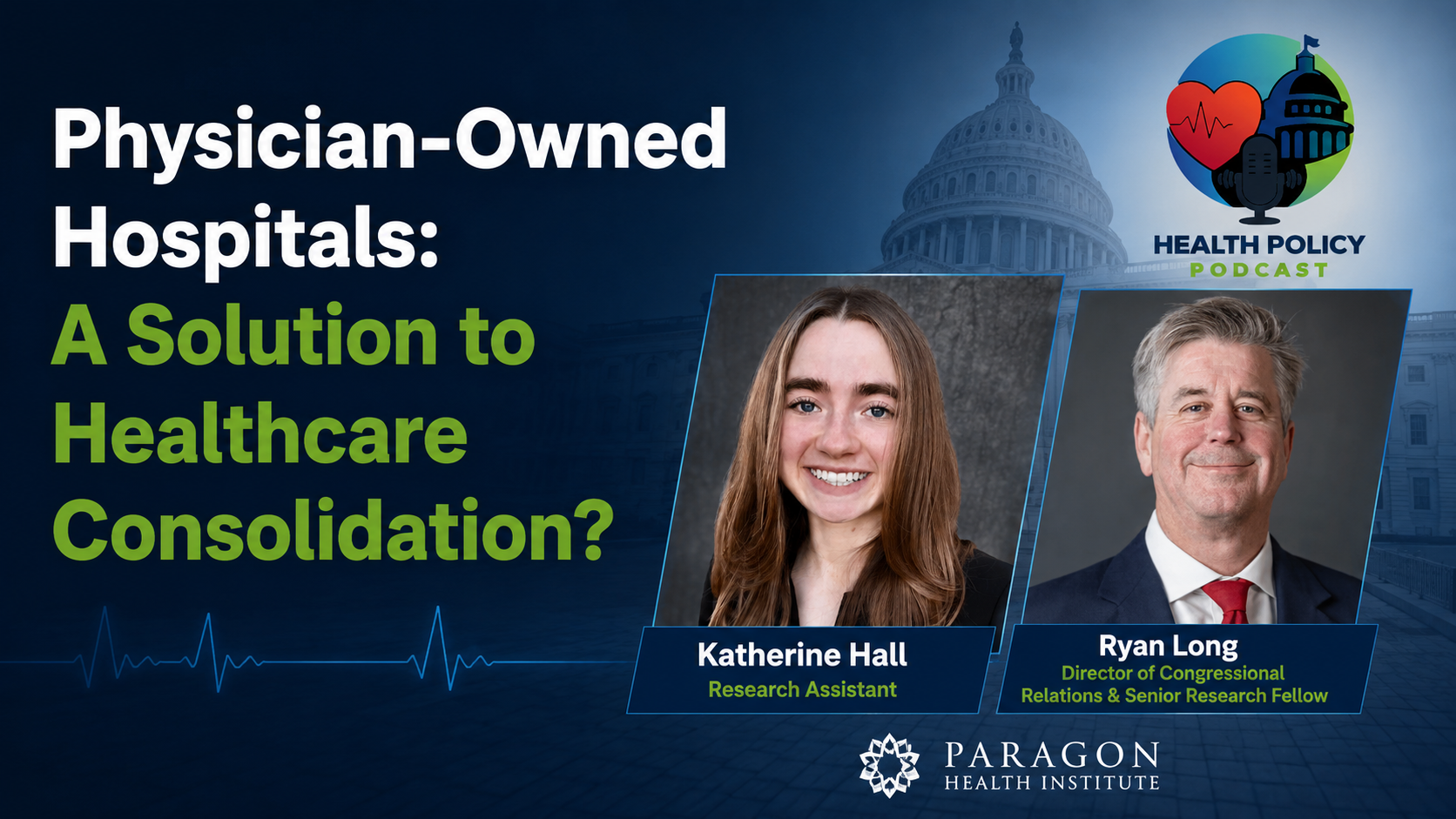
[00:00] Bryan Hyde: Welcome to the Health Policy Podcast. I'm Brian Hyde, and today I'm joined by two guests. I'm joined by Katherine Hall and Ryan Long, who are both joining us from the Paragon Institute. And I know that both of you have different titles and some very different duties, but we're going to be examining a common subject that you are both experts on. Katherine, let's start with you. Tell us a little bit about who you are and what you do. Yeah.
[00:24] Katherine Hall: Hi, my name is Katherine Hall, and I'm a research assistant for Paragon Health Institute. Um, so we are a nonprofit health policy research organization, and we focus broadly on policies that empower patients across the board. Um, we do research on everything from Medicare and Medicaid policy to private health insurance to state health reform. Um, and a lot of our research focuses on how government incentives affect health policy markets. Um, and I'm particularly interested in research on affordability and competition. Which includes my research, recent work on physician-owned hospitals.
[00:58] Bryan Hyde: Okay. And Ryan, tell us a little bit about your role.
[01:03] Ryan Long: So I am a senior research fellow, and I'm the director of congressional engagement for Paragon Health Institute. And my background is I spent the majority of my career working in different health policy roles on the House representative side, most prominently with the Energy and Commerce Committee.
[01:23] Bryan Hyde: —very good—
[01:24] Ryan Long: over a lot of these issues.
[01:25] Bryan Hyde: Yeah, you know, we're going to be talking about physician-owned hospitals, and I think, Ryan, we're going to draw upon you for some of the historical context about this. But Katherine, I'm also looking at a paper that you had written on lifting the restrictions on physician-owned hospitals. Ryan, first of all, let's start with what is the history behind physician-owned hospitals? On one hand, it kind of sounds like a no-brainer. You know, I know in Katherine's article, she points out chefs can own restaurants, lawyers can own law firms. Has it always been the case that it's been rather difficult for physicians to own, you know, part of the hospital?
[02:04] Ryan Long: Well, I agree it is a no-brainer. And if we're worried about consolidation and competition, to me, that this allowing physicians to own hospitals is a great way to inject more competition and battle consolidation. It's something that we should, we should look at getting rid of some of these restrictions. But the big restriction came from the Affordable Care Act in, uh, in 2010. And what that did was say if you're an existing physician-owned hospital, you are not allowed to expand, um, and if you are a new physician-owned hospital, you cannot open. Now, the trigger that they use to enforce that prohibition is saying you're not allowed to have Medicare or Medicaid, um, patients. And, and so there have been some physician-owned hospitals that have opened, uh, after the 2010 ban, but they're not allowed to take Medicare or Medicaid. And so that really does impact their ability to, to be a sustainable business. Now, prior to that, there was a lot of growth in the, in the late '90s and early 2000s with physician-owned hospitals. There is a provision that was in the Medicare Modernization Act that passed in December of 2023 that said for 18 months there cannot be new physician-owned specialty hospitals. And back then the debate was really about not just visit— not physician ownership, but physician ownership of specialty hospitals. And they would say cardiology or cardiology hospitals, orthopedic hospitals. And the, the criticism there was because they were specialized and because they were physician-owned, they were cherry-picking sort of the most profitable patients. And so there was that 18-month moratorium, and again, only on specialty hospitals, not on physician-owned hospitals. Congress required both MedPAC, the Medicare Payment Advisory Committee, Commission and HHS to do several studies on specialty hospitals, which they did. They made some recommendations on some payment changes, which HHS made. And they said you shouldn't extend the moratorium if those changes were made. They were. And, but then the ACA came about and, you know, the incumbents don't want competition. And so they saw that as an avenue to potentially restrict some of their competition. Again, the debates before the ACA were all about specialty hospitals, but then they went a large step further in the ACA by saying this is going to apply to all physician-owned hospitals, regardless if they were a specialty hospital or sort of a whole hospital. And that's where we, we sort of find ourselves today.
[04:47] Bryan Hyde: Katherine, talk to me about the practical effect of that restriction against physician-owned hospitals. What, uh, What has that brought about?
[04:57] Katherine Hall: Well, it amounted to an effective ban on physician-owned hospitals, even though it wasn't technically a ban. It was a restriction on Medicare payments, as Ryan discussed. Um, it effectively meant new physician-owned hospitals could not open. Um, the few that— as Ryan mentioned, there were a few that did, but the amount of physician-owned hospitals has largely stayed the same, around 250, since the Affordable Care Act. And existing ones are allowed to operate at the capacity that they were prior to the law, but they effectively can't expand and compete at the same level as traditional hospitals. So this has just effectively stopped new physician-owned hospital growth and entry into the market.
[05:32] Bryan Hyde: And remind me, what exactly was this to protect us from? I mean, the consumer, the patient?
[05:38] Katherine Hall: Well, the short answer, it was, it was to protect traditional hospital systems from competition. It wasn't really to protect the patient, but the justification was these concerns surrounding self-referral, and cherry-picking the healthiest and most profitable patients. And like Ryan said, specializing in profitable services at the expense of community hospitals, which would have to take the unprofitable ones. Now, yeah, the main things about these concerns are that number one, they haven't played out. We have a universe of existing physician-owned hospitals that existed prior to the law, and studies on these hospitals have shown that these concerns have not played out. The concerns that have allegedly would impact the patients. But another point about these concerns is that they actually exist in the traditional hospital system. So when you look at negative referral incentives, you've got major hospital systems where CEOs are making tens of millions of dollars and their compensation is tied to patient volume. So there are not the best incentives there, and their patient referral does happen within these major hospital systems that have acquired physician practices from primary care all the way up to specialties. So there is referral within the same hospital systems. And they also engage in contracting practices to include all facilities in network and effectively steer patients there. So, so patients are feeling the effects of these concerns, just not from physician-owned hospitals.
[07:03] Bryan Hyde: Are they feeling that most in healthcare costs? Yes, that is—
[07:10] Katherine Hall: healthcare affordability is a major concern right now. And central to this is hospital prices. If you look over the past decade or so, you see hospital prices skyrocketing far faster than inflation and faster than other services, including other medical services. So hospitals are really at the center of this. And central to that is the increasing hospital consolidation that has been happening, where you've gotten major hospital systems that have monopoly pricing power over certain areas. And this is associated with about a 12% increase in prices, as one study said, in areas that have monopolies compared to those with competition. And that's also associated with hospitals acquiring physician practices, which is also associated with higher costs. So yeah, hospital prices, major concern. And physician-owned hospitals could potentially provide an avenue for providers to operate and practice outside of these major hospital systems and potentially provide a counter to this consolidation.
[08:11] Bryan Hyde: Okay, now I'm not trained as an economist, and so I kind of tend to simplify these things down. But Ryan, I want to ask you, Does it really come down to more competition is needed to help correct the challenge here?
[08:28] Ryan Long: Well, I think more competition is absolutely needed. As Katherine mentioned, the hospital systems are consolidating at a rapid rate, both by buying other hospitals, but buying physician practices. You know, there's a policy called, you know, non-site neutral payments. That means, you know, hospitals get much more money than for providing the same service than a physician office would get for providing it. So we have all of these incentives to consolidate. And then we have the artificial limitations, whether it's the, the prohibition on physician hospitals, whether it's certificate of need laws that provide incumbents basically the ability to veto competition. And as Katherine said, you see more moderate prices in areas where you have more competition. I think the other thing on the physician-owned hospital bans, in states where they are prevalent, they're also states that are growing quite a bit. And really, the inability to expand does create access challenges in those fast-growing areas, like Texas, for instance.
[09:39] Bryan Hyde: So, Katherine, let's bring you back in here to— let's talk about what needs to happen and where does it need to start? I mean, Is Congress the one that needs to take the first steps towards rectifying what, what was imposed through the ACA?
[09:56] Katherine Hall: Yeah, I think that's the most effective step is Congress repeals the restrictions that were placed on physician hospitals. And that's the first step to simply allow them to operate on the same footing as traditional hospitals and allow them to compete on an equal level. There are also other complementary policies that need to happen. There are, like Ryan mentioned, things like certificate of need laws and barriers to market entry that exist beyond the simple restrictions on physician-owned hospitals. But repealing these restrictions is the first step by Congress.
[10:25] Bryan Hyde: Is, is there any action currently taking place, or is there anyone suggesting or proposing legislation to this end in Congress? Or is this something that's— is it an opportunity that's waiting to be picked up?
[10:37] Katherine Hall: Yeah, I mean, I think Ryan can speak a little bit to this, but there was some legislation back in 2025, but I don't think any of it advanced very far. I don't think there's any active legislation right now.
[10:48] Ryan Long: Yeah, yeah, there have been members that have wanted to straight repeal Section 6001 of the ACA. I think that's what we would support. There have been others that would like to take, you know, they're willing to take half measures by allowing existing hospitals just to expand if their community needs it. And unfortunately, there is a lot of incumbent resistance to any changes because of the sort of the financial incentives and implications that Katherine mentioned.
[11:19] Bryan Hyde: Now, okay, again, I'm dumbing this down, you know, to my non-economist brain here, but the lobbying power of those big consolidated healthcare concerns, are they using that to protect their position essentially? Am I understanding that correctly?
[11:39] Katherine Hall: Absolutely. They lobbied, they spent millions of dollars in lobbying during the Affordable Care Act passage, and they're still putting out studies that are opposing physician-owned hospitals today where they'll commission a study that will find that physician-owned hospitals are harmful, and then they'll use that study to argue that physician-owned hospitals are harmful. But they're the ones that paid for the study. But yes, I think their influence is very, very strong.
[12:02] Bryan Hyde: Ryan, anything you would add?
[12:04] Ryan Long: Well, you have kind of this structural issue because we mentioned certificate of need laws. And so you have a lot of states that don't have physician ownership. Even if we repealed Section 6001, they may have a certificate of need law that wouldn't allow a physician practice to open up a hospital anyway. And so you have people that are— they don't have any constituent reason to support a repeal, and they hear from the hospital associations in their state, please don't do that. It doesn't impact you because you're not going to have physician-owned hospitals in your state. And so you see a lot of the support for repealing 6001 in those states that have footprints of physician hospitals. And some of it is bipartisan, certainly. But because you don't have physician ownership everywhere, it's easy for some members just to say, I don't want to deal with that because it's not going to impact my state. And so it's those two things sort of working in concert.
[13:06] Bryan Hyde: You know, I hear a lot of talk, and this is pretty much across the nation, that rural healthcare is kind of a challenge. And I'm curious how Does this play into urban centers versus rural hospitals? It seems like some rural areas, healthcare, they've had to close down facilities because there just wasn't enough to support it. Is that a product of that consolidation, and could physician-owned hospitals actually help some of those lesser populated areas?
[13:36] Ryan Long: Well, I'm sorry, I was just going to say, I don't think it can hurt, and I think you have members that have said, okay, if you don't want to repeal 6001, on or you don't want to allow expansion. What if we allowed physician ownership in rural areas where you have hospitals that may go under? Well, to me, that, that, that should be just a simple thing to do. If you're going to lose the hospital, allow members of the community to band together to try to, to save it. But that's not an option for, for rural communities right now. And I think that if you're going to take a baby step, why not do that?
[14:14] Bryan Hyde: Katherine, your thoughts? Yeah, I was going to say the same thing.
[14:19] Katherine Hall: Allowing physicians the opportunity to expand into those areas can only be helpful.
[14:23] Bryan Hyde: Yeah. And here's kind of a third rail, but I'm going to go ahead and reach out and touch it. And that is because of the influence of Medicare and Medicaid, which, you know, is kind of the justification for, well, this is why, you know, if you take these funds, you can't have physician-owned hospitals. Is there any possibility that that governmental footprint will ever shrink in terms of how much taxpayer money goes into or is spent on healthcare?
[14:56] Katherine Hall: That's a great question. I think, yeah, like you said, the proportion of Medicare patients in particular that goes to these hospitals is just so outsized that I'm not sure whether the influence is going to go away anytime soon. It's about half of inpatient beds are Medicare patients or something like that. So, and especially with an aging population, it's hard to imagine that influence going away. But Ryan, do you have any thoughts?
[15:20] Ryan Long: Well, I do think we need to get our federal healthcare spending program sort of better in check because it is consuming so much of our federal budget. But we do have an aging population, Medicare population, so it's always going to remain a huge proportion of a hospital's revenue.. And so to— it is very difficult to say, I'm going to get by, uh, as a physician-owned hospital, not taking, uh, Medicare or Medicaid patients just because of the large number of people on those programs.
[15:51] Bryan Hyde: Well, it sounds like it would also be some very powerful political leverage, uh, for, for any legislator who wanted to, um, seek reform. You know, I, I mean, with that aging population, you know, all they have to be told is, hey, This individual wants to take away, you know, your healthcare, and that should be enough to keep, I think, most lawmakers at the federal level in check from, you know, being too vocal about it.
[16:16] Ryan Long: Well, I don't think it's necessarily a question of taking away healthcare. I mean, one, it's making sure that the people that are eligible for the program are actually eligible. So you do that, you can actually, you know, budget the cost a lot better than we do today. And it's making the programs more efficient and it's taking away the incentives that we have in our federal healthcare programs to be wasteful and have abusive spending patterns. Katherine mentioned the site-neutral payments where we pay exponentially more for the same exact service because it's done in a hospital versus you going down to your doctor's office. That creates enormous distortions. The 340B program, which is ostensibly to go to safety net hospitals and rural hospitals when most of the money actually goes to wealthier, not even indigent safety net urban hospitals. It goes to sort of the, the wealthier academic hospitals in the suburbs, not to poor hospitals. So we, we have a whole lot of distortions in our federal healthcare programs that if we eliminated those, you could do a lot to get on a better fiscal trajectory without taking away, you know, what you say, you know, people's eligibility for the programs if they're truly eligible.
[17:30] Bryan Hyde: Katherine, anything you'd like to add to that?
[17:33] Katherine Hall: I think Ryan captured it really well. I think though, I would like to just go back to the fact I don't think we explicitly mentioned this, but physician-owned hospitals, studies have shown that prices are actually lower for Medicare patients and also commercial and cash patients, anywhere from about 4 to 33% lower for commercial and cash-paying patients, one study found, and Medicare patients about 8 to 15% lower. So there is a real potential to help out Medicare patients. I don't think we explicitly said that part.
[18:01] Bryan Hyde: And the quality of care doesn't suffer just because those prices are lower, correct? Absolutely.
[18:06] Katherine Hall: All studies showed that quality measures were at least equal and often higher at physician-owned hospitals compared to traditional hospitals. Okay. One final—
[18:15] Bryan Hyde: oh, go ahead. Go ahead.
[18:16] Ryan Long: I was just going to say on the quality, Brian, I would recommend if you live near a physician-owned hospital, Go check it out. And what you'll see is high-quality care where the people that work there are excited to work there. They have, you know, in a lot of cases, less staffing issues because they have a welcoming work environment. These, for the most part, these are great institutions. When I went to go see one, you know, it just really blew my mind about what top-notch facilities they were. And that's a generalization, of course, but I think when you have ownership into what you're doing on a day-to-day basis, you tend to take a little more pride in making sure that the institution is run great.
[19:00] Bryan Hyde: One final question for both of you, and that is, with your work through the Paragon Health Institute, what do you wish more people understood about healthcare, you know, in America? Is there a general idea that you encounter that people just typically tend to get wrong for lack of knowledge?
[19:23] Katherine Hall: Brian, do you want to start?
[19:26] Ryan Long: I mean, I would say the biggest misconception is that we don't spend enough on healthcare. It is our largest budget item. I don't think that we spend it properly. We don't target subsidies properly. You know, there are hospitals that truly struggle, but our subsidy system is designed to just flood the zone with money, and most of that gets sort of consumed by large hospital systems. And so we need to do a better job of how we allocate the money and the subsidies we have, not necessarily a question of we need to continuously increase them.
[20:03] Bryan Hyde: Okay, same question for you, Katherine.
[20:06] Katherine Hall: Yeah, um, I don't know if this is something that people don't understand, but more just making sure that the broader picture of a healthcare affordability agenda is understood. I think there's multiple components and a lot of focus is often placed on the demand side, which is extremely important of putting money back in the hands of patients, things like health savings accounts, price transparency, etc. Very important things. And you also, as a complement, have to look at the supply side where there are a lot of restrictions on competition, including restrictions on physician-owned hospitals, these things like sinusal payments, incentives for consolidation. So really you have to make sure that you are doing both of these sides of reform or else a full market-based agenda for affordability isn't complete. Yeah.
[20:47] Bryan Hyde: Once again, we are visiting with Katherine Hall and Ryan Long with the Paragon Health Institute. I want to thank you both for taking the time to join me here on the Health Policy Podcast.
[20:56] Katherine Hall: Thank you, Brian. Thank you. Great to be here.