Show full transcriptHide transcript
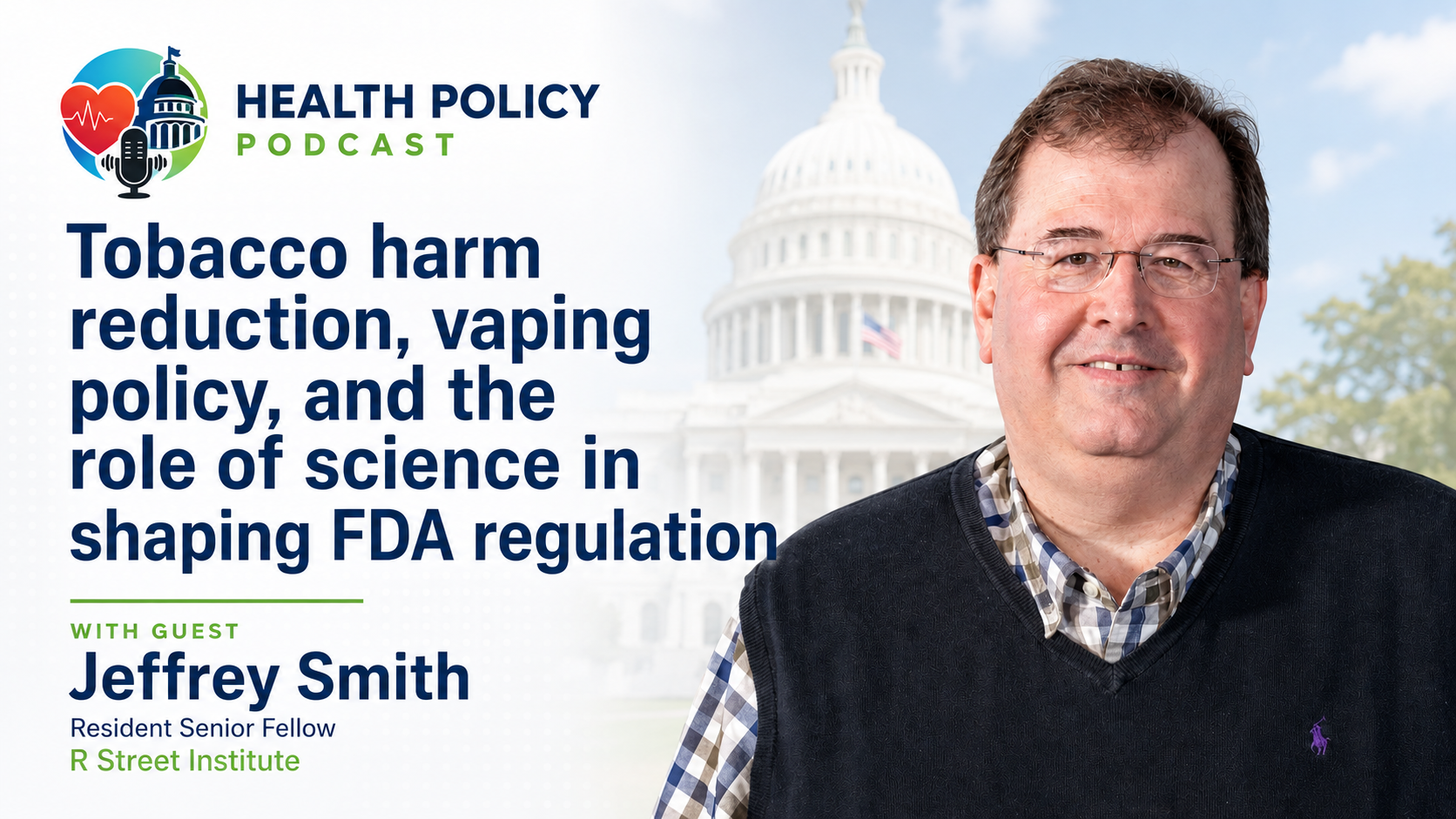
[00:00:00] Welcome to the Health Policy Podcast. I'm Brian Hyde, and today I'm joined by Jeffrey Smith. He is a senior fellow for the R Street Institute, where he explores tobacco control and harm reduction from the perspective of clarifying the risks associated with the use of combustible products and the potential of reduced-risk nicotine products.
Now, we're gonna unpack all that, right? Yes. We'll try to, at least. Tell us a little bit about your background, Jeff. Um, you know, what, what led you to the R Street Institute, and tell us a little bit about what you do day to day. Sure. Uh, uh, again, thanks for having me on today. I, I appreciate the opportunity to, to speak to your audience about this, uh, this topic.
Um, y- I have a very long... I, okay, first of all, I am a former college professor, so I'm very long-winded, so short answers tend to last 55 minutes, so I'll try to be briefer than normal. Um, but, um, but yeah, I, I, I started my career in academics studying the brain and really trying to understand how the brain organizes itself and how that [00:01:00] lead, the, those different and changes in organization leads to changes in behavior.
Um, and it was, at the time, really more focused on neuroplasticity in the context of trying to find ways to fix the brain after it's injured. Um, but it evolved over the years to one potential therapeutic for traumatic brain injury that, that, that my, my lab was exploring, was nicotine. And it was also about the same time where we started to see this uptick in my students using, uh, vaping products.
It was the, the, the, the, the early, you know, 2009, 2010 mod systems, and it was kind of cool to build your own mod. And, and I was naive to it. I, I, I was an anti-smoker. My grandparents, uh, uh, uh, all of them died of some form of smoking-related disease well before they should've. Um, and so I would always, you know, give my students a hard time for smoking, and when I saw they were vaping, I was giving them a hard [00:02:00] time about vaping.
And then as I started to do more research and kind of understand the product and the potential of it, it kind of, again, changed my thinking about, uh, nicotine, one, as a therapeutic, why people use nicotine products, and is there a reasonable, logical pathway to get products into the marketplace through innovation, through technology, that allows individuals to still get access to a smoking-like behavior, uh, without the, the, the, the toll of the, the death and the disease that comes with cigarettes.
Um, and so, you know, uh, you know, it was at a time in my career where I was working on a very difficult question that was gonna take us eons to answer, and I saw s- solving the smoking issue as being an easy question to, to work on. It was pretty much solved. We just had to get the right information into the hands of, of the pe- of the people and get the right products in their hands, and the deaths and disease would start to slowly, uh, uh, [00:03:00] become lower and lower numbers.
And You know, fast forward 15 years and the numbers quite haven't changed the way we wanted, and the products in the marketplace haven't changed the way we had hoped, and there's more stigma around these products than, uh, um, than, than truth unfortunately. And so I think that's really slowing the process down.
And so worked at, worked in industry for a little bit, trying to, to, to set up, help set up clinical teams to evaluate, uh, these reduced risk products and, and, and build out a, a scientific portfolio to support them, um, in terms of their, their journey through the regulatory rubric. Um, and after a few years of that, it was, well, this isn't getting anywhere fast.
Let's see if we can fix policy . And so I've been working at R Street now for just, uh, just barely over, over three years, and trying to bring science to policy makers so they can understand it in a way that allows them to, to make, uh, uh, clear decisions about how to shape this [00:04:00] space, um, to allow for, uh, not just folks in the United States, but globally because, quite frankly, the globe follows the US quite a bit in this space.
Um, FDA is seen as kind of that shining institute on a hill globally. Um, and so if we get it right, then there's a good chance that other countries will get it right as well. So, um, been working really hard trying to g- to, to, to, to kind of remove perception from the conversation as much as I can and try to insert conversation more around the science, and hopefully the policy makers will use that information to make good decisions for us.
Jeff, I'm guessing you and I probably have both lived long enough. We've seen some, some pretty noticeable shifts in terms of, of nicotine delivery. I mean, um, we probably both remember, you know, growing up, smoking was ubiquitous and, you know, had- Mm ... smoking and non-smoking sections. Then slowly the, the smoking sections have gone away.
There are very few places people publicly- Mm ... will smoke. But then, as you mentioned, here came, you know, vapes and, and of course, uh, chewing tobacco and, and, [00:05:00] uh, dipping tobacco, uh, was also kind of a thing growing up. Um, but nicotine pouches seems to be one of the new ones, and the, the only common thread I'm seeing here is they're all delivery systems for nicotine.
Is, is nicotine really the... Is that the focal point when it comes to tobacco harm reduction? I- is nicotine basically the central character? Um, yes and no. A- a- again, you'll love my answers because almost every answer is yes and no . Um, there was some research that came out in the, in the late '90s that suggested that s- uh, about a third of the people that smoke, smoke for nicotine Um, and for, for, and again, there's lots of reasons why people would want to use a nicotine product.
Um, I, I can go, you know, a- as someone who's been an anti-smoker their entire life, as I was doing my research in nicotine, um, when I hit about 50, I, I felt that, uh, my [00:06:00] cognitive, cognitively I was starting to slow down. And so with everything that I knew about ways to enhance the brain's performance, um, nicotine was at the top of the list.
Um, the research is pretty, pretty clear that it can help you improve cognitive performance, especially in the frontal cortex of the brain, uh, where all the nicotine receptors are. And so as we start to lose those, being able to make the ones we have left perform better, uh, adding nicotine to, uh, the, the equation, uh, helps.
And so I did not start smoking for this benefit. Th- in the case of smoking, the risks are much greater than the benefit that nicotine would have provided for me. But there are other products on the marketplace, and for me it was a product called Snus, uh, which is a, a pasteurized tobacco that was popul- that is popular in Sweden.
Um, and so you get a little bit of flavor, you get a little bit of something in your mouth, um, but it also, uh, delivers nicotine [00:07:00] as well. Um, and i- in a one type of example, I can almost remember names as well as I could when I was younger. I can-- I feel like I'm sharper, uh, than I would have been, uh, before I started using the product.
So for some people it's nicotine. Uh, for others, it's, it's the fact that it gives them a five, ten minute break during the day. It's an excuse to disconnect and breathe for a moment. Um, very much tied to more the behavioral, uh, you know, uh, i- impact of, of the smoking behavior, not necessarily the, the pharmacological aspects of the smoking behavior.
Uh, some it's social. It's a way to... You know, people say that alcohol is a social lubricant. Uh, well, for s-some smokers, cigarettes are a social lubricant. It allows you to build some sort of connection between others that smoke. Um, it, for some, it's a time machine. You know, I [00:08:00] had one colleague say that they, they finally tried a, a reduced risk product that reminded of them of when they were 16 smoking their first cigarette.
And so there's a lot... And again, it makes the question much more difficult than it is on the surface because there's the, the, the, the, the, that feeling of wanting a break, that feeling of wanting to have someone to, to, to, to connect with, that, that feeling of that strong memory is just as powerful as the power of the nicotine, uh, uh, chemical itself And so, um, you wrap all that up in a cigarette, then it becomes very difficult for any one individual to have a solution going forward in terms of how to stop using the product.
Um, you know, the, the, the reduced ri- risk products that are out, um, some that have made it through FDA clearance, others that have not, um, you know, the, the, the, the thing that I think is that the goal, end goal would be, you know, to have lots of different products in this space. Because th- [00:09:00] clearly one product isn't gonna solve the, the needs and the drives that the, the individual has for a cigarette, uh, the same way that it's gonna work for another person.
And so having lots of consumer choice is really kind of part of the equation to, to getting to a point where we can, we can, uh, start to really start to reduce the smoking numbers, especially in older, older individuals. Now, Jeff, I have a perception, and, and maybe this is wrong, but from, from where I st- from where I sit, it seems like the, um, uh, reduced risk products, and I'm talking like vapes for instance, um, I'm not saying that they're good for you, but it seems like the, the FDA, among others, treats them as if they were as dangerous if not worse than, you know, a regular combustible form of tobacco- Mm-hmm
like a cigarette. Mm-hmm. Um, help set the record straight on this. You know, uh, with- without trying to make the case that, "No, no, it's great for you," but, uh, it, it seems like it... I, I've talked to a lot of people who wanted to quit smoking, and that was the gateway. That was what actually got them to where they could- Yeah
step away from those products. Yeah. [00:10:00] So from the scientific perspective, just looking at the toxicological data, when we compare the toxicological risk of a cigarette to the toxicological risk of a ENDS product, an electronic nic- nicotine delivery system, it, it's, it's, they're, they're, they're just two very different products.
Y- you can s-... In ter- the, the, the, the, the, um, potential, potentially harmful, uh, constituents of the vapor that is, or aerosol that's generated by an ENDS product, um, 96% fewer, uh, harmful, uh, components Doesn't mean it's harmless, but way, way, way greatly, significantly reduced as compared to a cigarette. Um, and so for a smoker, the transition to an ENDS product, um, is, is a positive step in terms of their personal health.
Um, the FDA thinks about it [00:11:00] from a public health perspective, which includes smokers, but it also includes all non-smokers. And so if I were to take a non-smoker and expose them to the aerosol produced, we're increasing risk, uh, because that four percent or whatever is left that is negative in the aerosol itself, the way that the aerosol interacts with the lungs, um, leads to a potential risk.
Um, again, significantly, significantly less. As a scientist, I don't like to use "significantly" twice in a row, but in this case I do, um, because there's such a strong difference between the two products. Um, and so I, I, I think though we, we think of the FDA as being an organization that's science-based, and they talk about wanting and, and, and striving to be a science-based organization, there is a political aspect to it, and we've just seen this recently with the approval of the, the, the flavor products that just happened, uh, last week.
Um, you know, there were political [00:12:00] driving, uh, uh, political interests driving the decisions that the organization was making, not necessarily the science itself. And so there was a period of time in, in, in, in the, in the early tw- like twenty fifteen kind of range where the, the Center for Tobacco Products at the FDA was talking about the risk continuum, where they were putting into the categories of the most risky products, cigarettes, to the less and lower end of the spectrum for, say, an ENDS product, eventually getting to nicotine poult- lozenges and pouches and the, the, uh, the, uh, Cedar-approved, uh, treatments for smoking cessation.
Um, but then the problem with the kids, then Juul became a big political hot potato, and they very quickly changed the way they spoke about these products altogether. And now it feels like it might be turning back in a direction where it's more science-focused and talking about the continuum of risk. Um, trying, and, a- a- the, the [00:13:00] problem, the biggest problem with that is not really a political problem.
At the end of the day, it's a, it's a human problem because a lot of people have seen messaging coming out of the, the FDA and the CD- CDC saying that, that, that vaping is as harmful as smoking and, and the science just doesn't support that at all. But it led to the confusion and the challenges the average, the everyday folks have with trying to make a decision, you know, to, to, to change their behavior to these reduced-risk products.
If the CDC or the FDA says they're just as bad, why change, right? Um, and so, you know, I, I don't have a... Again, it's really hard to, to, to unring a bell. You know, once the, the, the message is out there, it's really hard to, to replace what was perceived as being the truth with the actual truth, but that's what we're trying to do, uh, vigorously at R Street every day.
You had mentioned earlier on that, uh, the numbers really hadn't changed like, like you had hoped th- they [00:14:00] would. And I'm just- The import number. Okay. Yeah. Uh, I'm, I'm just curious, overall, people who, who smoke cigarettes, is that number- Yeah ... down from, say, 50 years ago? O- over the average a- across all age spans, yes.
But we really see it heavily weighted toward younger adults, uh, in terms of, uh, not even picking up cigarettes to begin with. Uh, the numbers in older individuals, say 55 plus, uh, those numbers have not really changed much at all. Um, and so it seems like the messages are getting to, um, newer, uh, generation, younger folks, and they see lots of products that are out there, and they ha- it was...
They, they, they didn't grow up in the, in the space where there was just cigarettes or cigars or, or, or dip and, and chew. Um, now they see all these other products that are even more interesting, uh, than a cigarette would've been to a young person back in the, in the day. Um, and [00:15:00] so we, we still have significant challenges within the older generations.
And again, the older generations are the one that are dying. And so the number that I, that I talk about and, and, and, and won't stop is 500,000. And even, y- you know, even with changes in the population in terms of number of smokers, that number hasn't declined significantly at all. It hovers around 460,470 or so, uh, thousand people in the United States a year dying to smoking related disease.
Um, and until those numbers start to really significantly drop, having an argument about the risks associated with reduced risk products, if the adult population was to choose to replace smoking with these reduced risk products, um, i- is not a valid argument to have. If, if, if we get to a point in, say, 20, 30, 40 years and there's 10,000 people dying from smoking related diseases and it's people [00:16:00] primarily vaping, then that's a different problem that we'll have to deal with then.
The toxicolog- toxicological data doesn't suggest that it's gonna be the case, but it could be the case. We don't know because that's how science is. We won't know until the epidemiological data comes to pass, and that just takes time. There's no way to, to accelerate that. Uh, but 500,000 deaths versus $10,000...
Uh, excuse me, 10,000 deaths, that's a significant improvement. When we start to see movement in that direction, then we'll know that the FDA's figured it out and we're starting to do something right. And, and talk to me a little bit about, uh, the, the flavored, um, electronic nicotine delivery systems. Mm-hmm.
I know that there was controversy about that. Aha, that's the, that's the hook to get kids- Sure ... started. Um, I mean, I'd, I'd love to get your commentary on that. Sure. To, was it really to get a new generation of people, you know, uh, you know, going on nicotine? Or wh- was there something else behind it? Well, kids, kids love flavor.
You know, I, I, adults don't like flavor. I'm sure you have rice and water for dinner every night. You know? That's the healthiest diet you can have. Um, but, [00:17:00] um, adults, flavor, I wrote, I wrote a, a very long and very science-deep flavor paper two, two years ago, and I know no, no policy maker's gonna read it because it was very deep in the science.
I mean, though I tried to bring it to the, to the level, it's still challenging. But flavor is a big part that drives our behavior. Okay. Um, and I, and not just a behavior like eating, but all of our behaviors. Um, and, and there's such- Significant differences between individuals in terms of flavor, and it could be culture, it could be sociological, it could be, uh, income related, it could be genetics, it could be lifestyle, it could be a thousand different variables that impact what flavors are important to you.
The way you perceive a flavor, even if it's the same exact product, is gonna be different in terms of how I perc- perceive the flavor. Um, and so I, I-- people often talk about the Swedish experiment, the fact that Sweden's been able to s- so dramatically reduce [00:18:00] their smoking rates, and they talk about snus as being a culturally viable product for them.
But if you look at the snus marketplace, there are literally thousands of different flavors, from the sweetest candy-like flavors to, I had a bacon cheeseburger flavor snus from, from Sw- Sweden once, a very savory one, very tobacco-focused, a very... It is just a broad spectrum. So the flavors, there was an option out there that, that would, would, would, would be, um, attractive for you, um, was, I think, the key for the Swedish project to have been so successful.
Um, yeah, I, I think that's the case for many Americans as well. They can pick up a vape, and if it just doesn't taste like a cigarette and it doesn't taste different from a cigarette, um, because it now tastes like a, you know, apple or an orange or whatever the case may be, they'll, they'll put it down again because they'll go back to what they enjoyed about the cigarette.
But if it tastes kind of like a cigarette, but it also [00:19:00] tastes really good because it tastes like blueberry mango or whatever flavor combination they, that, that is, that is attractive for their palate, then that is, that is a powerful way to help them stay switched away from a cigarette and keep using that product.
And again, I, as a non-smoker, it's hard for me to talk about this from a personal experience, but I know a lot of folks, uh, in this space, and they talk about being able to, when I get bored of one flavor, be able to switch of ano- Instead of switching back to a cigarette, I switch to another flavor. Um, and so, you know, I think it's as important as it is, um, to, to make sure we have good regulation and policy in place to help, um, keep young folks from using these products, which I think we've done a pretty good job with the, the, the, the twen- uh, Tobacco Twenty-One law.
The smoking rates in youth of all tobacco u- not just smoking, but all tobacco use, has dropped, uh, from twenty nineteen when the law was, uh, the rule [00:20:00] was passed to now. It's, it's as if we could almost say kids don't use these products anymore. Um, which is ironic because if you look at the twenty one other age-gated products like alcohol and cannabis, it's still in the twenty one, thirty percents.
So there's another reason why kids were using the nicotine product, uh, other than just To be cool or whatever the reason why they were using it, so much that they don't fight to get access to it like they would fight to get access to alcohol and, and marijuana and other products. Um, so that's an, an interesting aside to, to, to, to, to dwell on and think about.
But, um, the key is, how do we build products that allow adults to move away from cigarettes? And if that's our guiding north star, if we really want to see that number drop from 500,000 down to zero, um, the idea is not what we need to do to limit access from kids. We've done that, I think. Um, it's now, well, what can we do to open up the marketplace to allow for [00:21:00] innovation, to allow the right products that are gonna help all Americans, high income, low income, high education, low education, older, young- younger, middle age, find the products that they need to help them move away from the cigarette.
Again, we are talking with Jeff Smith. He is a resident senior fellow with the R Street Institute. And, and I'm guessing that people who want to, to access, you know, some of the papers that you've written- Mm-hmm ... on this very subject, they can actually go to the website. Can you tell us what is the website for the R Street Institute?
Sure. Just rstreet, rstreet.org, and it's organized very well. You, we have, surprise, surprise, AI built into our search tool that will take you directly to any... If you just type in tobacco or tobacco harm reduction, it'll take you to the whole body of work that our team has put together. Jeff, thanks so much for joining us today on the Health Policy Podcast.
Thank you for having me.