2026-08-25 · Center for Modern Health
Rethinking Section 6001: Reinier Schuur on Physician-Owned Hospitals
with Reinier Schuur, Policy Analyst — Center for Modern Health
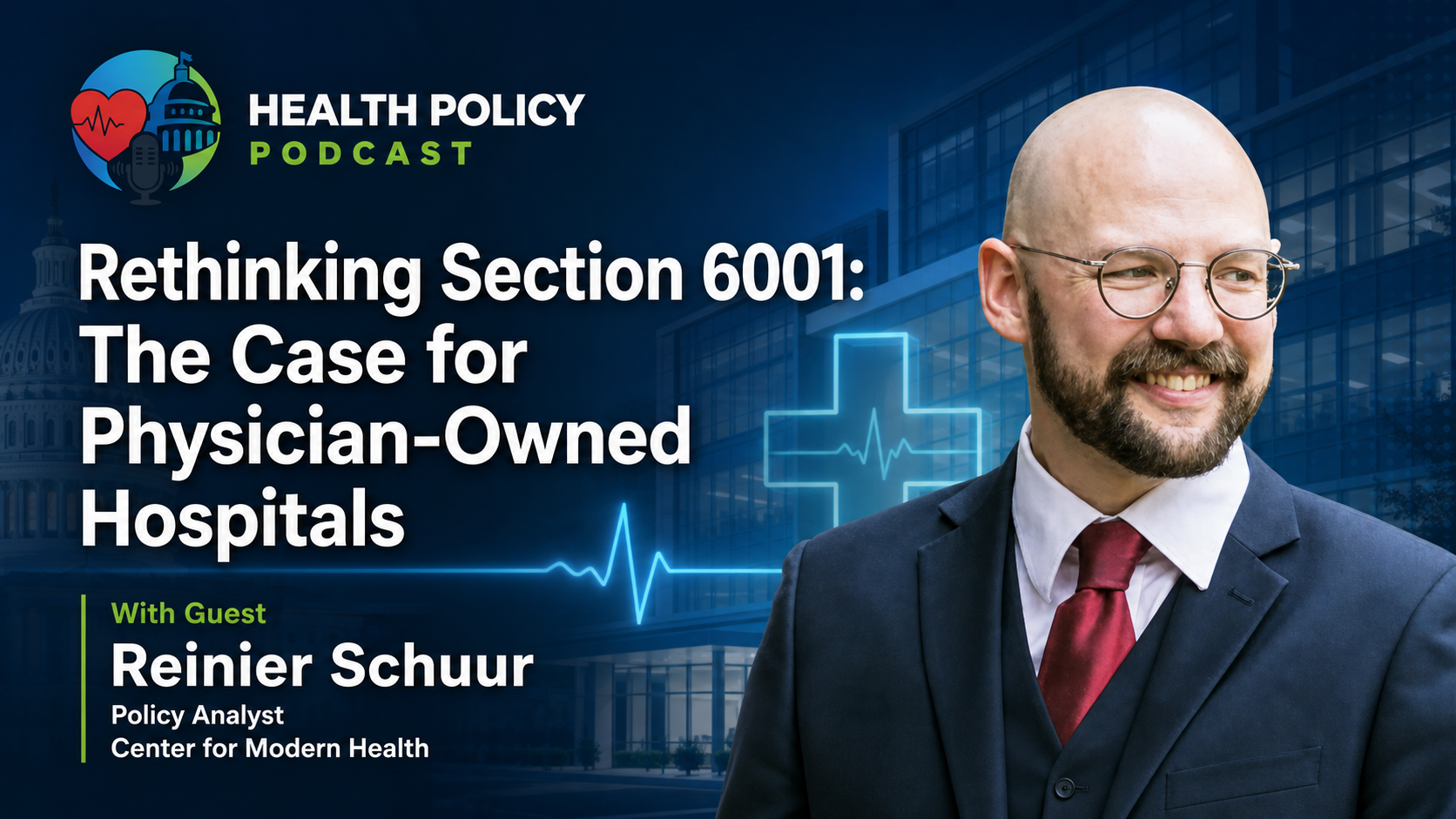
In the latest episode of the Health Policy Podcast, Bryan Hyde interviews Reinier Schuur, a policy analyst at the Center for Modern Health. They discuss Section 6001 of the Affordable Care Act, which restricts new physician-owned hospitals from receiving Medicare funding, and the implications for healthcare competition and market dynamics. Schuur argues for a reevaluation of this section, highlighting the need for a more equitable approach to healthcare ownership and the potential benefits of physician-owned hospitals.
Rethinking Section 6001: The Case for Physician-Owned Hospitals
Calls to Repeal Section 6001 of the Affordable Care Act: A Case for Physician-Owned Hospitals
In a recent episode of the Health Policy Podcast, Reinier Schuur, a policy analyst at the Center for Modern Health, discussed the implications of Section 6001 of the Affordable Care Act (ACA) and the potential benefits of physician-owned hospitals. The conversation highlighted the ongoing debate surrounding healthcare ownership in the United States and the impact of regulations on healthcare delivery.
Section 6001 of the ACA, enacted in 2010, prohibits new physician-owned hospitals from receiving Medicare funding. While not a complete ban, this restriction has effectively stifled the establishment of new facilities, as access to Medicare dollars is critical for viability in the healthcare market. Schuur noted that since the implementation of this section, no new physician-owned hospitals have opened, and some existing ones have closed.
The American Hospital Association advocated for this provision, citing concerns over conflicts of interest. Critics argue that allowing physicians to own hospitals could lead to self-referral practices, where doctors might prioritize profitable services over necessary care. However, Schuur contends that these concerns are not unique to physician-owned hospitals. He pointed out that corporate healthcare entities can engage in similar practices, raising questions about the fairness of the current regulatory landscape.
Schuur emphasized the need for a more nuanced approach to healthcare ownership. He argued that the distinction between physician-owned and corporate-owned hospitals is a product of regulatory frameworks that do not reflect a truly free market. He suggested that rather than banning a class of owners based on the actions of a few, policymakers should focus on addressing specific behaviors that are detrimental to patient care.
The discussion also touched on the moral implications of Section 6001. Schuur argued that the regulation creates a conflict between taxpayers and patients, as taxpayer funding often dictates healthcare access and quality. He believes that separating public funding from private healthcare pursuits could lead to better outcomes for both patients and taxpayers.
Schuur pointed out that existing physician-owned hospitals are grandfathered in under the ACA but face significant restrictions on expansion. This limitation has contributed to the closure of some facilities, further consolidating the healthcare market under corporate ownership. He argued that the data does not support the fears that motivated Section 6001, as there is no substantial evidence that physician-owned hospitals engage in self-referral practices at higher rates than their corporate counterparts.
The conversation also explored the possibility of a shift in healthcare funding from taxpayer reliance to a more privatized system. Schuur expressed hope that such a transition could empower individuals to make their own healthcare choices. However, he cautioned that simply cutting funding would not address the underlying issues of access and quality.
In conclusion, Schuur advocates for a reevaluation of Section 6001 and the broader regulatory framework governing healthcare ownership. He believes that fostering competition among various types of healthcare providers could lead to better outcomes for patients and a more efficient healthcare system. The Center for Modern Health continues to explore these issues through research and policy analysis, aiming to contribute to a more effective healthcare landscape in the United States.
Interview Q&A
Q&A: Rethinking Section 6001: The Case for Physician-Owned Hospitals
Rethinking Section 6001: The Case for Physician-Owned Hospitals
Q: Who is Reinier Schuur and what is his background?
A: Reinier Schuur is a policy analyst at the Center for Modern Health. He has a background in philosophy, specifically in the philosophy of medicine, and transitioned into health policy due to his interest in the field.
Q: What is Section 6001 of the Affordable Care Act (ACA) and its implications?
A: Section 6001 of the ACA prohibits new physician-owned hospitals from receiving Medicare dollars for treating Medicare patients. This effectively restricts their ability to operate in the healthcare market, as access to Medicare funding is crucial.
Q: What were the concerns that led to the implementation of Section 6001?
A: The American Hospital Association argued that allowing physicians to own hospitals could lead to conflicts of interest, self-referral practices, and the creation of boutique hospitals focusing on high-reimbursing care while neglecting unprofitable services.
Q: How has the healthcare landscape changed since the ACA was enacted?
A: Since the ACA's implementation, there has been significant consolidation in corporate-led healthcare, with independent practices being acquired by larger corporate entities. This raises questions about the validity of concerns regarding physician-owned hospitals.
Q: What is the moral case for repealing Section 6001?
A: The moral case centers on the idea that discriminating against an entire class of owners based on the actions of a few is unjust. It suggests that the focus should be on addressing specific problematic behaviors rather than banning physician-owned hospitals altogether.
Q: How does taxpayer funding create a conflict in healthcare?
A: Taxpayer funding separates the interests of patients and taxpayers, leading to conflicts over what care is worth paying for. This separation complicates the pursuit of healthcare and can limit patient choices.
Q: Are existing physician-owned hospitals affected by Section 6001?
A: Yes, existing physician-owned hospitals are grandfathered in but face severe restrictions on expanding their capacity. Some have closed or been acquired by corporate healthcare due to these limitations.
Q: What evidence exists regarding the concerns that motivated Section 6001?
A: Data does not support the claims that physician-owned hospitals engage in practices like cream skimming and self-referrals more than corporate-owned hospitals. This undermines the rationale for maintaining Section 6001.
Q: What is the potential future of healthcare funding according to Schuur?
A: Schuur hopes for a future where healthcare funding shifts back to private hands, allowing individuals more control over their healthcare choices. He believes this requires separating public and private healthcare systems.
Q: What role do regulations play in the current healthcare market?
A: Regulations have created a divide between physician-owned and corporate-owned hospitals, distorting the market. Schuur argues for deregulation to enable a more competitive healthcare environment.
Q: What does Schuur suggest as a solution to current healthcare issues?
A: He advocates for separating public funding from private healthcare pursuits, allowing for the development of a parallel free market alongside the public system. This could lead to better healthcare options and innovation.
Q: How does Schuur define market disruption in healthcare?
A: Market disruption goes beyond introducing new business models. It involves challenging existing assumptions about healthcare and providing innovative solutions that redefine what is possible in the market.
Q: Where can listeners find more information on this topic?
A: More information can be found on the Center for Modern Health's website at www.centerformodernhealth.org, as well as on their Substack and Twitter accounts.
Key takeaways
- “It's actually a prohibition on new physician-owned hospitals from receiving Medicare dollars for seeing Medicare patients.”
- “The data doesn't bear out the concerns that motivated Section 6001 to begin with.”
- “It just doesn't make sense to discriminate between an entire class of owners because of the actions of a small number of them.”
- “Your ability to control your own money when it comes to healthcare is really tied into your own right to pursue healthcare.”
- “Most of the problems with the American healthcare system is precisely because of that.”
About the guest

Policy Analyst — Center for Modern Health
Reinier Schuur, PhD, is a policy analyst at the free-market health-policy think tank Center for Modern Health and hosts The Pursuit of Health podcast. A native of the Netherlands, he earned a PhD in philosophy from the University of Birmingham—specializing in the philosophy of medicine—and an MSc in philosophy of psychiatry from King’s College London; he was also a visiting Fulbright scholar at NYU and the University of Pittsburgh.
Full transcript
Show full transcriptHide transcript
Filed under