Thursday, May 28, 2026 · The Health Policy Podcast
Health Policy Podcast logo
← Health Policy Podcast

2026-03-03 · The Goldwater Institute

Brian Norman on Right to Try 2.0: Expanding Patient Access to Care

with Brian Norman, Director of State Affairs — The Goldwater Institute
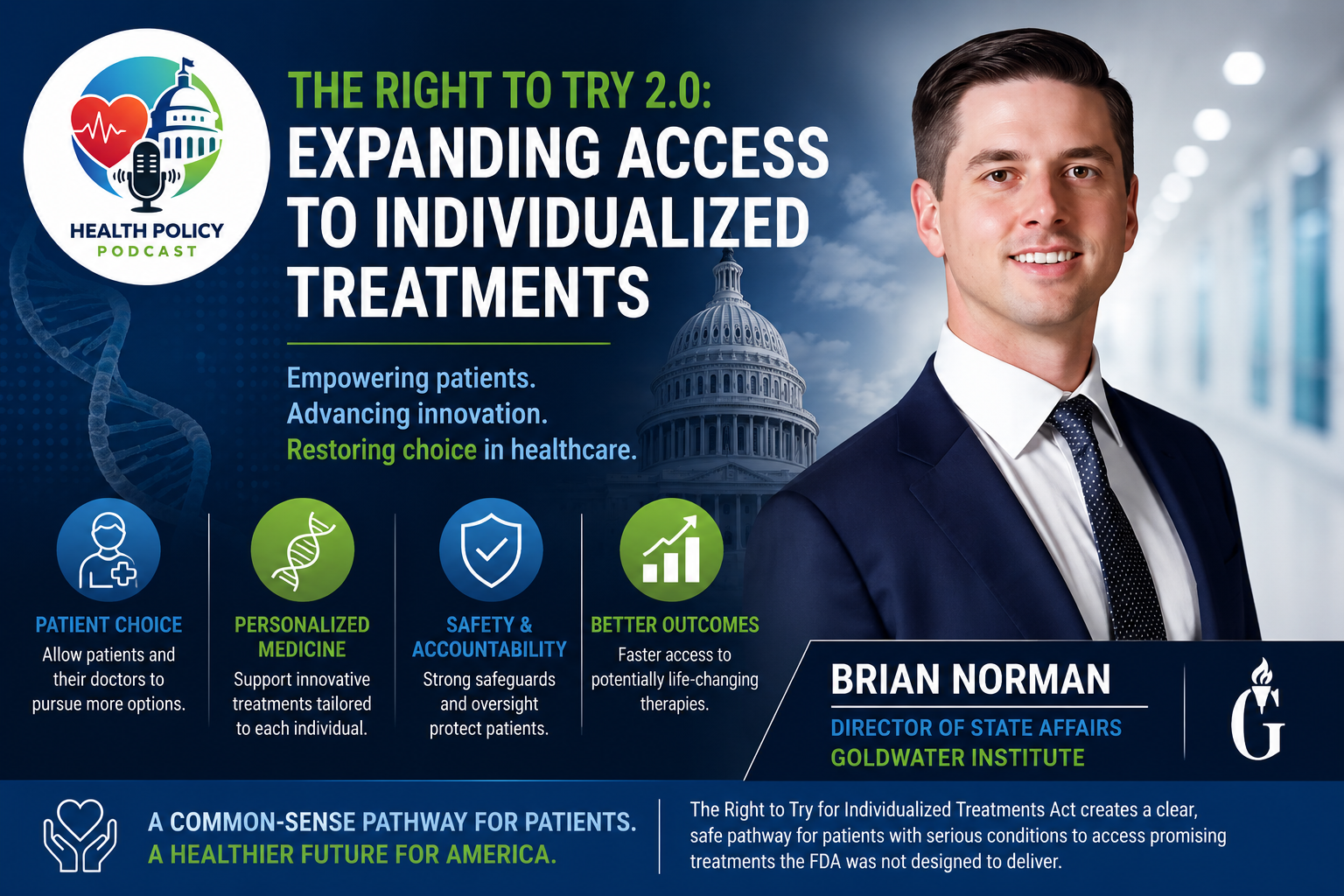
Health Policy Podcast episode featuring Brian Norman discussing Brian Norman on Right to Try 2.0: Expanding Patient Access to Care

In the latest episode of the Health Policy Podcast, Brian Norman, Director of State Affairs at the Goldwater Institute, discusses the Right to Try 2.0 legislation aimed at improving patient access to individualized treatments. The initiative seeks to streamline the regulatory pathway for patients with rare diseases to access investigational drugs, building on the original Right to Try Act established in 2014. Norman emphasizes the need for reform in the FDA's drug approval process to better accommodate personalized medicine and address the challenges faced by patients with limited treatment options.

The Goldwater Institute’s Brian Norman Discusses Right to Try 2.0 and Patient Access to Treatments

0:00 / 0:00

The Goldwater Institute’s Brian Norman Discusses Right to Try 2.0 and Patient Access to Treatments

Goldwater Institute Advocates for Right to Try 2.0 to Expand Patient Access to Treatments

Brian Norman, director of state affairs at the Goldwater Institute, discussed the organization's push for Right to Try 2.0 during a recent episode of the Health Policy Podcast. The initiative aims to enhance patient access to individualized treatments, building on the original Right to Try Act established in 2014.

The Right to Try Act was initially designed for terminally ill patients, allowing them to access investigational drugs that had completed phase one of FDA clinical trials. The legislation gained traction, with 40 states adopting it before President Donald Trump signed it into federal law in 2018. However, Norman emphasized that advancements in medical science, particularly in personalized medicine, necessitate a new approach.

“Since then, there have been a lot of advancements in medical science, particularly individualized care,” Norman said. He noted that treatments tailored to individual patients, such as gene therapies and immunotherapies, are not reaching U.S. markets as quickly as in other countries, including Japan and Germany.

The current FDA approval process can take over a decade and cost more than a billion dollars, which poses significant challenges for patients with rare diseases. Norman explained that for ultra-rare diseases, the traditional clinical trial process is often not economically viable. Right to Try 2.0 seeks to create a regulatory pathway that allows patients with life-threatening or severely debilitating diseases to work directly with their physicians to access individualized treatments.

Norman shared the story of the Riley family from Arizona, whose daughters suffer from a rare genetic condition called Metachromatic leukodystrophy (MLD). The family had to relocate to Italy to access an effective treatment for their younger daughter, as it was not available in the United States. “They should have been able to access that here at home in Arizona,” Norman said, underscoring the need for Right to Try 2.0.

Despite the progress made, Norman acknowledged that resistance to the initiative may arise, particularly from medical ethicists who prioritize patient safety and the traditional FDA process. He argued that patients should have the autonomy to make decisions about their healthcare, especially when they have exhausted other options.

“Those sorts of medical decisions should be left to the medical expertise of the doctor on the ground,” Norman said. He emphasized that the Right to Try movement began at the state level, but a federal law is necessary to create a comprehensive regulatory pathway for patient access.

The Goldwater Institute focuses on state-level reforms, working with legislators to tailor solutions to specific issues. The organization collaborates with like-minded groups to build coalitional support for its initiatives. Norman noted that the goal is to get legislation signed into law, which requires grassroots advocacy and partnership with local organizations.

As the conversation turned to the regulatory environment, Norman expressed empathy for researchers facing bureaucratic hurdles. He highlighted the lengthy and costly process of drug development, which can stifle innovation and delay access to potentially life-saving treatments.

“Reform is needed to that structure,” he said, advocating for a more efficient drug development process that prioritizes patient needs.

The Goldwater Institute continues to push for reforms that enhance individual liberties and improve patient access to treatments. Norman concluded, “The government will always keep the Goldwater Institute in business because they’re always coming up with new problems for us to solve.”

The ongoing efforts of the Goldwater Institute reflect a broader movement toward expanding patient rights and access to innovative medical treatments in the United States.

Interview Q&A

Q&A: The Goldwater Institute’s Brian Norman Discusses Right to Try 2.0 and Patient Access to Treatments

Health Policy Podcast Q&A with Brian Norman

Q: Can you tell us about your role at the Goldwater Institute?

A: I am the director of State Affairs at the Goldwater Institute, a free market-oriented think tank and public interest litigation firm. We conduct research on various public policy issues impacting individual rights and work in capitals, courtrooms, and communities nationwide to advance individual liberty.

Q: What is the Right to Try Act?

A: The Right to Try Act allows terminally ill patients to access investigational drugs that have passed phase one of FDA clinical trials. It began in 2014 in Colorado and was adopted by 40 additional states before becoming federal law in 2018.

Q: How has the Right to Try Act evolved?

A: The original act focused on terminally ill patients. Right to Try 2.0 expands this to include patients with rare and ultra-rare diseases, allowing them to access individualized treatments that may not be available through traditional FDA processes.

Q: What challenges do patients with rare diseases face in accessing treatments?

A: The traditional FDA drug approval process is designed for mass-market drugs, making it economically unviable for treatments aimed at small patient populations. This creates significant obstacles for patients with rare diseases to access potentially life-saving treatments in a timely manner.

Q: Can you explain the concept of individualized treatments?

A: Individualized treatments are tailored to the specific genetic makeup of patients, often involving gene therapies or immunotherapies. These treatments can vary significantly from patient to patient, and advancements in medical science have made them more viable.

Q: What is the goal of Right to Try 2.0?

A: Right to Try 2.0 aims to create a regulatory pathway for patients with rare or life-threatening diseases to work directly with their physicians to access individualized treatments. This process includes safeguards to ensure patient safety.

Q: What opposition does Right to Try 2.0 face?

A: Opposition primarily comes from medical ethicists who argue that unproven treatments may provide false hope. They believe that patient safety is best protected through the traditional FDA clinical trial process.

Q: How does the Goldwater Institute address regulatory challenges?

A: The Goldwater Institute focuses on state-level reforms to create pathways for patient access to investigational treatments. We develop model legislation tailored to specific state needs and work to build coalitional support for these initiatives.

Q: What is the significance of the Riley family's story?

A: The Riley family's experience illustrates the need for Right to Try 2.0. They had to move to Italy to access an effective treatment for their daughter with a rare genetic condition, highlighting the barriers faced by families seeking timely access to individualized care in the U.S.

Q: How does the Goldwater Institute collaborate with other organizations?

A: We partner with like-minded organizations and advocacy groups to build grassroots support for our initiatives. This collaboration is essential for effectively addressing regulatory issues and advancing our legislative goals.

Q: What is the broader vision for drug development reform?

A: While Right to Try is focused on rare disease patients, broader reform is needed in the drug development process to expedite access to treatments for all patients. The current regulatory structure must be improved to better serve the needs of patients and researchers alike.

Q: How does the Goldwater Institute plan to proceed with Right to Try 2.0?

A: We are working to advance Right to Try 2.0 at both the state and federal levels. Our goal is to create a regulatory framework that facilitates patient access to individualized treatments while ensuring necessary safeguards are in place.

Q: What challenges do researchers face in the current regulatory environment?

A: Researchers often encounter significant bureaucratic hurdles that can delay the initiation of clinical trials. The lengthy approval process can hinder innovation and limit patient access to potentially beneficial treatments.

Q: What is the ultimate goal of the Goldwater Institute's efforts?

A: Our ultimate goal is to protect individual rights and promote patient access to innovative treatments. We aim to reduce regulatory burdens that impede healthcare decisions and empower patients to make informed choices about their care.

Key takeaways

  • There are a myriad of government interventions that interfere with free markets when it comes to healthcare and also interfere with the ability for individuals to make their own healthcare decisions.
  • In the United States of America, we are falling behind other countries... getting these individualized treatments to market.
  • For rare and ultra rare disease patients, those mass market drugs are not getting the job done.
  • The story of the Riley family is the perfect illustration of why Right to Try 2.0 is necessary.
  • These are patients who are out of options and they need to try anything available to them to try to improve their condition.

About the guest

Brian-norman-goldwater

Brian Norman

Director of State AffairsThe Goldwater Institute

Brian Norman is the Director of State Affairs at the Goldwater Institute, where he leads the Institute’s nationwide government affairs strategy. Brian works with lawmakers, Governors, and other elected officials in states across the country to advance Goldwater Institute reforms. Prior to joining Goldwater, Brian served as a Policy Advisor for Arizona Governor Doug Ducey, focusing on housing, economic development, workforce development, and regulatory issues. In that role, he worked with senior government officials, agency department directors, and external stakeholders to implement the governor’s agenda. Brian was raised in Baton Rouge, Louisiana, and he has lived in Arizona since 2016. He graduated from Louisiana State University and holds a J.D. from the Sandra Day O’Connor College of Law at Arizona State University.

Full transcript

Show full transcript
[00:00:00] Welcome to the Health Policy Podcast. I'm Brian Hyde, and today I'm joined by Brian Norman, who is the director of state Affairs at the Goldwater Institute. Uh, Brian, welcome to the program. Take a moment. Would you tell us a little bit about who you are and what you do? Sure. Um, thanks for having me, Brian. It's a, it is a pleasure to join you today. Uh, as you mentioned, I'm the director of State Affairs at the the Goldwater Institute. We are a, um, free market oriented think tank and, and public public interest litigation firm. We do research on a, a wide variety of public policy issues impacting individual rights, um, and we work in capitals. Courtroom and communities nationwide to ad advance individual liberty. And so I, I run our, I run our multi-state government affairs department, uh, which involves also dealing with the folks out in dc So I, we're gonna be talking today about, uh, something that may not be familiar to a lot of [00:01:00] people, and that is the, the right. To try for individualized treatments. And, and this is what you mentioned, free markets here a minute ago, Brian, and that is when, when it comes to healthcare, it really feels like the free market is, is fighting a, an uphill battle sometimes. And I think this, this, uh, legislation may be, uh, an example of that. Absolutely. Um, I mean, it. There are a myriad of of government interventions that interfere with free markets when it comes to healthcare and also interfere with the ability for individuals to make their own healthcare decisions, and that is the basis of what we're. Trying to accomplish with the right to try for individualized treatments Act. Uh, so if we back up a little bit to, to 2014, um, this is whenever the original right to try act, the movement that started it all, uh, when it began. Um, the original Right to Try Act, uh, applied to terminally ill patients. And it allowed those terminally ill patients to [00:02:00] access investigational drugs that have passed phase one of FDA clinical trials that Bill first passed in Colorado and 40 additional states went on to pass that law before it ultimately became federal law in 2018, when, when President Trump signed the the Right to try act. Uh, since then, um, there have been a lot of advancements in, in medical science particularly. Um, individualized care, personalized medicine, and what I mean by that, um. Is, is treatments that vary from patient to patient, what we call in of one treatments, number of one treatments. Oftentimes these are designed using an analysis of the, the patient's own genetic information, their own DNA, um, think things like gene therapies, uh, immunotherapies, uh, some of the most innovative types of treatments available today. Uh, unfortunately. Um, and in the United States [00:03:00] of America, we are falling behind other countries, uh, countries like Japan, Germany, the uk, Italy, uh, and getting these individualized treatments to, to market the FDA doesn't have a true clear path, um, that that can, that can. Provide patient access to, to individualized treatments in a, in a timely manner. Um, just going through the traditional FDA process, you know, you have three stages of clinical trials. It can take upwards of a decade and over a billion dollars to get a drug fully approved. And so whenever you're talking about, uh, individualized treatments that could benefit. Rare disease patients or ultra rare disease patients, um, that's a really large obstacle to overcome. Whenever a patient population, let's say, take an ultra rare disease, it might have 10 patients in the country who have this particular disease, it's not economically viable to go through that entire clinical [00:04:00] trial process. And so these, these individualized treatments for that apply to an ultra rare disease. It's nearly impossible to get, to get patient access, uh, in a timely manner. So right to try 2.0 or right to try for individualized treatments. Seek to create a common sense regulatory pathway, uh, for patients to access it. If you have a, a rared rare disease, uh, life-threatening or severely debilitating disease, uh, it allows you to work directly with your physician, um, to to develop a recommendation. That you can take to the, the manufacturer of the individualized treatment, the manufacturer then agrees to provide access to that treatment. And then, um, and you have to. Uh, you have to receive the treatment in an eligible facility that has federal certifications that abides by all the rules and regulations that protect, um, protect patients who are engaging in, in, um, in, in human research. That's the crux of what [00:05:00] we're trying to accomplish here. That's the deep history. I know that was a long-winded answer, but there's a lot, there's a, in order to understand, right, to try 2.0, you have to understand the full context. Of, of the regulatory environment and, and what's been done already. Man, I gotta tell you, as, as just an outsider hearing about much of this for the first time, it, it still strikes me as extremely bureaucracy heavy. And I, I get it. You know, we don't wanna throw people out there, you know, like lab rats and Sure. You can try whatever it, it sounds like in the first, uh, iteration of Right to try, uh, they kind of, well, let's, let's pick people who have nothing to lose at this point. Right. A terminal diagnosis. What do they have to lose? Um, ha has that much changed just in, in the last, uh, few years? You know, that, that it's time to, to start opening it up as, as you mentioned, where, where it's not just somebody who's on death's door, but you know, potentially, uh, people who may, I don't know, they may have many years ahead of 'em, but still could use that help sooner than later. Yes. [00:06:00] Well, we've seen really great advances and as I alluded to earlier, um. In the advancements in, in individualized care, personalized medicine, um, we're understanding how gene therapies work and we're, we're developing a greater understanding of which genetic mutations, uh, contribute to which diseases and, and how to, how to solve those. Um, the reason we need to open it up a little bit more under right to try 2.0 is the, the regulatory mismatch that. Uh, individualized treatments, uh, are, are going through right now. So the, the, the drug approval process, uh, was designed for mass market drugs, for, for patient populations that are in the thousands, sometimes tens of thousands of, of patients. That's what makes it economically viable to go all the way through the FDA clinical trial process. Um, as I mentioned at the, the, the onset of, of this episode. [00:07:00] Um, for rare and ultra rare disease patients, those mass market drugs are not getting the job done. And so an individualized type treatment might be their next best hope. Uh, right now there is not a expedient pathway for them to get access to that. So we think the science is right for this moment, and we think we need because the science is, is right. For these types of patients, we need to provide a pathway for them to, to access the most promising treatments. And I'll just tell you a quick story about a family in Arizona. Um, that was actually the genesis for this entire idea. Um, this is the Riley family. The Riley family has two daughters who have a particular rare genetic condi condition called Metachromatic leukodystrophy, uh, otherwise known as MLD. Um. Their, their older daughter was diagnosed, um, after she was [00:08:00] symptomatic. And if you're already symptomatic with MLD, there is not much you can do. Um, but they had the state of mind to go ahead and test their newborn daughter for the same de disease. Um, and the, the test came back positive. She did have the, the genetic markers for MLD. Fortunately for the youngest daughter, there was an individualized treatment, um, in Italy that was, that was approved and available to the Riley family. The only issue was there was no way to access that treatment here in the United States. So. They had to pack up their entire family and move to Italy, uh, during the COVID-19 pandemic. Mind you, um, in order to, to access this drug that's called Lin Meldy, um, they administered Lin Meldy to the youngest [00:09:00] daughter, uh, over the course of, uh, of a few months, and we're happy. To report that, that the youngest daughter is now meeting all of her developmental milestones. She's dancing, she's playing. Um, she is living a bright, normal and vigorous life that a, a normal, you know, toddler would live juxtapositioned against her older sister, um, who was not able to receive that treatment, um, who is now in, in hospice care. Wow. So. Yeah. So that the story of the Riley family is, I, I think the perfect illustration of why right? To Try 2.0 is necessary. There was an effective individualized treatment available in another country. They should have been able to access that here at home in Arizona. Um, and that is what we're trying to accomplish, um, with Right. To try 2.0. Let's talk about where resistance to. Um, right to try 2.0 [00:10:00] would would likely be coming from, or is coming from, and maybe it was, maybe it was there for the original right to try. Who stands against, um, pulling back some of these regulations and what's in it for them to keep them in place? Well, it's a bit of a complicated question. Um, resistance to the original right to try act mainly came from, um, what we would call. Uh, medical ethicists, right? So these are academics who maybe specialize in public health, and they really do believe in the protections afforded, um, to patients by the FDA clinical trial process. Um, they were, there were arguments being made that, uh, these are unproven treatments. They provide false hope. Um. Which my retort to that would be, these are patients who, um, are out of [00:11:00] options and they need to try anything available to them to try to improve their condition. And at the end of the day, that is, that is a decision that should be made, um, within their families and between the patient and their own doctor. Um, and. With the original right to try, we, we were talking about drugs that have already passed the safety trials and, and were yet to go through the, you know, the effic efficacy trials. Um. With Right to try 2.0 as, as we've rolled it out across the states, and I, I forgot to mention that, that, um, 16 states have adopted right to try 2.0. Um, opposition has been fairly minimal. I think people are more familiar with the concept of, of Right to try now. Um, but I, I, I think as we take this to DC and and into Congress, more opposition will come out of the woodwork and I, I, I think it'll mirror the arguments being made. Um. Uh, whenever we [00:12:00] pass the original right to try act, a lot of talk about patient safety, which we think is addressed in the safeguards contained within the bill. Um, lots of arguments about false hope, uh, which, you know, i, I reject outright. Um, again, this is a, a decision when it. Who I, I just, it that, that, that argument is so foreign to me. Um, because at the end of the day, if, if a doctor thinks this might help, then I should be able to pursue that or not. You know, whether that's false hope or whatever. If, if I want to go down that path, I should be able to do so. Um, so that's the type of opposition we, we often hear when it, when it comes to these sort of medical freedom issues. Brian, I, I really am tickled at, at the way you portrayed that, you know, well, you know, we don't wanna give 'em false hope and it's like. But even if it's, even if it turns out that, uh, you know, it doesn't provide the result they were hoping for, that's still better than no hope at all. Totally agree. I totally agree with you, Brian. [00:13:00] And, um, I, I think those sorts of medical decisions, whether they're based on false hope or not, uh, should be left to the, the medical expertise of the doctor on the ground here. Here. So let's talk about as, as far as, um. As far as making this something that, that doesn't require, you know, jumping through so many regulatory hoops, where does that kind of reform begin? Is it at the state level or the, or the, the federal level. So, um, it, it can be twofold, right? So we started. The right to try movement at the state level. Uh, we, we believe there's strong constitutional basis to create this pathway for patient access. Um, we've, we've seen it in other spaces like access to whether you agree with this or not, like access to medical psilocybin or medical marijuana. Um, there's strong constitutional basis to create. [00:14:00] State protections for patients to make their own healthcare decisions as it relates to investigational treatments. Um, so that's one route. The most effective route is to create a, a federal law, uh, which we're attempting to do right now, that that also creates that regulatory pathway for patient access because the, the, the biggest barriers to patient access do exist at the federal level. Um, it is the ultimately. The FDA's regulatory structure that slows things down. Um. Reform is needed to that structure, right to try is just one tool in the toolkit that we can use to potentially, um, smooth access for a particular patient population. But for broader America, for America in general, reform is absolutely needed in, in drug development. Um, but Brights Try is [00:15:00] focused on. Rare and ultra rare disease patients, patients with terminal illnesses and speeding things up for those patients because time is of the essence for them and, and we really should not be dragging our feet in any circumstances when it comes to their healthcare decisions that they make in construction with their doctor. Brian, as you described this, I actually find myself feeling. Uh, some sympathy for the, the researchers. And, and what I'm seeing is, you know, it's, it's the, the classic chicken or the egg thing. Well, you know, we really can't let you, uh, try any of these alternatives, uh, without the proper safeguards in place. But in some ways that research could help determine what the proper safeguards are or the efficacy of a, of a given treatment. I mean, um, they need enough freedom with the patient's informed consent to try those things that, that maybe have not been tried or studied before. But it seems like the. The regulatory burden that even the researchers are facing is, is heavy and ties their hands to well in the name of patient safety. We just can't let you try that. [00:16:00] Absolutely. I no notes there. Um, they, they researchers experience a lot of the same frustrations that, that patients experience. Um, I mean, if you've, I don't know how familiar you are with clinical trials, but the amount of time and paperwork you have to go through in order to. Get a clinical trial off the ground is substantial. I, I hinted to that dollar amount and timeline earlier in the call, you know, upwards of a billion dollars and about 10 years is, you know, not uncommon for, uh, a, for a drug going through all three stages of, of clinical trials. Um, so I do feel for the researchers as well. Um, and I do hope for. Some sanity to be injected into, into the, the drug development process, um, for both the researcher's sake and, um, primarily for, uh, America's sick and, and our, our, our patients' [00:17:00] sake. Talk to me a little bit too about the role that the Goldwater Institute is playing to help address some of these, uh, bureaucratic log jams, like, like the one you've described all, um. As I, as I mentioned, we work on a wide variety of issues. Regulatory reform being one of those. Uh, gold. The Goldwater Institute is primarily a state focused organization. Um, the states are where government most often touches the individual. Um, when it comes to regulation. If you think about things, the right, like the right to earn a living, um, occupational licensure, property rights, um. Getting a permit approved. These are functions that, um, most often go through state and local governments. Um, of course federal, the federal government does play a huge role in our lives. But at nine times out of 10, whenever an individual person is thinking about the [00:18:00] frustrations they're experiencing in their day-to-day life with government, it's, it comes from state and local. Um, so. Yeah. Every year we get together and we think about these issues that individuals are facing across the states and how state government is infringing on a variety of, of constitutional rights. And we talk through solutions, um, and our brilliant team of attorneys comes up with, uh, a model piece of legislation that I can then take out to legislators and we can, uh, tailor it to the specific needs within their states. These are oftentimes issues that are cropping up in many states across the country, but each state has its own flavor of how it presents itself. And so model legislation has to be tailored to the specific problems within a state. Uh, from there, you know, we, we work to build. Coalitional support. So we partner with like-minded organizations that are based in that state. Uh, we find, um, advocates who are oftentimes the ones that are [00:19:00] impacted by these issues to, to try to contact their legislators and, and support the bill. So we try to get. Uh, you know, the grassroots if you will, involved. Um, and the ultimate goal is to get that bill signed into law, which is pri primarily my job. I'm, I'm the one who has to her herd the cats at the legislature and, and try to get the governor's signature. Um, but none of this would be possible without the, the great partnerships we have, um, in, in states across the country with, with like-minded organizations and with issue advocacy groups who are, are just so great on, on issues related to, to property rights, free markets, occupational licensure, healthcare edu education list goes on and on. Um, so that's really our role. And, and kind of how we come up with these solutions. And, uh, it's a long-term project. You know, I, I always like to say the, the government will always keep the Goldwater Institute in, in, in business because they're always coming up with new problems for us to solve. Again, we're talking with Brian Norman, he's the director of state affairs at the Goldwater Institute.[00:20:00] And Brian, thank you so much for being our guest today on the Health Policy Podcast. Thank you for having me, Brian.

Filed under