Show full transcriptHide transcript
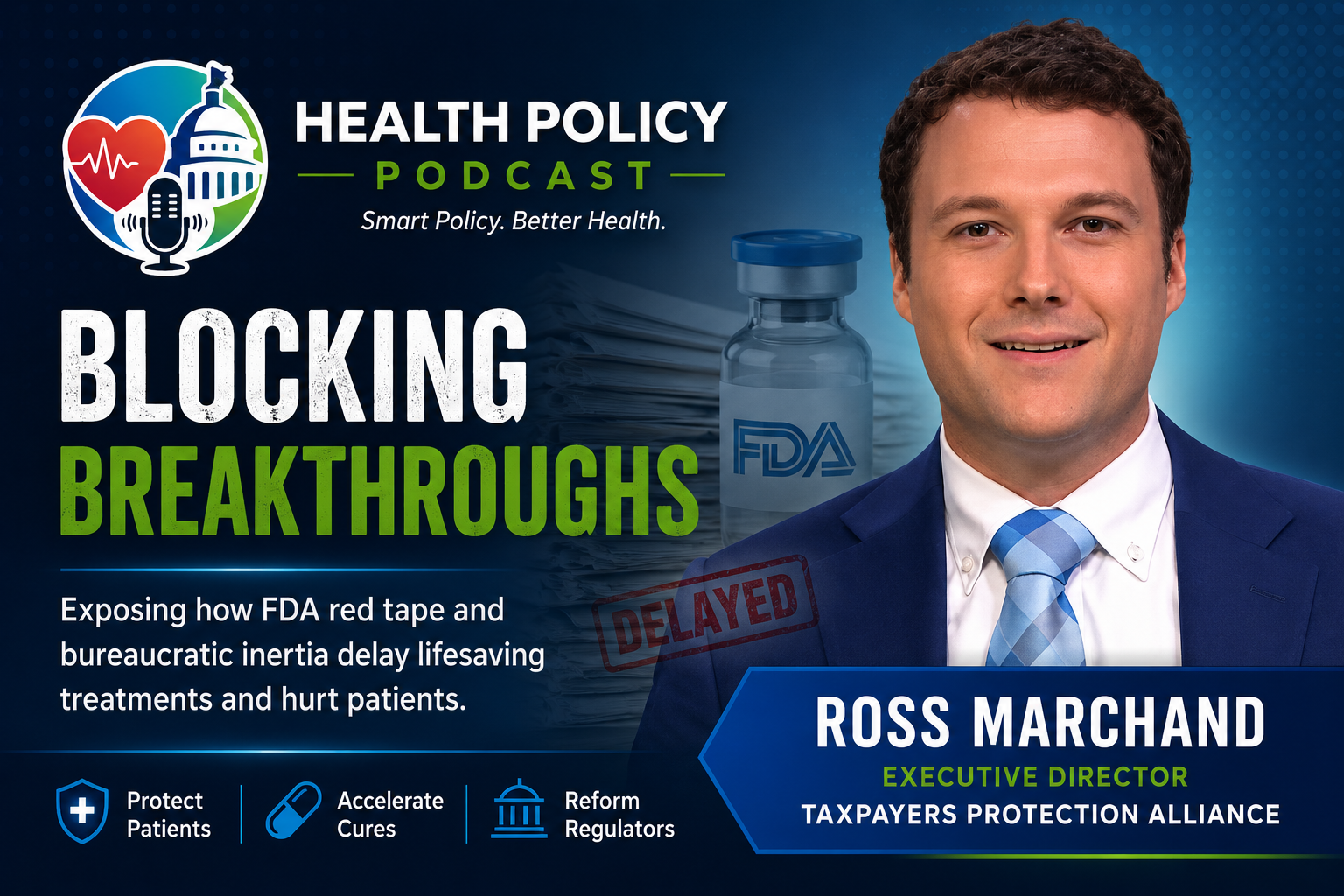
[00:00:00] Welcome to the Health Policy Podcast. I'm Brian Hyde. Today I am joined by Ross Marchand. He's Executive director of the Taxpayers Protection Alliance. And Ross, it's good to have you back on the program. Thanks. Great to be back. So for those who are meeting you for the first time, take a moment here to kind of tell us a little bit about who you are and what you do.
Sure. Yeah. So the Taxpayers Protection Alliance, we're always on the lookout for government run amok, and you don't have to look far. It seems like every day the government is coming out with some new and crazy proposal. It makes all of our lives more difficult. And what we've seen in the case of healthcare reform and the Food and Drug Administration in particular, as you have bureaucrats that are getting in the way of patient access to lifesaving cures.
I think I have probably heard that complaint more than any other about, you know, the regulatory agencies. Yeah. It's, it's, why does it take so long, you know, to, to get, you know, drugs approved and on the market, you know, when there are people who really need that, that help and I can understand safety and, you know, we wanna make sure that they actually work, but [00:01:00] it seems like there's something very cumbersome going on here.
Now I understand there's also a new FDA report. Out that, uh, that your organization has, has put together highlighting, you know, some of the, the challenges in particular. Tell me about that report. Yeah, so we recently released it, it's called Blocking Breakthroughs. And what we try to do is we try to put some data behind this idea that, you know, it's something that we've seen again and again.
You know, the media has reported on it and we've seen rejection after rejection. It seems like it is getting more difficult for patients to get access to these game changing treatments. And we looked at all the data and we found that over the past 10 years, rejection rates for medications. Has been going up and the cost of the FDA evaluating these treatments, the cost to taxpayers and customers is also going up.
Now, we don't just look at the data, we don't just look at the numbers. That's an important part of the analysis, but we also look at case. Studies and we [00:02:00] see, you know, in the individual cases for the individual drugs, what is going wrong in terms of these FDA evaluations And what we find, the FDA is always shifting the goalposts and they are always making up new excuses to deny patients access.
And that is deeply troubling. Now when, uh, health and human services Secretary Robert F. Kennedy Jr. Was, uh, was actually, uh. Put in as, as overseeing, you know, the FDA among other things. Um, I expected that we would see some pretty big changes. And so, um, I have to ask, have we seen some positive movement or is there some bureaucratic inertia that that keeps some of the problems in place?
Unfortunately, there's a lot of bureaucratic inertia. So when RFK first got in, he said, look, we're not trying to take anything away from patients. We're trying to preserve access. And when the Food and Drugs Commissioner Marty McCarey got sworn in almost exactly a year ago, he said something very similar.
He said, we're trying to accelerate cures and we're trying to cut red tape. And [00:03:00] unfortunately. That just has not taken place. Now you do see some isolated examples, of course, credit, where credit is due of drug approval processes that have, you know, gone pretty smoothly or pretty quickly. But that is largely the exception to the rule and the rule that we're seeing is an increasingly cumbersome and unpredictable process just failing patient.
So talk to me about, uh, some of the, the more egregious examples where, um, the FDA has either dragged its feet or otherwise put too much red tape in the way of, of drugs that could be making a difference. Yeah, so you have a medication called avalo, and this is for a rare type of cancer, and it's not like the US would be the first country to approve this medication.
You have regulatory authorities in the eu, in the UK, and in Switzerland that have already approved this medication. They looked at the data and they said, this is really helping out these patients who are seriously ill, and the US and the FDA. They just keep dragging their [00:04:00] feet and they're shifting the goalpost too.
This is a very common theme. Of what we saw in the report. They'll say, oh, there are manufacturing deficiencies, um, at this production plant, so therefore, um, we just have to wait until you get your act together and then we'll prove it. And then the company goes back to the FDA and says, yeah, we fixed everything.
And then the FDA says, well, you fixed as manufacturing deficiencies. But then we identified another issue. We said that your studies, uh, look good before, but now guess what? Now we have an issue. So it drags on for years. And years and years and, you know, patients are left. And these are seriously ill patients.
They're left without a cure and bureaucrats just keep getting in the way. And I have to ask, is the excuse, we're just trying to keep 'em safe even though they're, you know, actively dying because they, they need those drugs. Yeah, I mean it's, you know, we're trying to keep people safe. Um, you know, we identify this small issue in manufacturing, but here's the thing, whether it's food or drugs, there's always gonna be some sort of manufacturing issue.
[00:05:00] So, I mean, you see this in, uh, medications that have been approved for diabetes, for example. Um, for many, many years. Sure. You know, manufacturing plants will have some degree of contamination, and that's not good. And the FDA needs to keep close, watch out for contamination. But the proper response to that is not to just ban the drug or not approve it.
It's to say, look, the drug is approved, but you need to fix this deficiency. It shouldn't be back to the drawing board for these medications. Um, let's talk about how this affects the cost of medications too. My understanding is, uh, for a pharmaceutical company to put a drug out there for approval, um, that process in and of itself, not even counting the research and development, but just the approval process can be extremely expensive.
Why is that? Oh, absolutely. And it costs $2 billion to bring a drug to market. And that is mainly, yeah, yeah, yeah. So you need to run these, you know, very elaborate clinical trials. And a lot of that, of course, you know, is a good idea. You wanna make sure that the medication works. You wanna run, um, a [00:06:00] blind study to make sure that, you know, you really want to compare closely patients who have received this medication versus patients who have not received this medication.
But a lot of these. Extraneous requirements are adding to the cost. And the FDA is very, very picky about what data it uses. Now, again, it's good to an extent to be picky about the data that you're using. 'cause these drugs impact a lot of people. But the FDA is being a lot stricter than regulators in other countries.
And we're not just, we're not seeing the benefit of that added strictness. In fact, it's an invisible graveyard because you're keeping these patients away from these medications that could save their lives. That was one of the things that really struck me, that you mentioned earlier, was other countries, you know, some of these drugs have been approved, they're actually in use in other countries.
Right. And, uh, you know, I mean, maybe, you know, the first conclusion I jumped to, well, they must have, you know, a really bad, you know, regulatory, you know, kind of, kind of, um, agency. I don't think that's the case though. What, what is it that the, that makes the FDA [00:07:00] so much more strict? So one thing, and there's a few things, but one thing that comes to mind is if you are studying a rare disease, you can't have a really big clinical trial.
It's difficult because the universe of people suffering from the disease who benefit from the drug, it's just not that big to begin with. So what you do in that case, if you have a drug targeting a rare disease, is you're gonna bring in historical data. You might have data that's, you know, 20 years old or 30 years old that predates that drug and you use it as a part of, you know, maybe you're bending the survival curve and, you know, you could see maybe after the limited introduction of that drug for study purposes, maybe the death rate is going down compared to what we would expect 20 years ago from that disease.
But the FDA. Has been very strict about that historical data. And if even if it's, you know, the rarest disease that this drug is targeting, the FDA will say, well, we don't really like using this historical data, but that is the only way to prove the efficacy and the safety of the [00:08:00] medication. So what are you left with if you do not have that data at your.
Disposal. The FDA has been way stricter with what data is allowed to go into the application, and it's resulting in these denials that, again, um, these drugs have been proven and have been approved in other countries by other regulators. And as you pointed out, these are high quality regulators in other developed countries and developed jurisdiction.
I'm thinking back, you know, 25, even 30 years ago, um, there were drugs and that one that comes to mind is maybe Viox, that, that were approved by the FDA, but then later had to be pulled off the market. There were, there were some side effects that were found out. My point being, sometimes even with all that caution, they still get it wrong.
Um, does your study show are the, um, denials. Are are, are they becoming stricter about denying drugs because of of past mistakes? I mean, is it, is it the aversion of, oh, we don't want to let something out there. Yeah, I think so because every time there's an approval and then something bad happens, um, it gets [00:09:00] extensively reported on.
And again, it should be extensively reported on, but those instances should not speak louder than the FDA being too risk averse. But unfortunately they do, because if you have a headline, you know, three people significantly sickened, um, by this FDA approved medication, you know, heads will roll, figuratively, people's jobs will be on the line at the FDA.
These FDA bureaucrats will never get in trouble for the opposite situation being too risk averse. So yeah, it has definitely informed that, but that doesn't make it right by any stretch of the imagination. I just have to think that if, if other countries are able to find that balance between the perfect set of rules where nothing bad ever happens or slips through right, versus, you know, getting needed drugs on the market, if they can do that, uh, what is it that's holding us back here in the us?
I think it's just a culture especially of risk aversion. Now the FDA has this reputation. It is the gold standard and you know, rightfully so. I mean they definitely are very rigorous and they [00:10:00] have some of the best expertise in the world, but I think to an extent that's gotten to their head and they think, oh, we're the gold standard, so we need to be the strictest.
We need to treat this historical data. In the most strict way possible, even stricter than our peers. Otherwise we're gonna lose, you know, that gold standard status. And I think that's a really misguided way of looking at it. I think the FDA is the regulator that it is, it has a prestige that it has because it has, um, a tendency towards flexibility and innovation.
And America has the. Innovative biopharmaceutical sector in the entire world. But the FDA is going to squander that with heavy handed rules and not allowing patients access. What about medications that, uh, have been approved as a prescription medication, but have become so common in use that, uh, that they, uh, may be ready to become over the counter?
Um, talk to me a little bit about the process of, of how that takes place and, and is, does the FDA drag their feet on that? As well, [00:11:00] surprisingly, maybe, surprisingly, maybe not. So surprisingly, the answer is yes, they do drag their feet. So one, you know, really great. Go-to example is statins. So statins help lower blood cholesterol levels.
If saved millions of lives, they prevented countless heart attacks, and yet the FDA will not allow them to be sold over the counter. You need a prescription if they're very, very well tolerated Now look. There are side effects. Of course there are side effects with any medication, right? Even, even commonly sold over the counter medication and cold relief medication.
You know, there are serious side effects, but statins are so well tolerated and have such few side effects that they should absolutely be over the counter. And this is not a theoretical discussion. This already happens in the uk. You know, if you live in the uk, you can get. Statins over the counter, and there's no serious issues associated with that.
So, you know, you have such an important drug. It has been, you know, instrumental in helping prevent heart attacks, and yet you have [00:12:00] to jump through hoops to get it. Um, not everyone has access to primary care doctors, and for those people, I mean, you know, it could be life or death because then they can't get access to statins.
So let's, let's bring it around now to what are some of the recommendations? In other words, um, I think you, you've done a good job of outlining the problems here. Mm-hmm. What can we do, or what can the FDA do to, to help, uh, alleviate some of these hurdles? Well, one easy thing you could do. So a lot of our case studies point to examples where the FDA drags their feet while international regulators, you know, approve these medications.
So if you want to close that gap, a very easy way to do it is regulatory reciprocity. So you say something like, you know, here's a list of approved regulators. It's gonna be EU regulators, it's gonna be UK regulators, Swiss regulators and regulators in Japan and Korea. Um, so you look at this approved list and you say.
If a drug is good enough to get approval in those countries and those jurisdictions, it should be good enough [00:13:00] for US approval. Um, so that's regulatory reciprocity, and they can do the same with FDA approved drugs as well. So it avoids duplicative regulatory reviews and it will get drugs to patients faster and with less hassle.
Okay. That, I mean, that sounds like a wonderful place to start. What about the over the counter medications that we were talking about earlier? What, what could they do differently there? So the FDA is already starting to do this. So this is one sort of bright spot where the FDA is actually embracing reform.
They should come up with a list of drugs that have, and they're well tolerated and have an acceptable safety profile, and that have saved lives and. Or currently prescription only. And they should really ask. I mean, should these be over the counter, statins are top of mind. Um, albuterol for asthma, um, would be another great candidate.
And you know, there are at least dozens more that could easily be reclassified to over the counter. And that would, that would do probably more than anything else to [00:14:00] increase patient access to these medications. Remove the go to the doctor first requirement. Talk to me too about, uh, um, I, I'm looking at the report here that, that you put together, and one of the suggestions is permitting provisional approval of medications that meet safety but not efficacy thresholds with prominent labeling.
Can you help me differentiate between safety and efficacy? Sure, yeah. Safety is, you know, if we are giving this to patients or a significant percentage, for example, reporting serious adverse effects, sometimes you'll have a promising medication, but it's not really worth it to approve because a large percentage of the people taking the drugs require hospitalization.
Um, you know, the body of course, is very complex and, um, there are interactions that sometimes we don't fully understand that even the most promising medication can run into serious. Safety concerns, but there are a lot of medications that are perfectly safe, but it's kind of unclear whether they're effective.
Maybe there's one big [00:15:00] clinical study saying, okay, this drug is really effective in treating one's supposed to treat, and then maybe another study goes in the other direction. So for the universe of drugs that are. Safe, acceptably safe, right? They're not gonna, you know, put patients in the hospital or give 'em serious adverse effects, but we don't quite know.
We need to study more. Are they effective then, for the time being, give patients access to these medications and then after approval you could do post-approval studies to get at that question? Does it actually work? It sounds like that would also put some of the responsibility as well as, um, some of the, um, power or authority to act back on the patients themselves instead of them.
That's right. Simply being passive, you know, you know, people waiting for someone above them to approve, you know, a particular medication. Yeah, exactly. Let patients make that choice. I mean, there are a lot of medications right now that are approved where, you know, reasonable people can disagree. How well does this work?
So this would just be taking it a step further [00:16:00] and, you know, giving patients and their doctors the power to decide that and not saying, um, oh, this is. You know, this is above your pay grade. You know, you're not worthy of making this decision. Patients are worthy of making this decision. These drugs can tremendously benefit patient lives, but you have to give them that choice to begin with.
You had mentioned that, uh, the FDA is kind of the gold standard. Um. Through throughout the world, you know, when it comes to, to approving drugs. Um, talk to me a little bit about, uh, is, is there, is there a sense that other countries just aren't as advanced as we are and therefore, you know, even if they have the clinical trial data, you know, it came from this country, so we really, you know, can't give it any, uh, you know, serious weight.
Um, what could be done to, to help overcome that hurdle where, um, they're, they're more focused on, you know, does it work as opposed to where it came from. Well, I think it's really just sharing best practices and improving communication between the regulators because clearly there's less than ideal [00:17:00] communication if the European Medicine Authority is saying, oh, this drug is perfectly good.
You know, we've looked at the studies and it all points in one direction. The FDA is going in in different direction. So I think communication is the best practice going forward. Um, and it's, it's concerning that. A bunch of regulators, you know, around the world from developed countries are coming to one conclusion.
The FDA is coming to a different conclusion. So I think it's important for these regulators to talk it out, but even if the FDA is more risk averse than the other countries, then I think it's really important to err on the side of patient choice. And if you have the EMA and Japan and South Korea and all these regulatory authorities coming down on one side, really the FDA should be coming down on that same side as well.
Ross, one final question for you, and that is, um, you had mentioned earlier, you know, that sometimes the FDA will, um, hyperfocus on, you know, some, some manufacturing issue or, or some supply chain issue as, as a reason for this is why we can't offer approval. Is there [00:18:00] something they could do differently in, in addressing those types of concerns, um, as opposed to the way that they're doing it now?
It's great that they're identifying those manufacturing related issues, but instead of um, saying, okay, now we can't approve the drug as a result, I think they should proactively work with the company to remedy that issue while they offer preliminary approval. It shouldn't be back to the drawing board.
It should be This is approved. There's this one issue and we're actively working it out. And if they can, you know, for example, if there's one manufacturing facility or part of the facility that's causing the problem, maybe they can isolate that out and otherwise green light that medication. But just saying, no, sorry, we can't approve at all back to the drawing board, it's exceptionally ill tailored.
And I think it is a huge mistake and it limits patient choice. Alright. Now, where can people access this report that, that we've been referencing through throughout this, this episode? Um, is, is it, uh, at the the Taxpayer Protection Alliance website? [00:19:00] Yes. Protecting taxpayers.org. Okay. We'll, we'll include a link in the show notes.
Again, we're talking with Ross Marchand, executive director of the Taxpayers Protection Alliance. And Ross, thanks for joining us once again here on the Health Policy Podcast. Thanks. Great to be back on your show.