2026-01-23 · Center for a Free Economy
Ryan Ellis on Why COVID-era Obamacare Subsidies Should Stay Expired
with Ryan Ellis, President — Center for a Free Economy
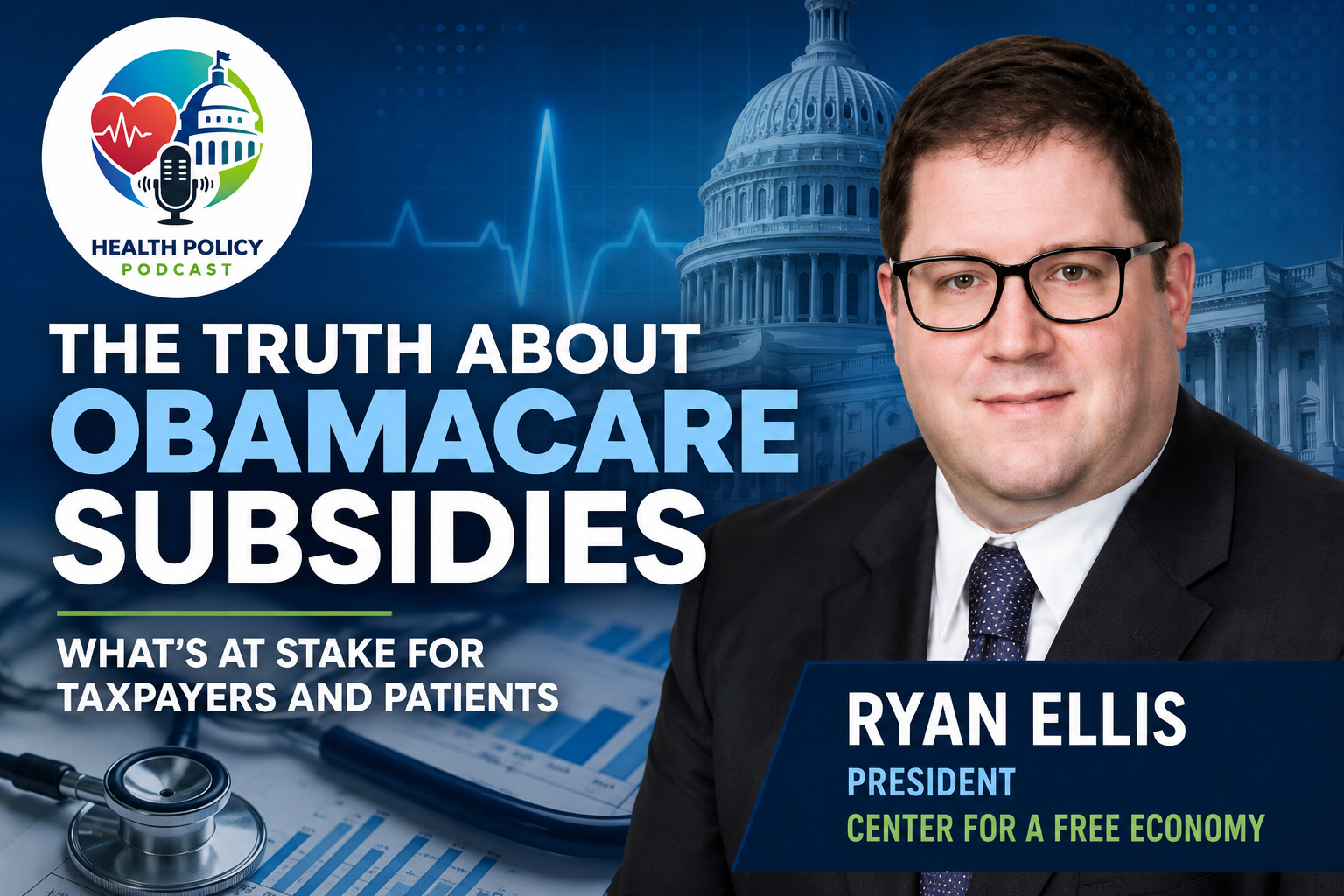
In the latest episode of the Health Policy Podcast, Ryan Ellis, President of the Center for a Free Economy, discusses the expiration of COVID-era Obamacare subsidies. Ellis argues that these subsidies should remain expired, as the existing Obamacare framework already provides necessary support for those in need. He emphasizes the importance of accountability and reform in government assistance programs, particularly in light of recent fraud cases in Minnesota.
Center for a Free Economy’s Ryan Ellis on Why COVID-era Obamacare Subsidies Should Remain Expired
Ryan Ellis Advocates for Expiration of COVID-Era Obamacare Subsidies
Ryan Ellis, president of the Center for a Free Economy, discussed the implications of the expired COVID-era subsidies for the Affordable Care Act (ACA) during a recent episode of the Health Policy Podcast. Ellis argues that these subsidies, which were designed to assist individuals during the pandemic, should remain expired due to their financial burden on taxpayers and limited effectiveness.
Ellis, who has extensive experience in policy advocacy related to federal tax, spending, and regulatory issues, emphasized the need to return to the original structure of the ACA. "Obamacare is a heavily subsidized program for individuals to buy health insurance," he said. "The additional COVID-era subsidies were intended as a temporary solution, but they have now expired."
The COVID-era subsidies were implemented to provide financial relief during the pandemic, but Ellis contends they were not necessary for many recipients. He noted that these subsidies extended to individuals earning significantly above the federal poverty level, leading to potential misuse. "There was a lot of enrollment of people who didn't even know they were enrolled," he explained. "Getting that completely put away and done is important."
Ellis criticized the push by some Democrats to make these subsidies permanent, calling it an expensive proposition that could add hundreds of billions of dollars to the national debt. He pointed out that the existing ACA subsidies already serve those who need assistance, particularly those transitioning from Medicaid or lacking employer-sponsored coverage.
The Need for Reform
Ellis also addressed the broader issues within the healthcare system, asserting that the ACA has not achieved its goal of making healthcare affordable. He highlighted design restrictions imposed by the ACA that limit the flexibility of insurance plans, resulting in higher premiums. "Obamacare made a lot of those products either illegal or functionally illegal," he said. "As a result, it's caused insurance premiums to go up and up every year."
He argued that competition in the healthcare market is stifled by these regulations and that deregulation is necessary to foster innovation and lower costs. "If the only thing you could buy is McDonald's hamburgers, then it doesn't matter how many McDonald's you have," he said. "Until you have the deregulation that says everything has to be a McDonald's hamburger, there's very little chance of the competition that we need."
Political Dynamics
Ellis also provided insight into the political dynamics surrounding the subsidies. He suggested that the Democratic Party's push to extend the subsidies is influenced by a close relationship with the insurance and hospital industries. "There's an iron triangle effect happening here," he said, referring to the collaboration between government officials and industry stakeholders to secure funding from taxpayers.
He posited that the Democrats' long-term goal is to establish a single-payer healthcare system, which would require significant government subsidization. "More subsidization is always a good thing for them," he stated.
Addressing Fraud and Accountability
The conversation also touched on recent reports of fraud in Minnesota's healthcare system, particularly involving daycare centers and government assistance programs. Ellis pointed out that the current welfare system lacks accountability, leading to misuse of funds. He advocated for reforms that would introduce basic eligibility checks and work requirements for government assistance programs.
"The entire apparatus of helping people that we have in this country is in deep need of reform," he said. "Basic work requirements within SNAP and similar requirements within Obamacare are essential."
Future Directions
Looking ahead, Ellis expressed the need for comprehensive reforms to address the structural issues within social programs, including Social Security and Medicare. He emphasized that while the recent One Big Beautiful Bill Act made progress in welfare reform, more extensive changes are necessary to ensure fiscal responsibility.
The Center for a Free Economy, founded in 2018, aims to address these issues by focusing on national fiscal policies. Ellis encouraged listeners to engage with their content and participate in discussions about critical economic and healthcare reforms.
In summary, Ryan Ellis advocates for the expiration of COVID-era Obamacare subsidies, emphasizing the need for accountability and reform in the healthcare system to reduce costs and improve efficiency.
Interview Q&A
Q&A: Center for a Free Economy’s Ryan Ellis on Why COVID-era Obamacare Subsidies Should Remain Expired
Health Policy Podcast: Q&A with Ryan Ellis
Q: Can you tell us about your role at the Center for a Free Economy?
A: I am the president of the Center for a Free Economy, a conservative 501(c)(4) organization. We focus on federal tax issues, federal spending, and federal regulatory issues that matter to the American people.
Q: What is currently a major focus for the Center regarding healthcare?
A: Recently, we have been focused on whether to extend the COVID-era Obamacare subsidies. These additional subsidies were intended as a temporary measure during the pandemic but expired at the end of last year. The Democrats want to extend them, which would significantly increase national debt.
Q: Should the COVID-era Obamacare subsidies be reinstated?
A: No, they should remain expired. The legacy Obamacare subsidies are sufficient for those in need, and adding more subsidies to a fundamentally broken system is not advisable.
Q: Did Obamacare achieve its goal of making healthcare affordable?
A: No, I don’t believe it ever could. The Affordable Care Act imposed design restrictions on insurance policies that made health insurance more expensive. These restrictions limited flexibility and innovation in the insurance market.
Q: What is needed to address the issues caused by the Affordable Care Act?
A: Competition is essential, but it is impossible without deregulation. The current structure limits the types of insurance products available, which stifles competition.
Q: Why did Democrats fight to keep the COVID-era subsidies?
A: There are theories suggesting that the big insurance and hospital industries have aligned with Democrats to secure more government funding. Some Democrats also ideologically support increased government involvement in healthcare, aiming for a single-payer system.
Q: What recent fraud cases in Minnesota highlight issues in government support programs?
A: The fraud cases in Minnesota, particularly involving daycare centers and government healthcare, reveal a lack of accountability in welfare programs. Reforms are needed to ensure that only eligible individuals receive benefits.
Q: What reforms were included in the One Big Beautiful Bill Act?
A: The bill included welfare reform restrictions, such as work requirements for SNAP and eligibility checks for Obamacare and Medicaid. It also aimed to eliminate waste, fraud, and abuse in government spending.
Q: What is the Center for a Free Economy doing to address these issues?
A: We focus on national fiscal issues, including tax policy and healthcare reform. We provide content and advocacy on various topics, from food stamp reform to social security.
Q: How does the Center engage with the public?
A: We share content daily on our website and social media platforms to inform the public about fiscal issues and propose solutions.
Q: What are the long-term goals of the Center for a Free Economy?
A: Our goal is to promote fiscal responsibility and reform in government programs, particularly in healthcare and welfare, to ensure accountability and efficiency.
Q: How can people learn more about the Center for a Free Economy?
A: People can visit our website at centerfreeeconomy.org and follow us on social media at CF economy for updates and information.
Key takeaways
- “The COVID era Obamacare subsidies expired at the end of last year, and they should remain expired.”
- “Obamacare made a lot of those products either illegal or functionally illegal, causing insurance premiums to go up and up every year.”
- “If the only thing you could buy is McDonald's hamburgers, then it doesn't matter how many McDonald's you have that are competing with each other.”
- “The entire apparatus of helping people that we have in this country is a model that is in deep need of reform.”
- “More subsidization is always a good thing for the Democrats; they want the government to pay for it anyway.”
About the guest

President — Center for a Free Economy
Ryan Ellis is the president of the Center for a Free Economy and an IRS-enrolled agent.
Full transcript
Show full transcriptHide transcript
Filed under