Show full transcriptHide transcript
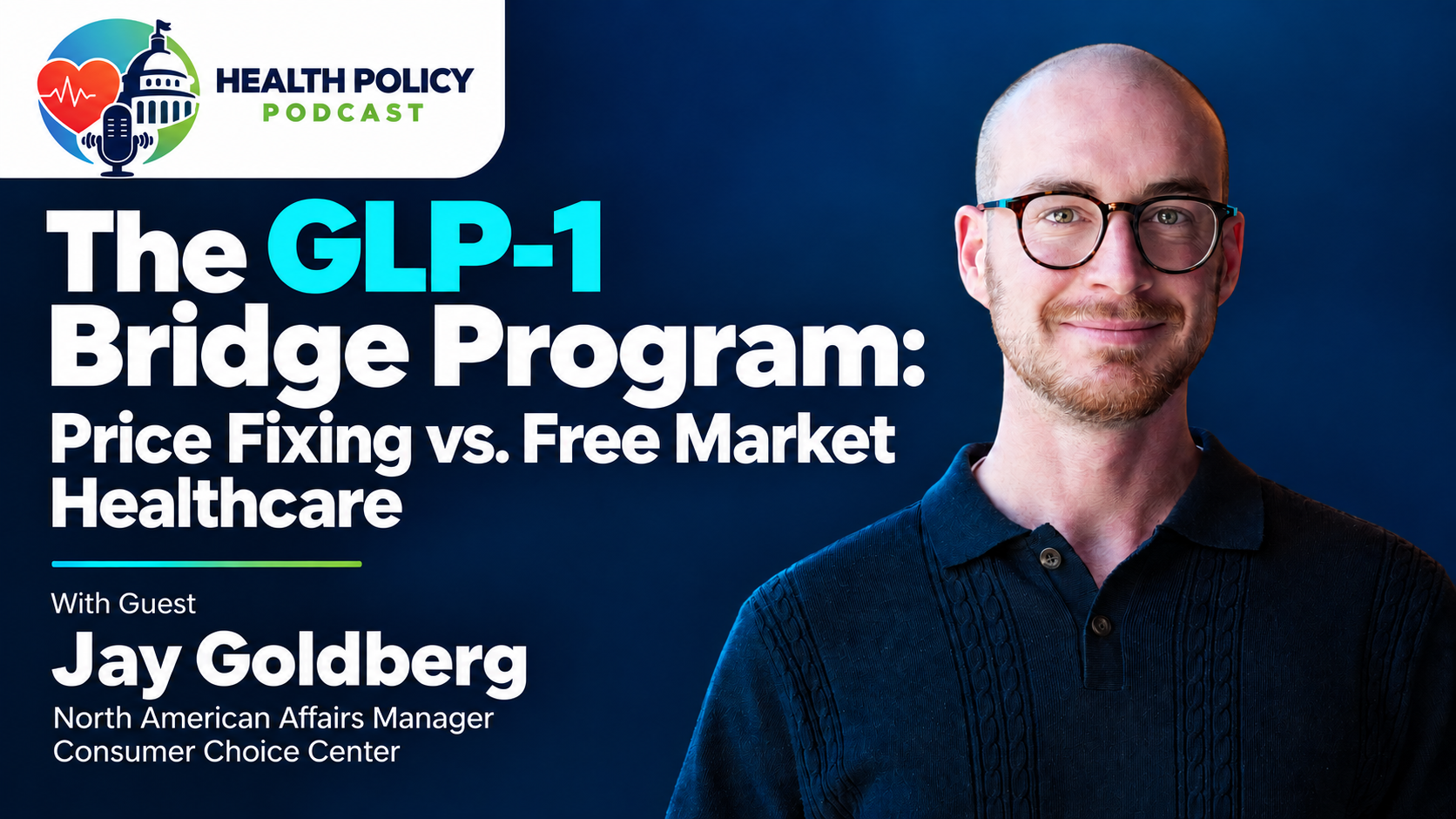
[00:00] Bryan Hyde: Welcome to the Health Policy Podcast. I'm Brian Hyde. Today I am joined by Jay Goldberg. He is the North American Affairs Manager at the Consumer Choice Center. And Jay, welcome to the program. For those who are meeting you for the first time, let's take a moment to have you tell us a little bit about who you are and what you do.
[00:15] Jay Goldberg: So my name is Jay Goldberg. Thank you. It's a pleasure to be with you. I'm the North American Affairs Manager at the Consumer Choice Center, and we advocate for consumer choice in all kinds of sectors. So In particular today, we're gonna be talking about choice in healthcare, but we work on other issues as well, energy, trade, a whole host of issues. But anyway, it's a pleasure to be with you today.
[00:40] Bryan Hyde: So Jay, when you say consumer choice, I'm just gonna dig a little bit deeper here. We're talking about, you know, this is about free markets and allowing the market to do its work, correct?
[00:51] Jay Goldberg: Absolutely. It's about free markets, the ability for the market to do its work, and the ability for people to make their own choices in their own lives. and ultimately determine what's best for them without, in the vast majority of cases, government intervention or the most minimal possible. And of course, we'll talk more about that today.
[01:11] Bryan Hyde: You know, it would seem that that would be a very easy sell to most people. And yet, it feels like a lot of the people that I encounter just day to day, they're not so sure they trust the free market. I mean, it's good, but just in case, maybe the government should get involved and it should intervene here because for some reason, that's gonna get a better outcome result. Um, let's just dive into the topic here and we can, we can see whether or not that, that bears out. Um, talk to me about the GLP-1 Bridge Program. We're talking about weight loss drugs, correct?
[01:45] Jay Goldberg: Yes, we are. Uh, so we're talking about weight loss drugs, uh, and the GLP-1 program, the Bridge Program I should say, uh, was created by the Trump administration and, um, CMS has been championing this, um, as, as a way for people on Medicare and Medicaid to access GLP-1 medications at lower prices. So you'll be paying, if you're eligible for the program, $50 a month to get these prescription drugs. Obviously, it's been shown in a whole host of studies and just anecdotally that these GLP-1 drugs are helping, you know, hundreds of thousands, if not millions of Americans lose weight. We know that's important for cardiovascular health, for treating things like sleep apnea. There's no question This is a benefit to millions of Americans. But what the GLP-1 Bridge Program does is that it essentially embraces price fixing, right? So there's a fixed price that individuals are paying, $50 a month. Now, the way that it's been negotiated with the relevant companies is that the government, essentially taxpayers, are also paying $195 a month to go along with that. So the companies themselves are getting $245 Now, that's under market price. So obviously, there's a hit there in terms of what these companies are able to get back for medical innovation. And we can talk later on about how important it is for the free market to keep America as the home of medical innovation and making sure that we are the first place where you're seeing new drugs come out and things like that. But the GLP-1 Bridge Program, again, designed to get people on Medicare and Medicaid to get these drugs at lower prices. But it embraces really a price-fixing model from— that you see from other countries where, frankly, healthcare just doesn't work as well as it does in the United States.
[03:48] Bryan Hyde: And I want to define the term price fixing just to make sure that I'm clear on it. When government engages in price fixing, what is it trying to accomplish?
[03:58] Jay Goldberg: It's essentially trying to get prices down at At the expense of the companies that are providing the drugs, but the ultimate expense that the ultimate cost is to actually the consumer itself because it's it may sound nice fifty dollars a month that sounds great we're going to fix the price at fifty dollars a month what does it actually do well it means that companies can't pay for the in many cases the average is two and a half billion dollars that companies are paying to create new drugs so if you're talking about recouping costs, if you're talking about making sure that companies are actually able to pay for the medical innovation that they go through, if you're just going to fix a price, that's not going to happen. And I'll talk about other countries. I work with other countries too. Canada, for an example, the government fixes prices all the time, just says, we're going to pay $50 a month, $100 a month for this drug. Well, what it does is the medical companies don't actually— they're not in a rush to get to these countries to get their drugs on the market because they're not getting the price that they need to recoup costs. And so what it ends up meaning is slower access to drugs for consumers. And the primary reason why Americans are getting drugs first is because in the majority of cases, there isn't price fixing where the government is dictating well, a drug needs to be this price or that price compared to other countries. You know, President Trump has talked about, for example, embracing most favored nation pricing, which again is essentially price fixing, which is done in other countries. And, you know, we can talk later about how that, what implications that might have for the United States going forward.
[05:48] Bryan Hyde: I feel like you're approaching this from a very balanced place too, in that this is not, you know, well, if government's doing it, it's automatically bad. It sounds like there may be some positives, for instance, paying less for those, you know, GLP-1 weight loss drugs. Great. However, that doesn't necessarily mean that because there's that benefit that there aren't some drawbacks too. Talk to me about— let's talk about the positives of this program first, and then let's talk about why competition really should be a part of this equation.
[06:18] Jay Goldberg: Absolutely. So the positives are people are getting to know that GLP-1s are important in getting weight loss achieved for Americans who desperately need Of course, the positives are that people who are on Medicare and Medicaid are people who in many cases are needing these drugs. You're talking about, particularly on Medicare, the elderly. And in many cases, this is when a lot of the health issues that obesity is going to manifest itself. So whether it's heart disease, whether it's sleep apnea, a whole host of other issues, high blood pressure, things like this. And that costs the US healthcare system. And because these individuals, if you're over the age of, you know, if you're on Medicare, it's costing the US healthcare system because of course taxpayers are paying for folks who are on Medicare. So in many cases, you are saving the healthcare system money down the line by making sure that people are able to lose weight, access these drugs, lose weight, get healthier, have healthier lives. And so you're going to cost the healthcare system less going forward, which in turn costs government and taxpayers less. So ultimately, the system will be saving money. And this is the logic behind the Bridge Program, is to say, let's target these specific individuals who are already in government healthcare, essentially, and let's make sure we can get them in a healthier place. And so that over the long term, We can make sure that healthcare costs come down for the taxpayer, and so that's essentially the the selling point of the bridge program. There's not too many people actually who know about the bridge program. It's a bit hard to access, but for those who do know about it and who can access it, these are some of the selling features. Obviously, the lower price—the fifty dollars a month—but for taxpayers over the long term, the good news is you're trying to make Americans healthier. You're trying to get the healthcare system. To cost less.
[08:29] Bryan Hyde: All laudable goals. And I think, you know, most people would agree, wow, you know, that's great. There's the benefit. However, when we're talking free markets, you know, now we're talking about economics and you can't be a good economist without looking at what are some of the unintended consequences that come when government intervenes like this. And let's maybe talk about the downside of government, you know, stepping in to create that bridge.
[08:57] Jay Goldberg: Absolutely. So I would say at the outset too, if you look at companies like Eli Lilly or Novo Nordisk, both companies have over the past year or even less than a year really gotten prices down themselves. And so the way in a free market you want to get prices down is to have more options, more competition, And therefore companies have to compete with each other to get prices down. What the bridge program is doing is artificially lowering the price. Again, it's $50 a month for those who are paying. It's $195 on top of that that taxpayers are paying for. But you're only compensating these companies $245, which is less than the market price right now. Even though it's come down, it's still less than than the market price. So what it does is, for example, if this were to apply to all Americans, not just those on Medicare and Medicaid, but if everyone could do this, it would disincentivize companies like Eli Lilly, Novo Nordisk, and others from wanting to produce these drugs, from wanting to invest the billions of dollars they have to, to create these drugs that are changing lives. because they're not getting the return that they need to pay for it. And so that's the risk that you're creating. Obviously, the GLP-1 bridge program right now is just for those on Medicare and Medicaid, but it could end up— there could be suggestion. Of course, we know that there are politicians out there who will probably suggest, well, let's extend this to everyone. And if you do that, you start to get to a very dangerous place, slippery slope, where you end up again price fixing, going towards a more socialist healthcare model.
[10:46] Bryan Hyde: Yeah, I am— I'm so glad you tied that in there because that's when you start by normalizing a few smaller, you know, really desirable places. Well, if government fixed the prices here, you know, then that must be a good thing. But it never just stays in one place, does it? I mean, it seems like that kind of sets the stage for, um, well, government price fixing seems to work there, why not everything else?
[11:08] Jay Goldberg: Absolutely. That's going to be the logic that politicians on— frankly, you know, from both parties will start to use. Because, you know, most favoured nation, for example, pricing used to be something you heard from a lot of Democrats. Now you're hearing it from the Trump administration. So it's on both sides that there's this appeal of price fixing. But you really have to look at the cost of price fixing, which is access, delays in getting access to new drugs, delays in treatment. So, you know, I can certainly speak from experience having spent time in Canada as well that, you know, there's a long delay in terms of accessing drugs. All kinds of other countries that engage in price fixing where the government just dictates how much money they're willing to pay these companies for the drug, well, the companies wait until the cost of the drug comes down or it's been long enough that they've recouped enough of the investment that they've made that it becomes worthwhile for them to actually go to those markets. They don't go immediately. And there's a reason why Americans get drugs first. And we don't want to mess with that. We don't want to ruin that. And that's, that's the risk if you start to engage in large-scale price fixing.
[12:24] Bryan Hyde: So let's, let's make the case for competition, Jay. I know in some circles, in fact, in a lot of circles, competition is kind of a dirty word. Oh, well, this is— everybody should get a gold star. You know, everybody You know, should get a participation trophy. But there's something about competition that seems to bring out the best. Let's make the case here why competition is better than running to government and saying, hey, fix that price for me.
[12:48] Jay Goldberg: Yeah, absolutely. So there's a difference in terms of if companies are facing price fixing, there's not an incentive themselves to get costs down, to innovate, to find ways to actually genuinely reduce costs. This is just an artificial way to reduce costs for the consumer when you're at your pharmacy and only paying $50. The way to actually reduce costs in the medical system is through competition, because if you have multiple companies producing drugs that are trying to treat a similar issue, in this case trying to help Americans lose weight, if you have multiple companies offering various ways to achieve discounts or various ways to get these prices down, they're going to start to compete with each other. Well, if you're offering this at a lower price, we're going to have to figure out how to get ours down too, without the government intervening. And that's the key. Without the government getting involved, these companies will naturally compete with each other. So what you want to do is foster an environment where you can have as many companies as possible producing similar kinds of drugs so that they compete with each other, so that they find ways to get costs down on their side, not artificially, but through actually innovating and finding ways to get costs down. And of course, there's other ways to look at whether it's pharmacy benefit managers, which inflates costs for Americans, or finding more ways to get direct-to-consumer selling directly to consumers so that consumers can buy directly from these companies, which actually these companies are doing. Eli Lilly and Novo Nordisk both are finding ways to— in one case, it's their own pharmacy. In another case, it's direct-to-consumer sales. But in both cases, these companies, through competing with each other and others, are finding ways to get costs down for consumers. Over the past year or so, as I said, Prices have come down significantly, not because the government has intervened, but because they've had to compete with each other.
[15:00] Bryan Hyde: No, that's a great explanation. And again, competition is— that's what brings out the best. But, but for some reason, some people seem to think competition equals the Wild West. And you've just given a couple of examples of how those GLP-1 prices could come down without government intervention. Jay, tell me this. Why is it that people have such a hard time seeing beyond, well, we'll get the government to take care of this or to intervene and solve this for us rather than letting the market do what it does best?
[15:33] Jay Goldberg: Well, I think, you know, politicians have made a career out of trying to convince voters and consumers that there's somehow a magic wand that politicians can wave and prices will come down and everything will work out. And that somehow, you know, companies are ripping consumers off and there needs to be a way. For government to intervene and save everybody. The reality is we see in other countries— you can look at countries across the globe where politicians do intervene for every pharmaceutical good, for every drug, and you see what happens. It's delays in access. It's delays in care. It's less choice for consumers, less innovation. And we don't want to see that in the United States. But unfortunately, that's what happens when you have politicians get involved in things. And again, it's, it's a way I think of trying to get votes, trying to, uh, say that we can do something that really politicians shouldn't be doing.
[16:37] Bryan Hyde: Yep. It's, uh, yeah, I don't know why it's so hard for people to accept that, you know, the, the market is a much better, uh, system for measuring what really matters to people, whereas as governments You know, it will do its best, but really, at the end of the day, force is how it gets things done. We pass a law, we enforce the law. You know, you do this or else. Whereas the market is driven by voluntary decisions.
[17:08] Jay Goldberg: Absolutely. The market is driven by voluntary decisions, as you say, but the market is also driven by preferences. And we've seen that There's hundreds of thousands, millions of Americans that are embracing GLP-1s. And so of course, because there's multiple companies out there that are producing these medications, there's been this natural competition that's developed because there is this marketplace, there's this outlet where there's a consumer base for it. They understand that there's a natural competition to get prices down so that companies can and try to serve as many consumers as possible. When the government intervenes, it disrupts that whole process. And instead of naturally innovating to get prices down, there's just this lack of incentive to try to get prices down the right way, and prices get down the wrong way. And what I mean by that is prices get down artificially and you end up with a backdoor subsidy. Via taxpayers, which you see in this bridge program case. And you end up with— if this were to become society-wide and the bridge program was to serve all Americans, you would end up with these companies just deciding it's not worth the competition and innovation because they're not going to make their money back that they spent the billions of dollars developing these drugs that are helping millions of Americans.
[18:38] Bryan Hyde: And like you mentioned earlier, it also kind of gives— it gives the government some unearned standing as well. You know, if you need a problem solved, we're the best solution. Where again, if you look at what the free market brings in terms of results because of that competition, you want the most people to get the most benefit for the best possible price. You know, the free market's how that happens. Where can people find out more about this? Tell me about your website and where people can go to learn a bit more.
[19:08] Jay Goldberg: So head to consumerchoicecenter.org. You can read more about this. There'll be a link to the— obviously, the article we're talking about today was in RealClearHealth, so you can take a look at that. But we're writing all kinds of things about this, the GLP-1 program, other unfortunate market intervention that we're seeing on the healthcare front, whether it's most favored nation pricing, which the Trump administration has been talking a lot about the 340B program. So check out consumerchoicecenter.org. There's a lot to see.
[19:41] Bryan Hyde: Again, we are talking with Jay Goldberg. He is the North American Affairs Manager for the Consumer Choice Center. And Jay, thank you so much for joining us today on the Health Policy Podcast.
[19:52] Jay Goldberg: My absolute pleasure. Thanks for having me.