
2026-07-24 · Grover M. Herman Center for the Federal Budget at the Heritage Foundation
The Medicare Time Bomb: Robert E. Moffit on $60 Trillion Liability
with Robert E. Moffit, PhD, Senior Research Fellow — Grover M. Herman Center for the Federal Budget at the Heritage Foundation
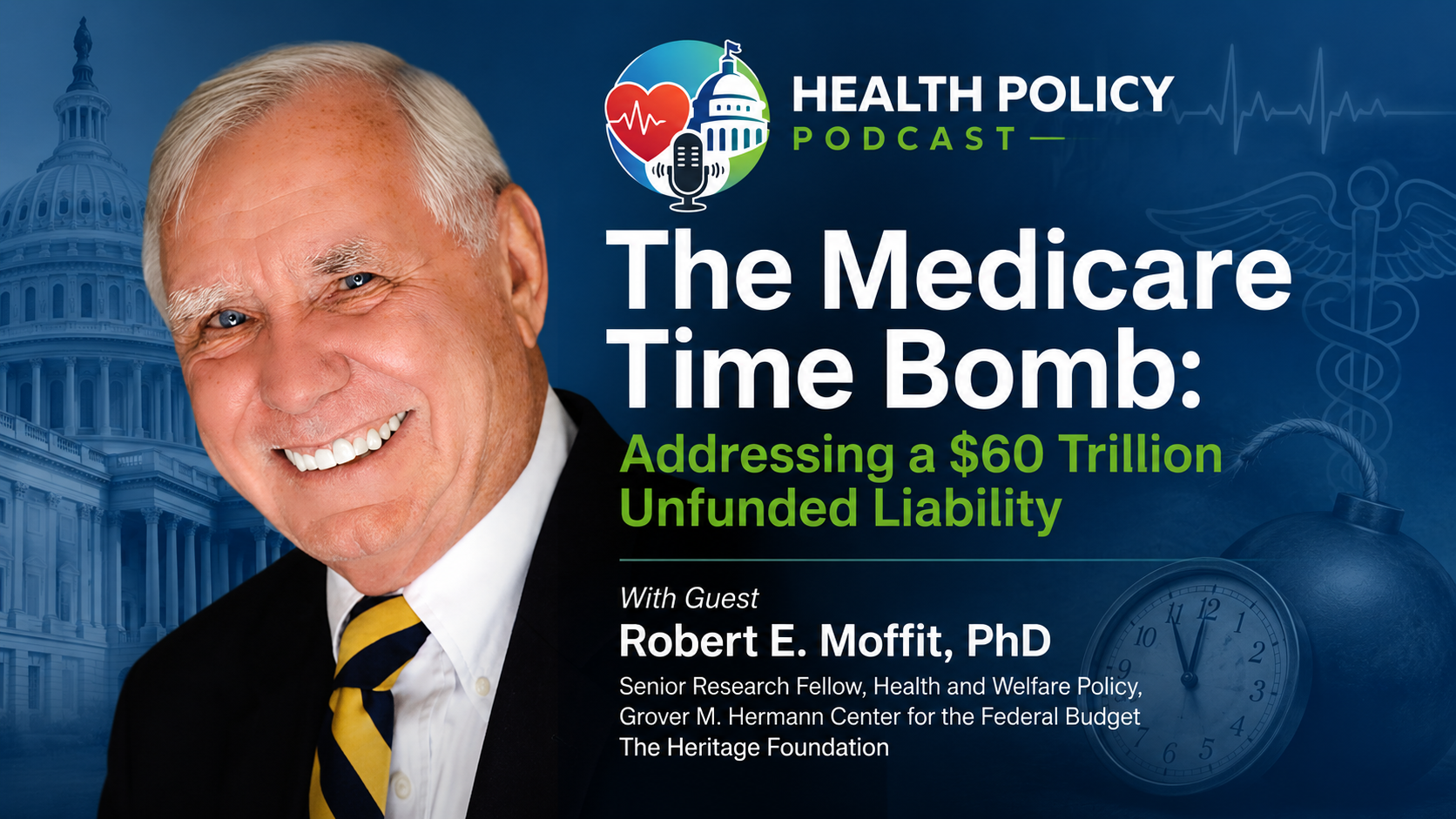
In the latest episode of the Health Policy Podcast, host Bryan Hyde discusses Medicare's significant unfunded liabilities with Robert E. Moffit, PhD, a senior research fellow at the Heritage Foundation. Moffit highlights that Medicare's unfunded liabilities are estimated at $60 trillion, posing a substantial fiscal challenge for future generations. He emphasizes the need for bipartisan solutions to improve the efficiency of Medicare financing and reduce healthcare costs.
The Medicare Time Bomb: Addressing a $60 Trillion Unfunded Liability
Medicare's Unfunded Liability Poses Major Challenge, Expert Says
In a recent episode of the Health Policy Podcast, Robert E. Moffit, PhD, a senior research fellow at the Heritage Foundation, discussed the significant challenges facing Medicare and Medicaid, particularly the staggering $60 trillion unfunded liability of the Medicare program. Moffit, who has over three decades of experience in health policy, emphasized the urgent need for Congress to address these issues as the nation grapples with rising healthcare costs.
Moffit explained that Medicare and Medicaid together account for approximately $2 trillion in federal spending, with Medicare alone costing about $1.1 trillion annually. He projected that this figure could rise to $2.4 trillion within the next decade. "The challenge that we're faced with is how to provide high-quality healthcare for a growing number of older Americans while maintaining economic stability for younger generations," he said.
The unfunded liabilities of Medicare, which represent the benefits promised to seniors over the next 75 years, amount to $60 trillion. Moffit pointed out that this translates to about $179,000 for every person in the United States. He warned that younger generations, particularly those in their 20s, will face significant financial burdens as a result of this escalating debt.
Moffit noted that Medicare and Medicaid are fundamentally different programs. While Medicaid focuses on the poorest and most vulnerable populations, Medicare serves a rapidly growing demographic of older Americans. He highlighted the increasing per capita costs associated with providing care, driven by advancements in medical technology and treatments. "The cost of delivering care on a per capita basis is significantly increasing due to these advancements," he said.
The structure of Medicare spending complicates efforts to reform the program. Moffit explained that Medicare operates under a system of mandatory spending, which means that funding for benefits is automatically allocated without the need for annual congressional approval. This structure limits the ability of lawmakers to make adjustments to the program's funding.
Moffit expressed concern about the political dynamics surrounding Medicare reform. He noted that members of Congress often fear the political backlash that can arise from proposed changes to entitlement programs. "This issue stimulates profound fear among members of the House and Senate because it's big, complex, and can have unintended consequences," he said.
He also recounted historical examples of failed reform efforts, including President Ronald Reagan's proposal for a catastrophic benefit in Medicare, which ultimately failed due to excessive additions that made the program financially unsustainable.
Looking ahead, Moffit emphasized the need for bipartisan cooperation to address Medicare's challenges. He called for leaders in Congress to prioritize long-term solutions over short-term political gains. "We need statesmanship that legislates for the next generation, not just the next electoral season," he said.
Moffit suggested that improving the efficiency of Medicare financing and reducing bureaucratic burdens could help mitigate costs. He advocated for the introduction of free market principles and competition to enhance care delivery and reduce waste in the system.
As the nation faces a looming healthcare crisis, Moffit’s insights underscore the critical need for comprehensive reforms to ensure the sustainability of Medicare and Medicaid for future generations.
Interview Q&A
Q&A: The Medicare Time Bomb: Addressing a $60 Trillion Unfunded Liability
The Medicare Time Bomb: Addressing a $60 Trillion Unfunded Liability
Q: Who is Robert E. Moffit?
A: Robert E. Moffit, PhD, is a senior research fellow at the Grover M. Herman Center for the Federal Budget at the Heritage Foundation. He specializes in health policy, particularly Medicare and Medicare Advantage.
Q: What is Moffit's background in health policy?
A: Moffit has been with the Heritage Foundation for nearly 35 years and previously served as the Principal Deputy Assistant Secretary for Legislation at the Department of Health and Human Services during the Reagan administration. He has extensive experience in congressional relations and has testified before various congressional committees on health policy.
Q: How much is currently spent on Medicare and Medicaid?
A: Together, Medicare and Medicaid account for approximately $2 trillion in federal spending. Medicare alone costs about $1.1 trillion today and is projected to reach $2.4 trillion within the next ten years.
Q: What challenges does the growth of Medicare present?
A: The challenge lies in providing high-quality healthcare for an increasing number of older Americans while maintaining economic stability for younger generations. The tax burden is expected to rise significantly due to the costs associated with Medicare.
Q: What are the unfunded liabilities associated with Medicare?
A: The unfunded liabilities of the Medicare program are estimated at $60 trillion, which represents the benefits promised to senior citizens under current law over the next 75 years.
Q: Why is entitlement spending difficult for Congress to manage?
A: Entitlement spending, such as Medicare and Social Security, is classified as mandatory spending. This means it is not subject to the annual appropriations process, making it difficult for Congress to debate or change funding levels.
Q: What fears do lawmakers have regarding changes to Medicare?
A: Lawmakers often fear unintended consequences from changes to Medicare, as these can lead to public backlash or harm to beneficiaries. This fear can inhibit legislative action.
Q: How has public perception affected Medicare reform efforts?
A: Public perception can be influenced by demagoguery around Medicare reforms, where proposed changes are framed negatively, leading to fear among beneficiaries. This makes lawmakers hesitant to pursue necessary reforms.
Q: What historical example illustrates the challenges of Medicare reform?
A: In 1986, President Reagan proposed a catastrophic benefit for Medicare, but the bill was loaded with additional provisions, leading to its repeal due to financial unsustainability. This reflects the difficulty in achieving targeted reforms.
Q: What is needed for bipartisan solutions to Medicare's challenges?
A: Bipartisan leadership is essential to address Medicare's challenges. Lawmakers must prioritize the country's long-term needs over short-term electoral considerations and work together on targeted solutions.
Q: How can the efficiency of Medicare financing be improved?
A: Improving the efficiency of Medicare financing could involve reducing bureaucratic paperwork and regulations, allowing for more effective delivery of care. Implementing free market principles and consumer choice could also help reduce waste in the system.
Q: What is the current political climate regarding Medicare reform?
A: The current political climate is characterized by polarization, making it difficult for leaders to come together and address Medicare's financial challenges effectively.
Q: What is the potential impact of failing to reform Medicare?
A: If Medicare is not reformed, future generations, particularly those in Gen Z, may face significant financial burdens due to rising costs and unfunded liabilities, leading to a fiscal crisis.
Key takeaways
- “With Medicare and Medicaid together today, we are spending about $2 trillion on both of those programs.”
- “The unfunded liabilities of the Medicare program... comes down to $60 trillion.”
- “For Gen Z, the kids in their 20s, they're going to get hit by a fiscal freight train.”
- “This issue stimulates profound fear among members of the House and Senate because it's big, it's complex.”
- “We have a poisonous polarization in our country today that we did not have during the Reagan years.”
About the guest

Senior Research Fellow — Grover M. Herman Center for the Federal Budget at the Heritage Foundation
Robert E. Moffit is a Senior Research Fellow, Health and Welfare Policy, for the Grover M. Hermann Center for the Federal Budget at The Heritage Foundation. Moffit long has specialized in health care and entitlement programs, especially Medicare. He brings to the reform effort his government experience as a senior official of the U.S. Department of Health and Human Services (HHS) and the Office of Personnel Management (OPM) during the Reagan administration.
Full transcript
Show full transcriptHide transcript
Filed under