Show full transcriptHide transcript
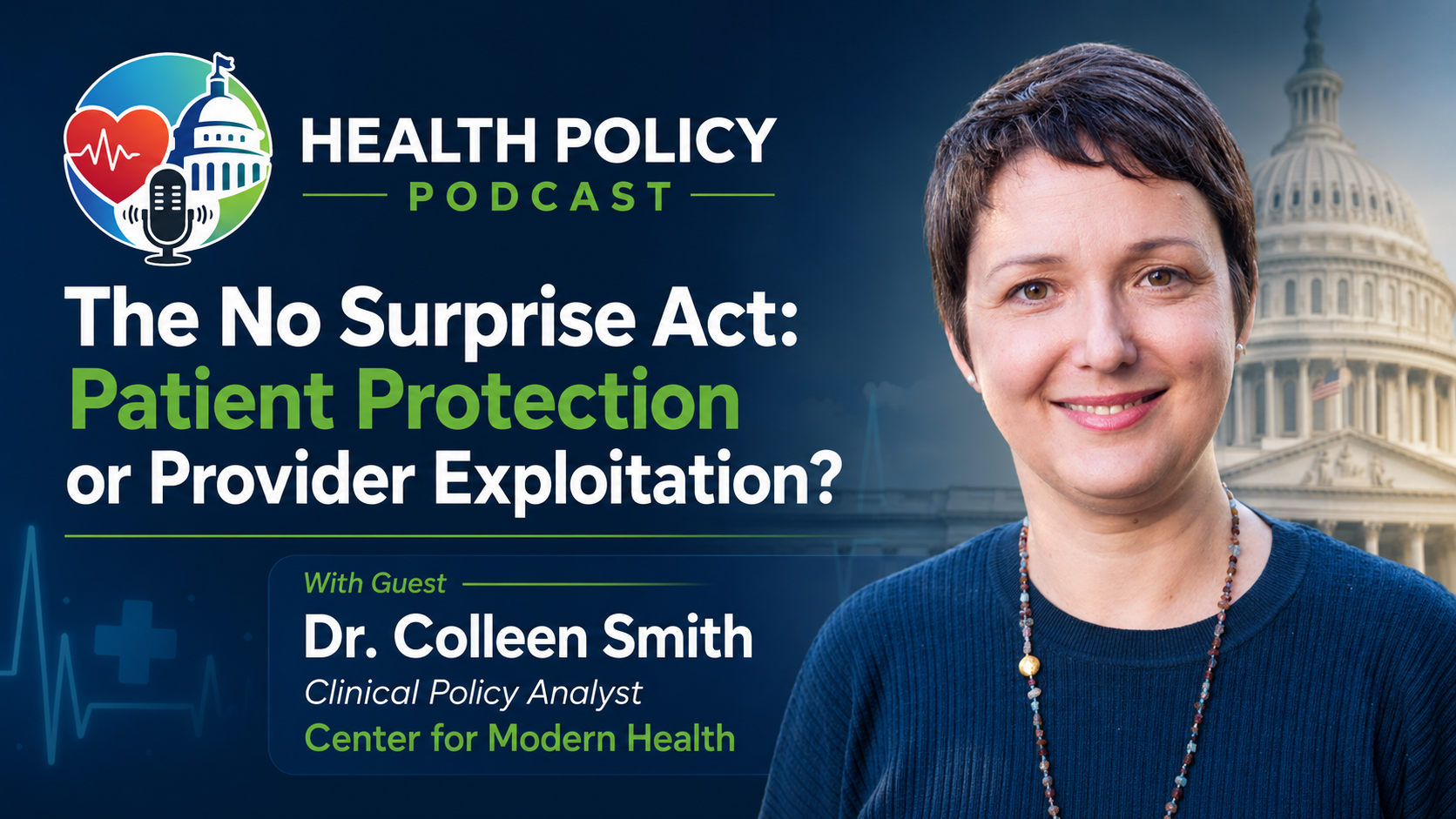
[00:00] Bryan Hyde: Welcome to the Health Policy Podcast. I'm Brian Hyde, and my guest is Dr. Colleen Smith. In fact, we're welcoming her back to the podcast. She's an emergency medicine doctor practicing in New York City and also works with the Center for Modern Health. And Dr. Smith, wonderful to have you back on the show. For those who are meeting you for the very first time, would you mind taking just a moment to tell us a little bit about who you are and what you do?
[00:24] Colleen Smith: Sure, thanks for having me back on the show, Brian. Great to talk, to chat again. So I'm an emergency medicine doctor, as you said. I practice clinically in New York City, and I also am a clinical policy analyst for the Center for Modern Health. And so what I do for them is, uh, you know, they're a health market, uh, uh, sorry, a health policy think tank, and they're really trying to envision a future of freedom in healthcare where patients and, and producers in healthcare can work together to pursue health and well-being and human flourishing. And we think that one of the best ways to do that is to is to promote freedom in the market and in interaction between those two groups, the producers and consumers of healthcare. And so a lot of what I do for the Center for Modern Health is look at policy proposals and look at what's going on in healthcare and try to think about whether or not that particular situation is conducive to freedom and conducive to human flourishing or not. And if not, how can we change it and what could we do better?
[01:32] Bryan Hyde: You know, I rarely hear people complain about the quality of healthcare available to us here in the United States. It's, it's, it's top-notch, but I regularly hear complaints about the cost and sometimes the, the hidden or surprise costs that come up after you've, you've had a surgery or procedure or hospital visit. Um, talk to me about the No Surprise Act. It sounds like Congress caught on to this some time ago, but for those unfamiliar with the No Surprise Act, how did that address that, that sticker shock that people sometimes feel?
[02:03] Colleen Smith: Yeah, so the No Surprise Act, I think in some ways it did a great job for patients. So what was happening back in, I guess, the mid-early 2000s was that you could go to a hospital that you thought was in-network for your insurance and get your care there and end up being admitted to that hospital. And then maybe the hospitalist who was in-network for your insurance would consult a cardiologist who happened to be the cardiologist on call for the hospital. So there's no reason you would ever assume that your health insurance wouldn't be be in network with that cardiologist, but in fact it wouldn't be. And now, as a patient, this cardiologist might bill you for very, very complicated care. If you were admitted to the hospital, maybe you got a cardiac catheterization, which is a procedure. Maybe you got, you know, a variety of, um, ultrasounds of your heart, a variety of complex things. So you'd get a really large bill from the cardiologist, which would go through the hospital. And because that one doctor happens to not be in network in your insurance, that bill would go to you as the patient in what's called balance billing, which has been going on for forever, where you pay the difference between what your insurance pays and the hospital pays, or, and the hospital charges. And in this case, the hospital would charge you everything because your insurance would say, well, they're out of network, we don't cover that. And so people were getting huge surprise bills thinking that they had done the right thing and gone to the hospital that that their insurance contracted with, on the order of tens of thousands of dollars, $50,000, $30,000, really huge amounts. And so Congress said, okay, we just need to take the patient out of this equation, which I don't actually think was a bad way to think about it. I do think patients should be in the equation more when it comes to paying for their healthcare. But given our system, You know, so they passed the No Surprise Act, which basically says that instead of billing the patient when an out-of-network charge comes up, the insurance company and the provider, the hospital, the doctor, the facility, whoever is providing the care, have to work it out together. And they created a dispute resolution process, or the IDR, Independent Dispute Resolution process in this case, where the provider of the healthcare would submit a claim saying we should have been paid by the insurer for this procedure or service. And the insurer on their hand would say, okay, we'll pay this much. And the arbitrator, the kind of person in the middle, would look at the two claims and pick one. And so there were sort of a lot of things about the system that were working great for patients and sometimes not so great for providers, but other times really great for providers and sometimes not so great for the insurers. And I think recently, Recently in the news, we've started to hear about, we've kind of seen this controversy play out. We have insurance systems that are saying, we can't pay these bills. We're getting charged not just tens of thousands of dollars, but hundreds of thousands of dollars for things that we normally would have paid significantly less for. Insurers are taking that to court, so they're delaying payments. And on the other hand, then doctors are saying, well, the insurance companies aren't paying us. They're taking it to court. Of course we have to ask for these high rates. And so we're getting this kind of back and forth. And then not surprisingly, I think there has been maybe a little bit of like kind of pushing the envelope on what's maybe kind of feels right. There have been reported cases of providers charging, requesting money, like not even close to in the range of what they would've gotten paid by insurance, hundreds of thousands of dollars for breast augmentation procedures, for example, doctors who before the NSA, the No Surprise Act, would not have even done the surgery on patients who are out of network. Now they're actively trying to recruit out-of-network patients because they know they can get so much money. That's kind of taking advantage of the system a little bit, I would say. And I'm usually really on the side of doctors being one myself. I don't know, man. And then there are other cases where I think the Congress Budget Office found that 5 private equity-backed organizations account for more than 60% of filings for the arbitration procedures. And so a lot of private equity firms are finding that they're able to make a lot of money by bundling their claims and trying to get this— get the arbitrators to side for them. And arbitrators are incentivized to side for the providers also because they get paid per claim. So it's just sort of become this kind of snowballing mess of he said, she said, and in the end it's causing insurance premiums to go up and patients are paying.
[07:25] Bryan Hyde: So I'm, you know, I, I have not worked within the medical profession, so I'm asking this from the perspective of a total outsider, but It wasn't always this complicated, was it? And, and on the heels of that question, what is it about the system that makes it so hard to, to get a fair price for services?
[07:47] Colleen Smith: Yeah, I mean, so I don't think it was always as complicated, but it has been pretty complicated for a very long time. And, um, at least I've been— so I graduated from medical school in 2008, so I think that's right, yeah, 2008. And so, I've been in the medical profession for some time and it's been pretty complicated for as long as I've been in it. But I did, the Affordable Care Act passed right around just after I graduated from medical school. So that kind of happened during my training. So I would say that I think over time, the patient as the primary consumer of medicine has been separated increasingly from being the person that's paying for their medical care. And that's made it so that the person who judges the quality or the group that judges the quality of care is really the group that pays for the care. And that's not the patient anymore. That's the insurance company or the government. And the other thing that that's done is really covered up what a real price— it's just hidden what a real price is for the services that doctors are providing. There's no value judgment. Really baked into the price. The cost of a procedure or service is not really a part of the price. It's almost entirely some sort of— either, either it's linked to a Medicaid rate, which is usually low, or a Medicare rate, which is usually on the low end, or it's based on kind of an insurer-hospital negotiation that is actually also not really linked to cost but more linked to like the leverage that one group can have over the other, which is, I think, ultimately linked to the network. So the number of patients that they can say are theirs and that they have control over. So the costs aren't really very clear. And I think we've had a lot of transparency laws passed recently to try to make that better. But I think transparency laws, they're ultimately also just reporting prices that aren't based on any kind of market. So we're still not looking at a reporting of fair prices or real prices. We're just looking at a reporting of kind of arbitrary prices. So I'm— I think I missed a little bit of what you said at the beginning. Maybe there was an internet lag, but we trust that—
[10:20] Bryan Hyde: we trust the market to do its job in so many areas of our lives, but it seems like when it comes to healthcare, hmm. There's a lot of calls for, well, but we need to intervene here and make sure that this goes this way or this goes that way. I'm just curious what you would see as some of the more likely solutions.
[10:39] Colleen Smith: Okay. So I think likely solutions, so, you know, there's sort of pie-in-the-sky solutions and then there are maybe what could we begin to do now? I do think the transparency rules are a step in the right direction, but I think they have to be reporting real prices. And so how can we start to get to a system where we have real prices. And really, I think the best way to do that is to both free consumers to shop a little bit and free providers to function kind of outside of this insurance employer kind of system. And so the best way to do that is to have patients be paying for their healthcare and be making the choices about where they want to put their healthcare dollars. And that's That is difficult in our system because providers of healthcare, whether it's an independent doctor or an entire hospital system, they're not used to having to compete. They're not used to having to say, come, you know, come here, not because like the Center for Medicaid Services says we're a great hospital, but because we actually provide care that you want to have. We actually like make things convenient for you or do a good job or make sure we hire doctors who have not just who have both a combination of bedside manner and great patient outcomes. And we don't even entirely measure the right thing. So we really have to get to a place where, where patients are paying and the money that patients spend is pointing to what they want out of their healthcare. And I think that partly means pulling back on having health insurance pay for every single thing, especially the really common and inexpensive aspects of healthcare. And if you consider If you're healthy, like a healthy 30-year-old, maybe you go to the doctor 4 times a year, maybe twice it's because you have a cold and twice it's for a regular checkup. So 4 times a year, if that costs $250, which I frankly think is high, that would be $1,000 a year, which is less than, than almost everyone pays for their health insurance. And I think, I don't know because we haven't tried it, but I think that those rates would actually, the $250 per visit would actually end up being less than that in a lot of cases if patients were paying. And I still think we could have a way in which we help poor people pay for their medical care. I mean, we give people food stamps. Food prices generally are are relatively affordable. I mean, we've had them going up a little bit recently, but they're relatively affordable. And I think largely that's because people decide where to spend their money, even if the money is in food stamps or, you know, they have however much money in food stamps and they go to the places where that money can go farthest. I think the same could happen in healthcare. I think one thing people will say is, well, what about information asymmetry? And I do think that exists. Yes, doctors do know a lot more about medical care than many patients, but there are a lot of intelligent people, especially in the age of AI where you now can— I mean, even Google was helpful before, but now there's AI, which really helps explain medical problems to people and helps people work through what's going on with them. I think doctors should be embracing that kind of decrease in the difference in information asymmetry that exists there, because I think that really is an argument for the information asymmetry doesn't exist to the degree that we think it does. I think part of doctors' jobs is to also bridge that gap, and I think it does. It's kind of a disservice to patients to say you can't understand where I'm coming from as a doctor. And similarly, I think if you can't describe that as a doctor, you're not doing your job well. So to me, that argument for we shouldn't— we should, we should have price controls and caps and all these regulations on healthcare, which is the main one that I hear, is not really a good argument.
[14:55] Bryan Hyde: What about fairness? I know that's a word that sometimes gets abused, but let's discuss fairness as it would, as it would apply to this subject. What would it look like?
[15:06] Colleen Smith: Fairness. So I mean, as it would apply— so let's see. So I think, I think there's some degree to which things just aren't fair, and we have to accept that. Um, personally, I think our system that we have now, the way that Medicaid exists, the way that Medicare exists, it's also really not fair. You know, for example, a Medicaid patient in many states can't choose to go to a doctor that doesn't accept Medicaid because that doctor won't see them because they're afraid that if they charge that patient any money, they can get— they can, they can be considered to be making fraudulent claims on the patient even if they don't participate in Medicaid. So many doctors who don't participate in Medicaid just won't see a Medicaid patient in other states. So that takes away so much choice for those patients, so much access. I think it does them a huge disservice. That's not fair. You know, so if you, if you really want a system that's fair, you need a system again where patients are making the choices about what to do with their money. And I think that will also sort of elucidate what patients value and what is valued in medicine. And of course, there will be very expensive things, always— organ transplants, traumatic injury. And so we will need some form of health insurance to deal with those things and to pay for those things. And we may even need to have some sort of safety net for poor people or for unexpected, really truly emergency events. I mean, I'm an emergency medicine doctor. People definitely don't expect to get hit by a car when they get hit by a car. So, you know, I think there's some degree that we do need to help with those things in some way, or expect people to be in a position where they can help with those things, or have some kind of funding process for the— for that type of event. Absolutely. But I also think there will always be a little bit of unfairness, but that's how we actually get, get innovation. So if you look at like longevity care right now, there's this whole movement. It's so expensive. I can't afford to pay to see longevity doctor. Is that fair? Maybe not. On the other hand, as people begin to want that more and more and more, producers will find ways to make that less expensive and cheaper and more available to more people. And we've seen this happen with GLP-1s, the, this, the like obesity medications. At first it wasn't fair, like most people couldn't afford them. Now we're seeing that drug companies are finding ways to make these medications more accessible and cheaper so more and more people can afford them, because it is profitable for them to be able to provide a medication to more people, even at a lower price.
[18:02] Bryan Hyde: So it sounds like, um, you know, affordability in healthcare is not going to just come to— come down to how can we make it as cheap as possible. It's about how can we really give the, the patient the opportunity to put their money where, where they feel it's most appropriate. And, and I think I'm looking at an article from the Center for Modern Health Substack. Um, you mentioned that's not a pipe dream. That's— there, there are actually emerging examples of this that are growing by the day.
[18:32] Colleen Smith: Yeah, I mean, I could list— I could rattle off examples, you know. I mean, but, but we've seen this happen with LASIK eye surgery. It's gotten safer, better, cheap, and cheaper over the years because— and I think largely because it's not been part of the health insurance marketplace. So there's no sort of third party in the middle, uh, in the middle of the payment scheme for it messing things up. Um, doctors can't charge too much for it or patients won't pay for it, whereas doctors and providers can charge too much, quote unquote, I'm putting air quotes there, for, you know, uh, pick a surgery for an appendectomy, because health insurance will just keep paying for it. And even though health insurances try to say, okay, don't go higher or negotiate, no, all these negotiations are behind non-disclosure agreements, and nobody really knows what a fair price is.
[19:34] Bryan Hyde: All right, let's, uh, let's bring it home for those who want to dig into this subject a little bit more. I know you have a Substack, and, and also let's tell people where they can learn more about the Center for Modern Health.
[19:45] Colleen Smith: So the Center for Modern Health, you can go to centerformodernhealth.org, uh, which is their main website. They also have a Substack, Center for Modern Health on Substack, and most of their articles are cross-posted there. Um, I have a Substack, Dr. Colleen Smith. Uh, I— a lot of what I write is also cross-posted on Center for Modern Health, but sometimes I write other things like stories about about being an emergency medicine doctor or things about having kids and fun stuff like that, which I don't cross-post to Modern Health. So to Center for Modern Health, because they're kind of unrelated. But, um, so you can find me on the Substack, and, uh, Center for Modern Health is also on X as well.
[20:27] Bryan Hyde: Again, we are talking with Dr. Colleen Smith. She is a physician and clinical policy analyst for the Center for Modern Health. And thank you so much for joining us once again on the Health Policy Podcast.
[20:38] Colleen Smith: Yeah, thank you so much for having me, Brian. Great to chat.