
· The Health Policy Podcast
Health Policy Podcast logo

Receive new episodes in your inbox.

← Health Policy Podcast

2026-06-23 · Health Management Associates

The Economic and Human Impact of Treatment-Resistant Depression

with Mark Desmarais, Principal — Health Management Associates
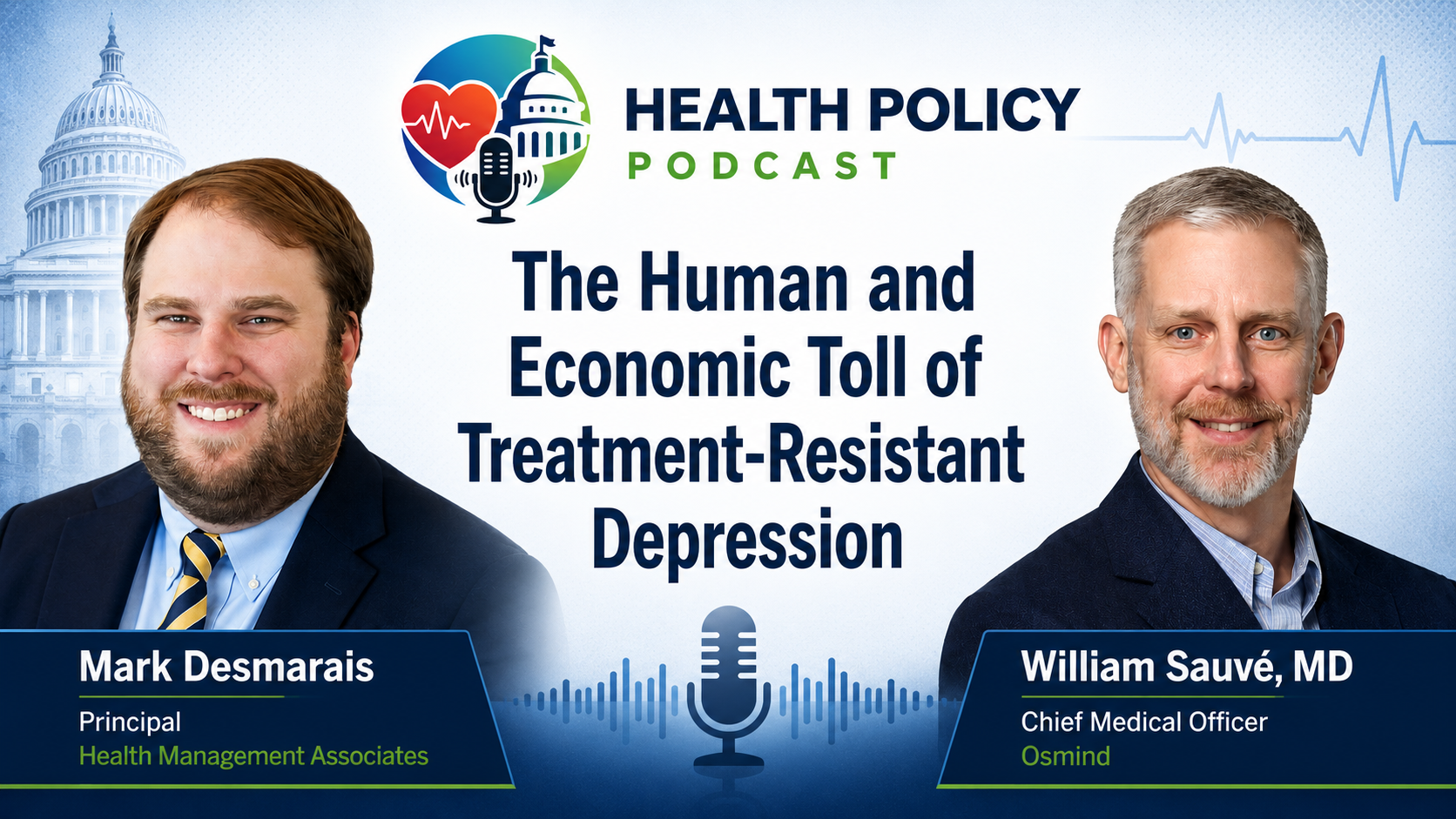
Health Policy Podcast episode featuring Mark Desmarais discussing The Economic and Human Impact of Treatment-Resistant Depression

In this latest episode of the Health Policy Podcast, Mark Desmarais, a principal at Health Management Associates, and Dr. William Sauvé, Chief Medical Officer at Osmind, discuss the economic and human impacts of treatment-resistant depression (TRD). Desmarais highlights a report indicating that individuals with TRD incur approximately $8,000 more in annual healthcare costs compared to those whose depression is well-managed. The conversation also addresses the challenges in diagnosing and treating TRD, emphasizing the need for timely and aggressive interventions to improve patient outcomes and reduce overall healthcare expenditures.

The Human and Economic Toll of Treatment-Resistant Depression

0:00 / 0:00

The Human and Economic Toll of Treatment-Resistant Depression

Human and Economic Toll of Treatment-Resistant Depression Explored in New Report

In a recent episode of the Health Policy Podcast, Mark Desmarais, a principal at Health Management Associates, and Dr. William Sauvé, Chief Medical Officer at Osmind, discussed the significant challenges posed by treatment-resistant depression (TRD). The conversation centered around a new report that highlights the human and economic impacts of TRD on patients and the healthcare system.

Desmarais, who has spent two decades analyzing healthcare data, emphasized the importance of understanding TRD's effects on Medicare. His report analyzed administrative claims data, revealing that individuals with TRD incur approximately $8,000 more in annual healthcare costs compared to those whose depression is well-managed. This finding underscores the broader implications of TRD, which not only affects patients' quality of life but also places a strain on healthcare resources.

"The individuals with TRD use more healthcare services, including hospital visits and medications," Desmarais said. "This is not just a personal issue; it has significant economic ramifications for the Medicare program."

Dr. Sauvé provided insight into the clinical aspects of TRD, explaining that it is defined by a lack of response to at least two medication trials. However, in practice, many patients undergo eight or more trials over several years without achieving remission. This chronic condition often leads to cognitive impairment and decreased work performance, a phenomenon known as presenteeism.

"Patients suffering from TRD often experience decades of chronic illness, which can exacerbate their condition and lead to additional health complications," Sauvé said. "The longer effective care is delayed, the more severe the consequences can be."

The podcast also addressed the growing mental health crisis in the United States. Dr. Sauvé noted that the number of individuals seeking mental health treatment has increased, with estimates suggesting that around 60 million Americans could benefit from care. However, the current psychiatric workforce, which numbers about 50,000, is insufficient to meet this demand.

Desmarais and Sauvé discussed the challenges faced by psychiatric practices in treating complex cases of depression. A significant barrier is the prior authorization process required by insurers, which can delay access to necessary treatments. This administrative hurdle can prolong patients' suffering and increase their risk of hospitalization.

"Prior authorization is a massive administrative challenge that can take weeks to resolve," Sauvé said. "During this time, patients continue to struggle with their illness, which can lead to crises that require hospitalization."

Both experts agreed that addressing TRD requires a shift in how healthcare providers and policymakers approach treatment. Desmarais suggested that finding effective solutions for TRD could not only improve patient outcomes but also reduce overall healthcare spending.

"Policymakers should create pathways that facilitate access to effective treatments for TRD," Desmarais said. "This would benefit not just those patients but the healthcare system as a whole."

Dr. Sauvé emphasized the importance of early intervention. He argued that moving to more aggressive treatment options sooner could save patients years of suffering and reduce long-term healthcare costs.

"We need to treat patients aggressively and not let them linger in ineffective treatments," Sauvé said. "The cost of inaction is far greater than the cost of providing effective care early on."

As the conversation concluded, both experts highlighted the urgent need for systemic changes in mental health care to better address the complexities of treatment-resistant depression. Their insights underscore the critical intersection of mental health and economic policy in improving patient care and outcomes.

Interview Q&A

Q&A: The Human and Economic Toll of Treatment-Resistant Depression

The Human and Economic Toll of Treatment-Resistant Depression

Q: Can you introduce yourself and your background?

A: I’m Mark Desmarais, a principal at Health Management Associates. I have spent the last 20 years using healthcare data, primarily administrative claims data, to conduct analysis and inform policymaking in Washington, D.C., and across the country.

Q: Dr. Sauvé, can you share your background and current role?

A: I’m Will Sauvé, a psychiatrist and the chief medical officer at Osmind. Osmind is an electronic health record dedicated to psychiatry, serving over 1,000 clinics nationwide. I have a background in military psychiatry and have focused on treatment-resistant depression for over a decade.

Q: What is treatment-resistant depression (TRD)?

A: TRD refers to depression that does not respond to standard treatments. In the literature, it is often defined as failure to respond to at least two medication trials. However, in practice, patients may undergo eight or more trials without success, suffering for many years.

Q: What economic impact does TRD have on healthcare?

A: Individuals with TRD cost the healthcare system approximately $8,000 more annually than those whose depression is well managed. This includes increased use of healthcare services, such as hospital visits and medications.

Q: What are the broader implications of TRD on patients?

A: Patients with TRD experience significant suffering, which affects their personal lives and productivity. Many face cognitive impairments and reduced work performance, contributing to presenteeism, where they are physically present but not performing effectively.

Q: Are we seeing an increase in mental health struggles in society?

A: Yes, there is evidence that both the prevalence of mental health issues and the number of individuals seeking treatment are increasing. Estimates suggest that around 60 million people in the U.S. could benefit from mental health care, while there are only about 50,000 psychiatrists available.

Q: How does a physician determine when a patient has TRD?

A: The diagnosis of TRD typically emerges after multiple medication trials fail to produce results. If a patient does not respond to two trials within 18 months to two years, they may be classified as having TRD.

Q: What happens when effective care for TRD is delayed?

A: Delayed care can lead to increased risks of hospitalization and worsening comorbidities. Patients may experience a decline in their overall health, cognitive function, and quality of life, leading to a cycle of escalating treatment needs.

Q: How does your military background influence your approach to treating TRD?

A: My military experience taught me the importance of aggressive treatment in high-intensity settings. Inactive duty environments, timely intervention is crucial to ensure that service members are fit for deployment.

Q: What challenges do independent psychiatric practices face in treating complex depression cases?

A: A significant challenge is the prior authorization process for treatments. This administrative burden can delay access to necessary care, exacerbating patient suffering and complicating treatment.

Q: What changes are needed to improve outcomes for patients with TRD?

A: Clinicians and policymakers should work together to create pathways for effective treatments. Early intervention with potentially more expensive therapies may ultimately reduce long-term costs and improve patient quality of life.

Q: What is your perspective on the urgency of treating TRD?

A: It is essential to treat patients aggressively and quickly. Delaying effective treatment can lead to years of suffering and increased healthcare costs. We must prioritize timely interventions to improve outcomes for individuals with TRD.

Q: What final thoughts do you have regarding the economic implications of TRD?

A: Addressing TRD effectively can have significant economic benefits. By reducing the long-term costs associated with untreated depression, we can improve the overall healthcare system and create more resources for other health issues.

Key takeaways

  • Individuals with TRD cost the system about $8,000 more each year than those patients whose depression is well managed.
  • It's having a human impact, but it's also good to remember that it's an economic impact, and that should incentivize everyone to really work harder to solve this problem.
  • In psychiatry, the word resistant is quite fraught... It is the condition itself which is resistant to treatment.
  • This is a chronic illness that can get worse and worse over time.
  • Moving quickly and getting people that life back is of course the thing that I would really, really want to have in mind.

About the guest

Headshot of Mark Desmarais, Principal at Health Management Associates

Mark Desmarais

PrincipalHealth Management Associates

Mark Desmarais specializes in Medicare and Medicaid policy consulting with a focus on large dataset analysis, including all Medicare datasets available to the private sector. He is a front-to-back problem solver for clients designing data analysis who strives to answer questions and anticipate future needs. Mark has extensive experience analyzing Medicare and other health datasets and applying the results in solving public policy challenges and supporting policy advocacy in the regulatory and legislative arena. Before joining HMA, Mark was a partner at The Moran Company, now an HMA Company. He manages project teams tackling policy issues across the healthcare spectrum. He has extensive experience helping pharmaceutical companies and device manufacturers as they navigate the regulations surrounding the Outpatient and Inpatient Prospective Payment Systems. He has performed in-depth modeling of issues related to the 340B program as well. In addition, Mark has vast experience with regulatory issues in ambulatory surgical centers, dialysis facilities, and skilled nursing facilities. He has led modeling of the Merit-based Incentive Payment System (MIPS) scoring proposals advanced by the Centers for Medicare & Medicaid Services (CMS) in implementing the Medicare Access & CHIP Reauthorization Act (MACRA). In addition, Mark has analyzed client data warehouses to inform public policymaking on issues where publicly available datasets lacked essential information. He manages client relationships and deliverables, leads small project teams, and trains analysts in programming, policy context, and data analysis. His clients have included pharmaceutical, biotech, and device manufacturers, trade associations, hospitals, and physician specialty societies. Mark graduated from the University of Chicago with a bachelor’s degree in mathematics. He has more than 10 years of SAS® programming experience with large healthcare datasets.

Full transcript

Show full transcript
[00:00] Bryan Hyde: Welcome to the Health Policy Podcast. I'm Brian Hyde, and today I'm joined by two guests. We want to welcome Dr. William Save, Chief Medical Officer at Osmind, and also Mark Damaris, who is the author of a, a health report. And actually, Mark, I'm going to start with you. Tell us a little bit about yourself and what you do, and then we're going to ask the same thing of you, Dr. Save. [00:23] Mark Desmarais: Yeah, hi, nice to be with you, Mark Damaris. I'm a principal at Health Management Associates, a nationwide consulting firm, and I have spent last 20 years of my career using healthcare data, including primarily administrative claims data, to conduct analysis and inform the policymaking conversation in Washington, D.C. and the whole country. [00:47] Bryan Hyde: All right. And same thing, same question for you, Dr. Sauvé. Tell us a little bit about who you are and what you do. [00:54] Will Sauvé: Well, I'm Will Sauvé, and I'm a psychiatrist, currently the chief medical officer at Osmind. And for perspective, Osmind is a psychiatry-dedicated a dedicated electronic health record that currently serves greater than 1,000 clinics coast to coast. So we're working directly with about 3,000 to 4,000 mental health clinicians who are on the front lines, you know, treating every psychiatric illness there is, to include depression, treatment-resistant depression. Before that, I was in the Navy. So if you ever wondered why I'm like this, it's because I'm military trained. We went through all those experiences. And during my time in the Navy, I worked in the combat theater and on the inpatient unit in San Diego and ECT, inpatient psychiatry, interventional psychiatry. And then for quite a few years between then and Osmind, I was exclusively in the interventional space. So for about 10 years, I would say I was completely up to my eyeballs in what we call treatment-resistant depression because I was focused on those modalities for a solid decade. [01:58] Bryan Hyde: And that's what we have you gentlemen here to discuss today is the reality of treatment-resistant depression. We're going to be referring to it as TRD, but if people will understand understand that right up front. Um, Mark, I'm going to ask you, first of all, um, talk to me about a new report that has been published that, that kind of breaks down the, the real-world data of, of the impact of, of TRD, as well as, uh, you know, what, what, what the current status is of this. [02:28] Mark Desmarais: Yeah, so we took a look. We wanted to update and, and examine— we wanted to examine what was going on in the literature around treatment-resistant depression, and then we wanted to look at the most recently available claims data so that we could do our own analysis of how TRD is making an economic impact on the Medicare program specifically, where we have really rich and available data. We have access to 100% of claims. So we were able to look at across all Medicare patients how TRD impacts folks economically. And so we were able to capture in our analysis a look at taking patients in Medicare who have depression, major depression, but don't have TRD. So their, their condition is well controlled by medication. And we compared them to those patients who aren't well controlled, who are switching medications frequently. And looking at that, we, we, by matching them, we were able to confirm that we weren't measuring something different going on. Something that was hidden in the data. We were really looking to isolate just the impact of that treatment-resistant depression on the economic reality for these patients and for, for the bean counters in Washington. And what we found was that individuals with TRD cost the system about $8,000 more each year than those patients whose depression is well managed. [04:01] Bryan Hyde: And what does that tell us? [04:03] Mark Desmarais: Well, it, it tells us that these folks, um, despite being very similar to other folks with depression, use more of all sorts of healthcare services. It's not just about using more medications at the pharmacy counter. These folks are visiting the hospital more often, visiting the doctor more often. They're really suffering. And it's not just showing up in their personal life, it's also showing up in how they access the healthcare system and how much they cost the federal government through the Medicare program. So it's, it's having a human impact, but it's also good to remember that it's an economic impact, and that should incentivize everyone to really work harder to solve this problem so that we can address the human and economic realities of it. [04:46] Bryan Hyde: And let's, uh, Dr. Silvey, let's, let's bring you into this for, for the sake of those who are maybe hearing this term for the first time about treatment-resistant depression. What does that look like? [04:59] Will Sauvé: Well, first of all, since you said it that way, I think in psychiatry, the word resistant is quite fraught. So when— and to this day, people, they chafe a little bit over treatment-resistant depression because it kind of sounds like you're accusing the patient of resisting. And we want people to know, like, no, nobody thinks that the patient is resisting, right? It is the condition itself which is resistant to treatment. Definitionally, I, you know, in the literature there, you know, there is no actual diagnosis called TRD, so there's no clear-cut, you know, definition in the Diagnostic and Statistical Manual. But in the literature, it is 2 medication trials that haven't been successful for that patient. In the clinic, what I can tell you what it looks like, uh, historically for me for the last 15 years, it's more like 8 medication trials that have not been successful for the patient. These people usually have been suffering from depression without really any significant breaks for a good 10, if not 20 years. So we're talking decades of chronic illness getting worse and worse with medication trials being repeated over and over and over for 8 to 10 to 12 medication trials. And it's also very common then to see some fairly significant cognitive impairment. And what I mean by that are people who are working but they're clearly not performing half as well as they could be if they felt well. So there's this phenomenon that they call presenteeism, right, where we're not missing work, we're not on disability, but we're not moving as fast as we should be. Errors are propagating at work. There's cost associated with that. People have anhedonia. They're not enjoying their activities. They're not able to enjoy their off time or their work time. And then the comorbidity are piling up, which I think was alluded to, you know, in what was just being talked about, that it isn't just the cost maybe of, you know, antidepressant medications, but it's the cost of potential hospitalizations. But then it's also a cost of medications for metabolic syndrome and maybe ultimately diabetes and many of the other chronic illnesses that really fly side by side with TRD as the years pile up. [07:15] Bryan Hyde: And, you know, I, I don't want to overgeneralize here, but, um, as far as, as the overall mental health, uh, you know, of, of the, the society, are, are we seeing an increase in, in, in mental health struggles? You know, not just related to TRD, but, but generally, um, are more people coming forward seeking treatment, you know, for, for, uh, for their mental health? [07:39] Will Sauvé: Yes, I think so. That those are, those are two different questions, right? Are, are we seeing an increase in you know, mental health, and are we seeing an increase in people coming forward wanting treatment for their mental health? I, I think it's probably fair to say both are true, but it— but also statistically, it's very, very difficult to know that, right? There, there are now numbers being thrown around that for mental health in general— this is not just psychiatry, this is all conditions— the number of people in the country that could potentially benefit from care is maybe something like 60 million. Which is extremely overwhelming when you think that there are only about 50,000 and change psychiatrists in the country. So we're very, very— if you thought of it in an adversarial way, we're very, very badly outnumbered at this point, you know, if we're going to be trying to provide good care to that number. But I guess in answer to your question, yes, it's been escalating. [08:35] Bryan Hyde: And that's, that's what I was trying to get was just some context for, for how widespread this problem is. Now, bringing it back to TRD, At what point, you know, does, does the physician start to realize, you know, this is— is it a matter of time, how much time it takes for a person to respond to treatment? [08:55] Will Sauvé: Uh, yes and no. And that, that's an interesting point when you think about the meaning of TRD, is that most diagnoses in psychiatry are based on superficial criteria. So we're not really talking about a true version of illness itself, or what exactly is happening in the brain right there. There's no tests, there's no, there's no blood test, there is no brain image that can tell you exactly what is the matter. Uh, the— those things are getting so good I can almost taste it. So ask me again in 5 years, you know, we may well be able to do a brain scan and say this is what's going on, and maybe this is how we can address it. But what that leads to is that you have somebody that, you know, meets criteria for a diagnosis of major depressive disorder because they've been ill for at least 2 weeks That's what's in the book. And then when you start talking about treatment resistant, which is again fairly loosely, but in the literature defined by two medication trials. If someone were really, really sticking to the concept of medication trials, two medication trials that aren't working for someone with depression could be completed in fewer than 18 weeks. Being conservative. So time course, if someone is treating someone aggressively, if they're following them up often and they're starting medication trials following, you know, any number of treatment guidelines or appropriate algorithms, yeah, time-based, that, that TRD diagnosis would be surfaced within, you know, 18 months, maybe 24 if we're being really permissive, if the medication trials aren't working. [10:38] Bryan Hyde: And then what happens when effective care is delayed? What are some of the consequences there? [10:46] Will Sauvé: Several things. Number one, if we're talking about depression that isn't responding to current treatments, and that means that either it's not responding at all or remission isn't being achieved. So the whole concept of residual depression. So someone's on a treatment, they're better, they're not that much better, but maybe they're not complaining 'cause they don't know what to ask for. And this is going on now for months and months and months. First of all, the risk for hospitalization is increased. We have someone who is not feeling well, the treatment isn't super effective for them, and then things may escalate. They may find themselves in a crisis, they get hospitalized. Once they've been hospitalized, the average length of stay I think is pretty stable at about 5-ish days. People go into an inpatient psychiatric hospitalization. That is extremely expensive. So that again goes back to the earlier conversation about just the cost of care with someone with treatment-resistant depression. That might be when medications get changed and then they're kind of back on that train again, you know, where we're back in the community. And if remission isn't being achieved with the new medication, then we're just kind of maybe working our way up to another hospitalization. But as this, you know, depression goes on without being resolved, more and more risk of comorbidity is also taking place. You know, this is a, this is a chronic illness that can get worse and worse over time. Cognitive impairment, anhedonia. The medications themselves are not without side effects, and some of the medications alone place the patient at risk for metabolic problems and metabolic disorders that will escalate over time, which which then may contribute to worsening depression over time, which I know kind of gets to a later question about maybe misdiagnosis and comorbidities. But you can see from that how this thing can just snowball as the years go by if we're not getting to the most effective treatments in a really timely fashion. [12:50] Bryan Hyde: Let's briefly talk a little bit about your background in the military. I mean, you've, you've worked in some very high intensity, high intensity settings. How does, how does TRD show up in those environments? And has that, has that affected how you treat it today? [13:07] Will Sauvé: Yes, it probably does. High-intensity settings, I, I think based on my active duty time, kind of mean two completely different things. Because one high-intensity setting is just simply that, you know, at one point in my career, I was in the inpatient environment, and we're treating, you know, active duty people and beneficiaries coming into inpatient who are, you know, if their diagnosis is depression, they are very severely depressed, which is why they've come into inpatient. So I'm in an environment where aggressive treatment is just called for. And then the other intensity you're talking about is, of course, I'm, I'm treating people in the active duty environment who have to be deployed and were in the deployed environment, or they have to be fit for deployment. You know, we can't— we just can't have a situation in the active duty environment where someone is, you know, suffering from depression, not really getting better, but not really getting worse, that can't be allowed to linger. Because when you're in the active duty environment, you're either able to deploy or you're not. And if someone isn't going to be able to deploy, you know, then we have to move into a different kind of disposition. So to answer your question, I think what that led to then is is that always, always, always treat aggressively because I have to, you know, for the entirety of my active duty time, I either have to get somebody well in a fairly timely fashion, or we have to figure out where the next best place is for that person where they are going to be able to, you know, take the time that they need in order to get treatment and be well and be in a safe environment. [14:40] Bryan Hyde: And where you work with a national network of independent psychiatry practices. Talk to me a little bit about what, what do these practices tend to struggle with most when they're trying to care for more complex depression cases? [14:59] Will Sauvé: I think the number one— when, when we ask that question, you know, in our auspices at Osmind, we ask where's the biggest pain point? And everybody probably just universally says in unison, prior authorization You know, that's, that's the hardest thing about getting the resources that you need for your patient. So when, when we're talking about private practices in the community and that, you know, complex— and by complex, I mean, again, not just treatment-resistant depression, but also the, the comorbidities that go with it. So it's almost a guarantee that a patient is going to require multimodal treatment now, like not just medications, but thinking about interventions and getting more and more aggressive, and then bringing other kinds of medical care to bear. Say, for instance, again, with metabolic problems and sleep apnea and things like that. Any individual private clinic may not have all those resources in-house. Even if they did, being able to bring those resources to bear can often require things like prior authorization, which is a massive administrative administrative challenge, first of all, you know, that's even if a clinic is, shall we say, good at doing it, it usually requires dedicated personnel, hours of time on the part of both the clinicians and administrative personnel to get these things done. And then depending sometimes on circumstances and the payer, it might take, you know, week or weeks for prior authorizations to turn around. So getting back to your point about time, If someone, you know, really is appropriate for some kind of interventional care, you start that process and it could be 1 week, 2 weeks, 3 weeks, 4 weeks waiting for that treatment to start. And once again, this person is continuing to suffer with their illness. It's continuing to get worse and continuing to be at risk for some kind of crisis that then might require hospitalization or something like that. [16:55] Bryan Hyde: Okay. One final question. And this is for both of you. And then, Mark, let's bring you back into this conversation. Based on what we have discussed here over the last little, the last little bit, what needs to change? [17:08] Mark Desmarais: Well, I think having seen that the treatment-resistant depression leads to much higher costs, if clinicians can find a solution, if policymakers can help create open doors that would lead to solutions for patients We might also have a positive impact on healthcare spending in America, which would redound with benefits not just to those specific patients who see new forms of treatment emerge, but would also benefit the whole system and create more space for caring for other types of illnesses. [17:40] Bryan Hyde: And the same question for Dr. Sove. What do you see from your end that needs to change? [17:47] Will Sauvé: Well, you know, with respect to the cost, I think before we let ourselves sound too cynical, you know, one of the things that needs to change is recognizing that if I have a patient, you know, with MDD, if we're going to focus on that condition, that if they're not responding to the first couple of medication trials, is going to then get labeled as TRD. Being aggressive, treating that patient quickly, and, you know, maybe even being willing to move to treatments that are more expensive but doing them much earlier in the game is potentially going to save that person more than 2 decades of life. So before we really get into the cost, you know, just thinking about the old thing we used to say when we're treating residents and we're looking at, you know, we're teaching residents and we see somebody suffering from depression and maybe we're being a little bit lackadaisical about, you know, how long it's going to take for a treatment to work or how long this person is going to suffer. And the attending looks at the residents and says, would you let your grandma suffer like that for, you know, 8 weeks, 6 months, a year or something. So moving quickly and getting people that life back is of course the thing that I would really, really want to have in mind. But then with the respect, you know, to like this paper and really, really understanding what it costs— treatment-resistant depression, first of all, that's been allowed to become treatment-resistant depression by having 2 or more on medication trials that aren't working, but then continuing to go down that medication road that we know statistically probably isn't going to be very helpful instead of moving into different modalities with different mechanisms. The fact of the matter is those treatments may look more expensive on the surface, but if you move to those treatments early in the course, it is highly, highly likely that you're saving much, much, much more than being spent by moving to some kind of intervention after the second medication trial, you know, that only went 8 weeks instead of 2 years. [19:50] Bryan Hyde: Again, we have been visiting with Mark Demaris. He is the author of this report from Health Management Associates, as well as Dr. William Sauvé, Chief Medical Officer at Osmind. Gentlemen, thank you both for joining me today here on the Health Policy Podcast.

Filed under