Show full transcriptHide transcript
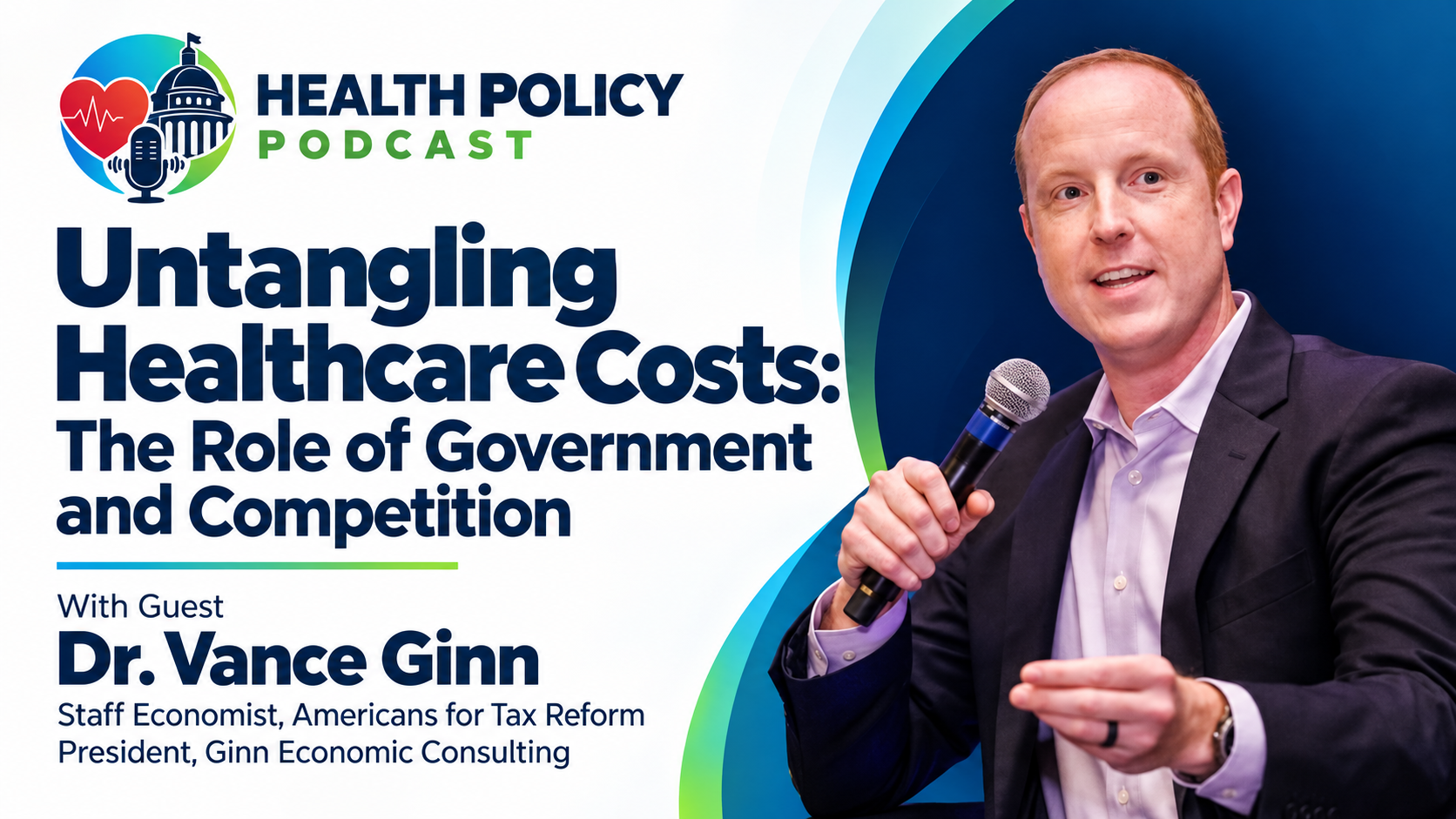
[00:00] Bryan Hyde: Welcome to the Health Policy Podcast. I'm Brian Hyde. Today I am joined by Dr. Vance Ginn. He is, uh, well, you actually wear a number of different hats. He is a staff economist for Americans for Tax Reform and also president of Ginn Economic Consulting. And, and I get the feeling I'm probably just, I'm probably scratching the surface here. Tell us a little bit about yourself and your background, please.
[00:20] Vance Ginn: Well, thanks, Brian, for having me on. It's great to talk with you. And you're right, yes, I work and wear a number of hats through Ginn Economic Consulting. I work with about 20 different think tanks, including Americans for Tax Reform, but a lot of state-based think tanks as well. The Pelican Institute in Louisiana, CANDACE Policy Institute, there's a number of them. And I work on free market reforms that will let people prosper, really trying to get government out of the way as much as possible in different areas. And I've worked at the Texas Public Policy Foundation, a free market think tank in Texas, for about a decade. I've taught at Sam Houston State University and Texas Tech University in academia. And then I worked in the White House for a year as chief economist for the Office of Management and Budget in the first Trump White House. from June 2019 to May of 2020. So a number of hats, but I've enjoyed it and I've been blessed to have these different experiences.
[01:08] Bryan Hyde: You know, I'm looking at an article of yours published on the Americans for Tax Reform website about sending big government after medication retailers won't help what's ailing American healthcare. And, and I'm intrigued because I know people complain about what they're paying, you know, monthly for their prescriptions, and it just seems like the, the costs are exorbitant. Let's unpack this a little bit, Vance. Who wants big government to go after those medication retailers? And then let's talk about why that may not be the correct approach to the problem.
[01:40] Vance Ginn: Yeah, you know, this is a common thing that we hear across different states, including Texas, where I live. I live near Austin, Texas, but also in Tennessee. Arkansas has also taken this on, and a number of other states are looking at it, and they're saying, okay, we see the higher cost of healthcare, what can we do about it? And There's not a lot, honestly, that the states can do because it's mostly federal issues. When you think about the dominant factors of Medicaid and Medicare and just the overall expenditures of about $5.7 trillion a year, more than about 60% of that comes from government spending, right? And the federal government is the one that created Medicare and Medicaid back in 1965. But the states are the one that administer at least the Medicaid portion of it. And what we've seen then is say, okay, we can't really do a whole lot in healthcare. What else can we do? Let's look at the prescription drugs. That's a huge cost for many Americans across the country, including in Texas where I live. And they'll say, all right, what can we do? Let's look at these providers of pharmacies, what some call pharmaceuticals. Some will call them pharmacy benefit managers, PBMs. And they'll manage the cost, the reimbursement rates, rebates. There's a lot of things that go into that. But that's really where a lot of the states have embraced is saying, look, if we can just bring down the cost of reducing this middleman, Some are saying ban them, some are saying let's regulate them in some capacity, but try to reduce their amount of cost. Maybe we could bring down our prescription drug costs. And in this recent report that I published through Americans for Tax Reform, I say, okay, that's one way to look at it, but there are a lot of other factors that we gotta look at. And by going just after the pharmacy benefit managers misses a lot of other problems that I think is created by government. So making more government as a solution, it could exacerbate the problem.
[03:30] Bryan Hyde: I want to take just a slight step back because I need a little historical context for pharmacy benefit managers. I grew up, my dad was a pharmacist, I worked weekends at his drugstore. But pharmacy benefit managers or PBMs seems to be kind of a fairly recent development. How long have they been around and how did they come about?
[03:49] Vance Ginn: Well, that's a great question. I don't know the exact year that they started, but we have a lot of them now. When you think about CVS, some large ones, CVS, Walgreens, anywhere that's kind of where you go and get prescriptions. That's not the pharmacist in particular, but a lot of the— and like you said, some of these are smaller shops as well. But there are a lot of them across the country, and they've been going on and on for decades. I mean, it's not like they just came up yesterday or the day before. But it is something that I think a lot of people have grabbed a hold of and said, if we just remove this cost, we could bring down overall cost of healthcare. And I think that's not quite correct because there are so many other issues that's going on there.
[04:28] Bryan Hyde: Okay, so it sounds like they're, they're kind of a scapegoat, or they're being treated as a scapegoat. Um, let's talk about some of the other, uh, more, uh, more concrete things that are contributing to those high healthcare costs.
[04:42] Vance Ginn: Yes, well, starting off with the amount we spend, the $5.7 trillion that we spent on healthcare across the country in 2025, um, only about 9% of that— so not you know, a share of it, a little over $500 billion goes to pharmaceuticals. So that's 9%. Well, a third, about 33% of that $5.7 trillion is on hospitals. Hospitals is what really are driving a lot of these costs. When you think about long-term care, you think about a lot of the other costs that go into the hospital itself. That's a massive amount of cost that's going on there. And what facilitated a lot of this in this report that we look at in the research is Looking at the employer-sponsored insurance that was provided after World War II, we had price and wage controls during World War II, butter versus guns sort of trade-off that goes on there, and they put in these price and wage controls. Well, a lot of the price and wage controls fell away, but the employer-sponsored health insurance did not. That's remained, and that was one of these fringe benefits that a lot of employers would say, we can't raise your wage right now because of these wage and price controls, but we'll give you other benefits. And that's where the employer-sponsored health insurance really got, you know, going, uh, at a fast pace. And it never really went away. So there's an incentive, of course, then for our employers to get the health insurance, get this tax break. And now we're connected with our employer and this health insurance. And that drove a lot of this for a long time. But then, of course, you had Medicare and Medicaid put in place in 1965 during LBJ's, you know, Great Society. And that also expanded substantially the cost for taxpayers through government spending in the healthcare system. And so what does this do? This drove up a lot of the demand side for healthcare through these subsidies and other tax breaks and things of that nature. But on the supply side, we've restricted a lot of supply. We have certificate of need laws saying that you can't build a hospital here unless you first show that there is a need. We have a lot of scope of practice sort of restrictions like occupational licensing of how much nurse practitioners can do compared with doctors, and a whole bunch of other on the supply side types of restrictions. So more demand and a fixed, almost fixed supply, you're going to get higher prices in healthcare. And that's exactly what we've seen over time, Brian. And, and so that's why I'm like, well, yes, PBMs might be a part of this, but it really misses the forest for the trees.
[07:05] Bryan Hyde: No, that's a great explanation. And, you know, I, I guess I really did not realize how much PBMs were a part of, you know, processing those prescriptions, you know, that are dispensed by US pharmacies.
[07:19] Vance Ginn: Yeah.
[07:19] Bryan Hyde: Talk to me a little bit about the federal government's involvement. Now, you'd mentioned, you know, Medicaid, Medicare. These are, these are huge expenses. Has there ever been a time where the federal government in particular allowed the market to function and wasn't there to— I'm gonna put this in air quotes— help the market accomplish what it's trying to do?
[07:40] Vance Ginn: Yeah, well, but before 1965, it was much less, right? I mean, you didn't have Medicare, you didn't have Medicaid, and so the government wasn't as involved in the overall healthcare system, especially when you think about the amount of spending. Now, on the supply side, there still was, you know, there still were restrictions or regulations that were put in place. Some states had the certificate of need laws and other things that were going on. But so as a combination, maybe a patchwork quilt of different types of things, which I think is kind of the beauty of federalism, to be honest with you, to see what works and what doesn't. And then really in the 1960s, when the federal government started to put their thumb harder on that scale, that's really when you started to see a lot of these healthcare prices skyrocket. I know that Mark Perry from American Institute for— American Enterprise Institute, AEI, he puts out this chart every 6 months, which some have called the chart of the century, which will show how much prices have went up since 2000 compared to inflation wage growth. And the 2 things that have been the most expensive since 2000 have been higher education and healthcare. And both of those are dominated by government spending and subsidies and other things and restrictions on the supply. And that's where you see these massive increases in prices. And so I think really you have to go back to the 1960s to see a large footprint for the federal government. But there was always some of that, Brian, before that, just not as large, pushing the amount of spending that's been in place since then.
[09:07] Bryan Hyde: How could, you know, in addressing solutions for this, how could they protect competition without singling out competitors that need protected? Because right now, that's what it sounds like. It's barriers, you know, to new competition coming into the market.
[09:21] Vance Ginn: Well, I think that's exactly right. You create these barriers and of course then that doesn't allow for competition and prices can soar. Value, right, isn't as great as it otherwise would be. And we have to have— we have longer waiting times. than if we just had more competition. And so some of the work that I've been doing with Americans for Tax Reform is called the Empower Patients Initiative. I also have a book called Become an Empowered Patient with Dr. Dean Waldman, where we walk through some of the things we've already talked about today, but also how can we get the federal government out of healthcare more, get government out of the way. And one way to do that would be for— to get rid of this employer-sponsored health insurance tax credit. Instead of that being a tax credit for the employer, Why not give it to the individual? That way they can make choices with their own healthcare how they'd like, whether it be through a specific insurance company or maybe a different company or through these sharing plans that are out there, the healthcare ministries. You know, there's different ones that are out there, but really allow them to have more control of their dollars and put that into a no-limit health savings account. Today, there are all these limits on health savings accounts and other restrictions that are out there, but why not have it unlimited to where if that's where you wanna put your money as the taxpayer, as the person earning the money, you should have the ability to do so and then buy that health insurance and other services that you get. The other thing I think is gonna be really important is block granting the Medicaid funding from the federal government, block granting that to the states. So instead of having this federal matching assistance program where a portion is paid by the state and then they have a matching amount that's usually a lot greater, sometimes 2 to 1 of state money versus federal money, just make it a block grant. Say this is the amount you're receiving today. We're gonna give you that, and then we're gonna increase it by maybe inflation each year or population growth. So some specific measure. And what that would do is allow for more flexibility by the states to, like you said earlier, competition. We need some competition in the states to see what works. If California wants to come up with their single-payer government-run system, I don't like that. I think it's gonna be bad for the Californians, but let them do it. If Texas wants to do a free market sort of approach, then let them do it. And I think that would better allow for us to meet the needs of the people in those areas at a lower cost to taxpayers and improving portability and, and really healthcare. That's really the point here that we've been trying to make is we want healthcare to be better off, not healthcare of the system, but healthcare for the individuals, for the patients. And by bringing doctors and patients back together instead of all these other third-party payers, we'll be in a much better situation, I believe. And by looking at the research and in a lot of other areas of our lives.
[11:54] Bryan Hyde: I love the case that you make for competition. Because that really, if we're going to put power back in the hands of the patients, they've got to have choices. And right now it doesn't sound like their choices are so great. Let me ask this, who benefits most from the way that things currently are being run?
[12:09] Vance Ginn: Yeah, that's a good question. It would probably be the hospitals. I mean, the hospitals are receiving a lot of funding right now. A third of those overall costs of the $6 trillion, let's say, That's a massive amount, and that really feeds a lot of money into them. I think there's talk right now about, well, this just benefits PBMs. But remember, the pharmaceuticals are only 9% of the $5.7 trillion. So even if some of them are benefiting, which I'm not here to say whether or not their practice is right or wrong, there's probably some bad actors just like in everything else. But we should weed out any fraud and other things that are going on. But 33% is by the hospitals. And so that seems to be, to me, to be really where the problem's at. And some of that But I should be, you know, to be clear about this is we have a, um, we have baby boomers that are retiring. We have an aging population. And so there are higher costs when you stay in the hospital for a longer period of time and things of that nature at these hospitals. So I'm not saying there's not any reason for it, but I do think that they're benefiting the most from the current system given that Medicare and Medicaid continue to send a lot of money to these institutions.
[13:18] Bryan Hyde: Well, and it seems like you're, you're answering the, the question here of, you know, who is supposed to be benefiting from this primarily? You know, the patient, you would think, is the end user that, you know, is needing the healthcare. But it sounds like the benefit is flowing to a few other places, and then maybe some of it will reach the patients, you know, if they're lucky.
[13:39] Vance Ginn: Right. Maybe it'll— maybe that's where the trickle-down is, right? It's gonna trickle down to the patient somehow. But why not? Yeah, why not empower the patient? And honestly, the doctors too. Like, I think that the doctors and patients should have a better relationship. Too often today, when you go into the doctor, I mean, it's like they're turning you around quickly. They gotta get you in and out in 10, 15, 20 minutes because of a lot of the way that the reimbursement rates and the way the payments are made. But if you look at DPCs, direct primary care, in those types of institutional frameworks, you have a lot more patient-doctor relationships where you might even be able to call them after work if you need something. I think that could be another good opportunity for us to say, let's add more competition Why should a lot of these, these tax breaks, government spending go to the hospitals and others instead of allowing us to use DPCs as a model? I think that would be another good opportunity.
[14:32] Bryan Hyde: Sometimes it sounds like there are some not so great incentives that come from the way things are done. And I'm trying to be diplomatic in saying this, but I'm talking about it encourages misconduct, you know, by some of the various bureaucracies. Let's talk about how do we correct the problem? You know, how do we weed out the misconduct and keep that from being incentivized?
[14:53] Vance Ginn: Yeah, the first thing that comes to mind again is competition. The more competition that you have, the better off that you're gonna be in weeding out bad actors and creating a situation that's gonna be the most efficient compared to this top-down. I mean, in many ways I've argued that we have a socialist healthcare system. We just don't like to call it that. When 60 cents of every dollar is paid for by government, meaning us, the taxpayer, that is not a market, a free market. It's barely even a market sort of scenario. It really is a government-dominated system. So if we can bring back, get government out of the way more, we can allow for competition to take place. And look, for PBMs, for example, they've created or they filled a market need given the socialist system that we've had, where maybe they wouldn't have been created if it was entirely a free market, but that's not what we have. And so they've been able to fill in this gap. And so that's another reason why I think not only competition will be important, but also transparency is important. Making sure that we can see what these prices are. I've argued some, though, that we've gotta be careful about price transparency because which price are we making transparent? Is it the reimbursement rate? Is it the actual cost? This can also go in a lot of different directions to not feed the patients the right information. So we've gotta be careful about that. But I think at the end of the day, getting government out of the way, allowing for competition, we would have it be in a better situation for the patient and for the doctor. And ultimately, I think having lower prescriptions, lower hospital fees, and those things would reduce the overall cost of healthcare spending. Why are we spending $5.7 trillion? One of the things that we go through in our patient— our Power Patients initiative is to say that about $2 billion goes towards some sort of fraud, waste, or abuse within the system, because a lot of it's going to administrative costs and not to doctor care, not to services. And so when you have that much government intervening, You've got regulators, you've got all these different, you know, alphabet soup of different types of entities that are creating more cost to the healthcare system versus us being able to just have a more market-centered healthcare system.
[17:08] Bryan Hyde: Okay, one final question for you, Vance, and that is, um, you referenced this, this report written through Americans for Tax Reform, uh, that you've produced here. Where can people access that?
[17:17] Vance Ginn: So it's at atr.org, Empower Patients Initiative. That's where we have it. It's also my website, vanceginn.com. I have information there. And, and then the book that we have, Become an Empowered Patient, which I have right here behind me, if you can see, but that one is on Amazon where you can go out and buy that book today. I think those will be great resources to really help to see what we could have in the future and allowing for more competition to really bring patients and doctors together.
[17:45] Bryan Hyde: Again, our guest is Dr. Vance Ginn, staff economist for Americans for Tax Reform and president of Ginn Economic Consulting. Thanks again for joining us here on the Health Policy Podcast.
[17:56] Vance Ginn: Thank you so much, Brian.