Show full transcriptHide transcript
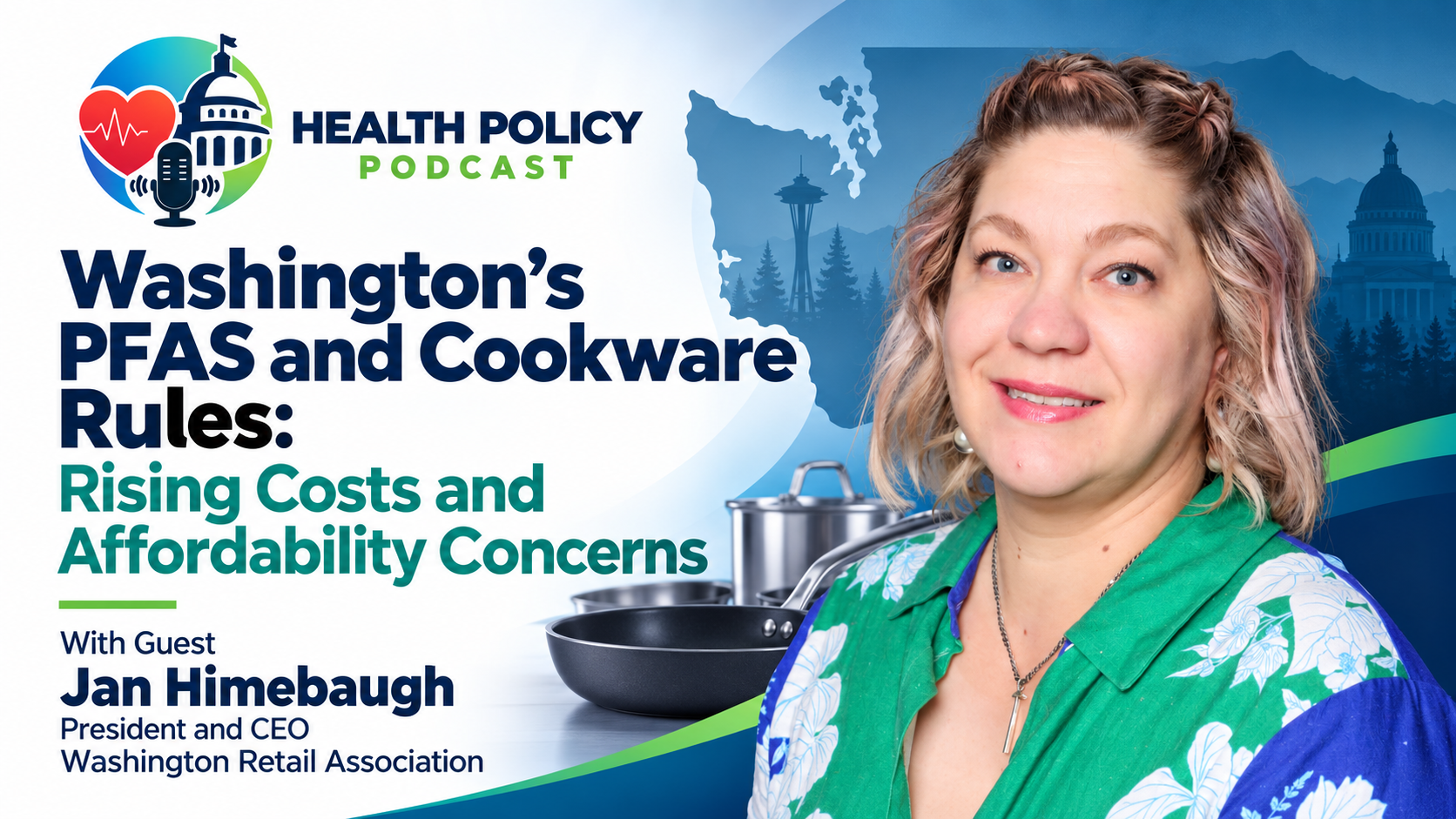
[00:00] Bryan Hyde: Welcome to the Health Policy Podcast. I'm Brian Hyde, and today I'm joined by Jan Heimbach. She is President and CEO of the Washington Retail Association. And I want to clarify, that's Washington State Retail Association. Jan, thank you so much for joining us today. Take a moment, if you would, to tell us a little bit about yourself and your background.
[00:18] Jan Himebaugh: Yeah, absolutely. Thanks, Brian. Good to be here today. I am, like you said, I'm Jan. I am the President and CEO of Washington Retail Association. I am relatively new to this role. I just started in June, but not new to the policy arena. I was the Vice President of External Affairs for the Building Industry Association of Washington, so doing all their policy work over for the homebuilders organization. So very familiar with a lot of the issues that my members now face as well, expanded issues, but also similar flavor of stuff I've worked on for the last 15 or so years.
[00:57] Bryan Hyde: So you're no stranger to policy and shaping policy. But let's talk a little bit about for Washington, for members of the Washington Retail Association, what exactly does your organization do for its members in the state?
[01:12] Jan Himebaugh: That is a great question and a question we get asked a lot. Most, I think most trade associations get asked that a lot. Well, we represent retail establishments. What's very unique about Washington Retail is that we represent your small independent mom-and-pop trinket shops. To the large national brands that we all know that are ubiquitous household names. You see advertising on TV. So we have very, very small shops and very large brands that are members of our organization, but we're the voice of retail in Washington State. Retail accounts for about 40% of our state sales tax. We're a very large industry. We contribute a lot to the state's revenue, and retailers of all sizes need representation. So we have a very loud advocacy voice, but we also offer a variety of member benefits that help bottom lines, that in a way sort of bottom lines for businesses where advocacy helps bottom lines, but it's hard to quantify. We have a workers' compensation program. We have a 401 program for small companies to be able to offer benefits to their employers. We offer education pieces to folks around stuff. We have workshops on security and safety measures and retail theft prevention. And so we do that and we make sure that our members are informed of changing laws and regulations so that they can comply and stay in business without getting hassled by regulators.
[02:40] Bryan Hyde: It sounds like you represent a very broad coalition of businesses and members. I'm curious, what are the top concerns that they express to you? And are there common concerns for both big and small businesses alike?
[02:55] Jan Himebaugh: Yeah, you know, here's the thing. Yeah, I think there are a lot of common concerns. There are actually most of our concerns are stuff we hear from our small independent one-off or twosies shops as well as our larger, our larger national companies. I think the cost of labor is very expensive and a concern for us and all the things that go in, all the variety of things that go into labor costs. But banning or significantly reducing the amount of product, whether it is like we're gonna talk about cookware or other products, cleaning products or clothing or makeup or stuff like that, that is also a big concern. We have some bigger issues around pricing requirements and how local and state, the state government is considering implementing some pricing stuff that potentially takes away discounts and coupons folks, as well as, and this is no surprise if anyone's anywhere close to the retail industry, retail theft, whether it's organized or just run-of-the-mill retail theft, grab-and-dash stuff. Retail theft is a huge issue for members large and small. In Washington, we think a survey says it's about $2.7 billion of product annually that's walking out of stores unpaid for. Just to put that in a little bit of context, our apple industry, we're the number one producing apple state in the nation produces just over $2 billion worth of apples. So retail theft in Washington is a larger, is a larger economic hit than our apple industry adds to our state. So $2.7 billion versus $2 billion. That's a lot of money that walks out of our stores. So retail theft, and that, that hits every single size shop.
[04:41] Bryan Hyde: Boy, that is a lot to cover. Let's, let's pivot. You mentioned the, you mentioned nonstick cookware. And I know Washington State is, is not the only state that is considered banning nonstick cookware. Set the stage for us, if you would. Why is there a proposal to ban nonstick cookware? And who is behind that proposal?
[05:01] Jan Himebaugh: So, you know, there are often conversations and proponents pushing to ban this product or that product. This really comes down to lead. The proponents are, or the advocates I would say, are folks who don't have any concept of how materials are manufactured or what our national standards are, very rigorous, safe standards for stuff. And then our Department of Ecology here has decided to exponentially expand the bill that passed to apply to all sorts of stuff that is not even touching food. So I think it's a bunch of folks who have probably reasonably good intentions but don't understand the science, but also are refusing to acknowledge the downstream impacts when you end up banning products. It is It is bad for the stores. It is bad for the manufacturers. But really, really who it hurts at the end of the day is customers who are trying to afford stuff so that they can prepare food for their families. And that is a real— it's a real bummer that they're not acknowledging that these things have downstream effects. And what people do is do this shift to buy it elsewhere and go across state lines so that, one, our state doesn't get the tax revenue from that sale. And secondly, our businesses don't get the the profits from that sale so they can't continue to serve their communities as easily. So it's a big push to ban this product or that product, insert stuff, and not acknowledge the real science behind it and to put blinders onto the economic damage that you're doing and the potentially food desert damage that you are doing as well for people who would like to make food at home as it's more inexpensive to make food at home than to eat out all the time. So
[06:53] Bryan Hyde: I'm sure it's, you know, it's easy to sell something as, hey, we're just trying to protect the consumers. And so, you know, the consumers there, you know, that's— it's just them that we're looking out for. But tell me about what these cookware bans do to retailers, whether they're big or small. How does it impact them?
[07:09] Jan Himebaugh: Well, you know, a couple of things. One, it, it limits the product they can sell. So it limits their customer base. So when you limit supply and say only this type or this individual item can be sold, the price gets driven up. So it's more expensive to acquire the goods to sell, or that you can't get them because everyone else knows there's only one thing that you can actually legally sell. The other thing is regular regulators come in and potentially fine you if you are selling something that you shouldn't be selling, that you might not have knowledge that you are selling. There are a lot of retail businesses up and down the food chain, some that are very, very sophisticated and some that are just trying to provide goods and services or goods to their community, whether it's cookware or clothing or groceries or tires or whatever, that might not know the intricacies of the product that was, was banned to take it off the shelf. So it is, it is bad for sort of liability. It is bad for choice for them, and it increases their cost of doing business long term and all around. And then, you know, when your cost of going doing business or you can't stock the product that your customers want. What ends up happening eventually, enough of those small cuts force you to go out of business, and therefore you drive business elsewhere or out of state or online. We represent online sellers too, and that's a whole other sort of conversation around national places that, you know, national brands that sell countrywide, what products they can send into the particular state and what products they can't send into the particular state. And that gets additionally complex for the business, which adds additional costs, which also drives up the cost of all the other stuff that they're selling and all the other stuff in stores because this one product is costing us more to deal with. So now we have to make up that somewhere else.
[09:02] Bryan Hyde: And then let's, let's take it one step further. When it comes to consumer choice, I mean, ostensibly we're protecting the consumers, but tell me about how bans like this affect, you know, a consumer.
[09:14] Jan Himebaugh: Well, I mean, first of all, I am a consumer too. I think we all eat food, as every living person still eats food, and you need some cookware if you make food. I happen to love to make food. One of the things I love to make is omelets. I feel like none of these people have ever actually made an omelet because you can't really do that in a cast iron pan. It's very heavy, especially if you're a flipper, if you're a flipper omelet man or woman. So there's just sort of like just Practical life that can't happen with other pans. So you've limited choice. You've also driven up the cost of choice because our alternatives here are more expensive if they exist. So we're not even— we are assuming that we can actually figure out how to get to the level that they— that can't be measured, that there are pots and pans that exist to replace The nonstick stuff. This is not good for consumers. It limits your ability to prepare food at home. It limits your ability to afford the things that you can prepare food at home. We talk a lot about in Washington, we've had many grocery stores close across our state and urban centers. We talk about food deserts, and this only brings a food desert home because when you can't afford the things to prepare food that you get at the grocery store, You also sort of limit the ability to eat at home. And so what you're doing is putting pressure particularly on the most disadvantaged among us because they're now having added pressure to figure out how to prepare food because they can't afford the pot or the pan to make it in, as well as just not having the practical options. So now you're eating out or you're buying unhealthy food that's prepackaged, more unhealthy food. I don't— I mean, like, you know, we've all, we've all used it. But that's not something you should subsist on every day. It's a convenience. It shouldn't be the daily thing that you eat. So we are now sort of making the food desert appear in people's homes, instead of allowing choice for them to choose to be able to go buy eggs and make an omelet in a pan they want to make an omelet in.
[11:24] Bryan Hyde: Jan, let's talk a little bit about the science behind this push to ban nonstick cookware. As I understand it, this is about certain types of chemicals, sometimes called forever chemicals, But does the science back that, boy, if you, you know, you cook your omelet in a pan made with these chemicals, why, you know, you're doomed? Or is there something else at play?
[11:46] Jan Himebaugh: I think there is something else at play. I think forever chemicals is not a scientific term. I am no scientist, right? I'm a policy person. I will just full disclosure, I don't have a science background. I have a political economy degree, not even a political science degree, right? So The economics piece is the thing that sort of I tend to focus on. But forever chemicals is not a technical scientific term. It's not been proved. It just sort of— and it's a big assumption that these chemicals are imparting anything to a food. I mean, there's just that recent conversation. There's been a very recent conversation around microplastics. And you see all these studies and then turns out the studies that did it all were measuring microplastics around everything. Oh, turns out they were in the gloves. So all that sort of science that was behind that is not accurate because they were contaminating all their samples with their gloves. Right. So that's a bit of a tangent. But I think there's not a lot of science to back up that we're damaging or imparting these chemicals into food that people are ingesting. And I, you know, there are some, there are some advocate organizations that thrive on creating a sense of fear around products. And, and I think that's really where it comes from. Instead of focusing on the things that we can do, we have very stringent regulations federally around cookware. We have very stringent regulations around cleaning supplies. We have very stringent regulations around this or that product. You can insert almost any product in it that are federally enforced, that have not been rolled back, that don't get more lenient, but do ensure that people are healthy and safe and that products that are being sold across the country are safe. And when a state decides to do it on its own, we have significant manufacturing problems. We are not a large populous state, so we usually don't have those things that are manufactured nationally created just for our state. So we've got a whole bunch of different pieces of like, why is it healthy in Utah but not healthy in Washington? Doesn't make a lot of sense. Why is it healthy in insert whatever other state you want to talk about, what red state, blue state, purple state, whatever. And all of a sudden, but in Washington, it's going to, it's going to do this thing that it's not done anywhere else. We're going to regulate something that we can't even measure. It's not— there doesn't seem to be a lot of science there.
[14:20] Bryan Hyde: Well, and as you mentioned earlier, no matter how well-intended, if the actual results are creating, you know, higher prices or less consumer choices or business difficulties for, you know, for retail businesses, That seems like a pretty big— that seems like not delivering on the promise of, but we're just protecting your— it's too big of a cost for it. So in that sense, how could Washington State make the policy better for members of the Washington Retail Association?
[14:52] Jan Himebaugh: Yeah, absolutely. And I think making the policy better for retailers in Washington also means making the policy better for consumers and customers and people who make food in their own homes better. So it's not just about businesses, it's about people's everyday lives. lives. It's about people, real-life human beings. I think that the state could start with reality. One, these chemicals naturally exist, so we can't start from a zero-based line of saying we can't have anything. They exist. They are in the world. We cannot start from a baseline of zero and have the goal be zero. That is just not reality because it's not how our world operates. You go outside, you're going to encounter these things. And it's not because there's a nonstick pan in the parking lot, right? It's just— or in the woods, right? It's because these chemicals do exist. They exist. And so let's not start from a baseline of zero or the goal being zero because it's not possible. Make sure that we can actually measure what we are banning or measuring the products so that we can actually do those things. And I also think taking a real big look at the economic impact is is important. We— it is not in manufacturers' best interest. It is not in retailers' best interest to be selling or producing things that are unhealthy and bad for people. It's not— it's not in our best interest. And there are already hefty rules around product safety that are national and making sure that our rules are matching up with those so that we are not trying to go differently than the rest of the country. or the majority of the country, it is really important to do those things so that we can actually have products to make sure that we can still cook in our homes and our apartments and all of those things, because that's where we eat.
[16:44] Bryan Hyde: Jan, let's connect people with your organization. First of all, where can people go online to learn more about what you do?
[16:52] Jan Himebaugh: We are found at washingtonretail.org. And that is— there's lots of information around our advocacy efforts and our member programs and all of those things. And that is the best way to figure out who you need to contact. All of our contact information is on washingtonretail.org. Again, we're full— it's a long address, full Washington.
[17:16] Bryan Hyde: Again, we're talking with Jan Heimbosch. She is president and CEO of Washington Retail Association. And Jan, thank you so much for joining us today on the Health Policy Podcast.
[17:26] Jan Himebaugh: Thank you.