· The Health Policy Podcast
Health Policy Podcast logo

Receive new episodes in your inbox.

← Health Policy Podcast

The Brief · Pacific Research Institute

Wayne Winegarden Discusses 340B Drug Pricing Program's Transparency Issues

with Wayne Winegarden, Fellow — Pacific Research Institute
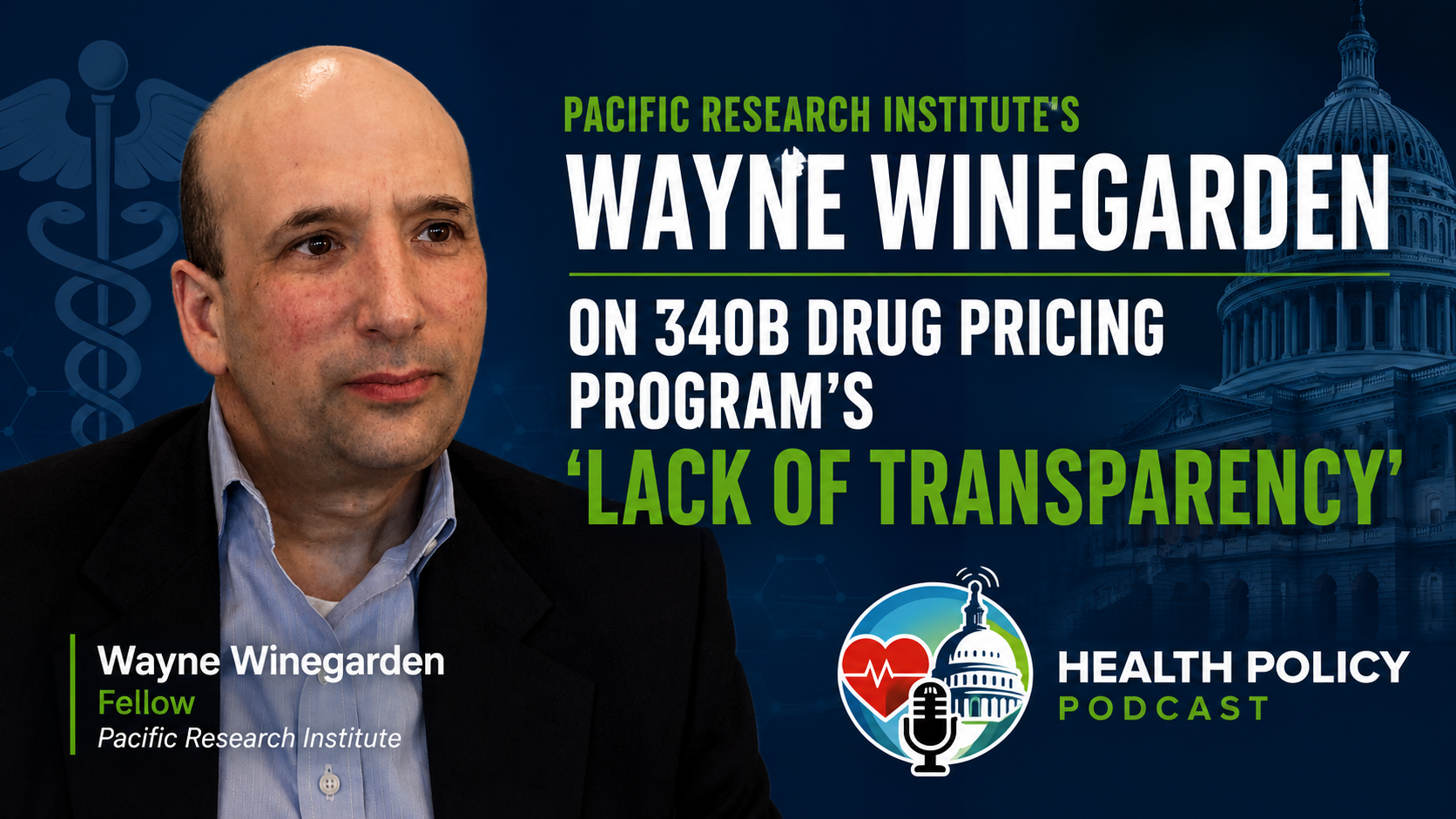
Health Policy Podcast episode featuring Wayne Winegarden discussing Wayne Winegarden Discusses 340B Drug Pricing Program's Transparency Issues

In the Health Policy Podcast episode featuring Wayne Winegarden from the Pacific Research Institute, the discussion centers on the 340B Drug Pricing Program. Winegarden critiques the program's lack of transparency and its unintended consequences, which have led to large hospital systems profiting at the expense of smaller institutions and patients. He advocates for reforms, including improved transparency and a shift in funding models to better serve the intended vulnerable populations.

Pacific Research Institute's Wayne Winegarden on 340B Drug Pricing Program's 'Lack of Transparency'

0:00 / 0:00

Pacific Research Institute's Wayne Winegarden on 340B Drug Pricing Program's 'Lack of Transparency'

Wayne Winegarden Discusses 340B Drug Pricing Program's Transparency Issues

Wayne Winegarden, a senior fellow at the Pacific Research Institute, addressed concerns regarding the 340B Drug Pricing Program in a recent episode of the Health Policy Podcast. The program, which is the second largest federal prescription drug initiative after Medicare Part D, aims to assist hospitals and clinics serving underserved populations. However, Winegarden argues that the program has strayed from its original intent and now lacks transparency.

The 340B program was established to help hospitals and clinics provide affordable medications to vulnerable patients. It allows eligible healthcare providers to purchase medications at significantly reduced prices. According to Winegarden, the program was initially designed to support small, rural hospitals. However, its scope has expanded dramatically since its inception in 1990, with participation growing from 90 hospitals to over 2,700 today.

"The program has gone from less than a billion dollars back then, maybe $7 billion in 2012, to more than $80 billion in purchases at the discounted price," Winegarden said. He noted that the list price for these drugs could reach $180 billion, with the difference representing profits for hospitals and pharmacies involved in the program.

Winegarden highlighted that while the program was intended to assist healthcare providers in serving low-income patients, it has inadvertently incentivized larger hospital systems to maximize profits. Major hospital networks, including Stanford Health and Boston General, have capitalized on the program's benefits, often at the expense of smaller institutions that genuinely serve underserved populations.

"There's a huge incentive to sell those medicines and get that spread and earn a lot of money," Winegarden explained. He pointed out that hospitals can purchase drugs at a discount and then bill insurers at the full price, pocketing the difference.

The expansion of eligibility criteria under the Affordable Care Act has allowed many large hospitals to qualify for the program, further complicating its original mission. Winegarden emphasized the need for reform, specifically advocating for increased transparency within the program. He argued that a lack of oversight has led to misuse and confusion regarding drug pricing and eligibility.

"Typically, when you have a government program, there are certain reporting requirements," he said. "We don't have that in this program. The transparency is nonexistent."

Winegarden suggested that funds should follow patients rather than simply being allocated to institutions. He noted that large hospital systems may resist transparency efforts, fearing that such reforms could jeopardize their revenue streams. "It's not in their incentive," he said, referring to the potential pushback from larger hospital networks.

Despite the challenges, Winegarden remains optimistic about potential reforms. He mentioned that some lawmakers are beginning to recognize the need for changes to the 340B program. However, he acknowledged that there is resistance, particularly from institutions that rely heavily on the revenue generated by the program.

One proposed reform is the implementation of a rebate model, which would require hospitals to submit claims to drug manufacturers for 340B discounts after the fact. This change could help ensure that discounts are applied appropriately and not to ineligible drugs.

"The rebate model is a major improvement," Winegarden said. "You've set the incentives up for making sure that all 340B drugs get the discount, but the discount doesn't go to drugs that aren't eligible for the program."

Winegarden concluded that while the 340B program was well-intentioned, its complexity has led to unintended consequences. He emphasized the importance of reforming the program to better serve the patients it was designed to assist.

For more information on the 340B Drug Pricing Program and related research, visit the Pacific Research Institute's website at pacificresearch.org or medecon.org.

Interview Q&A

Q&A: Pacific Research Institute's Wayne Winegarden on 340B Drug Pricing Program's 'Lack of Transparency'

Q&A with Wayne Winegarden on the 340B Drug Pricing Program

Q: What is your background and role at the Pacific Research Institute?

A: I am an economist by training and a senior fellow in business and economics at the Pacific Research Institute. I direct the Center for Medical Economics and Innovation, focusing on free market solutions to public policy issues, particularly in healthcare, energy, and fiscal policy.

Q: What is the 340B Drug Discount Program?

A: The 340B program is the second largest federal prescription drug program after Medicare Part D. It aims to help hospitals and clinics, particularly those serving underserved populations, by allowing them to purchase drugs at reduced prices.

Q: How did the 340B program originate?

A: The program was established in response to a law passed in 1990 that required Medicaid to receive the best price for drugs. This discouraged drug companies from donating medicines to hospitals. The 340B program allowed hospitals to buy drugs at lower costs to support their mission of serving vulnerable populations.

Q: What issues have arisen with the 340B program?

A: The program has expanded significantly, now involving over 2,700 hospitals compared to just 90 at its inception. This growth has led to increased profits for large hospital systems and pharmacies, which undermines the program's original intent to support smaller, rural hospitals.

Q: How do hospitals benefit financially from the 340B program?

A: Hospitals can purchase drugs at a discount and then bill insurers at the full price, keeping the difference as revenue. This creates a financial incentive for hospitals to use more expensive drugs, which contributes to rising drug costs.

Q: What reforms do you suggest for the 340B program?

A: A key reform would be to increase transparency regarding how funds are spent within the program. Implementing reporting requirements could help identify misuse and ensure the program serves its intended purpose.

Q: Should funds from the 340B program follow the patient instead of the institution?

A: Yes, restructuring the program to have funds follow the patient would significantly change the incentives and help ensure that resources are directed to those who need them most.

Q: Is there political support for reforming the 340B program?

A: There is a mix of support and resistance. Some lawmakers are advocating for reforms, but there are concerns from smaller hospitals that rely on the program for revenue. Balancing the needs of these institutions with the need for reform is a challenge.

Q: What is the issue with contract pharmacies in the 340B program?

A: Many hospitals have numerous contract pharmacies, which complicates the ability to ensure that drugs dispensed are eligible for the 340B discount. This has led to inappropriate discounts and mismanagement of the program.

Q: What is the proposed rebate model for the 340B program?

A: The rebate model would require hospitals to submit claims to manufacturers for 340B drugs, ensuring that discounts are only applied to eligible drugs. This would help align incentives and improve the program's effectiveness.

Q: Was the funding of institutions over patients inherent in the 340B program from the start?

A: Yes, the program was designed to fund institutions so they could better serve patients. However, the complexity of the system has led to inefficiencies and misalignment of incentives over time.

Q: Where can people find more information about your research on the 340B program?

A: More information can be found at pacificresearch.org and medecon.org, where our research on the 340B program and other healthcare issues is available.

Key takeaways

  • 340B is the most important drug program that you've never heard of.
  • The program has gone from, you know, less than a billion dollars back then, maybe $7 billion in 2012. Now it's more than $80 billion kind of purchases kind of at the discounted price.
  • We need transparency. I guess that would be a great place to begin.
  • If it's following the patient, that's a great way of kind of changing those incentives so we don't have those kind of activity being encouraged that we really don't want.
  • It was always meant to fund the institutions, and then the institutions would then serve the patients.

About the guest

Wayne Winegarden

FellowPacific Research Institute

Full transcript

Show full transcript
[00:00] Bryan Hyde: Welcome to the Health Policy Podcast. I'm Brian Hyde. Today I'm joined by Wayne Weingarten. Wayne is a fellow at the Pacific Research Institute, specifically a senior fellow in business and economics and director of the Center for Medical Economics and Innovation. Wayne, that is, that's a mouthful of a title, but it only scratches the surface of the stuff that you do. Take a moment here and tell us a little bit about who you are and what you do. [00:25] Wayne Winegarden: Oh, absolutely. And thanks so much for having me on today. So you just stated my title. I mean, what did we it really means I'm an economist by training. PRI were a free market think tank. You know, our goal was to find free market solutions to pressing public policy issues. And we look at a long range of, a long list of issues, education, healthcare, kind of taxes, fiscal policy, broadly speaking, trade policy, really across the board, federal, and a lot of California. That's where we're— Mm-hmm. We're located and we're in desperate need of free market reforms here. So my specific issues, I look at the energy and the environment, fiscal and macro policy, and healthcare, really drug pricing. So those are the areas I focus my time on. [01:17] Bryan Hyde: And that brings us to the 340B program. Some people will know right off the bat when I say 340B what that refers to. A surprising amount of people though don't know. And so I'm gonna ask you, let's begin this discussion by first of all talking about what the 340B Drug Discount Program is, and then we can go into what's it intended to do, but what is it actually doing? [01:40] Wayne Winegarden: Absolutely, and I think it's, 340B is the most important drug program that you've never heard of. It's actually the second largest federal prescription drug program after Medicare Part D. So it's a huge program, and its purpose is actually, you know, a very kind of, sound purpose. What it's supposed to do is help hospitals and clinics, smaller ones, rural hospitals that are serving kind of underserved populations, have less access, less insurance, less income, people who are vulnerable. The hospitals are kind of doing that good work, and the program is supposed to help them. And where it comes from, and this is really very much a kind of government coming in fixing problems that the government created, and then of course you have to go and then fix those problems very quickly. What happened was drug companies used to be donating drugs to these hospitals to help them fulfill their mission. Well, in 1990, what happened is they passed a law that says Medicaid gets best price. Well, if you're giving away medicines, then zero becomes the best price. That's obviously not tenable, so it discouraged all of that charitable giving. 340(b) 340(b) was the answer to that, where now the— there would be a specific program where the drugs can be sold into these hospitals at lower cost. [03:11] Bryan Hyde: So I, I get the intention, and, and it sounds like there's a real need that this attempts to address, but it also sounds like some incentives have come out of this that might be getting in the way of that 340B program actually fulfilling the needs of patients, and instead it's, it's helping the hospitals' bottom lines. Can you unpack that for us? [03:35] Wayne Winegarden: Oh, absolutely. And when we say hospitals' bottom line, we're also really talking about some of the largest hospital systems in the country. I mean, we're talking about Stanford Health and Boston General. I guess a great way to think of it is this way: when the program was first passed, 90 hospitals were participating. And these are small kind of rural hospitals. Today there's 2,700 hospitals that are enrolled in 340B. The program has gone from, you know, less than a billion dollars back then, maybe $7 billion in 2012. Now it's more than $80 billion kind of purchases kind of at the discounted price. It's actually double that, like $180 billion, what they would call list price. And the difference between those, by the way, are the profits that these hospitals and what they also call contract pharmacies are bringing in. And that's kind of the out-of-control growth that the program has kind of enabled. And basically what happened is policies changed and kind of things have evolved and the eligibility for 340B expanded well beyond what was intended. And so now major hospital systems, large pharmacies, CVS, Walgreens, are all participating, and it's costing a lot of money. And I think importantly, it jeopardizes the program for those hospitals and those clinics that it's meant to kind of address, that it's meant to help. [05:08] Bryan Hyde: So the, if I'm understanding you correctly, the hospitals can, um, they can buy at a very deep discount, but then, then they get taxpayer dollars at a much higher rate. [05:21] Wayne Winegarden: Well, well, not necessarily just taxpayer dollars, but in some cases, yes. So, so how the program works is there's basically, they say 50%, that's about the average. So if you have a drug that costs $1,000, and that's a very— we'll use that kind of vague kind of pricing— if it costs $1,000 bucks What the hospital gets to do is they, if it's a 340B hospital, they can purchase the drug for $500. They'll then go bill the insurer, get reimbursed for $1,000, and then that spread, that $500 becomes revenue for the hospital. So you can see how when, like if you're a cancer center, right? And cancer drugs are very expensive. Well, you can see there's a huge incentive to, you know, sell those medicines and get that spread and earn a lot of money. That's really what's happened with the program is, for instance, Medicaid is one of the kind of criteria. So if you're a hospital that serves a certain percentage of Medicaid patients, you're eligible for 340B. Well, with the ACA, right, the Affordable Care Act, changed the definition and now a lot of hospitals that really weren't the intended hospitals based on the kind of the thresholds that we have right now, all of a sudden qualify. And they all of a sudden realize how much money is there. So they started becoming 340(b) 340(b) and making lots of income. And then what they started doing is realizing, hey, wait a second, that independent cancer oncology practice, if I buy that practice, I'm going to turn all of these drug purchases that aren't 340B, I'm going to turn them into 340B drugs and I'm going to get that spread. And so you wonder why are there fewer kind of independent oncology practices going on? Well, the drug program you never heard of is a big driving factor that gives the big hospitals the revenues and the incentive to go acquire them. [07:23] Bryan Hyde: So It sounds like you're making a pretty strong case for however well-intended this program was when it was enacted back in 1990, some reform is probably needed at this point. How does that begin? How would we start to reform where these incentives are being misused? [07:44] Wayne Winegarden: Well, and that began to— I think there's a wide range. I mean, we need transparency. I, I guess that would be a great place to begin. I mean, typically, when you have a government program or government contract, or even just when you have just a donor giving money to kind of an organization, there, there are certain reporting requirements. You kind of want to know how was the money being spent, you know. Are you fulfilling the mission? You know, just kind of basic kind of financial, you know, checking that you'd want to make sure is being done. We don't have that in this program. We have— there are— the transparency is nonexistent. And so we don't know exactly how this money is being spent. We don't know, you know, we have grand estimates, but, you know, when it comes to specific institutions, there's a lot of questions in terms of, you know, how much is going on. So the first step, I guess, would have to be we need greater transparency. We need to understand what's going on with the program. And we also need to understand there's a lot of requirements that are being kind of violated with the program. So for instance, because of kind of the relationship with Medicaid, 'cause Medicaid has that best price rule, no drug is supposed to have both kind of a Medicaid discount applied to it as well as a 340B discount. They call that duplicate discounts, not supposed to happen. Because of the lack of transparency and kind of the confusion of the system, it does happen. It happens more often than you would think and certainly more often than you would like. So transparency will help kind of start identifying those issues and start bringing back some of the— and I don't necessarily want to use it with fraud, we'll just say just mistakes that are occurring. [09:30] Bryan Hyde: So I guess as part of that transparency then, It sounds like the funds should be going to, or following the patient rather than simply being paid to institutions. Is it in the interest of those institutions to, you know, to keep a good thing going? In other words, keep this quiet, or does it help them to, you know, to have it out there in the light of day and let people see what's happening? [09:57] Wayne Winegarden: No, I mean, it's not in their incentive. I mean, that's, you know, and what you mentioned, having the funds follow the patient, that would be a radical reform, would actually make a big difference. Difference in terms of how the program works. It would actually just radically restructure it. But that, you know, that would be kind of, if we wanted to go kind of that far, a great way of addressing the problems. And no, the big hospital systems, look, and I don't mean to vilify, I don't think, and I think this is really important, this is not about vilification, this is not villains and heroes, this is about the incentives of the system. And when you set up a system that incentivizes kind of all these activities, you're going to get them. And so this is about fixing incentives. But another problem that we have with this is the hospitals, however, incented to use more expensive drugs, right? When you're getting a spread and it's filling needs, right? I mean, you have hospitals serve a very important purpose. So, you know, they see a higher spread with a higher cost medicine, they're now incented to use more expensive medicines. One of the reasons why drug costs or drug spending is higher. So that needs to be fixed as well. So, you know, it just goes, it goes on and on. But I think it's really important that we, when we talk about reform, we're talking about how do we change these incentives? So going back to what you just said, if it's following the patient, that's a great way of kind of changing those incentives so we don't have those kind of activity being encouraged that we really don't want. [11:32] Bryan Hyde: Is there anyone in Congress, or for that matter, within the federal regulatory apparatus that's pushing for this kind of reform? Or is there resistance even from within those who have, you know, the oversight duty? [11:46] Wayne Winegarden: Yeah, I mean, both, right? I mean, we're definitely seeing kind of positive movement. That's great. There's definitely pushback, you know, and part of the pushback is kind of differentiating between, you know, the abuse in the program versus the institutions that really need it and kind of the fear that some of those institutions will have when you talk about reform. If you're talking about a kind of small rural hospital in Idaho, who's, you know, 340B is probably a very important source of revenue for them. And you start talking about reform and, you know, hospitals have a lot of mandates. It's a difficult business. In many of these rural ones, they're struggling. And now you start talking about, hey, wait a second, we're going to reform this program and they're saying, I'm getting by because I have this revenue structure. It becomes fearful for them and rightly so. So, and I think that becomes an obstacle is ensuring that the program is going to be there for the institutions that it's meant for, but we're kind of going to roll back the problems as it relates to some of these other issues. Perfect example, there are some hospitals that have what's called contract pharmacies. And they have hundreds, hundreds of contract pharmacies. And what the problem with that is, is that originally the program was you were allowed to have one contract pharmacy per hospital. And the idea was there were some of these smaller hospitals don't have pharmacies in-house. And since they didn't have pharmacies, you know, how do you participate in the program? So you were allowed to have one contract pharmacy so that you could, participate in, ideally that would be in the area that, you know, you're serving. So if you're a rural hospital in Idaho, you know, you're in that town, the contract pharmacy's in the town, you're serving that population. Well, now you have hospitals, you know, in Boston with contract pharmacies in California. And we're talking about Walgreens, we're talking about CVS, we're talking about Walmart. I mean, major corporations And contract pharmacies love it because they get a higher margin when they dispense a drug that's 340B. Now we're now one step removed from the hospital. So now the contract pharmacy's ability to make sure that this specific drug is a 340B kind of eligible drug is that much more difficult. Because if I'm a patient at a 340B hospital and I need a drug, Well, perhaps that drug wasn't prescribed by the hospital. Perhaps my doctor is outside of it and this is coming from that doctor. Well, it's much harder for CVS or Walgreens to recognize that. And so a lot of the inappropriate discounts start to occur. That's why another reform effort— you see this momentum on this side— is what they call a rebate model. [14:38] Bryan Hyde: Mm-hmm. [14:38] Wayne Winegarden: So right now when the manufacturer sells the drug to the hospital, that's being sold at 340B price. Well, in the rebate model, and a lot of programs work this way, the hospital would then have to submit to the manufacturer, say this is a 340B drug, and then you pay the rebate ex post. Well, now you've set the incentives up, and that's why the rebate model is a major improvement. You've set the incentives up for making sure that the all 340B kind of drugs get the discount, but the discount doesn't go to drugs that aren't eligible for the program. And you kind of have a better balance in terms of the organizations now to ensure the program is targeted towards kind of where it's supposed to go. [15:25] Bryan Hyde: So Wayne, I have to ask, was this practice of funding institutions over patients, was that baked into 340B? From its very inception, or was it something that crept in over time? [15:39] Wayne Winegarden: No, and I think you can fault the program for that, right? That, you know, it's kind of a government solution which makes things more complicated. It was always meant to fund the institutions, and then the institutions would then serve the patients. So it— and the idea was the small institutions or these hospitals or these federal clinics would be able to now better serve. They have more resources available. They can get drugs to their patients cheaper. They can provide more services. So it was always meant to directly, or I should say indirectly benefit the patients, but benefiting those patients were always kind of within the realm of the program. You could say, you know, in typical government fashion, it's doing it in a more complicated way and probably directly benefiting the patients, perhaps that would be a better structure. Mm-hmm. But, you know, we, we live in the world in which we live in. So reforming the program is, is, is the more practical way of, of, of addressing it. But that, that is a really good point, right? That the more complicated you make the structures, like that game of telephone, the more people you put in the line, the, the more likely the, the, the message gets, uh, uh, misread. [16:55] Bryan Hyde: And I know that you have, have written pretty extensively on this subject. Let's give people a web address that they can go to, or at least a website they can go to, to, to access your work with Pacific Research. [17:09] Wayne Winegarden: Oh, a, absolutely. All, all of our, um, uh, research on 340B and lots of other issues, that would be available at pacificresearch.org. You could also find it at medecon.org. [17:21] Bryan Hyde: Okay. I really appreciate you joining us today. Again, we're talking with Wayne, Weingarten. He is a senior fellow at the Pacific Research Institute. Wayne, thank you so much for joining us today on the Health Policy Podcast. [17:33] Wayne Winegarden: My pleasure. Thanks very much for having me.

Filed under