2026-11-05 · National Center for Energy Analytics
AI in Healthcare: Hype vs. Hope with Mark P. Mills on Future Innovations
with Mark Mills, Founder and Executive Director — National Center for Energy Analytics
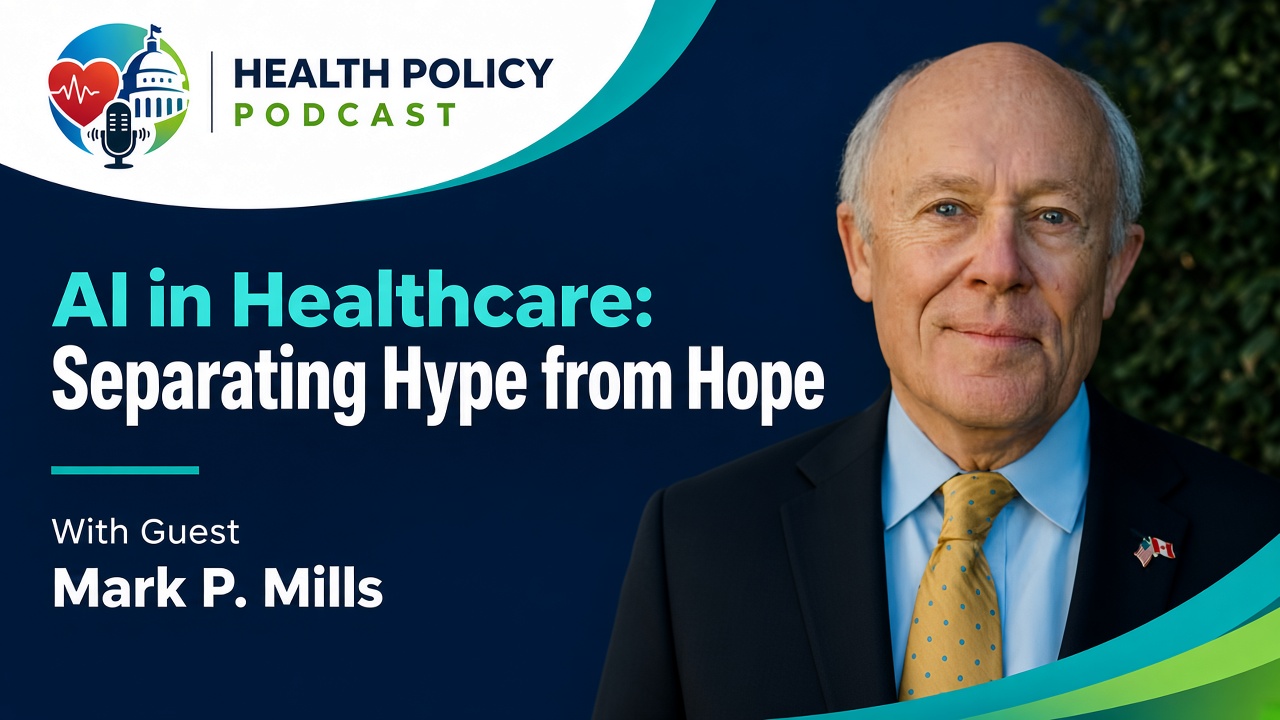
In the Health Policy Podcast episode "AI in Healthcare: Separating Hype from Hope," Mark P. Mills, founder and executive director of the National Center for Energy Analytics, discusses the potential of artificial intelligence in healthcare. Mills emphasizes AI's role in enhancing diagnostics, improving administrative efficiency, and accelerating medical research, while addressing concerns about the technology's impact on jobs and regulatory challenges. He advocates for a nuanced understanding of AI's benefits and risks in the healthcare sector.
Related coverage
- AI in Healthcare: Separating Hype from Hope with Mark P. Mills →
- AI in Healthcare: Separating Hype from Hope with Mark P. Mills →
- Q&A: AI in Healthcare: Separating Hype from Hope with Mark P. Mills →
- Q&A: AI in Healthcare: Separating Hype from Hope with Mark P. Mills →
- News: AI in Healthcare: Separating Hype from Hope with Mark P. Mills →
AI in Healthcare: Separating Hype from Hope with Mark P. Mills
AI in Healthcare: Separating Hype from Hope
In a recent episode of the Health Policy Podcast, Mark P. Mills, founder and executive director of the National Center for Energy Analytics, discussed the role of artificial intelligence (AI) in healthcare. Mills emphasized the need to distinguish between the hype surrounding AI and its practical applications in the medical field. He highlighted the potential benefits of AI in diagnostics, research, and administrative processes, while also addressing the challenges that come with integrating these technologies into existing healthcare systems.
Mills, who has a background in physics and technology, explained that AI is not a magical solution that will cure diseases overnight. Instead, he described it as a powerful research assistant that can significantly enhance the understanding of complex biological systems. "AI is going to be an incredibly— it already is— powerful research assistant to accelerate discovery," he said. However, he cautioned that while AI has made impressive strides, it still needs to become significantly more powerful to be truly transformative in healthcare.
Mills identified three key areas where AI could have a substantial impact: scientific research, diagnostics, and administrative processes. He noted that only 5% of healthcare spending is dedicated to scientific research, yet this area holds immense potential for AI applications. By accelerating the discovery of new treatments and understanding disease mechanisms, AI could revolutionize the field of medicine.
In the diagnostics sector, Mills pointed out that AI has improved the accuracy and efficiency of medical imaging. Contrary to early predictions that AI would eliminate the need for pathologists, he argued that AI has instead enhanced their capabilities. "What it's done is made pathologists and pathology reading better, faster, more accurate," he said. This improvement is crucial, as accurate diagnoses are essential for effective treatment.
The largest portion of healthcare spending, approximately 80%, is allocated to the deployment of care, including hospitals and clinics. Mills highlighted that a significant portion of this spending—between 25% and 35%—is attributed to administrative overhead. He suggested that AI could streamline these processes, potentially reducing costs by as much as 20%. "AI is really good at that and fast at getting better at that fast," he stated.
Mills also addressed the challenges faced by healthcare providers due to bureaucratic burdens. He noted that the administrative tasks required for record-keeping often distract clinicians from focusing on patient care. AI tools, such as AI scribes, can help alleviate this burden by transcribing conversations between doctors and patients, allowing healthcare professionals to concentrate on their primary responsibilities.
The discussion also touched on the vast amounts of data generated in healthcare, particularly from diagnostic imaging. Mills compared the potential of AI in healthcare to recent advancements in astronomy, where AI was used to produce the first image of a black hole by analyzing data from various wavelengths. He argued that similar techniques could be applied to medical imaging, enabling healthcare providers to gain deeper insights into patients' conditions.
Mills concluded by addressing the political and social challenges surrounding data centers, which are essential for processing the vast amounts of data generated in healthcare. He emphasized the importance of educating the public about the benefits of AI and data centers, framing them as critical components of modern healthcare rather than sources of concern.
As AI continues to evolve, Mills remains optimistic about its potential to improve healthcare outcomes. He believes that with proper integration and understanding, AI can play a transformative role in the medical field, enhancing both patient care and operational efficiency.
AI in Healthcare: Separating Hype from Hope with Mark P. Mills
AI in Healthcare: Separating Hype from Hope
In a recent episode of the Health Policy Podcast, Mark P. Mills, founder and executive director of the National Center for Energy Analytics, discussed the role of artificial intelligence (AI) in healthcare. Mills emphasized the potential benefits of AI in medical research, diagnostics, and administrative processes, while cautioning against the exaggerated claims surrounding the technology.
Mills, a physicist with extensive experience in technology fields, highlighted the intersection of healthcare, technology, finance, and policy. He noted that while AI is often portrayed as a magical solution capable of curing diseases or threatening humanity, its true potential lies in enhancing existing processes. “AI is going to be an incredibly— it already is— powerful research assistant to accelerate discovery,” Mills said.
The Promise of AI in Medical Research
Mills identified three primary areas where AI could significantly impact healthcare: scientific research, diagnostics, and administrative efficiency. He described the scientific research aspect as the “science bucket,” which focuses on understanding biology, disease mechanisms, and discovering new treatments. Mills believes that AI will serve as a powerful tool in this realm, although he cautioned that it would take time for the technology to reach its full potential.
Mills pointed out that only 5% of healthcare spending is allocated to scientific research, which may limit immediate advancements. He expressed optimism that AI could become 1,000 times more powerful within the next decade, accelerating discoveries in medicine.
Enhancing Diagnostics
The second area Mills discussed was diagnostics, which encompasses the processes used by physicians and machines to identify medical conditions. He noted that while there were initial fears that AI would replace pathologists, the reality is that AI has improved the accuracy and efficiency of diagnostic processes. “What it's done is made pathologists and pathology reading better, faster, more accurate,” Mills explained.
AI's role in diagnostics is particularly crucial, as accurate diagnoses are essential for effective treatment. Mills emphasized that AI can enhance the capabilities of diagnostic machines, making them more effective and efficient.
Streamlining Administrative Processes
Mills also addressed the administrative side of healthcare, which accounts for approximately 25% to 35% of total healthcare spending. He argued that AI could significantly reduce administrative overhead costs, potentially cutting them in half. This reduction could lead to a substantial decrease in overall healthcare costs, making the system more efficient.
“AI is really good at that and fast at getting better at that fast,” Mills stated. He acknowledged that while some jobs in administrative roles may be lost, the overall workforce would not diminish. Instead, the growth rate of administrative positions would slow, allowing for a more efficient healthcare system.
Improving Doctor-Patient Interactions
Another area where Mills sees potential for AI is in enhancing the doctor-patient relationship. He noted that AI tools, such as AI scribes, could alleviate some of the administrative burdens on healthcare providers. By transcribing conversations and managing documentation, AI could allow doctors to focus more on patient care rather than administrative tasks.
Mills explained that this shift could lead to a better patient experience, as healthcare providers would be more engaged during consultations. “It makes it better. It makes it more accurate. And it makes the experience that you have with the doctor better,” he said.
Addressing Public Concerns
Mills acknowledged that public resistance to data centers and AI technologies is a significant challenge. He suggested that the tech industry must engage with communities and address concerns about data privacy and environmental impact. By framing data centers as essential components of healthcare innovation, Mills believes the public may become more receptive to their presence.
He emphasized the importance of separating rational concerns from irrational fears regarding AI and data centers. Mills argued that discussions should focus on the benefits of AI in healthcare, such as improved diagnostics and patient care, rather than the broader political implications of technology.
In conclusion, Mark P. Mills' insights into AI's potential in healthcare highlight a transformative opportunity for the industry. While challenges remain, the promise of AI as a tool for enhancing medical research, diagnostics, and administrative efficiency could lead to significant improvements in patient care and overall healthcare costs.
Interview Q&A
Q&A: AI in Healthcare: Separating Hype from Hope with Mark P. Mills
AI in Healthcare: Separating Hype from Hope with Mark P. Mills
Q: Can you tell us about your background and how it relates to healthcare?
A: I am the founder and executive director of the National Center for Energy Analytics. My work focuses on technology fields such as sensors and imaging, which intersect with healthcare. I have written extensively about AI and healthcare in my book, The Cloud Revolution, and I study the connections between technology, finance, and policy in the healthcare domain.
Q: What are some promising areas where AI could be beneficial in healthcare?
A: AI's most promising near-term benefit in healthcare is as a powerful research assistant. It can accelerate disease discovery and improve diagnostics. While AI won't cure cancer overnight, it has the potential to significantly enhance our understanding of biology and disease.
Q: How does AI impact the diagnostic process in healthcare?
A: AI improves the accuracy and speed of diagnostics. For example, rather than eliminating pathologists, AI has increased the demand for them by enhancing their capabilities. It makes diagnostic tools more effective and efficient, which is crucial for correct treatment.
Q: What about the administrative side of healthcare?
A: Administrative overhead accounts for 25 to 35% of healthcare spending. AI can significantly reduce these costs, potentially cutting administrative expenses in half, which could lead to a 20% reduction in overall healthcare costs. This would slow the growth of the administrative workforce but not eliminate jobs.
Q: What challenges exist in the doctor-patient relationship that AI could address?
A: AI can alleviate the administrative burden on healthcare providers, allowing them to focus more on patient care. AI tools, like AI scribes, can transcribe conversations in real time, improving the accuracy of records and enhancing the patient experience by allowing doctors to engage more directly with patients.
Q: How does AI handle the vast amounts of data in healthcare?
A: AI can manage and analyze large volumes of diagnostic data, such as X-rays and MRIs. By integrating various imaging modalities, AI can produce comprehensive images that assist physicians in making more accurate diagnoses and treatment plans.
Q: What is the concept of a digital twin in healthcare?
A: A digital twin is a virtual representation of an individual that continuously collects and analyzes health data. This concept could revolutionize personalized medicine by allowing for more accurate and timely diagnoses based on a person's unique health data.
Q: What are the main concerns regarding data centers in healthcare?
A: There is a resistance to data centers due to concerns about privacy, cybersecurity, and environmental impact. However, the benefits of data centers, particularly in healthcare, often outweigh these concerns, as they enable advanced medical research and diagnostics.
Q: How can the public's perception of data centers be improved?
A: The tech industry needs to engage with communities to address concerns about data centers. By focusing on the positive impacts of data centers in healthcare and separating the issues of zoning and environmental impact from the technology itself, we can foster a more informed dialogue.
Q: What are some misconceptions about the water and power usage of data centers?
A: Data centers do use significant amounts of power, but the concerns are often exaggerated. They can employ closed-loop cooling systems that use less water than traditional methods. In fact, data centers typically consume less water than golf courses and other agricultural uses.
Q: What is the future outlook for AI in healthcare?
A: The trajectory for AI in healthcare is promising. As AI technology continues to improve, it will play a critical role in enhancing diagnostics, reducing costs, and ultimately improving patient outcomes. The integration of AI into healthcare systems is expected to accelerate in the coming years.
Interview Q&A
Q&A: AI in Healthcare: Separating Hype from Hope with Mark P. Mills
AI in Healthcare: Separating Hype from Hope with Mark P. Mills
Q: Can you tell us a little about yourself and your work?
A: I am Mark P. Mills, founder and executive director of the National Center for Energy Analytics. My background is in technology fields, particularly sensors and imaging, which intersect with healthcare. I have written extensively about these topics, including in my book, The Cloud Revolution, where I discuss AI and its implications for healthcare and drug discovery.
Q: What are some promising areas where AI could be beneficial in healthcare?
A: AI has significant potential in healthcare, particularly as a research assistant. It can accelerate discovery in understanding diseases and physiology. While it won't cure cancer overnight, its capabilities are improving rapidly, and within a decade, we expect AI to be 1,000 times more powerful than it is today.
Q: How does AI impact the diagnostic process in healthcare?
A: AI enhances diagnostics by improving the accuracy and speed of readings from machines like X-rays and MRIs. Contrary to earlier predictions that AI would eliminate pathologists, it has increased their demand and made their work more efficient.
Q: What percentage of healthcare spending is directed toward science and diagnostics?
A: Only 5% of healthcare spending is allocated to scientific research, while diagnostics account for about 20%. The remaining 80% is spent on the deployment of healthcare services.
Q: How can AI help reduce administrative costs in healthcare?
A: Administrative overhead accounts for 25% to 35% of healthcare spending. If AI can cut these costs in half, it could reduce overall healthcare spending by nearly 20%. This would not eliminate jobs but slow the growth of administrative roles.
Q: What challenges exist in the doctor-patient relationship that AI could address?
A: Administrative burdens often distract healthcare professionals from focusing on patients. AI can assist by transcribing conversations and managing documentation, allowing clinicians to concentrate on patient care.
Q: Can AI improve the overall patient experience?
A: Yes, AI can streamline processes such as scheduling and coordinating medical procedures, making the experience faster and less error-prone for patients.
Q: How does AI handle the vast amounts of data in healthcare?
A: AI can manage and analyze massive amounts of data from diagnostics and imaging. It can identify patterns that may be missed by human doctors, enhancing diagnostic capabilities.
Q: What is the concept of a digital twin in healthcare?
A: A digital twin is a virtual representation of an individual that continuously collects medical data. This could revolutionize personalized healthcare by allowing for more accurate diagnoses and treatment plans.
Q: How can we address public concerns about data centers related to AI in healthcare?
A: It's essential to communicate the benefits of AI in healthcare clearly. Addressing irrational fears while acknowledging valid concerns about zoning and environmental impacts can help mitigate resistance to data centers.
Q: What are some misconceptions about data centers?
A: Many concerns about data centers are overhyped. For example, they use significantly less water than commonly believed, and their power consumption can be managed effectively.
Q: How can tech companies improve public perception of their operations?
A: Tech companies should engage with communities transparently and focus on the benefits of their technologies rather than getting involved in broader political issues. This approach can help build trust and understanding.
Q: What is the future trajectory for AI in healthcare?
A: The future of AI in healthcare is promising, with opportunities for improved diagnostics, personalized medicine, and operational efficiencies. As technology evolves, we can expect significant advancements in patient care and outcomes.
Key takeaways
- “The misunderstandings and the hype are epic.”
- “Arguably, the single most promising near-term benefit from AI is in the healthcare industry.”
- “AI is going to be an incredibly— it already is— powerful research assistant to accelerate discovery.”
- “25 to 35% of all healthcare spending is administrative overhead.”
- “AI is really good at that and fast at getting better at that fast.”
- “The holy grail in healthcare is I have a personal digital twin— me, you— and what it does is constantly harvest, securely, all of my medical data.”
About the guest

Founder and Executive Director — National Center for Energy Analytics
Mark P. Mills is the Executive Director of the National Center for Energy Analytics, a distinguished senior fellow at the Texas Public Policy Foundation, a contributing editor at City Journal, a faculty fellow at Northwestern University’s school of engineering, and co-founding partner in Montrose Lane. His PragerU videos have been viewed over 10 million times. He is author of *The Cloud Revolution* (2021); earlier books include *Digital Cathedrals* (2020), *Work in the Age of Robots* (2018), and *The Bottomless Well* (2005, with Peter Huber), about which Bill Gates said, “This is the only book I’ve ever seen that really explains energy.” He served as Chairman/CTO of ICx Technologies (2007 IPO), worked in President Reagan’s White House Science Office, and earlier was an experimental physicist and development engineer in microprocessors and fiber optics, earning several patents. He holds a physics degree from Queen’s University, Canada.
Full transcript
Show full transcriptHide transcript
Filed under