2026-09-22 · American Council on Science and Health
As Washington State Regulates Nonstick Cookware, Toxicologist Says Fear Outpaces Evidence
with Susan Goldhaber, Writer — American Council on Science and Health
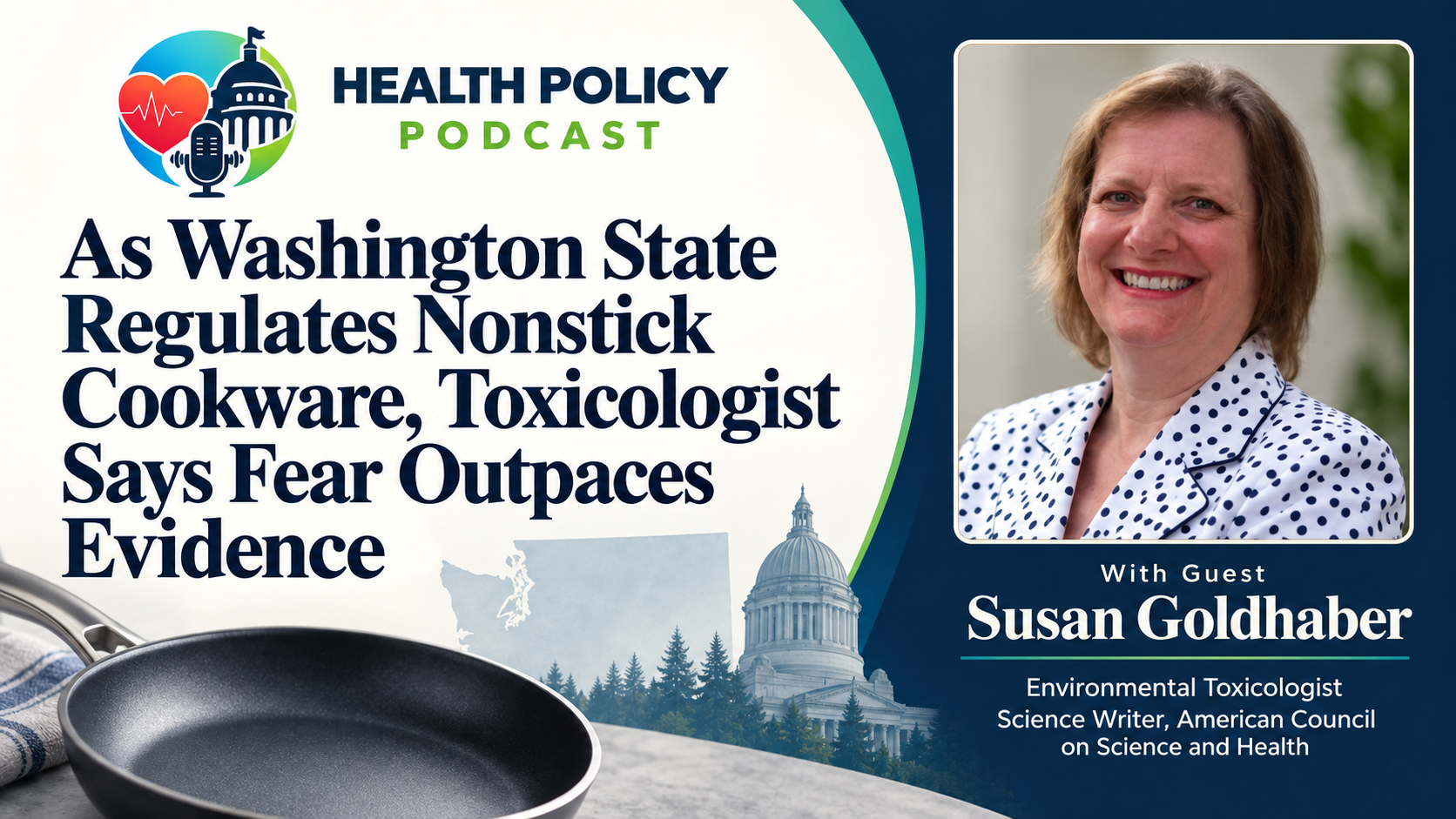
In the latest episode of the Health Policy Podcast, host Bryan Hyde interviews Susan Goldhaber, an environmental toxicologist with the American Council on Science and Health. They discuss Washington State's regulatory efforts regarding nonstick cookware and PFAS (per- and polyfluoroalkyl substances), highlighting the complexities of the chemicals involved and the ongoing debate over health risks associated with these substances. Goldhaber emphasizes that while PFAS are often labeled as "forever chemicals," the evidence linking them to serious health issues remains inconclusive.
As Washington State Regulates Nonstick Cookware, Toxicologist Says Fear Outpaces Evidence
Washington State's Nonstick Cookware Regulations Spark Debate on PFAS Safety
Washington State is moving to regulate per- and polyfluoroalkyl substances (PFAS) in nonstick cookware, a decision that has ignited a debate about the safety of these chemicals. Environmental toxicologist Susan Goldhaber, who writes for the American Council on Science and Health, discussed the implications of these regulations in a recent episode of the Health Policy Podcast.
Goldhaber has over 40 years of experience in environmental toxicology, including a decade at the U.S. Environmental Protection Agency (EPA). Her work focuses on translating complex scientific issues for the public, particularly concerning chemicals in the environment.
Washington's decision comes amid growing national concern over PFAS, often referred to as "forever chemicals" due to their persistence in the environment. These substances are prevalent in various consumer products, including nonstick cookware, food packaging, and firefighting foam.
In 2023, Washington State adopted a rule to restrict PFAS in several products, including carpets and textiles. However, the state faced pushback when it attempted to impose a complete ban on PFAS in cookware. As a result, the current regulation requires manufacturers to report the amount of PFAS in their cookware by January 31, 2027, rather than outright banning these chemicals.
Goldhaber noted that while some states, such as Vermont and Maine, have enacted outright bans on PFAS in cookware, Washington's approach reflects a compromise amid concerns about the availability of safe alternatives. "It's basically give up your pots and pans," she said, emphasizing the lack of viable substitutes for nonstick cookware.
The debate over PFAS safety is further complicated by differing opinions among stakeholders. In California, Governor Gavin Newsom vetoed a ban on PFAS in cookware, citing concerns about affordability and lobbying from prominent chefs who argue that nonstick pans are safe and practical for cooking. This decision surprised many, given California's reputation for stringent environmental regulations.
Goldhaber explained that the term "forever chemicals" is not scientifically defined but emerged from a 2018 editorial in the Washington Post. The term has since been used broadly to describe all PFAS, despite significant variations in toxicity among different compounds. She cautioned against using this label, stating that many PFAS are not as harmful as the term suggests.
When discussing the health effects of PFAS, Goldhaber emphasized the distinction between correlation and causation. While studies have linked PFAS exposure to various health issues, including kidney and liver problems, she noted that these associations often stem from animal studies rather than conclusive human research. "The evidence for an association between cancer and PFAS remains sparse," she said, highlighting the need for caution in interpreting these findings.
Goldhaber argued that the fear surrounding PFAS has outpaced the scientific evidence. She pointed out that while some PFAS compounds have been phased out due to health concerns, others remain in use and have been shown to be less toxic. She believes that the focus should be on understanding the specific risks associated with different PFAS rather than broadly vilifying all substances in this category.
As Washington State continues to navigate the complexities of PFAS regulation, the ongoing debate reflects a broader national conversation about chemical safety and public health. The state's decision to require reporting rather than banning PFAS in cookware may serve as a model for other states grappling with similar issues.
Goldhaber’s insights underscore the importance of informed discussions about chemical safety, urging policymakers and the public to consider the nuances of scientific evidence when addressing environmental health concerns.
Interview Q&A
Q&A: As Washington State Regulates Nonstick Cookware, Toxicologist Says Fear Outpaces Evidence
Health Policy Podcast Q&A: Susan Goldhaber on PFAS Regulations in Washington State
Q: Can you tell us about your background?
A: I have worked in environmental toxicology for over 40 years, including 10 years at the EPA. I have also worked for consulting firms and the state of North Carolina. Currently, I write for the American Council on Science and Health, focusing on translating scientific issues for the public.
Q: What is the current trend regarding nonstick cookware regulations in Washington State?
A: Washington State is looking to regulate nonstick cookware, particularly concerning PFAS, or per- and polyfluoroalkyl substances. The state has adopted rules to restrict PFAS in various products, including cookware, but faced pushback, leading to a requirement for manufacturers to report PFAS levels instead of an outright ban.
Q: What are PFAS, and why are they significant?
A: PFAS are a group of chemicals characterized by strong carbon-fluorine bonds, making them resistant to breakdown. They are widely used in nonstick cookware, food packaging, and other products. The definition of PFAS has expanded significantly over the years, now potentially covering over 7 million compounds.
Q: What are "forever chemicals," and do they apply to all PFAS?
A: "Forever chemicals" is not a scientific term; it originated from a 2018 editorial. It refers to the persistence of certain PFAS in the environment and human body. However, not all PFAS are equally persistent, and some can break down over time.
Q: How is Washington State's approach to PFAS in cookware different from other states?
A: While several states have enacted outright bans on PFAS in cookware, Washington State has opted for a reporting requirement. Manufacturers must report PFAS levels by January 31, 2027, after which the state will reconsider a complete ban.
Q: What happened with California's PFAS ban?
A: California initially passed a ban on PFAS in cookware, but Governor Gavin Newsom vetoed it due to affordability concerns and lobbying from chefs who argued for the safety and practicality of nonstick pans. The veto highlighted the tension between environmental groups and cookware manufacturers.
Q: Are there health effects associated with PFAS?
A: PFAS are often linked to various health issues, such as kidney and liver problems, heart disease, and cancer. However, these associations are often based on animal studies, and human studies have not consistently confirmed these links.
Q: Why is there skepticism about the health risks of PFAS?
A: Many studies show that while there may be links between PFAS and health issues, the evidence is not strong. High doses in animal studies do not necessarily translate to human health risks at environmental exposure levels, which are typically much lower.
Q: What is the significance of the terms "linked to" and "associated with" in health studies?
A: These terms indicate that while there may be some correlation observed, causation has not been established. They are often used in studies to suggest potential risks without definitive proof.
Q: How have PFAS levels in the environment and human bodies changed over time?
A: Studies indicate that PFAS levels in the U.S. population have been declining, particularly for chemicals like PFOA and PFOS, which are no longer produced in the U.S. This decline suggests that the situation is improving rather than worsening.
Q: What is the broader context of PFAS regulations across the U.S.?
A: Many states are enacting their own regulations regarding PFAS, often leading to a patchwork of laws. Some states have banned certain PFAS while exempting specific groups, such as fluoropolymers, which are considered less harmful.
Q: What should the public understand about the current discourse on PFAS?
A: The public should be aware that while PFAS are a concern, the fear surrounding them is often not matched by scientific evidence. It's important to differentiate between actual health risks and those that are overstated in media reports.
Q: What is your final takeaway regarding PFAS and public health?
A: It's essential to approach the topic of PFAS with a balanced perspective, recognizing both the potential risks and the limitations of current scientific understanding. Public discourse should be informed by evidence rather than fear.
Key takeaways
- “The term 'forever chemicals' is not a scientific or regulatory term. It came out in 2018 in a Washington Post editorial, and it was just trying to get people upset.”
- “When you look at the animal studies and then you look at the human studies, very few human studies confirm the things in animal studies.”
- “The evidence for an association between cancer and PFAS remains sparse.”
- “What you can see is that when you look at the way PFAS levels have been going down, they have vastly declined.”
- “I won't even use the term 'forever chemicals' because, number one, it's not correct, and number two, they don't last forever.”
About the guest

Writer — American Council on Science and Health
Susan Goldhaber, M.P.H., is an environmental toxicologist with over 40 years’ experience working at Federal and State agencies and in the private sector, emphasizing issues concerning chemicals in drinking water, air, and hazardous waste. Her current focus is on translating scientific data into usable information for the public.
Full transcript
Show full transcriptHide transcript
Filed under