Show full transcriptHide transcript
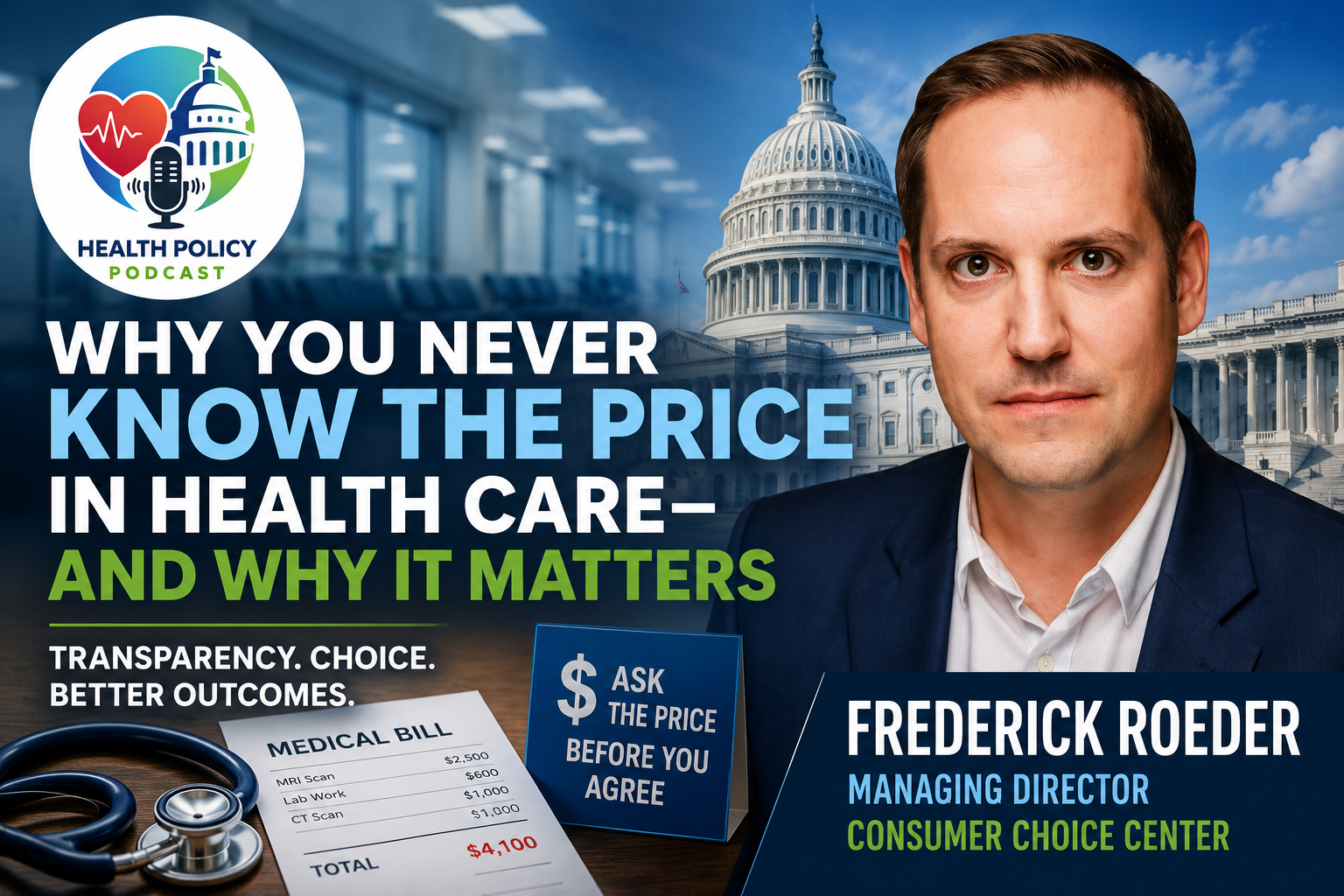
[00:00:00] Welcome to the Health Policy Podcast. I'm Brian Hyde, and today I'm joined by Frederick Roeder. I'll call him Fred. Fred is a health economist and a managing director of the Consumer Choice Center. Fred, wonderful to have you on the program. Before we dive into this topic, would you mind just telling us a little bit about yourself and about your background?
Yeah. Thank you so much for having me on the show, Brian. So, uh, I am the founder and managing director of the Consumer Choice Center, which is a global consumer advocacy group. I'm originally actually from Germany. Uh, I lived in, uh, many countries, uh, across the world and, uh, actually I studied health economics.
Uh, so I'm in health Economi. Kind of really sexy job title. Um, and no one gets enthusiastic about. But, uh, I worked in, uh, many different parts of the world and like modernizing health systems, healthcare reform, um, in North America, but also Europe, central Asia. And, um, when we started the Consumer Choice Center, which fights globally for [00:01:00] innovation and consumer advocacy, uh, we also decided to have healthcare as, uh, one of our important pillars because I mean, in the US almost every, uh, one out of $4 is being spent on healthcare.
So that's, uh, and patients should be also seen as consumers. So we try to empower patients and try to fight healthcare inflation. Sounds to me like you are the perfect guy to, to discuss the topic of why is it when, when we go to the hospital or when, when we go to, to have a particular procedure done? Why is this one of the only sectors of the economy where a person gets the service or gets the, gets whatever it is performed without ever knowing the price?
In other words, well, we have to do it then we'll tell you the price. Um, I can't think of very many other places in our lives where we would, we would make a purchase under those conditions. Yeah, I know. It's like a bit, the, the story of the person who walks into a hotel just says, I take the suite tonight.
And, uh, then checks the phone, check out what the price is, or you, and you get charged the rec [00:02:00] rate, you know, kind of this thing that's kind of. The back of the door in your hotel room, like, which is like never the price you actually end up paying. And unfortunately in the, in the most parts of the health system, there is kind of these opaque pricing and patients, consumers do not really know what the final price will be.
I mean, sometimes it's like medical emergencies or it's unclear what the, what has to be done. And it's understandable. I mean that's a bit like bringing your car to a repair shop and. You don't really know what's wrong with it, right? Uh, but, um, unfortunately in, in, um, US health system, it's even when it comes to like routine scans, you know, you want to get an MRI or, uh, literary your, your CT scan for your knee or some, uh, blood work done.
And it really depends to which hospital you go or to which healthcare provider you go, uh, what you pay. You know, if you go to the outpatient physician, it might be $500. If you go to the outpatient center of the hospital, it might be a thousand dollars. [00:03:00] And if you stay overnight in the hospital and you're inpatient and the, uh, scan you need might be two and a half thousand dollars for the same scan.
Right. And that just doesn't make sense. And, um, it's not just that this is the problem of the insurance because an average, uh, US. Patients have, uh, close to $2,000 annual deductible. Deductible is kinda the money you first have to pay before your insurance even kicks in. And then many, uh, insurance plans also have copays, so there might be a certain percentage they also have to pay themselves.
So, um, we as patients should be really interested in understanding the prices because let's say if you literally just have that one scan that year and it's. 1999, that's exactly a deductible, right? So your insurance won't help you. Um, so understanding what the price is is actually important for patients.
Um, about a third of Americans, uh, US households have experienced like medical debt. So it's actually a massive burden on [00:04:00] households and families, uh, because these are usually un unscheduled expenses and suddenly, you know, a few thousand dollars. On medical bills you have to pay for yourself are terrible financially for, for lots of families.
Um, I can tell you like one of my examples, like personal example, I went to see an endocrinologist, um, and um, the endocrinologist said. I need to do some blood work. You need to understand what's like with your thyroid and some other things. So I'm like, okay, sure. And um, all of this was like below my deductible, right?
So I knew, um, I actually will have to pay in cash. And, um, the, then she told me what the lab work would cost. It was like $600. I'm like, these are like very standard blood tests. And she said, well, you know, you can also just go somewhere else. The other lab will do it for like a hundred dollars. And I'm like, wow, yeah, I think I'll do that because this is, and she's like, oh, like your insurance will pay.
I'm like, it's not My insurance, first of all, will not pay for this [00:05:00] because it's below my deductible. Second. In the long run, if I just, if we all keep just throwing expenses on our insurance, we don't have to be surprised that premiums go up every year. Right. So because it's like, oh, someone else is going to pay for it.
Well, in the long term we're all going to pay for this, right? Um, so, um, I ended up actually getting the consultation about my endocrinologist, then scheduling a lab appointment with a third party lab, which was like a fifth of a price. Uh, and then I just emailed the lab results to the doctor and said, okay, should I take this truck?
Yes. No. And she's like, oh yeah. Yes. And it was literally the same kind of work. 'cause they use the same equipment. It's just like two different companies operating with different margins. And I was able to do this because I work in healthcare. And sort of a healthcare geek. And I don't like to overpay for things, but you cannot expect from every consumer to basically ask these critical questions.
So therefore there should be like more transparency. Consumers should be aware of these [00:06:00] differences in price and should be more empowered to go shopping around. And, um, there has been like some, some work in the past in the US to actually make hospital pricing more transparent. They're like requirements to make.
The prices and costs in hospital, like machine readable. But in the first couple of years this got introduced, Maryland, like a third of hospitals actually complied with it, and the enforcement is fairly weak. So on paper, patients have this right, and the hospitals then bury these price information somewhere in some massive spreadsheets.
So I mean, you, you cannot really read this. I, I can be read this, I'm supposed to. Uh, um, so, uh, that is definitely. Um, a problem because the hospitals basically play games, um, with, with the patients and insurance companies. Um, which yeah, again, leads like to a third of, uh, households having experienced medical debt, which is, which is not great, which is actually really bad.
And I think we should, sorry, I'm, I'm baling. No, [00:07:00] I You go ahead. I am picturing heads of people who are listening to you describe this problem right now. I'm picturing a lot of heads nodding, thoughtfully going, he is right. That's a very good description. I'm also pic picturing some hands ringing in frustration because A, as you pointed out, Fred, not many consumers know.
They could ask questions or would have a helpful person say, well, you know, you could go to another lab and, and, and get this done. Why is it that we have this disconnect where, um, people don't discover things? Uh, you know, until after the fact? We just, I guess with medicine, it seems like we're in the habit of, well, what can I do?
I really don't have any say, but it sounds like actually we do, if we were just willing to ask the right questions. Yes. And I think it goes both ways, right? So we, as consumers, patients should be more empowered to ask the questions. But on the other hand, uh, it, it's also really unethical of like healthcare providers to play these games.
Um, I mean, I have like another example. Uh, in the early nineties, there was like a program, uh, [00:08:00] drug pricing program created. It's like three 40 b, uh, which allows hospitals that provide care, uh, to, uh, vulnerable populations. You know, low income households, um, that to allow these hospitals to purchase medicines, drugs at massive discounts from the pharmaceutical companies.
So that's a great idea, right? Because I mean, these patients also have deductibles out of pocket payments, so let's. Try to get them cheaper drugs and the pharmaceutical industry will seem okay, you know, sort of means test that we are, we are in. The problem is actually the hospitals are not required to pass on these savings to the patients.
So at the end of the day, these patients who receive these discounted drugs. Pay the same sticker price as you would pay out on Beverly Hills in a hospital. Uh, and, uh, the hospitals, which are predominantly actually nonprofit organizations, these are like 5 0 1 c threes. Um, they just pocket the massive margin.
Yeah. Because they, they get these drugs that are [00:09:00] steep discount. Pocketed and there's like no accountability. They don't have to pass on these, uh, savings to patients. So patients still have to pay, like their massive deductible, they have copays with their insurance. Insurance also doesn't save on this.
Right. So it's kind of like a windfall for the hospitals where you kind of, I mean, we need hospitals. They're important, uh, like hospitals, um, to be run well. Uh, and I'm, I'm not against even hospitals making. Profits. But, um, kind of saying we treat one part of the health system where we have like insurance, pharmaceutical companies, hospitals, doctors, and one of them gets kind of this nice benefit of buying cheap and being allowed to sell expensive, what everyone else pays for it.
This is just not fair. So when, when hospitals or when people defending, you know, the, the hospital model say, well, you know, pricing is complicated. How would you respond to that? Uh, it's not that complicated. Right? Um, especially for standard procedures. So if it's [00:10:00] like about lab work, um, it, it, uh, you should at least be able to publish this on your website, what lab work costs.
And then as a patient, if you pick a hospital, you might also want to pick one that has like more competitive pricing. Because I, I had this like, I was inpatient for a few days last year with Lyme disease and I ended up in a hospital that has. Crazy high, um, uh, lab prices and I only discovered this once I got the bills and I was like, okay, most of the stuff they did was getting the antibiotics and taking my blood once a day.
Right. Um, so, um. Then I saw basically, I don't know, two thirds of this total hospital bill was just like blood work that was totally overpriced. Um, and I would be like, okay, next time I might pick a hospital with like more competitive, um, lab pricing or like blood work pricing because it's a commodity.
And if they want to charge that much, that's fine, but for that, I as a patient should know about this. And then, you know, it's like you take [00:11:00] Southwest or you fly like Delta first class, right? I mean, you, you make that decision and. If, if you want to fly Delta first class from LA to New York, fine, go for it.
But you, you want to be aware what you pay. Right? And that's a bit this problem. We just know X cost. Um, so there, there is like also when it comes to hospitals, like, um, many parts of the US have something called like a certificate of needs. Regime, which means basically that you cannot just set up a hospital in a community.
'cause it's, it's sort of self-regulated, how many hospitals you're allowed to have there. Uh, which then obviously also creates sort of this cartel of hospitals and they don't, they can actually block, uh. Challengers who actually would go in with a more transparent price structure. And you see this in outpatient care or like people with health savings accounts or direct primary care that there, you have patients that are much more cost conscious because they have a really high deductible, or they manage their health insurance more like a [00:12:00] 401k.
So you have to like withdraw money from it, but you could also keep it in your account. So that's when you start comparing. Um, so. One solution probably is to have patients being much more involved in. Understanding the prices and, um, actually benefiting from going for a more competitive price. And cheaper doesn't necessarily mean like worse quality, right?
It's just like more efficiently run or someone's margins are lower. Um, but, um, uh, it might actually mean that you don't have to max your deductible, right? Or that your insurance plan doesn't probably, premiums don't increase 10% every year, which is also a huge problem. I mean, again. You know, nearly a quarter of us, GDP is being spent on healthcare.
Um, and 15 to 30% of that, uh, so that's somewhere between four to seven and a half percent of the GDP is just administrative costs in the health system. Wow. I mean, this is insane, right? Um, and uh, part of [00:13:00] these administrative costs is also lots of so-called coders, medical coders in hospitals. Just kind of make sure to keep things complicated and max the loopholes so they can max what they can charge us patients and their insurances.
Uh, this is, this is like obviously driven by this opaque pricing and the lack of enforcement of, especially since 2021. There are like fairly clear rules that, uh, hospitals should have machine readable data and patients should have much more access to what something costs. Um, but unfortunately somehow the enforcement is not really happening.
So it, it actually it's worth for hospitals to hire like expensive admin staff to play, play these games with patients and insurances. And at the end of the day, we all pay for this. So let me ask you this, um, I think you've identified the program or the, uh, problem very, very well. What can people do? To avoid getting blindsided by a bill with, with charges that they didn't even know to ask about.
What are some of the things that, that they can do to, [00:14:00] to tip the scales in their favor in terms of some transparency in pricing. So I think we should all raise our voice and actually ask for more, uh, enforcement of, um, existing rules. For instance, the, uh, act that's in place since 2021, which is the hospital price transparency rule.
Um, that is just right now, roughly less than half of hospitals actually really comply with that. So that's something where, you know, you can write your local congressman and say, Hey, I, I, I checked hospitals in your constituency, and only half of them comply with this. And most of them who don't comply tend to be non-profit hospitals.
Somehow they get away with this, uh, which, which is like, I mean, they're supposed to like. Be a charitable organization and do good for society. So, um, they should also be held accountable by us, that they are actually violating, uh, the rule. And, um, I think the next thing is just to actually ask hospitals directly before you go there, if you can.
If it's like, [00:15:00] uh, an elective surgery or elective treatment, that means it's not urgent. Uh, and you can schedule it by actually. You know, ask three different hospitals for, for their price estimate. You know, that's like in, in procurement, that's something you do, you send out requests for proposals to different people and say, what would it cost to fix this or to buy this.
And, um, I think we as patients, especially because we have skin in the game with copays, with deductibles, with the development of our future premiums, we should, um. Uh, be much more engaged. Obviously, the moment you have transparent pricing, it would be also much easier for third party online websites to actually allow us to search, right?
I mean, we go on Google Flights or Kayak to figure out which airline or which rental car company has the best prices. And hospitals is really tricky because there's this lack of transparency, right? So getting there. Uh, would also allow us to, to actually [00:16:00] really shop for the prices and understand, um, what the cost of something is, uh, which is in our interest.
Um, so I think holding hospitals more accountable, but at the same time empowering consumers to speak up politically with their advocacy. Um, and also demanding, for instance, is discounts, right? Like, Hey, if you get these drugs cheaper, I, I want to get a cut from that. Uh, why, why, why do you just get like this, uh, windfall?
And, and I still need to pay the sticker price. Um, that, that probably would be helpful. Um, and, um, yeah, I think that would really help us to, to get, um, to a culture where patients are empowered to ask critical questions. And, um, ultimately doctors should also, and hospital administrators should go more towards this transparency model.
So if, let's just hypothetically, if someone were, were looking to, uh, to get an M-R-I-M-R-I rather, you know, um, what are the kind of [00:17:00] things they would want to specifically ask about? When they call to schedule that, um, I'm guessing the reason most people don't do it is 'cause they just don't know what they don't know, and therefore they don't know what to ask.
But when it comes down to being specific, what are some of the things that, that we need to specifically ask about to help lock in the price and leave it less, uh, shall we say, malleable. Okay, let's say you have a consultation with your physician and the physician says, okay, I don't know. You come back from a ski vacation and your knee hurts, and they're like, oh, we have to put your knee, or like an MRI, right?
Um, like I've prescribed now this MRI for you, and then you'd be like, okay, what would it cost at your clinic? Because it's a very expensive device, so it'll be expensive. You already know that there has nothing like a cheap MRI. Um, but then you should ask and then maybe even say, okay, I'll, I'll think about it if I do it yours or if I actually compare to other clinics or outpatient centers or email, hospital.
Um, and I'll go for the cheapest and then I come back [00:18:00] with the results and you can tell me what we should do. 'cause you might literally save thousands of dollars by just comparing prices. Um. And I said the average deductible is around $1,800 in the US and there are many, many patients who have much higher deductibles, like thousands of dollars.
So if you, if you save on that and that, that's probably especially for like younger patients and consumers who don't go to the doctor like too many times a year, um, then these price comparisons actually make a lot of sense. Again, we are talking with Fred Roeder. He is a health economist as well as managing director of the Consumer Choice Center.
Um, Fred, where can people find the Consumer Choice Center online? Google Consumer Choice Center, um, and you find our website, consumer choice center.org. Um, and we would, uh, be happy to be in touch with patients who would like to learn more about price, tri price transparency, and how you can actually reach out to your, um, local politicians to actually empower [00:19:00] you as a patient to, uh, compare prices in, in the health system in healthcare, and how you can avoid, uh, running up a large medical debt.
I feel empowered just from this conversation, so I think you're doing your job well and, and again, I want to thank you for joining us today on the Health Policy Podcast. Great pleasure. Thank you so much for having me.