Show full transcriptHide transcript
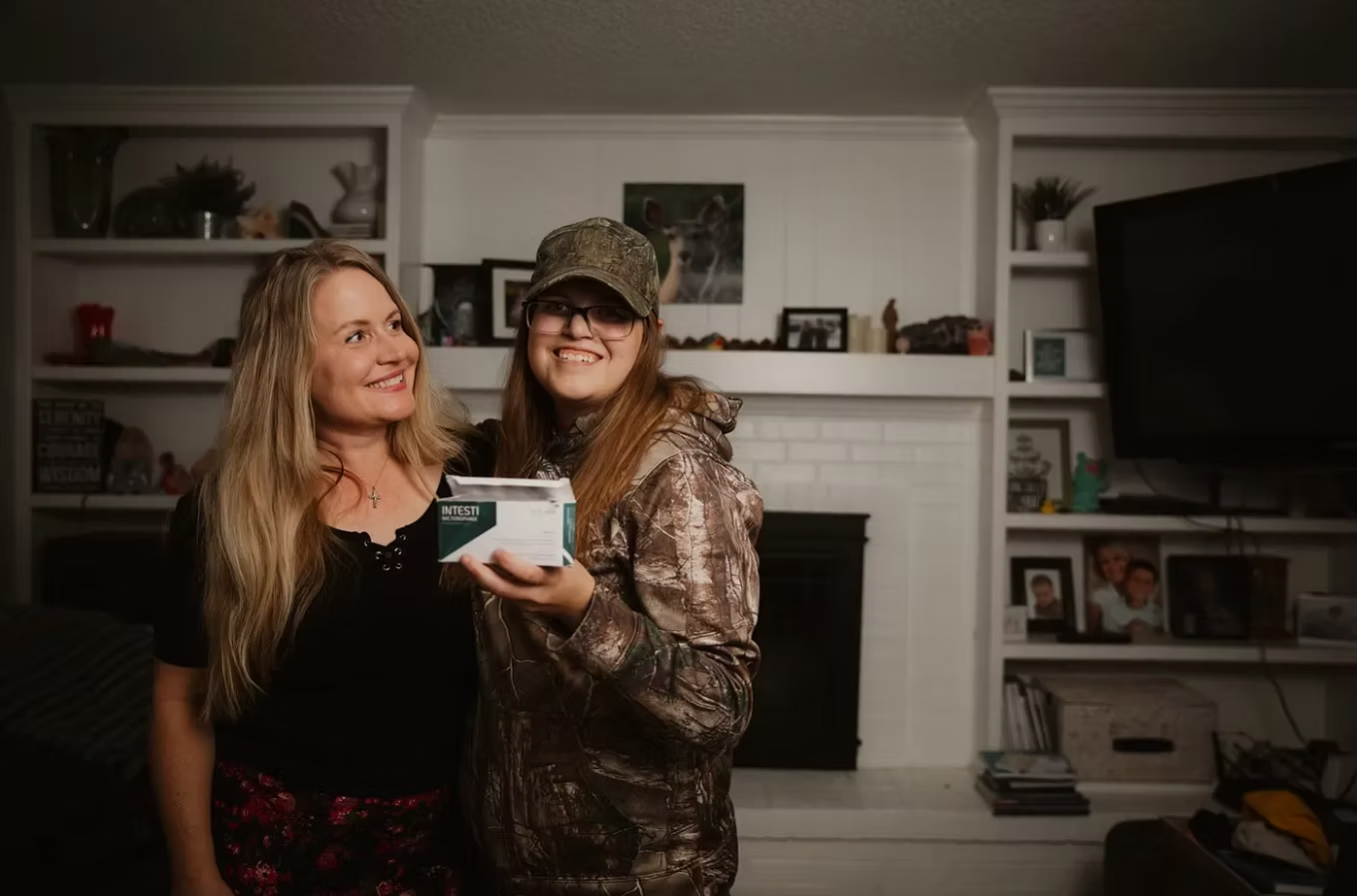
[00:00:00] Welcome to the Health Policy Podcast. I'm Brian Hyde. Today I'm joined by Maya and Jenny Reinhardt. Uh, Jenny is the mom, Maya is the daughter, and the two of you are here to talk about a really important issue involving the right to try, uh, specifically right to try 2.0. Before we get into the, the, um, policy part of this though, um, Jenny, I'm gonna ask you give us a little bit of background about you and your daughter and then, then let's talk about, uh.
About the real reason we're gathered here. So I live in Littleton and in Colorado, and, and so does Maya. She was born here in 2001, um, and she had a heart defect on cystic fibrosis. And so in 2001, people that were born with cystic fibrosis, which is a lung disease and a, a body disease that just, I impacts like your pancreas and all these different things, but lung infections will kill you.
I think her life. Expectancy was around [00:01:00] 30, and the median age of survival at that time was around 20. So it was a really serious thing. And when she was little, she looked like just a normal little kid, but she would get these lung infections. And when she got these lung infections, the antibiotics we would give her, we'd get rid of.
The lung infection. And that happened until she was around 16. She got hospitalized a couple of times, got different lung infections, and then when she was 16 she got a super bacteria, um, it was called pseudomonas. And it's just like the sheen that lives on top of water in the ponds, it's like it's nasty for people that are immune compressed.
Right? Like you and me, it wouldn't bother us. Um, but for someone with cystic fibrosis or that's immune co. You know, like she couldn't get rid of it on her own. Mm-hmm. And what had happened is we had given her antibiotics of for so many years to treat like staph and different, um, infections that she couldn't fight off herself, that the [00:02:00] antibiotics stopped working.
And so then what was happening is like she started just coughing all night. She started bleeding. Um, I took her to the hospital. They said, well, you know, you can do a month on a month off of Ciproxin. But it wasn't working. It wasn't like touching, so it was like she was sick from the antibiotics. It wasn't touching her infection.
She couldn't go to school. She was just not having any fun. And so I kept taking her back to the hospital and they said, well, we could cut open her sinuses and remove like some of this mucus. And I was just thinking like. Why would I wanna cut her open to let a super bacteria in her blood when we don't have a medicine to like.
Treat that. And so I started researching on all the, the different studies through the colleges and through all of the Facebook message boards with people with cystic fibrosis. Like how can we get rid of [00:03:00] infection? Um, and my mother actually sent me an article on a, a treatment that they had in Tbilisi, which is like Georgia, not like Peaches, Georgia, but like Orcas and other side of the world, Georgia.
Yes. And they had a treatment there to. Um, treat the antibacterial re infection, and so then I started researching like, where could I possibly get that? In Denver. And, and which was, which wasn't possible. Okay. That was my next question was, was that even possible? Now, as a parent, I can imagine your frustration, uh, Maya, tell me from, from your point of view, I mean, you, you've grown up with Yes.
Having to deal with this, this condition with the cystic fibrosis, which is no small matter. Um, what was it like for you as you were trying to find, you know, some kind of relief? For the most part, I just kinda laid around and delved into escapism. You know, I played a lot of World Warcraft, very popular video [00:04:00] game, uh, watched a lot of movies and mainly just kind of laid around.
Um, sorry, my dog is crying with that. You want me to, um, I can go put him in my son's room if you wanna pause it. No, you're good. I, I can't hear any of it, so, we'll, we'll just, we'll just edit this, this part out, but No, you're good. You're good. Yeah. So. Was, was that frustrating to, to be looking for help? I mean, um, yeah.
Did, did, did you see the frustration, you know, on, on your mom's part know, in trying to find answers mean, to answer your question about it being frustrating? Oh, absolutely. I mean, the whole family was, they didn't know what was going on, what to do really. You know, my dad was like, well just listen to the doctors and, you know, do this on and off, monthly antibiotic regimen, which was not.
Ideal. Of course, the idea then was just to slow down the infection because the pseudomonas infection is extremely aggressive. Once it takes hold, it's just an [00:05:00] exponential downfall. I mean, um, when I was born, my understanding is that, uh. My primary doctor at the time, uh, told my parents, Hey, you know, once these antibiotic resistant or Yeah, antibiotic resistant bacteria co um, colonize the lungs, then it's gave over.
So let, let me ask you this, were you able to find a treatment that actually did something for Maya's condition? Yes. Um, you know, the, the phages, it was kind of a, a last resort. Um, not only was it not FDA approved, you know, FDA approval takes billions of dollars in like 10 years. I didn't have that kind of time because my lung function was, you know, every time I went to the doctor, every two, three months, my lung function was down another 3%.
So let's, let's take one step back. 'cause I wanna make sure I understand. When you say a [00:06:00] phage. Yeah, I, I'm not fluent in medical terminology. Okay. Can you gimme a layman's description of what, what exactly is a phage? Yes. So a phage, which is a, actually, the real name is a bacterial phage. Bacterial means bacteria.
Phage in medical terms means eating. So bacterial phage is a virus that eats bacteria. They're, you know. They cannot infect human cells. They only infect bacterial cells. So basically what it does is the phage latches on to the bacteria that it's going after, injects that bacteria with DNA and that DNA basically forces that bacteria to become a phage factory and make like 40 or 60,000 different phages until the uh.
Bacterial cell literally explodes with more phages. So these things [00:07:00] very quickly propagate throughout the entire body. Um, without harming the person. Without harming exactly. No, no, no, uh, harm to humans whatsoever because bacterial phages by definition cannot infect human cells. That sounds like a pretty reasonable solution.
So now let's talk about, uh, I'm sure that, uh. You know, it was very easy to access and to get ahold of. Well, okay, I'm being sarcastic here, but what, what was it like trying to, to access that treatment? I mean, I'm not super privy to it because at the time, I mean, I was really out of it. I obviously, I was fif 15, 16 years old, uh, sick as a dog, just kinda.
Laying around waiting for the inevitable because I mean, ultimately I didn't have the energy to do much research. I didn't have the energy to go out and hunt these things down. It was really my mom that found these, so I'll let her answer that. Where did you find these, Jennifer? Well, my mother is a nurse and she sent me an article from [00:08:00] Prevention Magazine and it was entitled, if a Cure for Infection Exists, why are so many people sick?
And so I was researching it and then I, I've printed out like the government studies because you can like enter a condition and it'll go through the government studies and print out like which colleges are working on it and different things. And then, um, through my church. One of the ladies, her husband was a surgeon, and I just said like, Hey, is this a medicine?
This is a real medicine. Yes. And I'm in real estate. And so some of my clients were also in, in medicine and they're like, yes, this is a real medicine. So I was excited and I took it to Maya's doctors and I was like, look, we could do this. And they're like, this is not American. Right? Like, and the way that it worked.
In the healthcare system, and most people don't ever have to figure this out. And I hope that they don't. But like if you're sick, you think that they have the answer right? But sometimes you can get sick and they don't know. And then if it's outside of the FDA approval, they won't look at it like [00:09:00] their malpractice insurance or you know, it won't allow them to look at it.
And so I was like, there's this treatment. And they're like, well, we're not doing that. And I think that we got our chart notated for even looking at that. And then I learned like. You're not supposed to bring that up at the hospital. Um, it might, it's a little bit different now. Like I think it's getting more popular.
Mm-hmm. Um, there are cystic fibrosis clinics out there now, um, through places like National Jewish that do, um, phage treatment for specific. Infections, it's all research based and you have to be super, super sick. And it was just it. So after the hospital said no, I started scouring like the Facebook message, message boards and different things for cystic fibrosis.
I found a guy in Oregon that I tried the bio fage and then recommended a, a clinic in Oregon, um, Satya Ambrose. And so she's like a famous. Doctor and she's on the radio and she is a naturopath. And in Oregon they're allowed to [00:10:00] practice international medicine. And so then it was hard to really get ahold of her 'cause she was like on the radio, she was doing different things and um, leaving all of these messages.
And I just did this for weeks and weeks and finally she called me back and she said, yes, we'll see Maya, but you have to fly to Oregon. And Maya is like super, super sick. Yeah. Um, but. I couldn't find anybody in Denver that knew anything about this. I think they studied it like mostly in the Pacific Northwest, like Oregon and Washington.
Mm-hmm. So I guess that was the, the next big question I have. So did you have to go all the way just toe Georgia in order to get this, uh, or Thankfully no. No. Okay. But you were able, but we did have to, we did have to apply to Portland, Oregon. So. Uh, well, that's almost as far. Well, maybe not, but No, but you were able to, to access this particular kind of treatment.
So Maya, what was it like? Did, did you, did you notice an improvement after receiving the treatment? Yeah, I mean, to be honest, [00:11:00] I don't really remember it that well. But what I do remember is, so we got to Portland, you know, I'm grouchy as can be, of course. Um. But they basically told us, you know, put this bacterial phage solution in my nebulizer.
And the nebulizer is basically it mystifies, uh, medication so I could breathe it in. And, um, that's what I did. And right away it started to work and I knew it was working because I was coughing more and instead of the cough just being a cough, I was actually bringing stuff up and getting out on my system.
Within two weeks I was, my infection was basically done. There's no more, um, infection left. It was just mucus at that point. So I'm happy to hear that you were getting results, but tell me about the hoops that you had to jump through in order to [00:12:00] get that. 'cause it sounds like this took a lot of extra steps.
Yeah, again, I'm not privy to it 'cause I was, you know. A teenager, I wasn't feeling good, but I'm sure my mom knows how all of her, so steps were like, I had to do all of the research. I had to talk to doctors that would talk to me off the record. Um, then I had to find the one person in the United States that knew like, and saw patients.
Then I had to call her for like. Three or four weeks. Then I had like my little son and I'm a single parent, and so I'm like, how do I take him out of school, fly to Oregon and deal with his treatment? And then I didn't know like if I should stay in Oregon and do the treatment or not. And um, so my cousins live in Seattle, so I had to arrange, like to fly there for them to pull my son outta school, for them to watch my son and then for me and Maya to drive to, um.
Portland to get this treatment. Then we had to get it back to Denver and you have to, you know, get FDA, at that time you'd had to get FDA [00:13:00] approval. And so like, it was really, really, really hard because like even, so they're flying it from Tbilisi and then it gets. It goes through all these international co countries and then it's in Detroit and it's like getting hot in Detroit at customs.
And so I'm trying to call customs and I'm like, Hey, this is gonna die. Right? And it's just, it's so hard. And then I'm like, shipping samples of Maya mucus to Tbilisi to figure out like which bacterial phage could treat it. 'cause they, they pretest it to make sure that it works and. It was just like so hard.
And then it's like some of some people would be like, why are you giving this experimental virus to your child? And what people don't realize is like if you have somebody that's dying in your family, it's not like, Hey, this healthy person is taking this experimental treatment. It's like we know what's going to happen with pseudomonas.
We can see the pictures of like in the lab of the, her lungs literally bleeding. She's coughing up blood. [00:14:00] You know, like we're involved in the cystic fibrosis community, we know that people die as teenagers. Mm-hmm. Like, we know a hundred percent what's going to happen if we keep this pseudomonas infection.
Um, and that's what it gives me a shiver. Like, it's like, well, this, this might work, but what is the downside of it really? Mm-hmm. You know, it's just it and it, it's, it was like, um, it was like salt water. It it, well, yeah. For the downside to the phages, that's a legitimate downside is that they fish it out of the sewers, right?
That's how they get phages. But you can't purify that mixture without killing the phages. So you kind of just have to, you know, it's like eating raw cookie batter, you know, we all do it and chances are it's gonna be okay, but there's always a chance that it could go wrong. Um, it sounds like though it was [00:15:00] worth the risk and maybe the discomfort of knowing where it came from, uh, because it was actually getting you results.
And, and from here I'd like to shift to, let's apply this to Right to try. 2.0 and, and I think your, your case is a wonderful example of, of why this is something that that needs to happen. Where, where we don't make people jump through unnecessary hoops and unnecessary waiting or denials just because, you know, some official bureaucracy has yet to sign onto it.
Talk to me about what to right to try 2.0 would do for people like you. It would make things a lot faster, a lot easier, uh, without these hoops. Like I said, the FDA approval takes like 10 years and billions of dollars. I didn't have that and frankly, I was really healthy all things considered with cystic fibrosis and I didn't have that kind of time back when I was sick.
Um. And feasibly, people in my situation really don't have that time. They, they can't wait [00:16:00] around for the FDA to just do something. So at the end of the day, you kind of just have to go, uh, and do it yourself. And also like the FDA can't, it's my understanding that the FDA can't approve a thing that's alive.
Like you can't patent this. It's like its own little animal. And so there should just be. A law that says, Hey, if, if your doctor approves this and they're willing to help you. Let's go ahead and get this treatment that's individualized for you. Right? And back when Maya got the bio Fage, we had to go through the FDA and there were significant delays.
And now with this new law, you can bypass that, um, under a DA doctor's supervision. But can you imagine trying to go through the FDA, like, okay, let's take Maya's sample. Let's test it against all these bio fages. Now let's patent that bio Fage weight. It has to be synthetic. So let's, you know, spend another 10 years trying to make it synthetic.
Oh, and when it's. Synthetic, it doesn't work as good. So like this is what's happening in the trials in the United States because like [00:17:00] god in nature make things perfect sometimes. Right? Like one of my clients who was teaching me about international medicine, 'cause some of my real estate tri clients, they travel all around the world.
He said sometimes if like a tree is poisonous, the plant growing next to it is immune to that poison and that's how they find treatments. And so like it just makes sense. To find the thing that kills the bacteria in nature. Um, and so logically, that's why I think we should be able to use it because like the government shouldn't be able to say, there's this treatment, but sorry, you have to be rich to go get it.
And. By the way, if they had denied us in Oregon, we were starting to try to like learn Russian. Um, some of my friends were like, really? Ride or die? We're like, okay, what does Tbilisi look like and how much are these tickets? And like, okay, it's, you know, this amount of money, but if your kid is dying, like what would you do?
You'd sell your house, you sell your car. You know, like luckily I'm in real estate. So I could take a couple months off, right? [00:18:00] But most people can't do that. And that's where the privilege comes in of like, Hey, this treatment by the way is $90. And so for $90, does my child have to die? Because I can't access that without going on a plane and getting, you know, like learning Russian and doing all these weird things like it's so hard.
And in the meantime. I'm laying outside Maya's bedroom at night. She's coughing all night. Like, we're exhausted, right? Like, because there, when you're, when you're that sick, it's like, should I take her to the hospital? But then when I took her to the hospital, they couldn't do anything and then they sent her home.
And so it's like looping, like she's sick. There's nothing we can do. And so like the way that my mind worked was just. If I have a path, if I have a something that I can work on, I feel better, even if it's not going to work. Right? Like, and I think that taking away hope from people is not what anybody wants to do.
Like they just don't realize they're doing it, right? Mm-hmm. Like, they're like, oh, we want things to be approved. We want them to be safe. It's like, [00:19:00] okay, fine. But cystic fibrosis, pseudomonas. Not safe. Not safe. No. No. It's terrible. Like, come stay with us for a week. Right? Like it's, it's awful. My own mother wouldn't come over because like she's just coughing and coughing and sick and she's like, what am I gonna do?
Like it gets exhausting watching someone that sick. And I'm sure it was worse for you, but Well, that's why I delved into World Warcraft because I'm like, screw this, I'm just gonna sit and play video games and I'm gonna sleep, uh, sleep, all the rest of it. So one final question for you before we have to wrap things up, and that is where do you go from here?
So. Um, the bacterial phage wasn't a cure to cystic fibrosis, but what it did is it bought me enough time for the FDA to do its job. 'cause in two, two years later, um, in 2019, the FDA approved a new medicine called Tri Kafta for cystic fibrosis. And essentially what Tri Kafta does is it corrects the faulty [00:20:00] proteins caused by the faulty genes in my DNA.
So that my cells work normally and my body works normally, so I no longer get sick. Um, every now and then I test positive for pseudomonas, but it doesn't do anything to me because it's frankly, you know, for healthy people it's not a big deal. Um. And I was able, I mean, tri Kafta completely changed my life.
Um, my lung function skyrocketed. My, you know, I was super, super skinny 'cause I couldn't digest my food. All of a sudden I could digest my food and now I'm back to normal weight. Uh, my energy levels are through the roof and that all enabled me to, you know, do what I'm doing now, which is going to university for biotechnology.
Uh, so it kind of came around full circle. Um, I used to be the Guinea pig and now I get to be the Guinea pig and the scientist, and it's great. That sounds like a nice completion of the circle there and, and, and very fitting. Uh, [00:21:00] Jennifer, any final thoughts that, uh, that you would like our audience to take away from this discussion?
I would say if your, um, family member is really sick and there's not an answer in the hospital, start reading through the journals mm-hmm. And start like, help us get this law passed. The, the right to try 2.0 to bypass the FDA. Because you know, when you talk to the people in the government one by one like this, this law went through Colorado with bipartisan, unanimous support.
Like it just seems common sense. If there's a treatment, you should be able to access it. And then maybe one day. We'll have like a doctor that has an encyclopedia of, here are all the things that you can do with international medicine. Mm-hmm. And then if your family member is sick, you could just go get the treatment instead of figuring out like, travel and if it's real and which doctors are legit and, you know, like, it's, it, it's so.
Hard. Yes. Do I have to learn to speak Russian? Exactly. I I cannot speak Russian. I took [00:22:00] two, I took two semesters of Spanish. I can barely speak Spanish, so I can only imagine what Russian is like. So I want to thank both of you for, for being my guest today. Again, we're talking with Maya and Jenny Reinhardt, and thank you both for joining us on the Health Policy Podcast.
Thank you for having us.