Health Policy Podcast logo

Receive new episodes in your inbox.

← Health Policy Podcast
Medicare & Medicaid

2026-11-10 · Empower Patients Initiative

The Patient as Single Payer: Dr. Deane Waldman on Reforming Medicaid

with Deane Waldman, M.D., MBA, Chairman of Board — Empower Patients Initiative
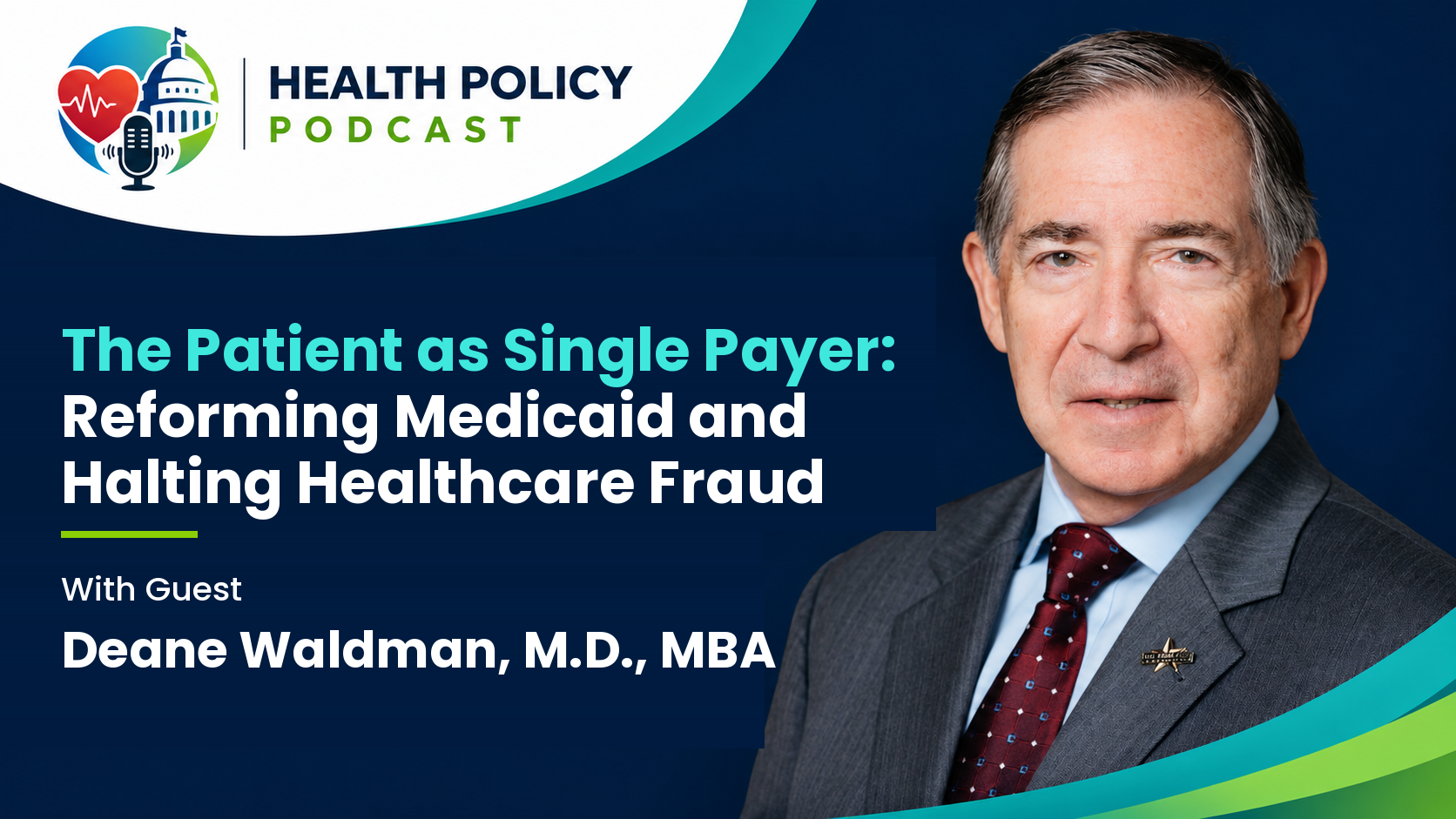
The Patient as Single Payer: Dr. Deane Waldman on Reforming Medicaid and Halting Healthcare Fraud

In the latest episode of the Health Policy Podcast, Dr. Deane Waldman discusses the implications of Medicaid reform and healthcare fraud. As Chairman of the Board at the Empower Patients Initiative, Waldman advocates for a patient-centered approach to healthcare financing, suggesting that patients should control their healthcare spending to reduce fraud and improve care. He critiques current federal policies and emphasizes the need for state-level flexibility in Medicaid management.

The Patient as Single Payer: Dr. Deane Waldman on Reforming Medicaid and Halting Healthcare Fraud

0:00 / 0:00

The Patient as Single Payer: Dr. Deane Waldman on Reforming Medicaid and Halting Healthcare Fraud

Dr. Deane Waldman Advocates for Patient-Centric Healthcare Reform

In a recent episode of the Health Policy Podcast, Dr. Deane Waldman, chairman of the board at the Empower Patients Initiative, discussed the pressing need for reform in Medicaid and the issue of healthcare fraud. Waldman, a pediatric cardiologist with a long history in medicine, emphasized that the current healthcare system is failing both patients and providers.

Waldman, who has a family legacy in medicine spanning four generations, transitioned from treating patients to advocating for systemic change. He expressed frustration over the healthcare system, stating that many healthcare professionals share similar sentiments. “I’m trying to be a physician for one patient, and that patient is our healthcare system, and it’s dying,” he said.

The conversation touched on the political landscape following the midterm elections, with Waldman predicting that Democrats would attempt to revive enhanced subsidies initially introduced during the COVID-19 pandemic. He criticized this approach, asserting that the subsidies primarily benefit able-bodied individuals rather than those who are medically needy. “We are diverting resources from the medically needy Americans to the able-bodied,” he stated.

Waldman argued that the solution lies in empowering patients to control their healthcare spending. He advocates for a system where patients are the single payers, eliminating the third-party bureaucracy that he claims leads to wasteful spending. “The politicians don’t want to give away the power that they have over healthcare,” he said. He believes that true reform will only occur when patients demand control over their healthcare dollars.

The discussion also highlighted the role of states in managing Medicaid. Waldman pointed out that states have the potential to make significant changes if they are given block grants to manage their Medicaid funds. He cited the original Medicaid legislation from 1965, which intended for states to have autonomy over their healthcare spending. “The states should decide how to take care of their medically needy individuals,” he said.

Waldman also addressed the issue of healthcare fraud, particularly in states like Minnesota and California. He noted that fraud can take many forms, from private citizens posing as legitimate providers to state governments misappropriating funds. He emphasized the broader implications of fraud, stating that it deprives vulnerable populations of essential services. “When it got stolen, yes, money got stolen, and that’s a bad thing and it’s illegal and it’s wrong. But worse, children went hungry,” he said.

To combat fraud, Waldman proposed a system where patients have direct control over their healthcare funds, thereby reducing opportunities for fraud. He believes that if patients manage their own healthcare spending, the incidence of fraud would significantly decrease. “If we had the Empower Patients Initiative, the only people who would have control of the money would be the patients,” he said.

Waldman concluded by urging individuals to take an active role in advocating for their healthcare rights. He encourages people to educate themselves about their options and to demand accountability from both political parties. “It’s you, the American people, who need to stand up and say to Washington, we want to control our healthcare dollars,” he said.

The Empower Patients Initiative aims to provide a framework for patients to navigate their healthcare choices effectively. Waldman’s book, "Become an Empowered Patient," serves as a resource for individuals looking to understand their rights and options within the healthcare system.

As discussions around healthcare reform continue, Waldman’s insights highlight the need for a fundamental shift in how healthcare is managed and funded in the United States.

Interview Q&A

Q&A: The Patient as Single Payer: Dr. Deane Waldman on Reforming Medicaid and Halting Healthcare Fraud

Health Policy Podcast: Q&A with Dr. Deane Waldman

Q: Can you tell us about your background?

A: I come from a family of doctors spanning four generations. I trained as a pediatric cardiologist and served as chief of cardiology. However, I became frustrated with the healthcare system, which led me to research and develop solutions to improve it.

Q: What changes do you anticipate in healthcare with the recent midterm elections?

A: The Democrats are likely to try to resurrect the enhanced subsidies that were introduced during the COVID pandemic. This approach is misguided as it diverts resources from those who are medically needy to able-bodied individuals who do not require Medicaid.

Q: What is the impact of enhanced subsidies on Medicaid?

A: Between 2020 and 2022, 20 million Americans enrolled in Medicaid due to enhanced subsidies. Many of these individuals are now back at work and eligible for employer-sponsored insurance but remain on Medicaid because it costs them nothing.

Q: What do you mean by the patient as the single payer?

A: Patients should control their healthcare spending instead of third parties. This would reduce wasteful spending and empower patients to make informed choices about their healthcare.

Q: How can states play a role in healthcare reform?

A: States should have the authority to manage their Medicaid budgets through block grants. This would allow them to tailor their healthcare solutions to meet the unique needs of their populations.

Q: What issues have states like Minnesota and California faced regarding healthcare fraud?

A: Minnesota experienced fraud involving private citizens posing as legitimate payers, while California's fraud was perpetrated by the state government itself, which misappropriated Medicaid funds through a tax scheme.

Q: How does healthcare fraud affect patients?

A: Fraud diverts funds intended for patient care, resulting in negative outcomes for vulnerable populations, such as hungry children and seniors unable to access necessary medical services.

Q: What solutions do you propose to combat healthcare fraud?

A: By giving patients control over their healthcare spending, we can eliminate opportunities for fraud. If patients manage their own funds, there would be no third parties to exploit the system.

Q: Where can people learn more about the Empower Patients Initiative?

A: The Empower Patients Initiative can be found on the Americans for Tax Reform website. The book "Become an Empowered Patient" is also available for those looking for a more accessible explanation of the initiative.

Q: How can patients effectively manage their healthcare spending?

A: Patients are often resourceful shoppers, especially when managing limited funds. They can inquire about prices, wait times, and provider success rates, which encourages transparency and competition among healthcare providers.

Q: What is the ultimate goal of the Empower Patients Initiative?

A: The initiative aims to provide necessary care without financial burden while also preventing fraud. It empowers patients to take charge of their healthcare decisions and spending.

Q: What message do you want to convey to patients regarding healthcare control?

A: Patients need to advocate for control over their healthcare dollars. They should demand the ability to shop for their medical care just as they do for other services.

Key takeaways

  • “I mean, we are doing God's work if you're a religious person, or let's just call it noble work.”
  • “The politicians...don't wanna give away the power that they have over healthcare.”
  • “You can say to this doctor, okay, what's your price? And how long do I have to wait?”
  • “We are taking money away from the medically needy Americans to the able-bodied. This is wrong on so many levels.”
  • “If we had the Empower Patients Initiative, the only people who would have control of the money would be the patients.”
  • “The doctors will either compete or they won't have patients.”

About the guest

Deane Waldman, M.D., MBA

Chairman of Board — Empower Patients Initiative

Full transcript

Show full transcript
[00:00] Bryan Hyde: Welcome to the Health Policy Podcast. I'm Brian Hyde, and my guest is Dr. Dean Waldman, Chairman of the Board at Empower Patients Initiative, and also the author of the book titled Become an Empowered Patient. Now, you also have a lot of other history, and welcome back to the program, by the way, Dr. Dean. Take a moment for those who are meeting you for the first time to tell us just a little bit about your background. [00:22] Dr. Deane Waldman: My background is, given the fact of my age, there's a lot to tell, but I can summarize it by saying I come from a family of doctors, literally everybody for the last 4 generations. I went to all the right schools and got really great training and became a pediatric cardiologist. I loved taking care of the kids. The kids seemed to like me. And to make a long, painful story short, I mean, chief of cardiology, this and that, I was unhappy professionally. I kept being frustrated and I didn't know why. And when I started to look around and talk to my colleagues, it became clear to me that everybody else felt exactly the same way. The nurses and the doctors had this sort of frustration with our work. I mean, we are doing God's work if you're a religious person, or let's just call it noble work. But it's something special about taking, in my case, a baby who's got a big hole in his heart and is gonna die, and we fix him, and then he ends up being Normal, healthy little person and grows up to be a productive adult. That's pretty amazing. So why was I so frustrated? Long, long story short, did research to try and figure out what the hell's going on. Found out what was really wrong with healthcare, including why doctors and nurses were leaving, why we're all so frustrated, which we can talk about. now or another time, and developed with a PhD economist a way to solve this problem. And the whole reason I'm telling you this long story is that now, instead of trying to take care of babies with heart problems, I'm trying to be a physician for one patient, and that patient is our healthcare system, and it's dying. [02:23] Bryan Hyde: Well, the midterm elections have come and gone, and there's been some tectonic shifts in terms of who will be in charge come January. Let's talk a little bit about healthcare as it pertains to what federal lawmakers have been— I was gonna say doing, but in many cases, I think it may have been promising and haven't yet got around to doing. And then let's talk about what's likely to happen with the upcoming shift. [02:50] Dr. Deane Waldman: Unfortunately, I will— let me answer your question. It is very likely that the Democrats are going to feel very emboldened and certainly are empowered at present on the congressional side, on the legislative side. So they're almost certainly going to try and resurrect The subsidies that were passed during the COVID pandemic. This, of course, is a mistake because the whole reason for the— let me backtrack for a second. We've had subsidies for the medically needy since the Affordable Care Act was passed in 2010 and was actually implemented in 2014. Point is, we've had subsidies all that time. The enhanced subsidies, which is what people are talking about, which caused the shutdown back in 2023, or at least was the justification for the shutdown. Those are enhanced subsidies, meaning the eligibility to get them dropped dramatically. The amount of money you got increased dramatically. And the whole reason for it The rationale for it was that literally millions of Americans got thrown out of work by the lockdowns. We had to, and then, you know, they lost their job, they lost their employer-supported insurance, they also lost their income. So we gotta do something for them. So, and these are mostly able-bodied, not the medically needy, because they're the workers that got thrown out of work. Okay. Between 2020 and 2022, 20— repeat, 20 million Americans came on the Medicaid rolls. [04:52] Bryan Hyde: Wow. [04:53] Dr. Deane Waldman: Okay. A huge expense. Okay. According to the Bureau of Labor— and they got on because of and got paid by the enhanced subsidies. Okay. According to the Bureau of Labor Statistics, more than 64% of the people who were thrown out of work are back now at work and therefore eligible for employer-sponsored healthcare policy insurance. But they have to have a— they pay a share of that. They don't pay anything for Medicaid. So all of those— not all of them, many of those millions of people stayed on Medicaid. Why am I saying this? Because, A, the Medicaid cuts that Trump administration wants to do are those people who shouldn't be on Medicaid in the first place. B, the last thing we need to do is spend more money on enhanced subsidies because that's going to people who don't need it, who aren't medically needy. We are taking money away from— we are diverting resources from the medically needy Americans to the able-bodied. This is wrong on so many levels. So the bottom line is they're probably going to try and push Those— stop the Medicaid cuts and start— restart the subsidies. The Democrats want to do that because it sounds good. It sounds like we're doing something about unaffordability. But the trouble is, that's very sort of— it's a good soundbite and it's a great optic, but it doesn't Do anything for we the people. [06:56] Bryan Hyde: I think the last time we talked, you had mentioned there should be single-payer healthcare, but it should be the patient who should be the single payer. It sounds like we, we're gonna be moving away from that possibility. [07:07] Dr. Deane Waldman: The politicians, notice I'm not saying which party, the politicians don't wanna give away the power that they have over healthcare. Now they fancy it up with all sorts of words, but the bottom line is, Both sides of the aisle will resist what we should be doing, which I said in the previous podcast, and I'm gonna say again, which is the patients should be in charge of their healthcare spending, not a third party. And there are a whole bunch of reasons why that works for the patients, that gets rid of a huge amount, trillions, of dollars of wasteful spending on bureaucracy. But that will never happen unless we the people, I like to call us we the patients, we the people rise up and say, excuse me, it's my money that you are spending on yourself a lot. I don't like that. I wanna decide what doctor I see, when I get seen, What surgery, who operates on me. I don't want the cheapest surgeon. I want the guy with the best results. And I wanna see the results of those 3 people that are on the panel, okay? Because then I wanna be able to choose. Well, you can't do any of that unless you control the money. So will that happen? Not until there is a huge groundswell from from our people. By our people, I mean we the patients. It won't happen. And so the Democrats will, you know, now they're in power, they're going to say, oh, we're going to fix the unaffordability. But what they're really going to do is increase the spending of taxpayer dollars to make it look like it's costing you less because you don't see it In a bill, an insurance bill, for instance, you don't see it, but the fact is you're going to pay more taxes. [09:18] Bryan Hyde: So what about the role of states? I know that we had, we had touched on that before. [09:25] Dr. Deane Waldman: That is a very interesting subject. And frankly, I tried to do things here in Texas when I was the director of healthcare policy. There is a— the states could do something really powerful. They have a problem because Washington still controls those purse strings for Medicaid. I'm talking specifically Medicaid. If you go back to the original, and I'm going to answer your question with a real answer, which is block grants. If you go back to the original Medicaid legislation, 1965, Section 1801 says— the title of it is, and I quote, Prohibition Against Any Federal Interference. The law was intended for the federal government to give a certain amount of money to the states and for each state to decide how that money should be spent, how resources should be apportioned for their medically needy people, who should be on the eligibility rolls, should there be work requirements or not. That should be a state decision, not a federal decision. And so Montana might want to do one thing and Rhode Island might want to do another. I picked those 2 states because They— it's one size fits all. The rules for Rhode Island are the same as the rules for Montana. Yet Rhode Island has got 1,200 square miles and Montana has 145,000 square miles. Montana has no trauma center closer than 8 hours away, level 1 trauma center in Salt Lake City. You know, in Rhode Island, you can go to 3 of the most famous world-class trauma centers on the planet in less than 45 minutes. Bottom line is the states should decide how to take care of their medically needy individuals. And so what the states should do is— and I'm saying all of them, all of the states should say to the government, we want block grants, give us a certain amount of money. Well, we'll take care of our people. We'll do it a hell of a lot better than you can do it and get out of our business. And by the way, we don't want to pay all that money for that regulatory compliance, for all those reviews, for all of those things that don't help the patients. [12:09] Bryan Hyde: Dr. Dean, I know that I would love to see the states much more in the driver's seat. And at the same time, I'm looking at states like Minnesota and California and realizing they had to deal with a pretty fair amount of healthcare fraud in the near past. Let's address that and talk about the extent to which, you know, that kind of fraud has been uncovered and what needs to be done to nip that in the bud. [12:38] Dr. Deane Waldman: That's a big topic. It has gotten a fair amount of play in the press, but in my opinion, not enough Because while they're talking, they keep talking all the time. We talk about money, and I'm not saying money isn't important, but remember that that money was intended to provide care for people who needed it. And when it got stolen, yes, money got stolen, and that's a bad thing and it's illegal and it's wrong. But worse, children went hungry. Autistic children didn't get their counseling. Seniors who were relatively immobile couldn't get to the doctor because the transportation wasn't provided, etc., etc. When you're talking about just one program, Feeding Our Future, $254 million worth of nutrition didn't go to Minnesota children. Okay. I mean, I look at— I look at the end of this thing and go, we have to do something about this. Now you're saying, what should we do? The 2 states you mentioned, which are the 2 most prominent in the, in the news, are very different because Minnesota was a private citizen. Now, it's true that it was essentially One immigrant group. It was from Somali, and so we get into the whole you know Islamophobia, racism, whatever, which I don't want to go into because this isn't a racist remark of mine. It's just a fact. The whole thing was structured by and run by Somalis anyway, but it was private citizens who stole this money. By posing as legitimate third-party payers, except that they weren't. They were just taking the money for themselves and not providing the goods and services. California passed a law. It was the state government that stole all that money. Guess the latest estimate according to Brian Blaze at at Paragon. $19 billion of Medicaid money was taken through this tax scam. What they did was they added a tax onto the Medicaid providers. They then turned around and therefore their Medicaid budget increased by, let's say, $19 billion, in which case the federal government, through the matching program, had to give the state $19 more billion of taxpayer money. And then the state of California basically did what the hell it wanted with that money and didn't use it for Medicaid. So while the fraud was through the third-party payment structure, In California's case, it was actually the state government that did it. In Minnesota's case and in most of the other states, it was private citizens who did it. So again, I'm sorry to be so long-winded, but healthcare has become so complex that I need to give all this detail. How do you solve this? Well, you can try and get really great oversight, but when you're talking about last year, It was $693 billion was the Medicaid budget. And if you're going to have enough overseers to see where all that money, that's $700 billion this year, it's estimated to be close to $900 billion. You're going to spend more money overseeing than you are actually providing or doubling it. The solution, in a sense, is really— I said before we started this, Podcast, I I mentioned to you that our Empower Patients initiative, which is in that book Become an Empowered Patient, was written intending solely to provide the care that people need when they need it without going broke. It didn't occur to us when we were designing it that it also stops medical fraud. Now let's think about it for a second. All of the medical fraud, whether it was California or it was Minnesota, was done because a third party had access to the money. And instead of spending it on people, they spent it on themselves. If we had the Empower Patients Initiative, the only people who would have control of the money would be the patients. There'd be no third party that could steal your money. So medical fraud would essentially be gone simply by that one step of giving the patients control of the spending, including Medicaid patients. And there is a good way to do that. It's in the book. As a matter of fact, we did a financial model of this in the paper because it's also the position of Americans for Tax Reform showing how that would work, that you could actually have Medicaid patients have their own HSAs and be in charge of their own money. No third party. [18:22] Bryan Hyde: And where can people find the Empower Patients Initiative website? [18:28] Dr. Deane Waldman: Real simple. Real simple. You know, if you want— if you want to read the sort of more academic financial one, If you're into that, go to the website of Americans for Tax Reform and it's right there. It's called the Empower Patients Initiative. You can read if you're not— if you don't have an accounting degree, you probably should read the book, which is called Become an Empowered Patient. And we wrote it literally for the average person, the average American, not for other people with MDs, PhDs, MBAs. and so forth, because it's you, the American people, who need to stand up and say to Washington, both parties, Washington, we need to say, no, we wanna control our healthcare dollars. We shop for everything else. Isn't that another argument that I have to share with you for a second? People have said, well, you know, the poor, they don't, they're not as educated as, you know, we elites. and they won't know how to shop for medical care. And I turn around and say, if you are living at the poverty line, you are one of the best shoppers in the world. Mm-hmm. Because you're surviving on a hell of a lot less money than I'm surviving on. And you're very careful with your shopping. And I'm sure you can, when you have a limited amount of resources like everybody does, You can say to this doctor, okay, what's your price? And how long do I have to wait? And if it's a surgeon, how many have you done? And what are your results? And the ones that don't share their data won't have patients. It's that simple when the patients are in control of the money. The doctors will either compete or they won't have patients. [20:22] Bryan Hyde: Thank you again. We've been talking with Dr. Dean Waldman. He is the author of Become an Empowered Patient and also chairman of the board of the Empowered Patients Initiative. Dr. Dean, I'm looking forward to our next conversation. Thank you for joining us on the Health Policy Podcast. [20:36] Dr. Deane Waldman: You have a great day.

Filed under