2026-08-13 · Taxpayers Protection Alliance
The War on Nonstick Cookware: Why Washington State Regulators Are Targeting Your Cookware
with Ross Marchand, Executive Director — Taxpayers Protection Alliance
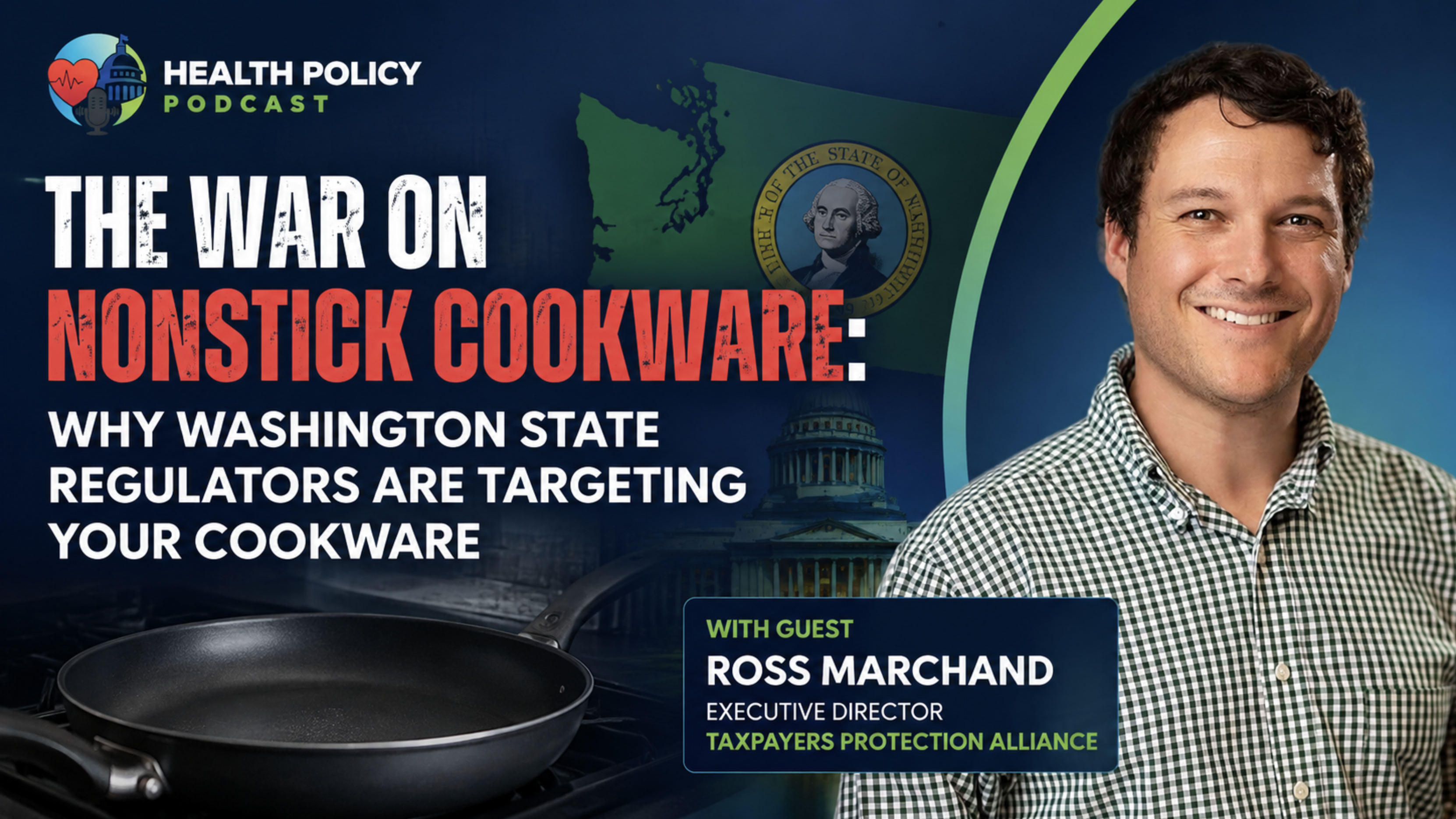
In the latest episode of the Health Policy Podcast, Ross Marchand, Executive Director of the Taxpayers Protection Alliance, discusses Washington State's regulatory efforts targeting nonstick cookware. Marchand discusses the potential impacts of these regulations on consumer costs and safety, arguing that existing studies show Teflon is safe for household use. He warns that if these regulations lead to bans, consumers may face higher prices and fewer options for cookware.
The War on Nonstick Cookware: Why Washington State Regulators Are Targeting Your Cookware
Washington State Targets Nonstick Cookware Amid Health Concerns
Washington State regulators are taking significant steps to restrict nonstick cookware, including Teflon products, due to environmental and health concerns. Ross Marchand, Executive Director of the Taxpayers Protection Alliance, discussed these developments in a recent episode of the Health Policy Podcast.
Marchand highlighted that millions of households in Washington and across the United States rely on nonstick cookware for convenience. He noted that the average price of nonstick pans has dramatically decreased from approximately $70 in the 1960s to around $25 today. However, he expressed concern that bureaucratic efforts to regulate these products could lead to increased costs and potential bans.
The proposed regulations are part of a broader trend, according to Marchand. He stated that regulatory bodies often begin with extensive reporting requirements, which can create a burden on manufacturers and ultimately lead to higher prices for consumers. "Bureaucrats just have this in their crosshairs and they're targeting this," Marchand said, referring to the push against nonstick cookware.
The safety of Teflon, or polytetrafluoroethylene (PTFE), has come under scrutiny. Marchand argued that the technology has improved significantly over the years, making it safer for household use. He emphasized that there is no substantial evidence linking Teflon to adverse health effects when used as intended. "The overwhelming array of evidence is that these products are safe for households," he said.
Despite the lack of evidence supporting the claims against nonstick cookware, Marchand pointed out that policymakers often rely on environmental concerns to justify their actions. He mentioned that many of these initiatives originate from California, which has a history of stringent regulations on consumer products. Washington's approach, he noted, could set a precedent for other states to follow.
Marchand warned that if Washington's regulations progress to outright bans by 2028, consumers could face significant financial impacts. He urged listeners to advocate against these policies, stating that it is crucial for taxpayers to voice their concerns about the increasing costs of everyday products.
The Taxpayers Protection Alliance is actively monitoring these developments. Marchand explained that the organization aims to hold regulators accountable and to prevent policies that disproportionately burden consumers. "We will fight these proposals tooth and nail," he said.
As the conversation around nonstick cookware continues, Marchand emphasized the importance of understanding the implications of such regulations. He encouraged consumers to educate themselves about the products they use and to recognize the potential consequences of overregulation.
For more information on the Taxpayers Protection Alliance and their efforts to address these issues, visit their website at protectingtaxpayers.org.
Interview Q&A
Q&A: The War on Nonstick Cookware: Why Washington State Regulators Are Targeting Your Cookware
The War on Nonstick Cookware: Why Washington State Regulators Are Targeting Your Cookware
Q: Who is Ross Marchand?
A: Ross Marchand is the Executive Director of the Taxpayers Protection Alliance, a nonpartisan nonprofit focused on holding bureaucrats accountable and analyzing government actions that raise costs for taxpayers and consumers.
Q: What is the current issue regarding cookware in Washington State?
A: Washington State regulators are taking proactive measures to restrict nonstick cookware, particularly Teflon, citing safety and environmental concerns. This is part of a broader trend affecting cookware across the country.
Q: How common is the use of nonstick cookware among households?
A: The vast majority of households in Washington and across the country use nonstick cookware, such as Teflon, due to its convenience and cost-effectiveness. The price of nonstick pans has significantly decreased over the years.
Q: What are the potential consequences of the proposed regulations on cookware?
A: The proposed regulations could lead to increased compliance costs for manufacturers, which would ultimately be passed on to consumers. There is a concern that these regulations may lead to outright bans on nonstick cookware by 2028.
Q: How safe is Teflon, or PTFE, as a cooking material?
A: Teflon, or PTFE, has a safety profile that has improved over the years. Current evidence suggests that ordinary use of Teflon products does not pose adverse health impacts, despite ongoing concerns from some environmental advocates.
Q: What is driving the regulatory push against nonstick cookware?
A: The regulatory push is largely influenced by environmental concerns and safety studies that have not substantiated claims of harm from Teflon. The movement often originates from states like California, which sets precedents for other states, including Washington.
Q: Is Washington State leading the way in these regulatory efforts?
A: Yes, Washington State is seen as a leader in these regulatory efforts, with other states like Maine and Minnesota also considering similar restrictions. The trend reflects a growing focus on health and environmental issues related to consumer products.
Q: What actions can consumers take in response to these regulations?
A: Consumers can voice their concerns to policymakers, educate themselves about the implications of these regulations, and advocate for the continued availability of nonstick cookware. There is still time to influence the regulatory process.
Q: How does the Taxpayers Protection Alliance approach these issues?
A: The Taxpayers Protection Alliance identifies problematic regulatory proposals across the country and actively fights against them to protect taxpayers and consumers from increased costs and restrictions.
Q: What are the broader implications of overregulation in consumer products?
A: Overregulation can lead to higher prices and reduced product availability, impacting affordability for consumers. It can also create unintended consequences that affect the overall market and consumer choice.
Q: What should consumers understand about the acronyms like PTFE and PFAS?
A: Consumers should recognize that PTFE refers to Teflon, a common nonstick coating, while PFAS is a broader category of chemicals. Understanding these terms can help consumers navigate discussions about cookware safety and regulations.
Q: Where can consumers learn more about the Taxpayers Protection Alliance?
A: Consumers can visit the Taxpayers Protection Alliance website at protectingtaxpayers.org for more information on their initiatives and advocacy efforts.
Q: Is cast iron cookware considered safe?
A: Cast iron cookware is generally safe, but it may require more cooking oil or spray to prevent sticking. However, consumers should also be aware of any safety warnings that may apply to various cookware materials.
Key takeaways
- “The overwhelming array of evidence is that these products are safe for households, and 80% of households across the country use these products.”
- “Bureaucrats just have this in their crosshairs and they're targeting this and they're saying that it's not safe, that it has environmental impacts, and it's just not the case.”
- “These justifications, they very rarely— excuse my pun here— they very rarely pan out.”
- “It's deeply unfair and it's unsustainable to hike the prices on all of these products.”
- “It's really important to understand, you know, it's Teflon, it's nonstick, you know, cooking products, and this impacts all of us.”
About the guest

Executive Director — Taxpayers Protection Alliance
Ross Marchand is Executive Director of TPA. Ross is an alumnus of the Mercatus Center MA Fellowship at George Mason University and a graduate of the University of Virginia School of Law. He has worked on a variety of legal matters, including the Alaska-Hawaiian airline merger and the United States Postal Service v. Konan Supreme Court case. He has also authored policy briefs on a variety of issues, including multiple analyses on the legal and policy issues facing the Food and Drug Administration. His work has appeared in numerous publications including The Wall Street Journal, National Review, Forbes, The Denver Post, and the Washington Examiner.
Full transcript
Show full transcriptHide transcript
Filed under