· The Health Policy Podcast
Health Policy Podcast logo

Receive new episodes in your inbox.

← Health Policy Podcast

2026-10-06 · Institute for Women's Health

Dr. Alma Golden on Transforming Global Health Strategy Beyond Politics

with Dr. Alma Golden, Global Health Consultant — Institute for Women's Health
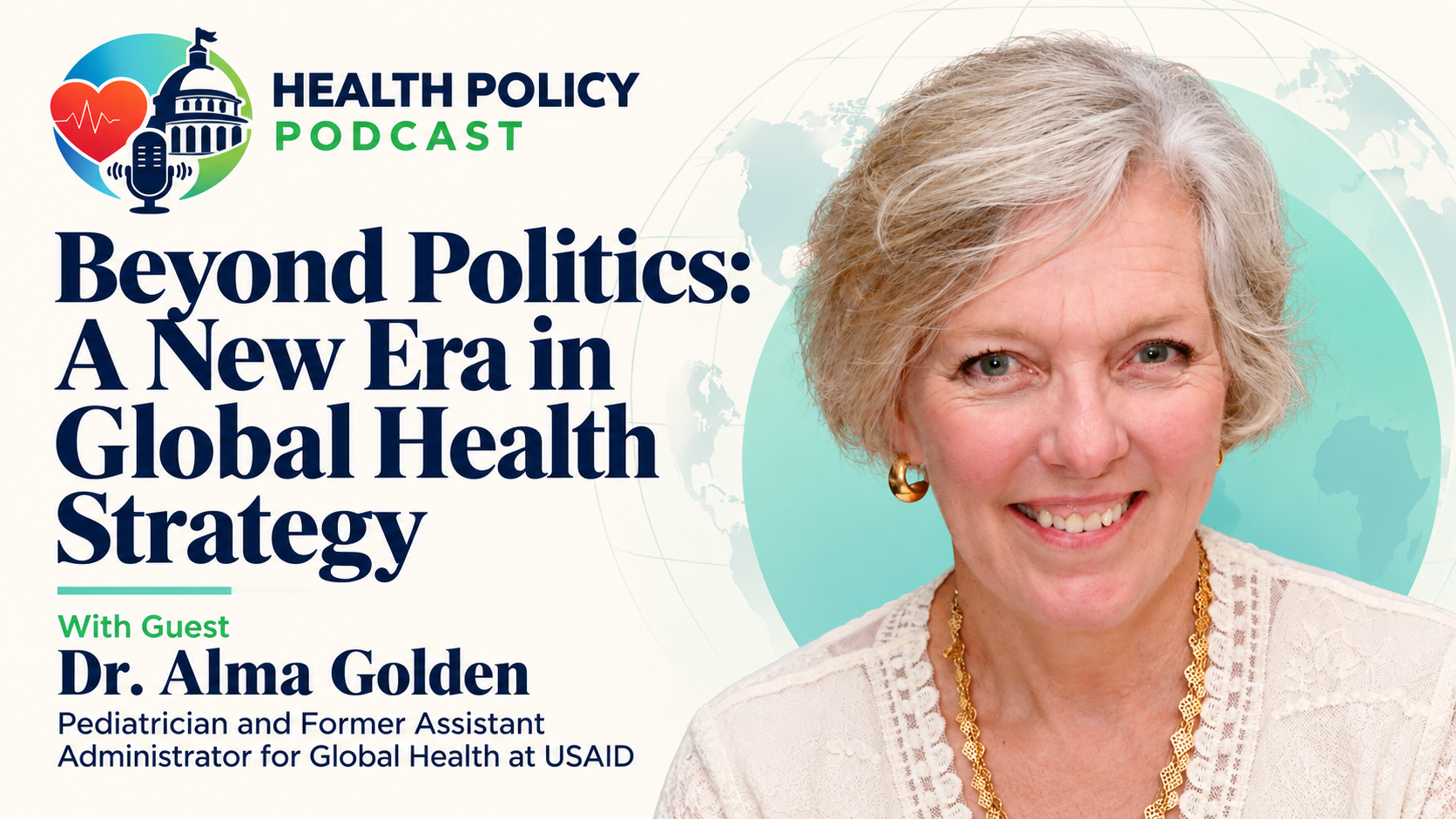
Health Policy Podcast episode featuring Dr. Alma Golden discussing Dr. Alma Golden on Transforming Global Health Strategy Beyond Politics

In the latest episode of the Health Policy Podcast, host Bryan Hyde interviews Dr. Alma Golden, a global health consultant and former USAID official. They discuss the evolution of global health strategy under the Trump administration, focusing on the Geneva Consensus Declaration and the shift towards bilateral agreements that respect the sovereignty of nations. Dr. Golden emphasizes the importance of family in health outcomes and the need for integrated care without ideological strings attached to funding.

Beyond Politics: A New Era in Global Health Strategy

0:00 / 0:00

Beyond Politics: A New Era in Global Health Strategy

Dr. Alma Golden Discusses New Era in Global Health Strategy

In a recent episode of the Health Policy Podcast, Dr. Alma Golden, a global health consultant at the Institute for Women's Health and former Assistant Administrator for the Bureau for Global Health at USAID, discussed the evolving landscape of global health strategy. The conversation, hosted by Bryan Hyde, centered on the intersection of politics and practical health initiatives, particularly under the current America First approach.

Dr. Golden, a pediatrician with extensive experience in public health, emphasized the importance of addressing global health issues without political strings attached. She noted that while the United States has historically approached global health with compassion, there have been instances where funding was tied to mandates that did not align with the priorities of recipient countries.

"Some groups would offer to give money as long as you would provide abortions in the country," Dr. Golden explained, highlighting a common issue in international health funding. She stressed the need for a more respectful approach that recognizes the sovereignty of nations and their unique healthcare needs.

Focus Areas of Global Health Strategy

Dr. Golden identified several key areas of focus within the current global health strategy, particularly maternal and child health. She pointed to successful initiatives that promote training for midwives, prenatal care, and access to essential vaccines. However, she also noted that past funding practices often imposed conditions that were not culturally appropriate or welcomed by the countries receiving aid.

The shift towards bilateral agreements, as opposed to funding through non-governmental organizations (NGOs), represents a significant change in strategy. This approach allows countries to determine their healthcare priorities without external mandates. Dr. Golden remarked, "We're looking for localization of care, and respecting their priorities."

The Geneva Consensus Declaration

A pivotal aspect of this new strategy is the Geneva Consensus Declaration, which Dr. Golden helped develop during her tenure in the Trump administration. The declaration aims to empower countries to take responsibility for their health systems without ideological conditions attached to funding.

Initially signed by 34 countries, the declaration has since grown to include 41 nations. Dr. Golden noted that countries have expressed a desire for integrated healthcare systems that address multiple health issues simultaneously, rather than fragmented approaches that separate services.

"Countries were often offended by the way the U.S. gave money," she said, explaining that many nations felt undermined by the conditions placed on aid. The Geneva Consensus Declaration seeks to rectify this by promoting a partnership model that respects national sovereignty.

Successes and Future Outlook

Dr. Golden highlighted the successes of the Geneva Consensus Declaration, including annual gatherings that foster collaboration among participating countries. These events have seen increasing participation, indicating a growing commitment to the principles outlined in the declaration.

One notable achievement has been the development of a curriculum for sex education that aligns with culturally appropriate values. Additionally, the Institute for Women's Health has created a women's optimal health framework to support comprehensive healthcare for women and families.

Despite the progress made, Dr. Golden acknowledged the potential for political shifts to impact these initiatives. "The political winds can blow very, very strongly," she said. However, she remains optimistic that the partnerships formed through this strategy can lead to lasting improvements in global health.

Dr. Golden concluded by underscoring the importance of family in health outcomes. "The family is the first healthcare system," she stated, emphasizing that supportive family structures can significantly enhance maternal and child health.

As global health strategies continue to evolve, the focus on collaboration and respect for national priorities may pave the way for more effective and sustainable healthcare solutions worldwide.

Interview Q&A

Q&A: Beyond Politics: A New Era in Global Health Strategy

Health Policy Podcast: Q&A with Dr. Alma Golden

Q: Can you tell us a little about your background?

A: I am a pediatrician and public health expert. I served as the Senate-confirmed Assistant Administrator for the Bureau for Global Health at USAID during the Trump administration and was the Chief Operating Officer for the Institute for Women's Health. Personally, I am a grandmother with 16 grandchildren.

Q: How do you view the intersection of politics and global health strategy?

A: The U.S. has had mixed success in addressing global health issues. While there have been compassionate responses to health crises, there have also been instances where funding was tied to political agendas, which complicated efforts.

Q: What areas does the current global health strategy focus on?

A: The strategy emphasizes maternal and child health, including training midwives, providing prenatal care, and ensuring access to vaccines and nutrition. It aims to respect the priorities of the countries involved rather than imposing external mandates.

Q: How has the approach changed under the Trump administration?

A: The Trump administration shifted from funding through NGOs to bilateral agreements between the U.S. and other governments. This approach allows countries to prioritize their own health needs without external conditions attached to funding.

Q: What is the Geneva Consensus Declaration?

A: The Geneva Consensus Declaration emerged from discussions about how the U.S. provides health funding. It emphasizes that countries should manage their healthcare systems without external mandates, particularly regarding issues like abortion, which is not considered an international right.

Q: What successes have been observed since the Geneva Consensus Declaration?

A: The declaration has grown from 34 to 41 countries. Annual commemorations have fostered community among participating nations, and there is ongoing work to implement effective health education and frameworks.

Q: Why is it important that funding for health initiatives is not tied to ideological outcomes?

A: When funding is not tied to ideological mandates, countries can focus on their actual health needs, such as improving childbirth outcomes. Trustworthy, faith-based health systems often provide effective care without ideological strings attached.

Q: What role does the family play in health systems?

A: The family is the first healthcare system, providing nutrition, education, and support. A supportive father can significantly improve prenatal outcomes by ensuring that mothers receive proper care and resources.

Q: Will the current approach to global health endure beyond the Trump administration?

A: While political changes can impact strategies, the current approach fosters self-sufficiency in partner countries, which could lead to long-term improvements. However, there may be efforts to reverse some progress.

Q: How do you feel about the future of global health partnerships?

A: I am optimistic that these partnerships can create sustainable healthcare systems. While challenges remain, the dignity afforded to these countries through collaboration is likely to have lasting effects.

Q: What is the significance of treating countries as partners rather than projects?

A: Treating countries as partners respects their sovereignty and allows them to take ownership of their health systems. This approach fosters accountability and encourages countries to develop tailored solutions that meet their unique needs.

Q: Can you discuss the importance of integrated healthcare systems?

A: Integrated healthcare systems allow for comprehensive care, addressing multiple health issues simultaneously. This approach is more efficient and effective, particularly in countries where resources are limited.

Q: What are some challenges still faced in global health initiatives?

A: While there is progress, challenges include ensuring consistent funding, navigating political changes, and addressing humanitarian crises that require immediate response. Continuous adaptation and collaboration are essential.

Key takeaways

  • “I think that we can totally understand why and how the American people got involved in some of the health issues.”
  • “One of the big ones that kept coming up is that some groups would offer to give money as long as you would provide abortions in the country.”
  • “What can the country develop that they know is their priority and develop systems of care that are in line with what they really need.”
  • “The family is the first healthcare system.”
  • “If you have a father in that environment that recognizes the value of his wife and his children, he helps ensure that she gets the right nutrition.”

About the guest

Peter Pitts

Dr. Alma Golden

Global Health Consultant — Institute for Women's Health

Peter Pitts is President and co-founder of the Center for Medicine in the Public Interest. He also serves as a Visiting Professor at University of Paris School of Medicine. Pitts lives in New York City Professor Pitts is a former member of the United States Senior Executive Service and Associate Commissioner of the US Food & Drug Administration where he served as senior communications and policy adviser to the Commissioner. He supervised FDA's Office of Public Affairs, Office of the Ombudsman, Office of Special Health Issues, Office of Executive Secretariat, and Advisory Committee Oversight and Management. He served on the agency’s obesity working group and counterfeit drug taskforce. He is a member of the Council for International Organizations of Medical Sciences (CIOMS) Expert Working Group to help advance patient involvement in the development and safe use of medicines. (CIOMS is an international, non-governmental, non-profit organization established jointly by WHO and UNESCO in 1949.) He is the lead author of many professional peer reviewed publications including the Lancet, Therapeutic Innovation and Regulatory Science, and Nature Biotechnology. He is an Associate Editor of Therapeutic Innovation & Regulatory Science (the official DIA journal), a member of the External Advisory Board, IMS Institute for Healthcare Informatics in Asia, Executive Advisory Board, the Galien Foundation, Editorial Advisory Board, Food and Drug Policy Forum, Advisory Board, Journal of Commercial Biotechnology and a member of the Editorial Advisory Board of The Patient Magazine.

Full transcript

Show full transcript
[00:00] Bryan Hyde: Welcome to the Health Policy Podcast. I'm Brian Hyde, and today I'm joined by Dr. Alma Golden, and she is a pediatrician as well as a public health expert who served as the Senate-confirmed Assistant Administrator for the Bureau for Global Health at USAID during the Trump administration, and also a former Chief Operating Officer for the Institute for Women's Health. Dr. Golden, wonderful to have you on the show. Would you mind taking just a moment to tell us a little bit about who you are and, and some of the things that you've done? [00:27] Dr. Alma Golden: Thank you very much, Brian. It's an honor to be here, and I appreciate this opportunity to talk about global health because it's very important to me. Now, my background is as a pediatrician. I did a lot of direct care, both in private practice, and I also worked at universities and taught at University of Texas Medical Branch and Texas A&M Health Science Center in the past. I worked for President Bush to help with domestic policy and administration issues back in the early 2000s. I also had the distinct pleasure of serving as health policy advisor and collaborator with Dr. Ben Carson during his— when he was doing his campaign. And then I was asked to come and serve in the last administration doing international health. So that's my professional side. But personally, I am a happy grandmother with a total— When you add them all up, I've got 16 grandchildren. So that's my main focus right now. [01:35] Bryan Hyde: So let's talk a little bit about global health strategy. And I'll admit, when I hear about, for instance, I'll just go with the United States or America's first global health strategy. The first question that comes to my mind is, is this more political? Or is this more practical? Can a government be involved in health? strategy without politics spilling over? [02:00] Dr. Alma Golden: That's a really good question. And I think that we have done it well sometimes, and we've done it very poorly sometimes in terms of how we've interacted with global health issues. I think that I can totally understand why and how the American people got involved in some of the health issues. When you look back over the last 50 to 70 years, there were situations where those of us who were Americans, who were compassionate, were just so distressed to see people starving, babies dying, people suffering from malaria or AIDS or tuberculosis. And I am proud of our country that we have compassion to want to respond. There have been times when we've done it pretty well and set systems up that were very focused on getting things done, and other times where health funding has been used to manipulate countries. So I think you have to talk about specific issues, and then we need to talk about what our opportunities are with the America First strategy. [03:13] Bryan Hyde: Let's talk a little bit about one, just because health can be such a broad term. Are there specific areas in which this this policy is focused? For instance, I think you had mentioned, you know, childbirth, and I know that's kind of a basic one. This is where it all begins. What are some of the main focus points when it comes to this global health strategy? [03:37] Dr. Alma Golden: You also, again, have to look at it in terms of, are we talking about what was done in previous administrations, or what is done now with the current America First approach. When you look at the past, one of the areas that I always, obviously as a pediatrician, have been concerned about is maternal child health. And there have been some wonderful things that have been done to kind of promote training of midwives, availability of blood products, you know, prenatal care, appropriate vaccines and nutrition. A lot of that has been done through some of our funding in the past. And we have been successful at identifying low-cost, high-efficiency programs in a lot of places. The problem that we got into was then when some of the funders started tying their priorities to giving money. And when I got— when I was Senate-confirmed to help in the Trump administration before, I was rather distressed to see the number of organizations, whether they were UN or family foundations like, you know, like Gates or Soros or some of those, or whether they were even administration where they had conditions, guidelines, or mandates. And some of those really were not consistent with the country's— with the country's priorities. And one of the big ones that kept coming up is that Some groups would offer to give money as long as you would provide abortions in the country, something like that. And not asking the country whether that was important to them, but saying, well, we'll help you with your maternal child care, but you have to be willing to offer abortions. That's an example of how 2 things happened. One was They tied money to mandates. And another was where they were not treating people, they were treating a problem. And so the Institute for Women's Health that I'm in, we really, we really want to promote whole-person care. And so that's been one of the reasons we think there may be good opportunities in the current administration strategy. [06:11] Bryan Hyde: Dr. Golden, tell me a little bit about the shift. You mentioned there was a way things were done. I think you just gave us an example of how it What happened within the Trump administration that has shifted away from that and more towards, you know, something more workable towards treating the whole person? [06:27] Dr. Alma Golden: I think one of the main things that happened is that in the previous administrations, almost all of the healthcare and the healthcare dollars went through what they called non-governmental organizations, the NGOs. There are some very large, very sophisticated organizations that have taken US money from our government and then developed programs in another country. And so, one, they also kept a significant portion of the money that was available because they had to provide funding for their own organization and their own infrastructure and then ship it overseas. Well, one of the things that the current administration is doing is doing what they call bilateral agreements. That means it's basically between between our government and their government with that and taking out the middleman with the NGOs, that also instead of it being like this money can only be spent on tuberculosis, it's what can the country develop that they know is their priority and develop systems of care that are in line with what they really need, not what we tell them to do and not through an extra organization. So we're looking for localization of care, and respecting their priorities, and addressing the fact that they have their own culture and patterns that they deliver healthcare through. Interesting. [08:07] Bryan Hyde: So it sounds like these countries respond more favorably when there's not ideological strings attached to the funding that's coming to them. Tell me about the Geneva Consensus Declaration. I had not heard about that before seeing an article here that was published in the Washington Examiner talking about global health strategy. What's the background on the Geneva Consensus Declaration? [08:31] Dr. Alma Golden: During the time that Valerie Huber, who is the president of IWH, the Institute for Women's Health, during the time she and I were both working for President Trump, we were both— she was in Health and Human Services, I was in USAID, but we both were very much aware that The countries were often offended by the way the U.S. gave money. First of all, it basically told them that they weren't capable of managing their own citizens. So they felt they were a little intimidated about that. And then we— there were guidelines, mandates, conditions on the funding. And then the money didn't go directly to them for them to be able to use for their citizens. It went through these organizations. So particularly when we would go to events like the World Health Assembly in May of each year in Geneva, you could listen to these countries talk about, well, if we could do this ourselves, we would do integrated healthcare systems. So instead of having one system for HIV and one system for malaria and one system for maternal child health, They have different clinics, different providers, and we would do integrated care so that we were offering all of these at the same place at the same time without so many strings attached. And so we listened to that. They also were very offended. One of the first ladies told us that she tried to start a teen pregnancy prevention program and an outside organization, not the U.S. this time, but an outside organization said, oh, we will give you X millions of dollars, tons of money, all you have to do is offer abortions, and then mandate contraception for the girls in school. And the First Lady was so appalled, she said, we can't accept your money because that violates the culture and faith of our country. And she actually turned down the funds for that. And so, we were hearing those stories, stories over and over about— they're ready to assume more responsibility. They care a lot about their women. They care deeply about families. And they really want to be able to be sovereign nations that can serve their people themselves. And many of them are very ready to be accountable, too. They're mature enough to be able to be our partners, not our recipients. And so that is what drove the Geneva Consensus Declaration. And the initial agreement had 34 countries. We're now at 41 countries. Wow. [11:19] Bryan Hyde: And there was some skepticism, I understand, you know, when, when that declaration took place, people saying, oh, this is never going to work. [11:26] Dr. Alma Golden: There was a lot of skepticism and a lot of criticism, because one of the statements in the declaration acknowledges that abortion is not an international right. Countries decide for themselves whether or not it's legal and whether or not it's going to be available. And, and, and that— so that became a real trigger point for a lot of the folks that did not want the Geneva Consensus Declaration. And the Biden administration was, uh, immediately removed the U.S. and contacted all the other countries and told them that they should get out of it. So it was, um, it was sketchy on whether it would actually survive. Therefore, and we're so excited that it's actually grown. [12:13] Bryan Hyde: Now that we've actually had a period of time, I mean, this has had the chance to kind of prove itself for a few years. Talk to me about some of the successes that you have seen or some of the results that point toward this was the right way to go. [12:27] Dr. Alma Golden: Well, one of the things that we've done is we've gathered the countries together for an annual commemoration. And so the ambassadors and sometimes even the first ladies or other leaders from countries will come in once a year and we have a discussion. And we— I think we ended up with like 45 countries that participated last October in our Geneva Consensus Declaration. So there is an ongoing desire to build the community both at the UN level where they interact there and also just as a separate Geneva GCD event. The other thing that's really been interesting is that It is one thing to say you believe in women's health, and that you really want to promote the family, and that you want to have great programs. But going from a policy to actually implementing, let us say, like good sex education, you know, what does sex education look like that promotes medically accurate information, and families, and virtues, And so we have been completing a curriculum on that that can be adapted by the countries. We've also developed a beautiful women's optimal health framework that can be accessed on our website. [13:52] Bryan Hyde: And let's talk a little bit about, again, why it is so important that, for instance, in the case of childbirth, that the money not be attached to some sort of ideological advocacy or outcome. What happens when these systems in these various countries that are part of this program are able to focus on the needs that attend, you know, childbirth complications? [14:21] Dr. Alma Golden: One of the great examples of success in actually promoting healthy childbirth has to do with a lot of the faith-based health systems. Some of the most effective health systems throughout Africa, particularly, and in other parts of the world as well, actually were— many of them were started by missionaries 50, 80, 100 years ago. And these systems are trusted. They tend to have high-functioning training systems associated with them. They often have people in the United States that help support them or even come and do teaching or provide care. And one of the reasons that the America First is so effective— can be so effective on this is that it has removed all the restrictions about Not funding religious organizations. For a while, during a couple of the administrations, they, they didn't care. You know, the, the system was predominantly just for like government or secular systems that many times were not trusted as much. So the America First thing allows a reinforcement of the faith-based and local organizations that people trust. And they also at the same time take the lessons from what we've learned from the last few years in terms of effective delivery systems, high-quality prenatal care, appropriate training for nurse midwives and things along those lines. And when you allow them to take the best of what they have, then they can go ahead and develop systems that really do meet the needs of these Pregnant women, pregnant and delivering women, and these beautiful babies. [16:24] Bryan Hyde: And I also wanted to ask you about— let's talk about the role of the family when it comes to, you know, the health systems that we rely upon to stay healthy. Why does the family play such an integral part? [16:37] Dr. Alma Golden: Well, one of the things that my colleague Valerie Huber said in that editorial that you referred to is the family is the first healthcare system. And that is exactly right. And one of the— and that is the place where we get our nutrition. We learn how to rest. We learn how to eat. We learn how to play. We learn how to communicate and talk. But the other thing about it, particularly if you refer back to the healthy pregnancy and delivery, one of the most consistent findings about improved outcomes for Prenatal is a husband that is loving and protective. If you have a father in that environment that recognizes the value of his wife and his children, he helps do— make sure that she doesn't overextend herself, that she gets the right nutrition, and that she gets to those clinic visits and that she's at a safe place for the delivery to occur. So, just the The roots of family are so critical to health in so many beautiful ways. But this values men. One of the reasons we did the Women's Optimal Health Framework is that we want to honor the role of dads and husbands, as well as the moms and the children. And they— because they really do change the trajectory of health outcomes. [18:08] Bryan Hyde: And one last question here. And that is, it sounds like some remarkable improvements, you know, where these nations dozens of them now are being treated as partners rather than projects. That's got to feel good to them. But is it likely to endure as the political winds change? In other words, is this just dependent upon the Trump administration being in power? When President Trump is no longer president, is this something that's likely to be discarded? [18:37] Dr. Alma Golden: I guess, is it susceptible to changes I think we've both lived long enough to know that the political winds can blow very, very strongly. And so, I am an optimist, but a realist at the same time. And that is that I believe this gives the countries an opportunity to create patterns of self-sufficiency that could contribute to some long-term changes. So, I am optimistic on that. I'm optimistic on that too. Will there be efforts to reverse some of this? I'm sure there will. And, and actually, we've not done everything perfect on changing what we've done. There have been some baubles in terms of getting the money out or creating the guidance partnerships or the accountability thing. But the concept is great. And it has the opportunity to create more of an integrated partnership that really will provide more integrated healthcare across these nations that we care so much about. I'm not going to neglect the fact that there are humanitarian crises that happen sometimes where we, you know, we will be kind of coming in as the crisis responders, the first responders. And I want us to do that where there's great need and vulnerability. But I do believe that we've given a dignity to these countries that will be appreciated for decades to come. [20:21] Bryan Hyde: Dr. Alma Golden, thank you so much for joining us today on the Health Policy Podcast. [20:26] Dr. Alma Golden: Thank you for having me, Brian. I appreciate it.

Filed under