Show full transcriptHide transcript
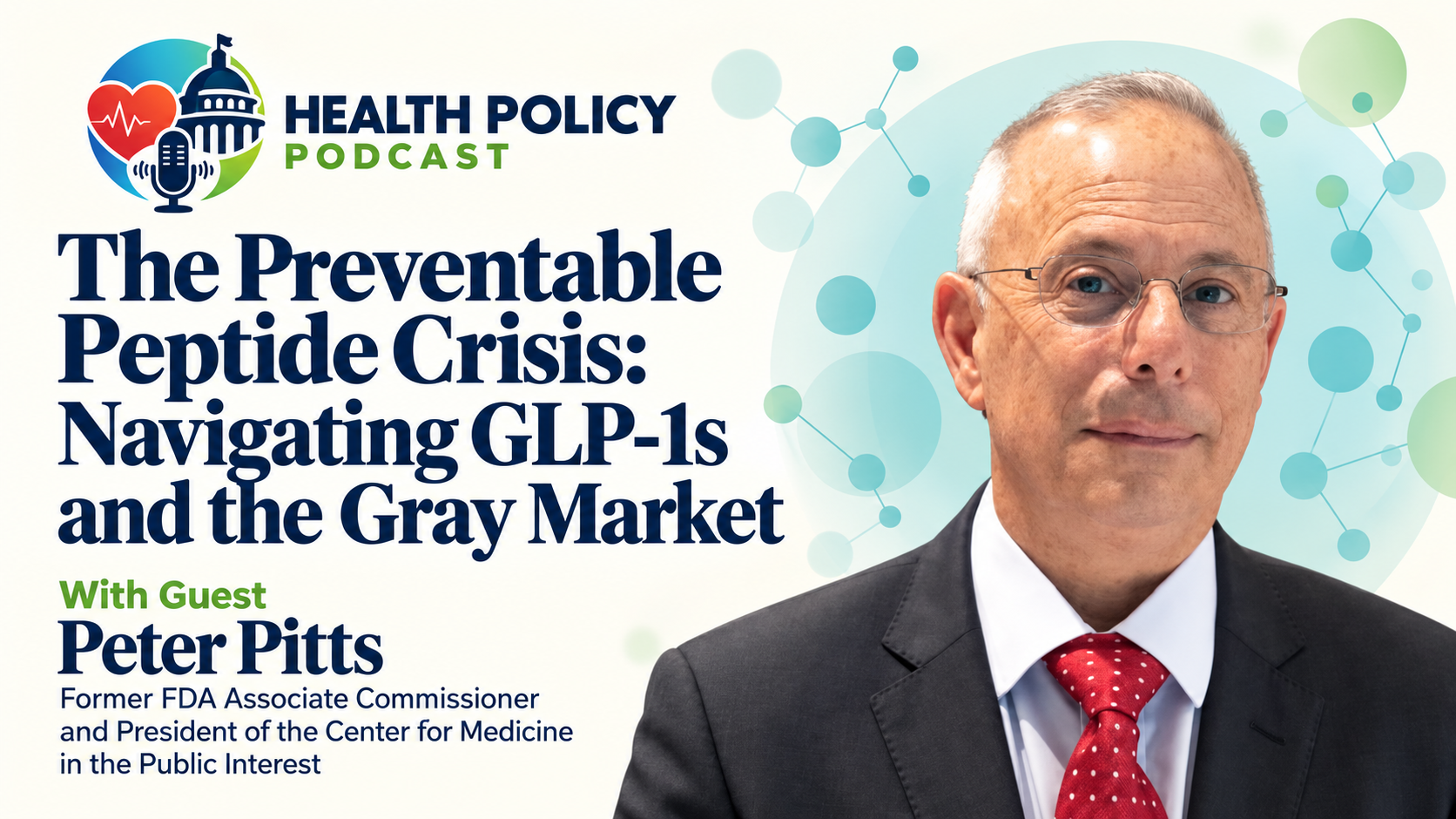
[00:00] Bryan Hyde: Welcome to the Health Policy Podcast. I'm Brian Hyde, and today I'm joined by Peter Pitts, former FDA Associate Commissioner and President of the Center for Medicine in the Public Interest. Peter, it's great to have you on the program. Would you mind giving us a little bit of background about yourself? Tell us who you are and what you do.
[00:16] Peter Pitts: Thanks for asking, Brian. I'm the President of a public policy institute, better known as a think tank, called Center for Medicine in the Public Interest, www.cmpi.org. Get my little plug in early. I'm also a former FDA Associate Commissioner, so as they say, I'm a former government official here to help.
[00:37] Bryan Hyde: Well, actually, we've, we've got a topic here that is really timely. And, you know, I don't think I would have really paid attention to the word peptides because I, I just don't run in the circles of, you know, the pharmaceuticals and so forth. But I cannot deny how shocked I am when I see my neighbor and how much weight he has lost and how good he looks. And he says, well, it's because he was using GLP-1 weight loss, you know, to achieve that. Um, I'm specifically looking at an article that you penned earlier this month, The Preventable Peptide Crisis. And Peter, I'm wondering first if you could set the stage for us. How did we get to where GLP-1s are kind of becoming— this is a preferred way for people to, to become more aerodynamic. Can you kind of walk us through the process of how did we get here?
[01:23] Peter Pitts: Sure. Well, you know, this is a 24— a 24-hour conversation, but, you know, it's— let's kind of do it tersely in 20 minutes or so. You know, the, the issue is obviously we've got a problem with obesity in this country. That's not a political issue. No one disagrees with it. The question then becomes, how do we deal with it? So the first kind of issue is obesity is not and shouldn't be dealt with primarily as a cosmetic issue. For example, I want to thin down to fit my suit. Being the proper weight is a really important thing to make sure we live longer, healthier lives. It reduces heart disease. It makes our lives better. It reduces health care expenses for ourselves personally. It allows us to live longer. And of course, on a national level, it's a major driver of health care costs, not to mention its impact on things like diabetes. So, you know, being the proper weight— I hesitate to say thinner— being the proper weight is a really important thing. has profound positive implications across the board. That being said, how do we accomplish that? Now, for years, it's been, hey, Brian, diet and exercise. Watch what you eat and exercise more. And that's hard. I'm sure we've all had our doctors say that to us a million times. We've tried to diet after Christmas, after Thanksgiving, and we always fail for a whole host of reasons. The other issue is what we call in my business the magic pill problem, which is, wow, if there was a magic pill that can make me thin, that would just solve everything. Well, now we've actually got pills that do that. Now, the problem is GLP-1s, whether they're injections or now they're moving into orals, pills, the issue is they're not indicated for use forever. They're not indicated for chronic use. You're supposed to use them for a short period of time and then stop. Now, just like antidepressants, GLP-1s are indicated to be done in combination with certain lifestyle issues. So for example, antidepressant pills are indicated to be used in combination with talk therapy, but they rarely are. GLP-1s are indicated to be used in combination with diet and exercise. But again, once again, most people kind of just ignore that. They want to take the pill, not change anything about their habits, and just move on with their lives. And that's dangerous because there's no real scientific data that show what happens with GLP-1s if they're used in chronic conditions. And that's going to bite us in the behind because When you use a pill, like, for example, Vioxx, for reasons other than its indication, you learn things, negative things, in real time. And I don't think that anybody taking GLP-1s want to be real-time clinical trial experiments without their complete understanding. So, again, moving away from a magic pill solves all my problems, don't change my eating habit, don't have to exercise, It's leaving us in a bad place. That's problem number one. Problem number two are illegitimate actors out there hawking these pills, not FDA approved. From where they're coming, we don't know. And they're readily available. It allows people to circumvent going to their doctors, because their doctors say, hey, Brian, put down the Twinkie, start exercising. People don't want to hear that, but they're totally comfortable going on a website, buying these drugs from who knows where, you know, to address these problems. So it's a very timely and extremely important conversation.
[05:08] Bryan Hyde: So that shortcut, and I assume it's largely to save money, it seems like if memory serves, these GLP-1s were not cheap, at least when they first became available. I believe those prices are coming down, but is this basically then people, you know, entrepreneurs, I'll use that in air quotes, stepping forward and saying, hey, we can provide a product that's gonna give you the same result, but like you're saying, saying it's not given the same kind of strict regulatory controls and, and assurances that, that the actual, you know, GLP-1s are?
[05:40] Peter Pitts: Well, you know, clearly, you know, there's that. Now, that's the big issue. I'll come back to that. But, you know, relative to who is buying these products from illegal— you know, they're not entrepreneurs buying, they're criminals, they're breaking the law. But, you know, the question then becomes, You know, are people embarrassed to go to their doctor who have already said, Brian, I'm not going to give you this drug. I want you to change your diet and exercise. Then maybe we'll talk about it. I think people are going online to avoid being embarrassed in front of their doctors, kind of like in years past, people going online to order erectile dysfunction pills because they were embarrassed to talk to their doctor about it. Relative to these illegal actors out there, obviously, we all know when it comes to things online, people are willing to sell you anything for any price if you're willing to put rationale and reason aside. I think that's really what's happening now. People, consumers want to believe that going online and buying a pill for a lower price, or for something that their doctor doesn't want to give them a prescription for is legit. And it's not, and it's dangerous, and has real-world profound negative consequences.
[06:50] Bryan Hyde: And that was what I wanted to ask you next, Peter. Let's talk about some of the downsides of going with the, the sketchy suppliers of, of, you know, this miracle weight loss. Um, I understand there, there is real harm being done. Can you kind of help flesh that out for us?
[07:05] Peter Pitts: Sure. So these fall into 2 categories. There are counterfeit drugs and there are drugs that are not approved. Counterfeit drugs are basically one area of criminal activity where it basically puts the brand name on their product, hawks it as the real thing, and it's not, right? So that— I don't think anybody disagrees that counterfeiting is a criminal, dangerous activity. Where most of the issues coming from now are companies selling kind of their own house brand of these drugs. These drugs are not FDA approved. They're not reviewed by the FDA. Their manufacturing quality is not reviewed by the FDA. They can be real. They can have just fake Aspirin tablets, no one knows exactly where they're coming from or what's in them. And that's dangerous because the impact could have— it has no impact at all. The impact could be you get a serious healthcare consequence because of poor manufacturing quality or who knows what goes into these tablets. Because a lot of them are coming from, let's say, for example, China. What's in them? We don't know. When things go wrong, Who do you report them to? Because people are embarrassed to call their doctors when they've gotten drugs from outside their doctor's supervision. All sorts of profound consequences here, but the most important consequence is unintended, very negative health consequences for the people that are trying to circumvent the system. I understand people have cost issues. I understand people have issues with being embarrassed in front of their doctors. That's all real. But the solution to those problems is not going outside FDA's regulatory system of quality control to, you know, throwing up, rolling the dice and seeing what happens.
[08:49] Bryan Hyde: So it's not just, you know, well, you're not going to lose the weight that you had hoped to lose, but we're talking hospitalizations, even deaths, I guess, in some cases where people have used these products that were either improperly formulated or improperly used, for that matter.
[09:06] Peter Pitts: That's exactly right. And, you know, buyer beware. Caveat emptor, you know, is bad pharmaceutical policy. You really want to be using a drug under your doctor's supervision, but also the drug that actually has been reviewed by the FDA, by the federal government, and has been deemed safe and effective. Because, I mean, there are lots of ways to think about this. But one of one is you take an unapproved weight loss product. And you have kidney problems, for example, and you have serious hospitalization, first of all, there's nobody you can sue because it's all on you. So, you know, that's where the role of smart regulatory oversight really comes into play here. You want a product that has been reviewed, that everybody agrees on the quality levels, so that when, God forbid, something goes wrong, you have some type of avenue to pursue And I, I have to ask this just because, um, it, you know, it really does seem miraculous.
[10:05] Bryan Hyde: And I'll use again my neighbor for an example. Um, it wasn't that he was, you know, morbidly obese, but there is no doubt he experienced real-world, you know, significant and it appears to be healthy weight loss. Now, this was under his doctor's direction and using, you know, uh, these GLP-1, uh, methods for doing so. But are there some— I guess I'm going to ask, are there some similar breakthroughs? Is this opening the door to new ways to treat weight loss, you know, through pharmaceutical means? I'm just curious what it is from your perspective.
[10:39] Peter Pitts: You know, there's data out there that certainly supports that, you know, but again, you know, the plural of anecdote isn't data. You know, we really don't have any long-term data on you know, what GLP-1s look like for chronic use. You know, those experiments need to be done, but you can't cross your fingers and hope for the best.
[11:01] Bryan Hyde: And again, it takes time, as you pointed out. I guess it also takes a fair amount of money. That's probably one of the chief complaints I hear about the FDA's approval process is it can not only be time-consuming because it's very thorough, but it also tends to cost a lot. In your opinion, does that sometimes put the brakes on new therapies entering the market?
[11:25] Peter Pitts: I don't think it puts the brakes on it. What it does, it puts a timeline on it, and that timeline costs money for the companies that develop them. That's the way that it works. But, you know, the, the, um, the trade-off is when a company like, you know, Lilly or Novo Nordisk who make GLP-1s, when they get FDA approval for these drugs, you know, they pay for the privilege. The FDA review process is not free and it's not cheap, but then the public has the you know, the authoritative voice of an FDA-approved product. And then it's up to the company to market it in a way where it can recoup its investment. And that's the free market. And that's what drives innovation.
[12:01] Bryan Hyde: And is there any other regulatory pharmaceutical regulatory organization out there in the world that can compare to the FDA? I mean, you mentioned China seems to send us a lot of products. I understand India is a pretty good clearinghouse for a lot of these, you know, off-brand Pharmaceuticals. They have a lot of brainpower, but do they have the kind of results that we get through the FDA and its process?
[12:27] Peter Pitts: Well, I'm a former FDA associate commissioner, so I'm biased. You know, I really believe that the FDA is without question the world's gold standard when it comes to regulatory review. And I think many other countries believe that as well. That's why a lot of other countries peg their approvals to the FDA process. So do I trust the FDA? I absolutely do. You know, is it, you know, the hand of big government? Sure. But I think it's— but I think appropriately so.
[12:55] Bryan Hyde: And that's the next question I wanted to follow up with. Is there anything that the FDA could be doing better or that could expedite things, you know, improve the process, in your opinion?
[13:06] Peter Pitts: Well, there's no value in rushing to judgment. You know, you have to have sound science. So, you know, one, possible solution is give the FDA more staff, give the FDA more money. The more folks they've got to get the job done, the quicker they can get it done. Secondly, I think the FDA has really got to step up their efforts to close down these bad actors. You know, you know, they are criminal. This is criminal activity, full stop. These people need to be chased, need to be found, and they need to be prosecuted to send a message that you can't just kind of open up a website and sell junk to the American public. It's just too important and the repercussions are too Fatal in many cases to ignore it.
[13:44] Bryan Hyde: And, and let's talk a little bit about that gray market out there that exists. And, you know, I, I know the, the kind of tongue-in-cheek references— well, you know, the gas station pills, uh, specifically gas station erectile dysfunction pills. Now, I was reading an article the other day that said someone actually tested some of them and said they contain the active ingredient that you would find in, for instance, Cialis. And, and I was surprised. Is, is there gray market stuff out there that, uh, that sometimes provides legitimate things, not just herbal, you know, variants, but, but actual— are they providing the actual pharmaceutical, albeit under, um, false pretenses?
[14:22] Peter Pitts: Well, you know, when it comes to pharmaceuticals, having the active ingredient in the product doesn't necessarily mean it's going to work because there are all sorts of things that go into a medicine beyond the active pharmaceutical ingredient. And it's geeky, and I don't want to go too deeply into it, but excipients count as well. So sometimes these counterfeits or sometimes these non-approved GLP-1s have the active ingredient. Sometimes they don't. Sometimes they're placebo pills. You don't know what you're going to get because there's no quality control. And I, for one, would not want to be putting into my body products that have no quality control and are not— that don't carry the FDA seal of approval. It's just too risky. And sometimes a bargain is just too expensive, as my grandmother used to say.
[15:11] Bryan Hyde: Has the FDA taken steps to address some of these concerns that you've brought up here in today's episode?
[15:19] Peter Pitts: They have, actually. Recently, the FDA has issued quite a number of very aggressively written letters to these companies telling them to stop, stop, you know, making illegal and selling illegal pills. That being said, they've largely been ignored. I think where the rubber really meets the road is the FDA's got to work in closer collaboration with the Justice Department to bring, you know, criminal cases against these people to really show that their words have bite, and that has yet to happen.
[15:47] Bryan Hyde: And for people who want to make sure that they're getting products that have been properly vetted, Let's, let's talk about some rules of thumb here. You had mentioned, you know, that, you know, anybody with a website and a little knowledge of human nature can play upon our vulnerabilities and get us to do things we might not do under circumstances where we were, you know, clearly seeing the bigger picture. What are some rules of thumb people might use to keep from being duped or persuaded to take something that may ultimately be harmful?
[16:19] Peter Pitts: Well, I think you know the first rule is if if what is driving you to the illegal, you know questionable websites is price. You know both Eli Lilly and Novo Nordisk who manufacture legally these GLP ones have a website that through Trump Rx and other methods really offer these products at very affordable low prices. So my first my first recommendation would be go to these websites. They're not hard to find. And secondly, again, sometimes a bargain is too expensive. So rule number 2 is if something looks too good to be true, a big red flag should go up. And I'll add a third, which is if you're concerned about talking to your doctor, don't be. And just because your doctor isn't telling you what you want to hear, don't ignore them and decide to become your own prescriber.
[17:12] Bryan Hyde: That's just It sounds like one of the keys to good health is maintaining a healthy sense of skepticism, especially when you see those online offers.
[17:22] Peter Pitts: And just plain common sense. And of course recognize that if you want to lose weight, you know, put down the Twinkie and exercise more and don't think about solving the problem through a magic pill. That's just not the right way to think about the proposition.
[17:37] Bryan Hyde: Let's take a moment here as we wrap things up today, Peter. Tell me a little bit about the Centre for Medicine in the Public Interest and what you do there. And where can people find your website?
[17:48] Peter Pitts: Oh, thanks for asking. Center for Medicine in the Public Interest, cmpi.org, is an organization I started over 20 years ago when I left the FDA, really to drive smart regulatory policy, you know, to encourage innovation and to make the process a lot more friendly to the general public. Because if the public doesn't understand how the FDA works, how drug development works, how prescribing works, They're not going to have faith in the system. And if there's anything we learned from the COVID experience, is we need to have a better understanding and enhanced trust in the process.
[18:19] Bryan Hyde: Again, we are talking with Peter Pitts. He's a former FDA Associate Commissioner and President of the Center for Medicine in the Public Interest. Peter, thanks again for joining us here on the Health Policy Podcast.
[18:30] Peter Pitts: My pleasure. Thanks again.